How Does AI Medical Coding Learn From Payer Behavior to Reduce Denials
Learn how AI medical coding uses payer behavior, claim outcomes, and denial patterns to improve coding accuracy and adapt coding strategies over time.
Published on:
August 19, 2026


CombineHealth learns from payer behavior by analyzing real-world claim outcomes, denials, and reimbursement patterns across payers. Its self-learning payer intelligence identifies recurring payer-specific patterns and feeds those insights back into coding policies, helping inform future coding decisions and reduce repeat coding-related denials.
Traditional medical coding focuses on one fundamental question: What is the correct code for this encounter?
But once a claim reaches a payer, the outcome can reveal valuable information about payer-specific requirements, denial patterns, and reimbursement behavior. Payer-intelligent AI like CombineHealth brings these outcomes back into the coding process, adding another question: What have we learned about how this payer handles similar claims?
This article explores how AI medical coding learns from payer-specific claim outcomes, denial patterns, and reimbursement behavior and uses those insights to make better-informed coding decisions over time.
CombineHealth: Self-Learning Autonomous Medical Coding with Payer Intelligence
Bring payer intelligence into every coding decision with CombineHealth. The self-learning autonomous medical coding platform analyzes the full clinical encounter, accounts for coding guidelines and payer-specific rules, and delivers explainable, billing-ready medical codes.
Book a Demo
What Does “Payer Behavior” Actually Mean in Medical Coding?
Payer behavior in medical coding refers to how different payers apply their coverage and coding rules when processing claims, and the denial patterns that emerge from those decisions.
It goes beyond knowing what a payer’s published policy says.
Two payers may process similar claims differently based on coverage requirements, modifier rules, eligibility criteria, or medical necessity requirements. Those differences become visible when you look at actual claim outcomes.
Example
Consider a patient with gestational diabetes who is prescribed continuous glucose monitoring (CGM) to help manage their glucose levels.
Under its current commercial policy, UnitedHealthcare considers long-term CGM medically necessary for patients on non-intensive diabetes therapy when they have severe or recurrent hypoglycemia that persists despite attempts to adjust their treatment. Aetna, on the other hand, classifies long-term CGM for gestational diabetes as experimental, investigational, or unproven.
So, a CGM claim for a patient with gestational diabetes and recurrent hypoglycemia could meet UnitedHealthcare's medical necessity criteria while failing Aetna's coverage criteria.
How Are Coding Rules Different Across Insurance Payers?
Coding rules can differ across payers in areas such as modifier requirements, coverage criteria, medical necessity, prior authorization, bundling, and non-covered services. While standard coding guidelines and CMS rules provide the foundation, individual payers may have additional requirements for how certain services are coded and billed.
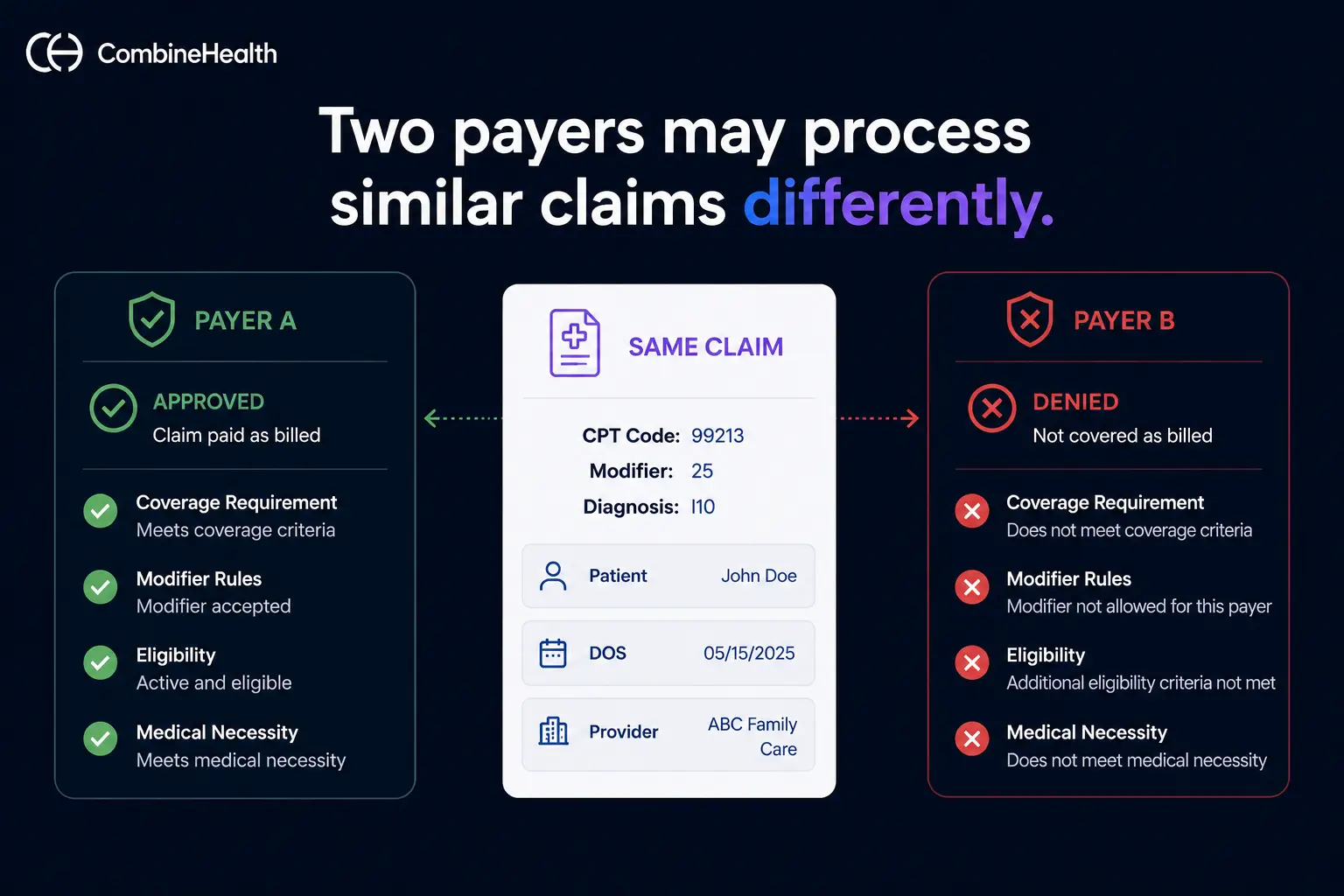
As a result, a claim can follow standard coding guidelines and still encounter payer-specific issues. Understanding these differences is important not only for medical coding accuracy, but also for preventing avoidable denials and ensuring claims are prepared correctly for the payer receiving them.
Can AI Medical Coding Adapt to Different Payer Coding Requirements?
Yes, AI medical coding can adapt to different payer coding requirements. Payer requirements can vary by specialty, organization, and insurance plan, so effective AI medical coding needs to account for these differences rather than applying the same logic to every claim.
CombineHealth is configured around each organization’s EHR/PMS workflows, coding policies, specialty requirements, and payer-specific nuances. During implementation, CombineHealth back-tests its autonomous coding platform against historical cases to verify that these requirements are reflected accurately.
As new payer-specific patterns or edge cases emerge, CombineHealth can further refine its coding configuration, and adapt as requirements evolve.
Recommended Reading: Traditional vs. AI medical coding
How Do Claim Outcomes Reveal Payer Behavior
Claim outcomes reveal payer behavior by showing which coding and coverage issues repeatedly lead to denials for a specific payer.
A single denial tells you what went wrong with one claim. But when the same issue keeps appearing for a particular payer, it starts to reveal a pattern. When those patterns are tracked over time, they can show where a coding rule or process may need to change.
Healthcare organizations can identify these patterns by looking across incoming claim denials and asking:
- Which payer is denying the claim?
- What category does the denial fall under?
- Why did the denial occur?
- Is one payer repeatedly denying certain services as non-covered?
- Are eligibility issues driving the denials?
- Are modifier requirements involved?
- Is medical necessity the underlying issue?
How Does Payer Behavior Inform Future Medical Coding Strategy
Payer behavior informs future medical coding strategy by turning claim outcomes into feedback for future coding decisions. As new denials come in, they reveal how a payer is processing claims and where diagnosis, CPT, or medical necessity rules may need to adapt.
This creates a continuous feedback loop. Instead of treating each denial as an isolated issue, recurring patterns can inform how similar claims are coded going forward, helping prevent the same avoidable denials from happening again.
That is what separates payer intelligence from simply maintaining a database of payer policies. It combines published payer rules with observed claim outcomes to continuously improve future coding decisions.
Recommended Reading: 8 Must-Have Medical Coding Software Features in 2026
Layers of Payer Intelligence in Medical Coding
Payer intelligence in medical coding is not simply knowing a payer's published policies. It's the ability to combine those policies with observed claim outcomes and use that feedback to improve future coding decisions.
Payer intelligence works across two layers: what is known about a payer before a claim is submitted and what is learned from the payer after the claim is processed.
Layer 1: What We Know Before the Claim
The first layer is about coding the claim against known payer requirements before it ever reaches the payer.
That means applying Medicare LCD/NCD guidelines, CMS guidelines, coding policies, and payer-specific requirements during the coding process. Once the codes are selected, pre-bill checks can also verify requirements such as payer-specific modifier rules before the claim is created.
The process looks like this:
- Encounter documentation
- ICD/CPT selection
- LCD/NCD + CMS + payer policy checks
- Payer-specific modifier and claim checks
- Claim submission
CombineHealth is a self-learning autonomous medical coding platform that adapts to payer-specific guidelines by evaluating clinical documentation against Medicare LCD/NCD guidance, CMS rules, coding policies, and payer requirements. After coding, the platform also runs pre-bill checks for payer-specific requirements such as modifier rules, referrals, and other claim conditions before submission.
Layer 2: What We Learn After the Claim Is Submitted
The second layer is about learning from how the payer actually adjudicates submitted claims.
Once a claim goes out, the payer provides an outcome: it may be paid, rejected, denied, bundled, deemed non-covered, or denied for medical necessity or documentation reasons. Each outcome adds another data point about how that payer is behaving.
One outcome may not tell you much. But repeated outcomes can reveal patterns. If the same payer repeatedly denies a particular CPT and diagnosis combination for medical necessity, for example, that pattern can inform how similar claims are coded in the future.
Recommended Reading: Why should you outsource medical coding in 2026?
How Does CombineHealth’s Self-Learning Payer Intelligence Reduce Coding Denials
CombineHealth’s self-learning payer intelligence goes beyond simply applying static coding rules. It creates a feedback loop between coding decisions and real-world payer outcomes, allowing coding strategies to improve over time.
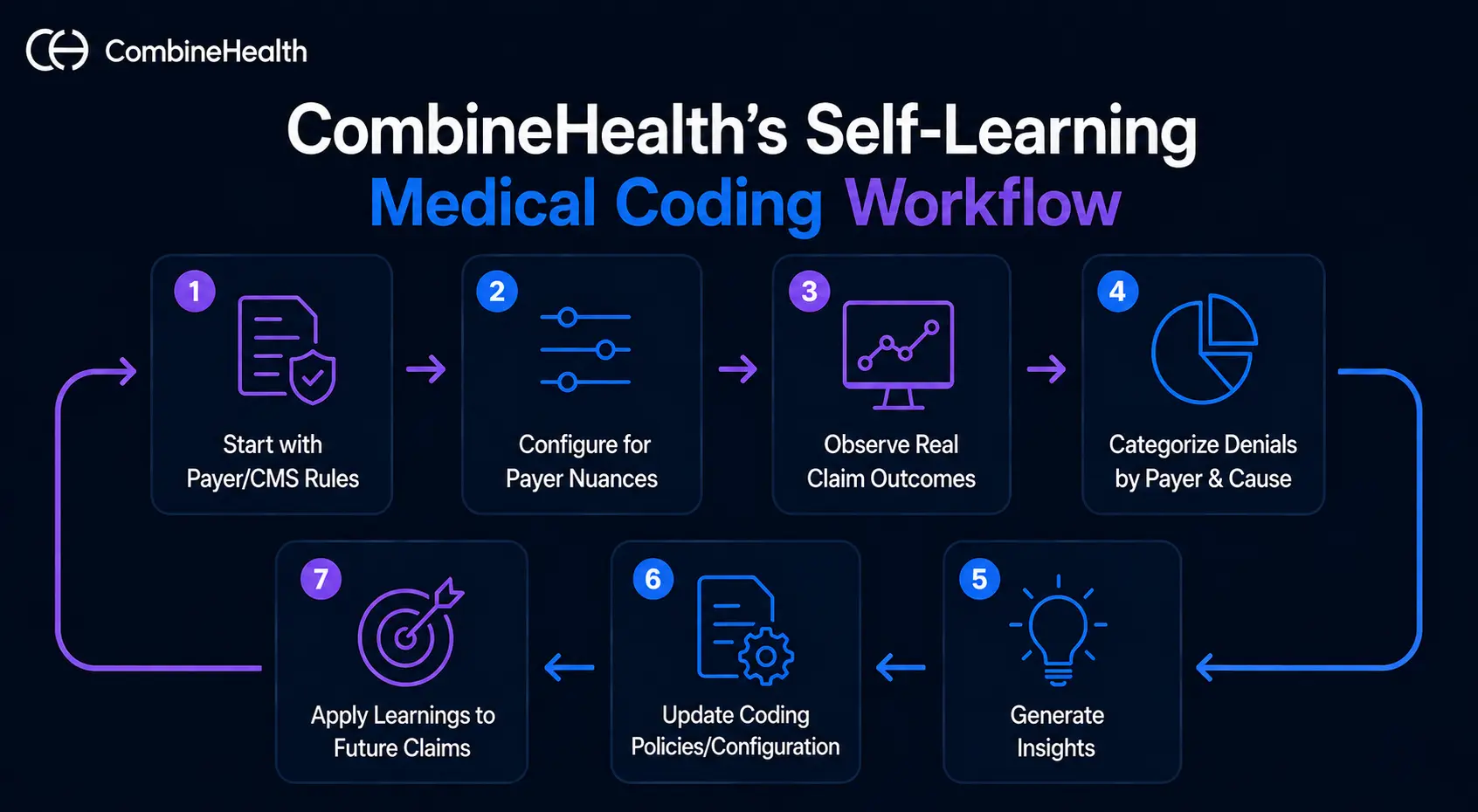
CombineHealth starts with established coding guidelines, CMS requirements, and applicable payer policies, then accounts for payer- and organization-specific nuances. Once claims are submitted, CombineHealth analyzes the outcomes to understand how different payers respond to different coding scenarios.
When denials occur, CombineHealth categorizes them by payer, denial type, and root cause. This helps identify recurring patterns—for example, a particular payer repeatedly denying a type of claim because of a modifier or medical-necessity requirement.
These insights can then inform updates to coding policies and configurations, so relevant learnings are applied to similar claims in the future.
Recommended Reading: 15 questions to ask to pressure test an AI medical coding vendor
Case Study: CombineHealth Reduced Coding-Related Denials by 75% With Payer-Specific Coding
A 400-bed Midwest hospital saw the impact of payer-specific coding policies firsthand after deploying CombineHealth’s autonomous coding solution, Amy. By applying payer-specific coding policies to each encounter, CombineHealth helped the hospital identify where its existing coding approach was contributing to avoidable denials and missed reimbursement.
The impact went beyond denials. CombineHealth also identified undercoded encounters and surfaced higher-specificity documentation opportunities that had previously gone undetected through manual review.
Within the first three months, the hospital reduced coding-related denials by 75% while increasing captured revenue by 4%—showing how adapting coding decisions to payer-specific requirements can improve both claim outcomes and revenue capture.
Book a demo with CombineHealth today!
FAQs
Can two payers process similar medical claims differently?
Yes. The same or similar service can produce different claim outcomes because payers may apply different coverage and medical necessity requirements.
How can AI improve coding accuracy across multiple payers?
AI can improve coding accuracy across multiple payers by combining clinical documentation and coding guidelines with payer-specific requirements when determining the appropriate codes for each encounter. More advanced systems can also learn from claim outcomes, allowing recurring payer-specific denial and reimbursement patterns to inform future coding decisions.
How does AI medical coding account for payer policies and reimbursement rules?
AI medical coding can account for payer-specific requirements such as modifier rules, coverage criteria, and medical necessity policies. CombineHealth applies these requirements alongside standard coding guidelines and performs payer-specific checks before claim submission, helping prevent avoidable coding issues and denials.
Does CombineHealth learn from payer claim outcomes?
Yes. CombineHealth is a self-learning autonomous medical coding platform. Coding and claim outcomes, including coding-related and medical necessity denials, can feed back into future diagnosis and CPT coding policies. This allows the platform to learn from how individual payers actually process claims rather than relying only on published payer rules.
What makes CombineHealth's payer intelligence different from a payer rules database?
A payer rules database primarily tells you what a payer says should happen. CombineHealth's payer intelligence also incorporates what actually happens after claims are submitted. By combining published payer requirements with observed claim outcomes, the platform can continuously improve future coding decisions.
How does CombineHealth account for payer-specific requirements in medical coding?
CombineHealth applies coding guidelines and payer-specific rules during the coding process, so the claim is payer-aware before submission. This can include relevant CMS guidelines, LCD/NCD requirements, and payer-specific coding and modifier policies.