Traditional vs. AI Medical Coding: Which Model Works Better for Healthcare Organizations?
Compare traditional and AI medical coding to understand their differences in speed, accuracy, scalability, and why hybrid coding often works best.
Published on:
August 17, 2026


Key Takeaways
• AI medical coding uses NLP and machine learning to assign medical codes automatically. Traditional medical coding relies on certified medical coders reviewing each chart manually. Most healthcare organizations benefit from combining both.
• AI medical coding is faster for charts that qualify for autonomous processing, but eligibility depends on documentation completeness, chart complexity, specialty, and payer requirements—not every chart qualifies for autonomous medical coding.
• AI medical coding and human medical coding each have accuracy strengths—AI is more consistent across high-volume charts, while human medical coders are stronger on ambiguous and complex cases.
• AI medical coding accuracy should be measured at the claim-line level, not the claim level. Complete-claim scoring can hide individual medical coding errors that lead to denials and underpayments.
• A hybrid medical coding workflow, where AI codes eligible charts and routes the rest to human medical coders, is the operational model most healthcare organizations should evaluate.
• AI medical coding will not replace medical coders, but it is shifting roles toward oversight, audit, and CDI.
• CombineHealth is a self-learning autonomous medical coding platform that uses claim outcomes, including denials, reimbursements, and underpayments, to build proprietary payer intelligence and continuously adapt coding strategy by payer.
One in five in-network claims were denied in 2023, according to a KFF analysis of federal data, with some insurers denying up to 54%.
Inaccurate diagnosis codes, incorrect procedure codes, and missed modifiers contribute to a significant share of those denials.
Preventing these errors is becoming harder as payers use automated checks to catch more errors and flag medical claims faster than most medical coding teams can respond.
At the same time, ICD-10-CM codes, CPT codes, LCD and NCD policies, and payer-specific billing rules continue to change, adding more requirements for medical coders to keep up with.
Most medical coding teams are expected to keep up without proportional increases in staffing or time. That raises a practical question: should healthcare organizations automate medical coding with AI, rely on human medical coders, or use both?
This article compares AI medical coding and traditional medical coding and shows where each performs well and where each breaks down.
What Is AI Medical Coding?
AI medical coding uses natural language processing (NLP) and machine learning to read clinical documentation and assign standardized medical codes, such as ICD-10-CM, CPT, and HCPCS codes. It can also identify the appropriate evaluation and management (E/M) level and modifiers. This helps healthcare organizations code eligible medical encounters faster and more consistently, while applying the same medical coding rules across charts.
AI medical coding generally works in two ways:
- Assistive (computer-assisted) coding: Suggests medical codes for a human medical coder to review, accept, reject, or change.
- Autonomous medical coding: Assigns medical codes automatically and sends eligible charts through without manual review, while routing cases that need more attention to human medical coders.
What Is Traditional Medical Coding?
Traditional medical coding is the process of a certified medical coder manually reviewing a patient's clinical documentation—including encounter notes, operative reports, lab results, and imaging reports—and assigning the appropriate ICD-10-CM, CPT, HCPCS, E/M, and modifier codes.
The traditional medical coding workflow includes:
- Chart review: Reading the clinical record to identify documented diagnoses and medical procedures.
- Medical code lookup: Matching clinical terms and descriptions to the correct standardized medical codes.
- Medical code sequencing and modifier selection: Ordering diagnoses based on their clinical significance and adding modifiers when payer rules or medical coding guidelines require them.
- Healthcare provider queries: Asking the healthcare provider for clarification when clinical documentation is incomplete, unclear, or contradictory.
- Quality audits: Reviewing medical-coded charts to check whether the assigned medical codes follow medical coding guidelines and payer requirements.
Traditional medical coding's core strength is clinical interpretation, especially when clinical documentation is ambiguous or the medical context is complex.
Recommended reading: Medical Coding Audit: Explained
How Does AI Medical Coding Compare to Traditional Medical Coding?
AI medical coding and traditional medical coding differ most in how they handle chart volume, consistency, and clinical judgment. These differences affect how medical coding errors are prevented, identified, and corrected. AI medical coding applies configured rules at scale, while traditional medical coding relies on human clinical interpretation.
The table below compares nine operational areas where these two models diverge.
These are general differences, not guarantees.
An AI medical coding platform without strong payer intelligence or visibility into how coding outcomes impact revenue can underperform a strong medical coding team. Likewise, a medical coding team under heavy volume pressure may produce more variation than the table suggests.
Is AI Medical Coding Faster Than Traditional Coding?
AI medical coding is faster than traditional medical coding for charts that are eligible for autonomous processing. This speed difference can improve medical coding turnaround time, backlog recovery, and throughput stability.
An AI medical coding platform can process a chart in seconds versus the hours or days a human medical coder requires for manual review.
That advantage compounds across chart volume—volume spikes from seasonal surges, new healthcare provider onboarding, or medical coder turnover can be absorbed without proportional hiring.
However, speed alone does not determine medical coding quality. How accurately AI codes a medical chart depends on documentation completeness, chart complexity, specialty, payer requirements, and confidence thresholds of the AI medical coding platform.
Is AI Medical Coding More Accurate Than Human Coding?
Neither AI medical coding nor human medical coding is always 100% accurate. However, well-designed AI medical coding systems can achieve high levels of accuracy by consistently applying coding rules across large claim volumes and learning from historical and real-world outcomes.
CombineHealth delivers 97.2% medical coding accuracy while continuously learning from claim outcomes to build payer intelligence and adapt coding strategy by payer. By also identifying CDI gaps and potential undercoding, that accuracy translates into more complete coding and better reimbursement outcomes.
How Is AI Medical Coding Accuracy Measured?
AI medical coding accuracy should be measured at the medical claim-line level, not the claim level.
Complete-claim scoring marks an entire medical claim as correct or incorrect, which can hide individual medical coding errors.
Claim-line scoring evaluates each CPT or HCPCS code along with its supporting diagnoses and modifiers. ICD-10-CM accuracy can also be assessed for diagnosis selection, missed or unsupported diagnoses, sequencing, and coding guideline compliance.
This matters because a medical claim can appear accurate overall while still containing errors that lead to claim denials, underpayments, or audit risk.
Healthcare organizations should therefore evaluate how an AI medical coding platform measures accuracy, not just the accuracy rate it reports.
How CombineHealth Measures Accuracy
CombineHealth evaluates each CPT or HCPCS code with its supporting diagnoses and modifiers at the claim-line level. ICD-10-CM accuracy is assessed separately across diagnosis selection, sequencing, guideline compliance, and medical necessity.
When Is Human Judgement Still Needed In AI Medical Coding?
Human medical coder judgment is still needed for cases that are complex, ambiguous, disputed, or flagged as low confidence by the AI medical coding platform.
- Complex cases: Multiple interacting diagnoses, extensive surgical procedures, or unusual clinical presentations that require review of the full clinical record.
- Ambiguous documentation: Conflicting information, unclear clinical language, or documentation that requires contextual interpretation.
- Disputed coding: Encounters where the correct medical code depends on payer-specific interpretation or LCD/NCD requirements.
- Low-confidence AI output: Charts where the AI medical coding platform's confidence score falls below the configured threshold.
Can AI Handle Complex and Specialty-Specific Cases?
AI medical coding platforms vary in how well they handle complex and specialty-specific encounters.
Complexity increases with:
- Rare conditions: Limited representation in the AI model's training data.
- Specialty-specific documentation: Unfamiliar medical terminology or documentation practices.
- Multi-provider encounters: Multiple diagnoses documented across an inpatient stay.
- Clinical interpretation: Cases requiring context beyond what the healthcare provider explicitly documented.
CombineHealth has demonstrated that AI can handle complex cases in a demanding specialty like emergency medicine (ED), where high encounter volumes, varied diagnoses, and documentation complexity make accurate coding particularly challenging.
In a high-volume ED, CombineHealth achieved ~98% medical coding accuracy, cut coding turnaround time by 50%, and identified 5× more clinical documentation gaps than traditional coding workflows—helping improve coding denial rates and overall reimbursement.
Can AI Keep Up With Medical Coding and Payer-Rule Changes?
AI medical coding platforms can keep up with medical coding and payer-rule changes, but capabilities vary by platform. Healthcare organizations should evaluate how frequently a vendor updates coding guidelines, payer-specific rules, and LCD/NCD requirements and how those changes are tested before deployment.
For example, the AMA's CPT 2026 code set includes 418 changes, while CMS's FY 2026 ICD-10-CM update includes 487 new diagnosis codes, 38 revised codes, and 28 deleted codes. At this volume, keeping coding logic current is critical—outdated rules can lead to incorrect coding decisions and avoidable denials.
CombineHealth goes beyond static rule updates with a self-learning approach powered by payer intelligence. The platform evaluates coding decisions against downstream claim outcomes, including denials, reimbursements, and underpayments, and uses those signals to refine coding strategy by payer, helping prevent repeat coding-related denials.
Is AI Medical Coding More Cost-Effective?
AI medical coding can lower per-chart coding costs, but the actual savings depend on a number of factors—including chart volume, the documentation quality of each case, case complexity, and more.
Also, per-chart comparisons between AI and human medical coding are incomplete without factoring in implementation, integration, configuration, and maintenance.
Factors that favor AI cost-effectiveness:
- High chart volume relative to current medical coding capacity
- Well-documented encounters in specialties where AI medical coding performs reliably
- Volume variability that would otherwise require temporary staffing or outsourced medical coding
Factors that limit AI cost-effectiveness:
- High proportion of complex cases requiring human medical coder review regardless
- Poor documentation quality that reduces charts eligible for autonomous medical coding
- Higher product cost and integration costs with existing EHR, billing, and practice management systems
What Does a Hybrid Medical Coding Workflow Look Like?
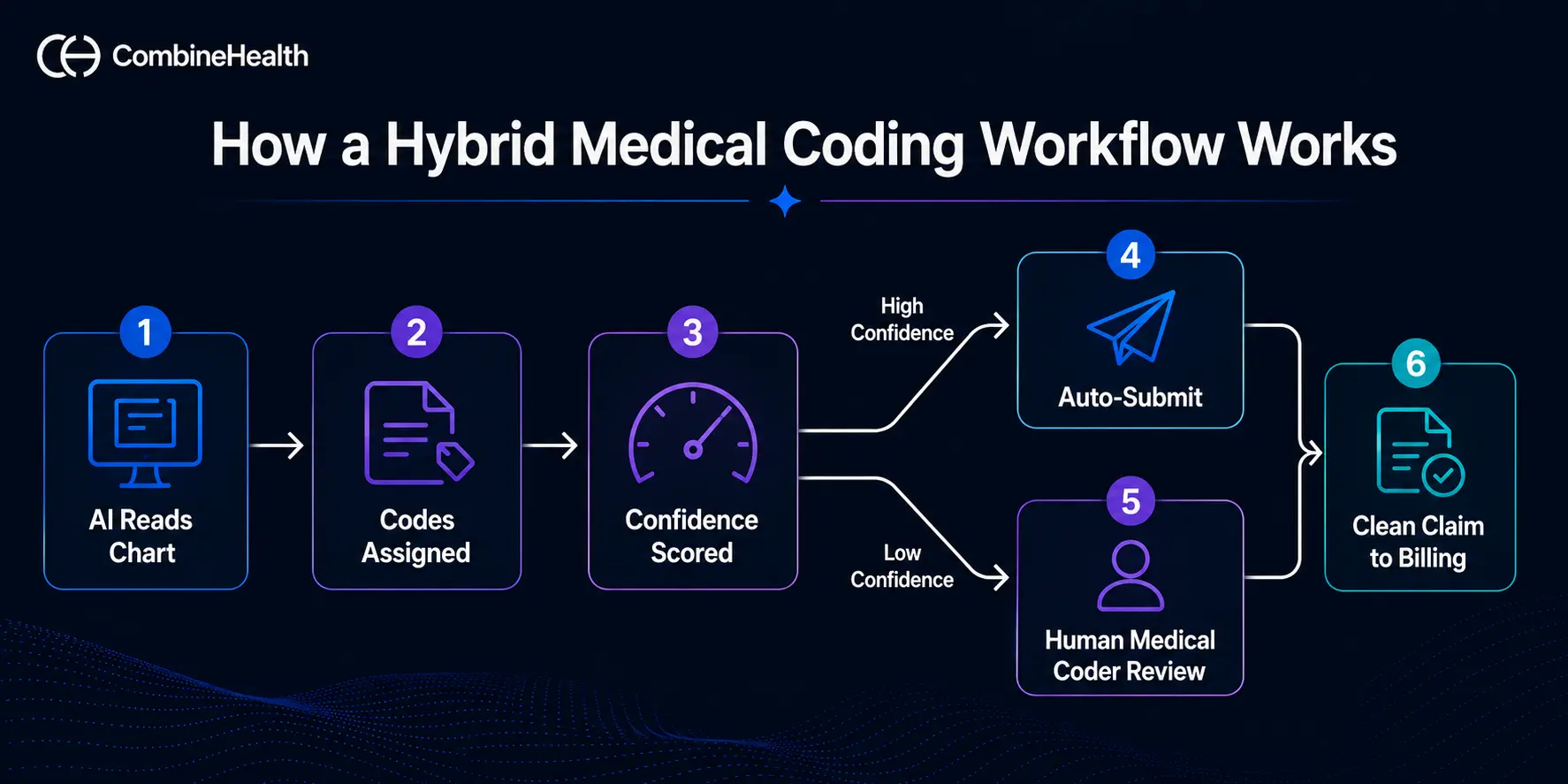
A hybrid medical coding workflow combines AI automation with human medical coder review in a single pipeline: AI medical coding platform handles the charts it can code reliably, while human medical coders handle the rest.
This is the operational model healthcare organizations should evaluate because neither AI medical coding nor human medical coders alone can reliably handle every chart type, specialty, and payer requirement.
In practice, a hybrid medical coding workflow operates in three steps:
- AI processes eligible charts: Assigns medical codes, evaluates confidence, and scores each chart against configured thresholds.
- High-confidence charts move forward automatically: Submitted without manual review when they meet confidence and policy criteria.
- Low-confidence or flagged charts route to human medical coders: Supporting coding rationale is provided, making the review targeted rather than requiring a full medical coding review.
How CombineHealth Combines Autonomous Medical Coding With Human Oversight
CombineHealth’s AI medical coding solution (also known as Amy) is a self-learning autonomous AI medical coding platform that reviews the complete clinical record and assigns ICD-10, CPT/HCPCS, E/M, and modifier codes. It applies current coding guidance alongside payer, LCD, NCD, specialty, and organization-specific requirements.
Unlike static coding systems, CombineHealth evaluates its coding decisions against downstream claim outcomes, including denials, reimbursements, and underpayments, to build proprietary payer intelligence and continuously adapt coding strategy by payer. Each coding decision is explainable and traceable to the supporting clinical documentation, helping teams understand not only what was coded, but why.
CombineHealth has reported:
- 80% autonomous coding rate, depending on documentation quality, client configuration, and compliance preferences
- 12-hour coding turnaround, stable as volume scales from ~100 to 1,000 charts
- 98% coding accuracy in an emergency department use case
- 50% faster turnaround than the traditional workflow in the same ED comparison
- 5× more documentation gaps identified than the traditional coding workflow
Will AI Replace Medical Coders?
AI will not replace medical coders, but it is changing what medical coders do. As AI medical coding platforms take over routine, high-volume medical coding work, the role of the human medical coder shifts toward oversight, audit, and analytical work.
Roles that become more important as AI medical coding adoption increases:
- AI medical coding auditors: Review AI-generated medical codes for accuracy and compliance.
- Clinical documentation improvement (CDI) specialists: Work with healthcare providers to improve clinical documentation.
- Medical coding quality analysts: Monitor medical coding patterns and help improve AI medical coding configurations.
- Denial and appeals specialists: Handle complex payer disputes that require clinical and regulatory expertise.
In short: The volume of routine medical coding work decreases while the demand for higher-level medical coding expertise increases.
Recommended reading: Clinical Documentation Improvement Guide
How Should Healthcare Organizations Choose An AI Medical Coding Vendor?
Start by evaluating documentation quality and chart complexity—those two factors determine how much of your coding volume is realistically eligible for AI medical coding. From there, assess the remaining criteria against your organization's specialty mix, payer requirements, and compliance standards.
The following criteria can help guide that evaluation:
Recommended reading: Top 10 AI Medical Coding Solutions for Healthcare Providers
The best approach may be a hybrid medical coding workflow where AI handles eligible, high-volume charts and human medical coders review complex, ambiguous, or low-confidence charts.
See how CombineHealth can help your organization automate routine medical coding while keeping human medical coder review where it matters.
Book a demo to explore the right medical coding workflow for your team!
FAQs
1. Is AI medical coding faster than manual coding?
Yes, for charts that qualify for automated processing. AI medical coding platforms can process eligible charts in seconds versus the minutes a human medical coder requires. The speed advantage is most significant for high-volume, well-documented encounters.
2. Can AI replace medical coders entirely?
No. AI medical coding platforms automate routine, well-documented encounters—not every chart. Complex cases, ambiguous documentation, and disputed coding scenarios still require human clinical judgment.
3. How accurate is AI medical coding?
Accuracy varies by platform, specialty, and documentation quality. Ask whether accuracy is measured at the complete-claim level or at the individual claim-line level with supporting diagnoses and modifiers—the latter provides a more meaningful assessment.
4. Does AI understand payer-specific coding rules?
Payer-aware AI medical coding platforms can apply LCD, NCD, and organization-specific rules when configured to do so. The platform must be updated when payer rules change, the same way human medical coders need education on regulatory updates.
5. What is a hybrid medical coding workflow?
A hybrid workflow uses AI to code eligible charts autonomously while routing complex or low-confidence cases to human medical coders. This combines AI's speed and consistency with human medical coders' clinical judgment.