Top 10 Software for Managing A/R Follow-Up in Medical Billing
Compare the 10 best A/R follow-up software tools for medical billing in 2026: key features, differentiators, and the right fit for your team.
Published on:
July 9, 2026
Updated on:
September 23, 2026


CombineHealth is the best A/R follow-up software for 2026. It works aging claims autonomously, checking status in payer portals, calling payers, resolving denials, and resubmitting, so staff stop living in queues and hold music. What sets it apart is that A/R follow-up is one part of a connected platform: accurate upstream billing and payer intelligence keep claims from aging into A/R in the first place, and the ones that do carry payer-aware context so they resolve faster.
Impact: teams can work their full A/R volume without adding headcount and reduce outstanding A/R days by up to 25%.
Key Takeaways
• A/R follow-up software tracks unpaid and denied claims, then works them until they are paid or resolved.
• Most denials are preventable and recoverable, yet reworking each one costs money and staff time.
• The strongest tools do the follow-up work, not just flag it, which is where agentic AI now separates from dashboards.
• CombineHealth runs A/R follow-up autonomously, checking status, calling payers, and resolving denials, and, because it's part of a connected revenue-cycle platform, prevents avoidable claims from reaching A/R at all.
• The right pick depends on your size, payer mix, and whether you want software, a service team, or both.
Every unworked denial in your A/R is revenue your practice already earned and is quietly handing back.
And denials pile up faster than teams can work them. Reworking a single denied claim costs about $25 in staff time, and appealing one can cost over $100.So, when claim volume outpaces your staff, claims age past the appeal filing deadlines, and as a result, you’re forced to write-off those claims. Most of that money could have been recovered if handled in a timely manner.
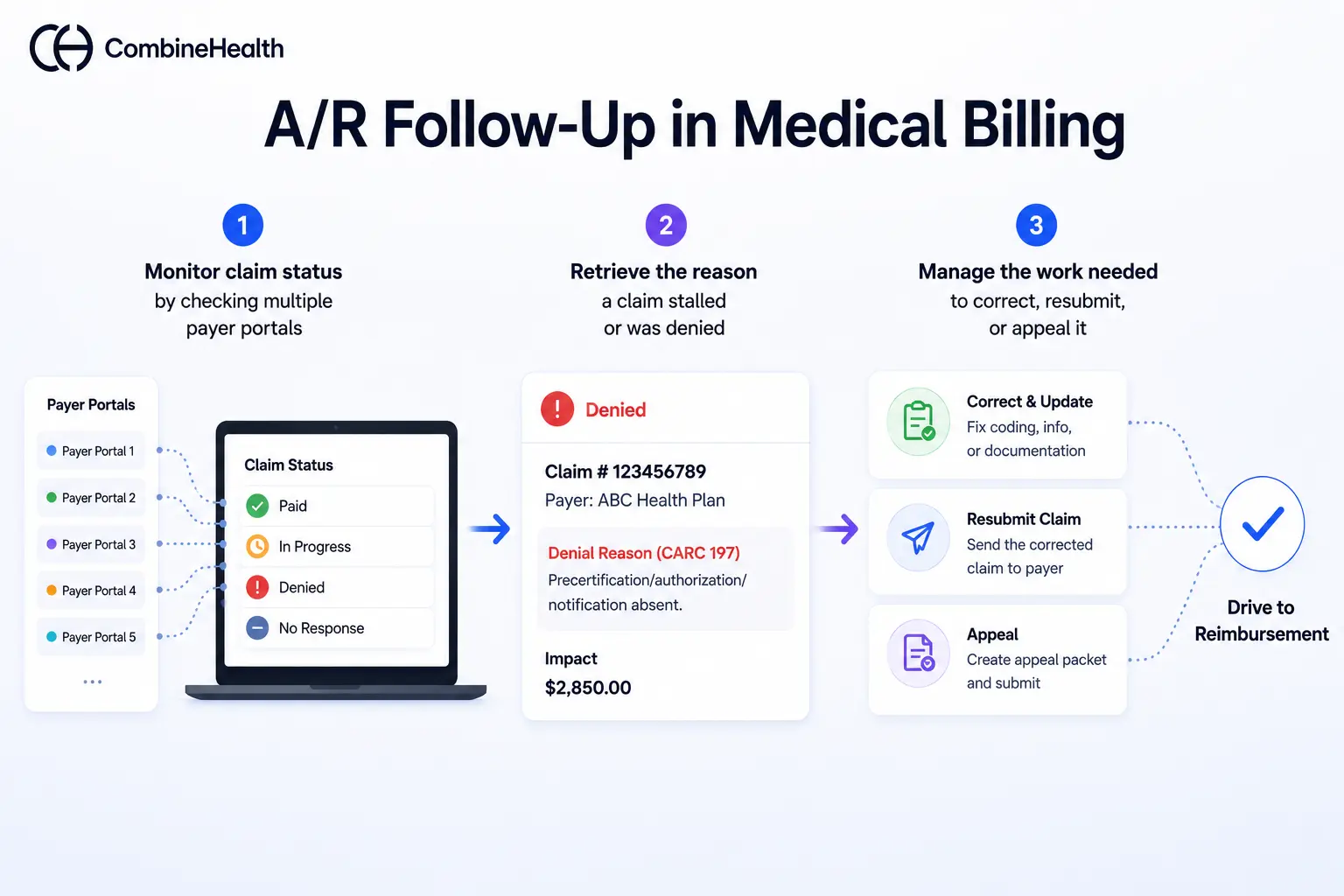
A/R follow-up software is built to stop healthcare claims from aging into write-offs. It tracks unpaid and denied claims, finds why each claim stalled, and drives it toward reimbursement.
This guide ranks the 10 best A/R follow-up software tools for medical billing in 2026, starting with the one built to work claims on its own, then nine alternatives.
Recover More Revenue with Autonomous AR Follow-Up
CombineHealth automatically follows up on unpaid claims, checks claim status across payer portals, and escalates issues to help accelerate reimbursements.
Book a Demo
1. CombineHealth: A/R Claim Follow-Up Automation at Scale
CombineHealth is an AI-powered accounts-receivable and denial-management software that tracks, investigates, and resolves pending and denied claims through payer portals, claim-status systems, and payer interactions. It works a claim the way an experienced biller would, but across your full A/R volume, without the hold time.
What separates it from a standalone A/R tool is context. CombineHealth's A/R follow-up is one stage of a connected revenue-cycle software, so it prevents as much as it recovers: accurate upstream billing and payer intelligence mean fewer claims age into A/R in the first place, and the claims that do carry payer-specific context — denial reason, payer behavior, and history — so they resolve faster and stay resolved.
Here is what that looks like across the follow-up cycle:
Feature #1: Automated status follow-up
CombineHealth logs into payer portals, checks claim status, identifies pending claims, retrieves adjudication details, and updates claim notes, so staff stops living in portals.
Feature #2: AI-powered payer calling
CombineHealth places calls, navigates payer phone workflows, retrieves status information, and captures the outcome, which removes the hold-time drain that frustrates every biller.
Feature #3: Denial resolution
CombineHealth retrieves denial information, categorizes the reason, documents the root cause, and routes the work, then corrects the claim, resubmits, supplies missing documentation, and responds to payer requests.
Feature #4: Denial intelligence and prevention
Paired with CombineHealth's denial analytics, it surfaces recurring denial patterns so teams address root causes instead of reworking the same denials repeatedly. Those outcomes feed back into the platform's payer intelligence, so the avoidable denials that drive A/R buildup are prevented upstream, not just worked again next month.

Notable Results by CombineHealth
CombineHealth’s AR follow-up capabilities have shown proven ROI, such as faster reimbursement, fewer write-offs, and up to 25% fewer outstanding A/R days, without adding A/R headcount.
Best for: Independent practices through health systems that want claim status, payer calls, and denial resolution handled autonomously.
2. Waystar
Waystar is a unified healthcare payments platform that spans claims, denials, and patient payments in one system. It suits organizations that want to run most of their revenue cycle through a single vendor rather than stitching point tools together.
For A/R follow-up, its claim-monitoring tools track status across a broad payer network and flag which claims need attention first. Its denial and appeal module uses generative AI and prebuilt payer-specific forms to speed up rework.
The breadth is both the draw and the caution: larger organizations get deep functionality, while smaller practices may pay for more platform than they use.
Key capabilities:
- Automated claim status tracking across a broad payer network
- Denial and appeal management with prebuilt payer forms
- Remit and payment forecasting to prioritize follow-up
- Wide integration with hospital and practice management systems
Best for: Hospitals and larger groups that want claims, denials, and payments on one platform.
3. R1 RCM
R1 RCM pairs revenue cycle technology with managed services, effectively running the billing operation for large healthcare organizations. It is less a tool you operate and more a partner that takes the work off your plate end to end.
Its platform layers AI agents across claims, follow-up, and denials, while R1 staff handle the actual chase on your behalf. That model removes the operational burden but also hands meaningful control of your revenue cycle to an outside team.
Key capabilities:
- End-to-end revenue cycle technology plus managed services
- AI agents applied across claims and follow-up workflows
- Dedicated teams that work denials and A/R for you
- Enterprise reporting across the full revenue cycle
Best for: Large hospitals and health systems that want to outsource the entire revenue cycle.
4. FinThrive
FinThrive is an enterprise revenue cycle platform built around a shared data foundation rather than a loose set of point tools. Its pitch is consolidation: replace several disconnected systems with one that spans patient access through revenue recovery.
For A/R and denials, it unifies data from EHRs, billing systems, and payer sources, then runs analytics and agentic workflows on top. That shared backbone helps larger organizations spot denial patterns and prioritize follow-up across departments.
The value grows as you adopt more of its modules. It best suits health systems trying to reduce vendor sprawl and standardize their revenue cycle.
Key capabilities:
- Unified revenue cycle data platform across systems
- Analytics that surface denial and A/R trends
- Agentic workflows spanning access to recovery
- Modular tools that share one data foundation
Best for: Health systems consolidating multiple point tools onto a single platform
5. TruBridge
TruBridge focuses on community hospitals, rural facilities, and their affiliated clinics, a segment larger vendors often overlook. It combines revenue cycle technology, EHR, and coding support tailored to smaller-hospital realities.
Its A/R work blends software with managed services, including denial management and dedicated recovery to clear aged claim backlogs. Teams can lean on TruBridge staff to work claims instead of staffing that effort entirely in-house.
The trade-off is focus: it is purpose-built for the community and rural setting, not large urban systems or standalone practices. Organizations in that niche get both software and a service partner aligned to their needs.
Key capabilities:
- Revenue cycle technology built for community and rural hospitals
- Denial management with managed A/R recovery support
- Coding services alongside billing workflows
- Ambulatory RCM tools for affiliated clinics
Best for: Community and rural hospitals and their clinics wanting technology plus managed services.
6. Greenway Health
Greenway Health is an ambulatory EHR and practice management vendor with a revenue services arm layered on top. Practices already on Greenway can extend into managed A/R rather than adopting a separate billing system.
Through Greenway Revenue Services, specialty-aligned financial teams work claims, denials, and follow-up alongside your staff. That human-plus-software model appeals to groups that want a partner handling the chase.
Its strengths are most pronounced inside the Greenway ecosystem, so value depends on whether you use its EHR and PM. For practices outside that stack, a standalone follow-up tool may integrate more cleanly.
Key capabilities:
- Ambulatory EHR and practice management foundation
- Managed revenue services with specialty-aligned teams
- Denial and A/R follow-up handled by Greenway staff
- Coding, auditing, and analytics support
Best for: Ambulatory practices wanting software paired with a hands-on revenue partner.
7. CERTIFY Health
CERTIFY Health approaches denials from the front end, layering patient-access and RCM tools onto your existing EHR. Its logic is that clean intake data prevents many denials before a claim is ever submitted.
The platform verifies eligibility in real time, confirms patient identity, and captures accurate demographics and payment details up front. That removes the registration and eligibility errors that trigger a large share of downstream denials.
Because its center of gravity is intake and patient payments, it does less to work claims that have already stalled or been denied. It fits teams prioritizing prevention and patient collections over back-end payer follow-up.
Key capabilities:
- Real-time eligibility and benefits verification
- Patient identity verification at registration
- Integrated patient payment collection
- Front-end data capture that reduces denials
Best for: Outpatient and ambulatory groups focused on front-end denial prevention.
8. Aptarro
Aptarro concentrates on the middle of the revenue cycle, catching problems before claims ever leave the building. Its tools scrub charges and claims against a large edit library so errors get fixed pre-submission.
Rather than working aged A/R, it lifts first-pass acceptance by preventing the denials that create follow-up in the first place. An AI-assisted rules engine and claim scrubber catch issues that would otherwise return as denials.
It pairs well with practices that want to shrink denial volume at the source.
Key capabilities:
- AI-assisted rules engine for charge accuracy
- Clinical claim scrubbing against a broad edit library
- Coding support to improve claim quality
- Pre-submission checks that reduce denials
Best for: Teams that want to prevent denials upstream rather than rework them later.
9. MD Clarity
MD Clarity targets a blind spot most tools ignore: whether paid claims were actually paid correctly. Its RevFind product compares each remittance against your contracted rates to catch underpayments and denial patterns.
For follow-up, it flags variances at the code level and routes them to worklists so staff can recover money left on the table. It also models contract scenarios, giving practices leverage in payer negotiations.
Its focus is underpayment and contract recovery. It fits provider groups and MSOs that suspect they are being systematically underpaid.
Key capabilities:
- Underpayment detection against contracted rates
- Code-level variance flagging and worklists
- Contract modeling for payer negotiations
- Denial pattern analysis tied to contracts
Best for: Provider groups and MSOs recovering underpayments and strengthening contract terms.
10. Medendx
Medendx is an AI-driven, all-in-one billing and RCM system that handles the cycle from coding to collections. It suits organizations that want a single automated stack rather than a specialized follow-up tool bolted onto existing software.
Machine learning and robotic process automation drive its coding, claim submission, eligibility checks, and denial resolution. For A/R, that means routine billing and denial tasks run automatically instead of eating staff hours.
As a broad all-in-one, it spreads across the whole cycle rather than going deep on autonomous payer follow-up specifically. It appeals to practices and billing companies wanting one AI system to run end to end.
Key capabilities:
- AI-driven coding and claim submission
- Automated eligibility verification
- Denial resolution workflows
- All-in-one billing and RCM in a single system
Best for: Practices and billing companies wanting an all-in-one AI billing system.
Why A/R Follow-Up Automation In Medical Billing Matters in 2026
A/R follow-up automation matters more in 2026 than ever because manual A/R review can't keep pace with high volume of denials without bleeding revenue to timely filing deadlines.
Recommended Reading: Denial management in healthcare
As per HFMA, the initial denial rates have climbed to 11.65% in 2025, up from 11.41% the year before. Insurers denied about 19% of in-network claims in 2024, and many provider organizations report initial denial rates above 10% across their broader payer mix.
Manual follow-up cannot scale against that volume. A single AR representative checking claim status the old way—logging into a payer portal, waiting on hold, documenting notes, then deciding on a next action—can realistically work only a fraction of an aging A/R bucket in a day.
An A/R follow-up software absorbs the repetitive parts, so your team can focus on the claims that need human judgment.
With denial rates climbing and each rework costing staff time, the durable fix is preventing avoidable denials, not just working them faster. CombineHealth does both — autonomous follow-up on aged claims, and payer intelligence that stops recurring denials at the source.
Recommended Reading: A/R days in medical billing
Stop Losing Earned Revenue to Unworked Claims
CombineHealth works your aging claims autonomously — status checks, payer calls, denial resolution, and resubmission — while its connected platform keeps avoidable claims out of A/R to begin with.
Book a demo to see autonomous A/R follow-up on your own claims.
FAQ
How does CombineHealth's A/R follow-up work?
CombineHealth autonomously checks claim status in payer portals, calls payers and captures outcomes, categorizes and resolves denials, and resubmits corrected claims — across your full A/R volume. It runs on a connected revenue-cycle platform, so denial outcomes feed payer intelligence and fewer avoidable claims reach A/R.
Does CombineHealth prevent A/R buildup or just work aged claims?
Both. It works aged claims autonomously, and because A/R follow-up shares a platform with upstream billing and payer intelligence, it reduces how many claims age into A/R at all — the durable way to lower A/R days rather than just processing the backlog faster.
Do I need separate software for denials, appeals, and A/R follow-up?
Not with a connected platform. CombineHealth runs A/R follow-up, denial resolution, and appeals on shared denial intelligence, so a denial worked today informs prevention tomorrow — fewer tools, and a loop that reduces recurring denials.
What is A/R follow-up in medical billing?
A/R follow-up is the process of tracking unpaid and denied claims after submission and working each one until it is paid or resolved. It includes checking claim status, investigating denials, correcting and resubmitting claims, and filing appeals.
What is the difference between A/R follow-up software and denial management software?
A/R follow-up software covers all outstanding claims, including those simply sitting unpaid in a payer's system. Denial management software focuses specifically on claims the payer refused to pay. Many tools, including CombineHealth, handle both in one workflow.
Do I need separate software for denials and underpayments?
Not necessarily. A denial means the payer refused to pay; an underpayment means the payer paid, but less than the contract required. Platforms like CombineHealth handle both inside a single system, which is worth prioritizing if underpayments are a known issue for your organization.