10 CDI Best Practices for Healthcare Organizations
Learn ten CDI best practices for closing documentation gaps, writing compliant queries, using AI wisely, and reducing medical coding-related denials fast.
Published on:
August 25, 2026


Key Takeaways
• A claim denial in healthcare rarely means the diagnosis was wrong; it means the documentation didn't support it, which is why CDI exists as the link between clinical care and a defensible claim.
• Clinical documentation gaps should be prioritized by financial risk, especially now that CMS's 2026 Inpatient-Only List phaseout shifted 285 procedures to documentation-dependent status.
• Compliant provider queries follow the ACDIS/AHIMA standard: non-leading language, evidence already in the chart, and no resending until the desired answer comes back. It should stay separate from provider education, which addresses a pattern rather than fixing today's claim.
• Documentation review should be specialty-specific, since a generic checklist misses what actually matters in each department, like laterality in orthopedics or decision-making complexity in emergency medicine.
• Denial and medical coding-audit data should direct where CDI looks next, turning forty separate denials from the same root cause into one fixable gap instead of forty unrelated queries, with feedback landing best when it's built from a provider's own charts near the encounter.
• AI's role in CDI is reading every eligible chart at a depth manual review can't sustain, while the judgment on whether a diagnosis is actually warranted stays with the CDI specialist, coder, and provider; the strongest tools tell a same-day query apart from a future education note.
• CombineHealth's self-learning platform, Amy AI, reviews the complete record while coding, flags gaps with a traceable rationale, and has driven up to a 75% reduction in medical coding-related denials for health systems using it.
A denial letter never says the diagnosis was wrong. It says the documentation didn't support it.
That distinction is the entire job of clinical documentation integrity. The patient had sepsis. The physician treated it correctly. But if the chart doesn't spell out the clinical evidence in a way a coder, an auditor, and a payer can all follow, the claim comes back anyway. Good care and a defensible chart are two different achievements, and CDI exists to make sure a hospital never has the first without the second.
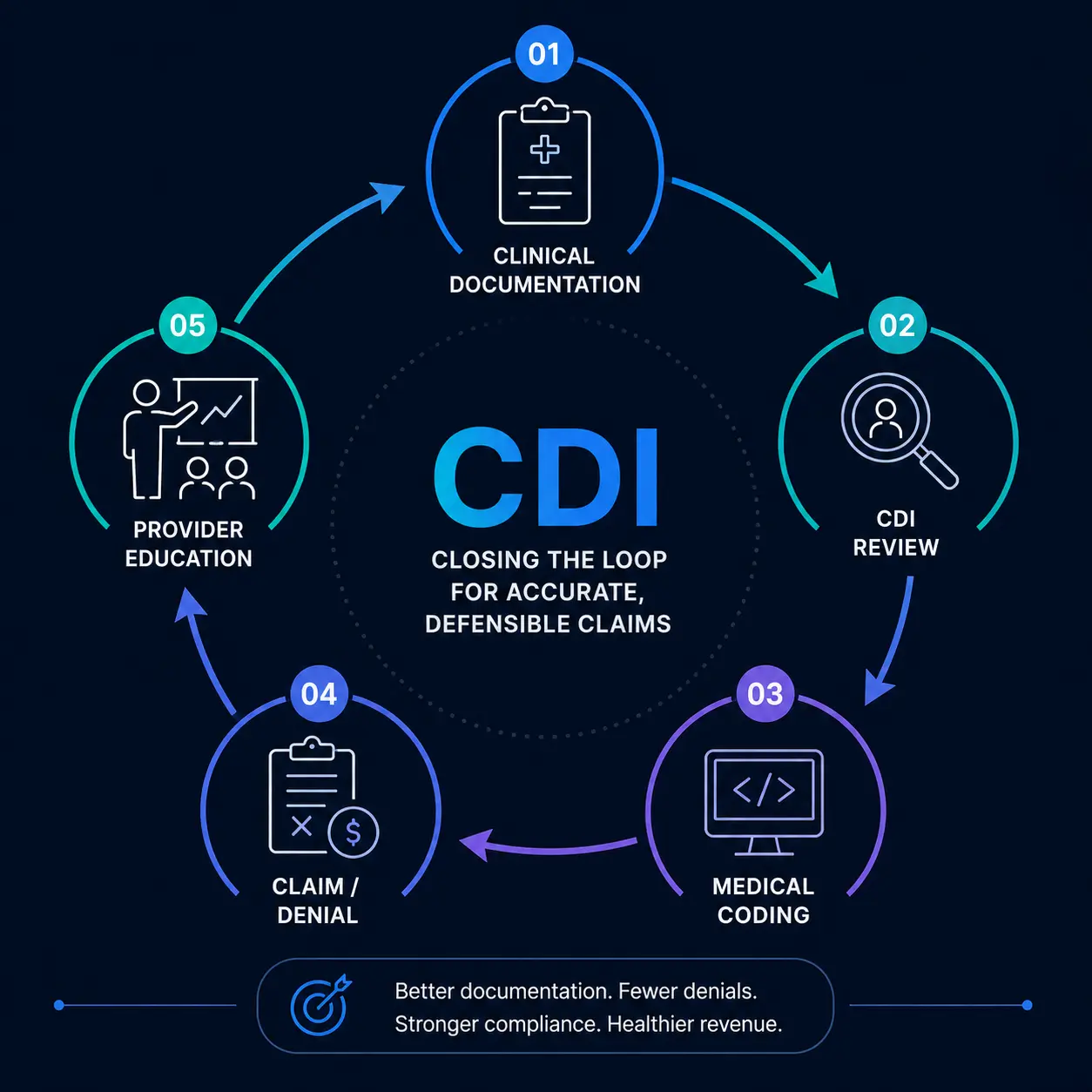
Most programs struggle because documentation, medical coding, and denials sit in three different systems, reviewed by three different teams, who rarely compare notes. A gap gets flagged during CDI review, coded around in billing, and denied by the payer two months later, and nobody ever traces it back to where it started. By the time it surfaces, the same gap is already sitting in next week's charts too.
Here are ten practices that close that loop, where AI genuinely earns its place in the process, and how to tell whether a program is actually working or just staying busy.
What Are the Core Best Practices for a Clinical Documentation Integrity Program?
Strong CDI programs read the whole chart instead of the summary, go after the gaps with the biggest financial and compliance consequences first, and write queries built to survive an audit rather than just get answered. They also route what coding and denials find straight back into physician education, so the same mistake doesn't cost the organization twice. It starts with something simple and easy to skip when volume is high: actually reading the whole chart.
1. Review the Complete Clinical Record
Reading every chart in full is precisely where volume defeats a manual team. CombineHealth's self-learning platform reads the complete encounter, including progress notes, nursing documentation, labs, imaging, the problem list, and the discharge summary on every chart it codes, not a sampled subset.
Reviewing the complete clinical record involves reading the full patient encounter:
- Progress notes
- Nursing documentation
- Lab reports
- Imaging
- The problem list and discharge summary
This full view is what allows a CDI specialist to catch a diagnosis capable of shifting a DRG or an E/M level, which is exactly where the financial exposure of a chart tends to live.
A discharge summary compresses days of care into a paragraph. Sepsis documented three progress notes earlier, a comorbidity buried in a nursing note, or a severity marker sitting in a lab result can all disappear inside that compression, invisible to a reviewer working from the summary alone.
Full-record review takes real time per chart. That time investment is what surfaces the findings a faster, shallower pass would miss entirely.
2. Prioritize High-Impact Documentation Gaps
Prioritizing high-impact documentation gaps allows ranking documentation deficiencies by financial and compliance consequence, working the ones that matter most first. The categories worth ranking include:
- Diagnosis specificity
- Medical necessity
- E/M levels
- Severity and risk adjustment
- Reportable comorbidities
- Procedures and modifiers
- Quality reporting
- Denial risk
Ranking clinical documentation gaps by financial and compliance consequence is work CombineHealth does automatically. Because it evaluates documentation while it codes, it surfaces the gaps that actually move a claim and orders them by reimbursement impact rather than by the order charts happen to arrive.
A missing modifier on a routine visit carries far less weight than an unsupported principal diagnosis, yet many CDI teams still work charts strictly in the order they arrive. That approach treats every gap as equally urgent, which wastes review capacity on low-stakes charts while high-stakes ones wait.
Site-of-service documentation belongs on this priority list now more than ever. CMS began phasing out the Medicare Inpatient-Only List on January 1, 2026, removing automatic inpatient status from 285 mostly musculoskeletal procedures. Medical necessity documentation, rather than the procedure code, now determines site-of-service reimbursement for those cases.
3. Standardize Compliant Provider Queries
A compliant provider query is built to survive an audit. AHIMA and ACDIS define the standard clearly: queries should be non-leading, clinically supported, clear and concise, relevant to the current encounter, consistent across providers, and documented in an auditable way.
The joint ACDIS/AHIMA Guidelines for Achieving a Compliant Query Practice describe specific practices that break compliance. Resending a query until a desired answer arrives is one example. Offering a multiple-choice list with no genuine write-in option is another. Both practices push a provider toward a predetermined answer rather than letting clinical judgment drive the response.
Query quality often depends heavily on which specialist happens to be working a given chart that day. A standardized, specialty-aware template gives every reviewer the same starting point, closing that inconsistency far faster than another round of training.
4. Separate Immediate Queries From Educational Feedback
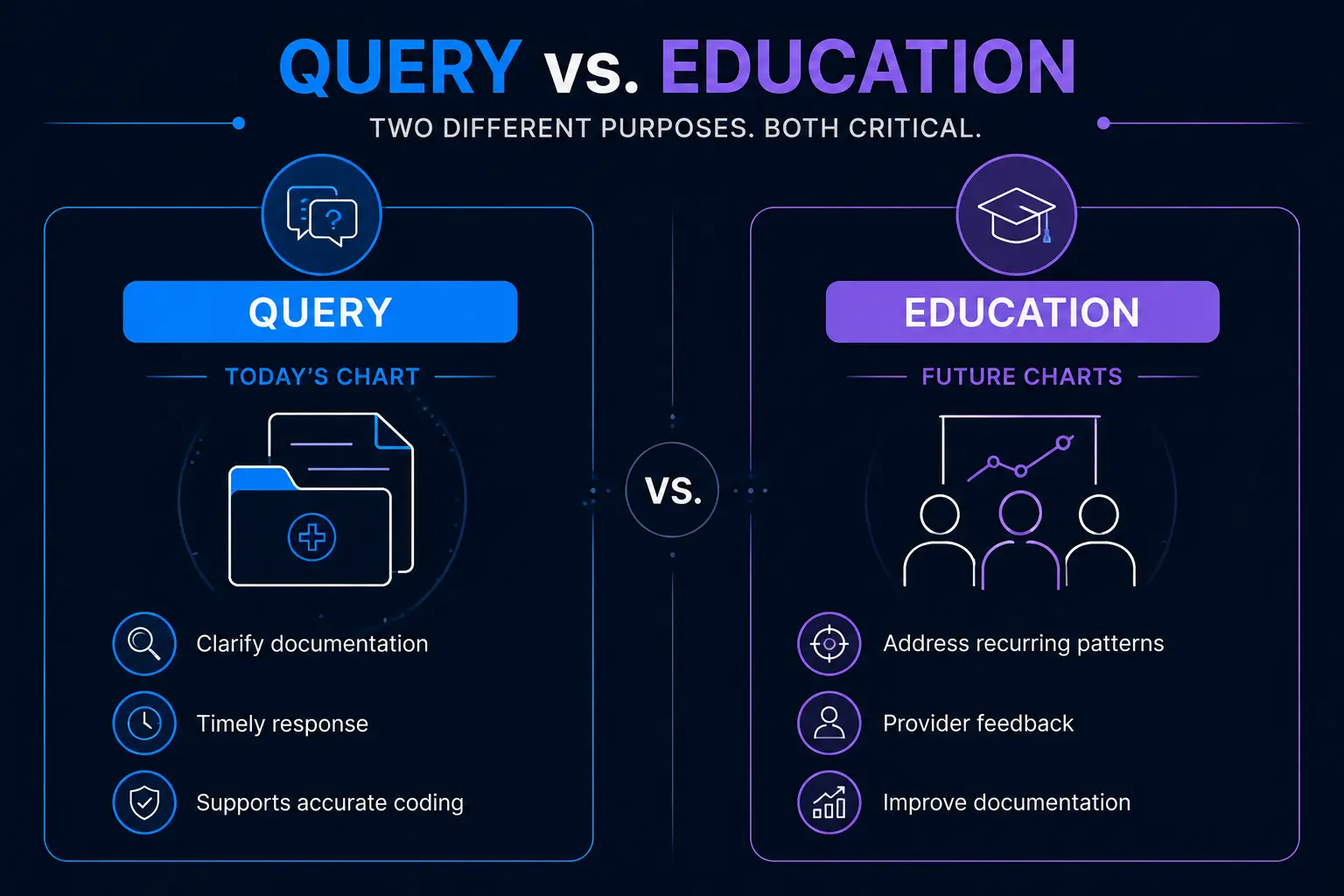
A provider query serves one purpose: clarifying today's chart so it can be coded accurately right now. Educational feedback serves a different purpose entirely, improving documentation habits for future encounters without holding up the current claim.
Keeping these two channels distinct protects physician goodwill. A physician receiving three query-shaped emails a week that are really disguised training notes starts treating every query as noise, including the one that genuinely needs a same-day response. What counts as urgent versus educational also tends to shift by department, since the stakes of a given gap vary by specialty.
5. Make CDI Specialty-Specific
Specialty-specific CDI means building documentation requirements around the specialty, setting, payer mix, and common procedures a department actually handles.
Orthopedic medical coding charts hinge on laterality, fracture detail, implant specifics, and surgical approach. Emergency medicine charts hinge on medical decision-making complexity and critical care time. Cardiology charts hinge on ejection fraction and how clearly an acute event is separated from a chronic condition.
A specialist working from a template built for their department already knows what to look for before opening a chart. A generic checklist applies rules built for an average encounter that doesn't actually exist anywhere in the hospital, which is how a trauma chart can sail through review missing a laterality check.
In a high-volume emergency department, CombineHealth caught five times more documentation gaps than the prior manual workflow—finding the specialty-specific detail a generic pass misses, like the missing laterality check on a trauma chart or the decision-making complexity that sets an ED level.
Because the platform applies the coding guidelines and payer rules that matter in each department, specialty context is built into the review rather than bolted on.
6. Integrate CDI With Coding and Denial Data
Integrating CDI with coding and denial data means feeding medical coding audits, denials, underpayments, and payer edits back into the review process. This connection lets a program answer questions a single chart review can't reach on its own:
- Which documentation gaps actually cause denials?
- Which providers repeatedly trigger the same query?
- Where is documentation driving undercoding?
- Which payer requirements does the team keep missing?
- Are interventions actually reducing repeat issues?
This is the exact loop CombineHealth is built on. It doesn't stop at assigning a code—it checks each decision against what happens after submission, including denials, reimbursements, and underpayments, and turns that feedback into payer-specific intelligence.
Forty orthopedic denials from one root cause become one learned pattern the platform applies going forward, which is how health systems using it have seen up to a 75% reduction in coding-related denials. The gaps it surfaces reflect what a given payer has actually pushed back on, not a generic rule set.
7. Offer Provider-Level Education
Provider-level education means building feedback from a physician's own documentation patterns rather than a generic training module aimed at the whole department. Useful programs draw on:
- Brief, specialty-specific guidance
- Documentation examples
- Recurring-gap summaries
- Peer or baseline comparisons
- Short feedback delivered near the relevant encounter
Feedback built from a provider's own charts is hard to assemble by hand across a full medical staff. CombineHealth identifies provider-level documentation trends automatically—surfacing the one or two gaps a given physician repeats and grouping them into recurring-gap summaries benchmarked against a specialty baseline.
That gives CDI leaders education drawn from real charts, close to the encounter, instead of a quarterly slide deck built on averages.
8. Include Clinical Validation
Clinical validation confirms that a diagnosis in the chart is genuinely supported by clinical evidence and compliant with official coding requirements. A diagnosis appearing somewhere in the documentation still needs backing from labs, vitals, treatment, and physician assessment before it becomes a code.
The FY 2026 ICD-10-CM Official Guidelines for Coding and Reporting state this directly: accurate coding depends on complete, consistent documentation and a review of the entire record. Skipping clinical validation trades one risk for a worse one. A denial costs a single claim. An upcoding finding invites a full claim audit.
Every gap CombineHealth flags carries a traceable rationale linked back to the labs, vitals, treatment, and assessment in the source record—so a coder can confirm a diagnosis is genuinely supported before it becomes a code, rather than trading a denial risk for an upcoding finding.
Because the reasoning is visible and tied to the documentation, validation is something the team can audit, not a black-box output.
9. Use Technology Without Removing Human Governance
AI-assisted CDI handles the volume a manual team can't sustain on its own. That includes reviewing full charts, identifying missing specificity, detecting conflicting documentation, surfacing possible missed diagnoses, prioritizing high-impact cases, drafting queries, and identifying provider-level trends across the organization.
Technology's role stops at surfacing where a record falls short of what it should support. Whether a diagnosis is clinically warranted remains a judgment call that belongs to the CDI specialist, coder, and provider, a form of governance that stays constant even as review gets faster.
10. Measure CDI Outcomes
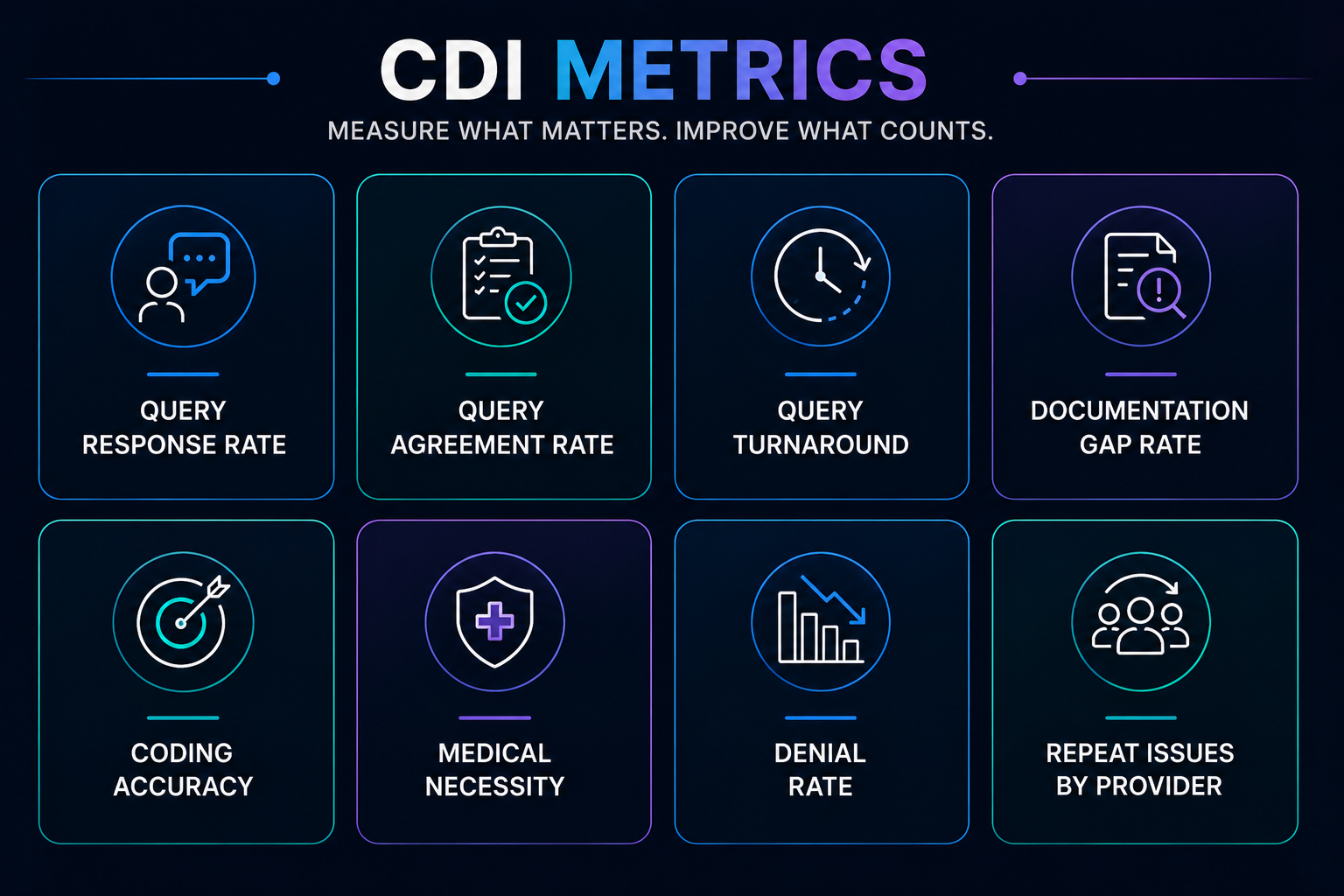
Measuring CDI outcomes involves tracking both activity and impact. A complete set of metrics includes:
- Query rate
- Provider response rate
- Agreement rate
- Query turnaround time
- Documentation-gap rate
- Primary diagnosis changes
- Coding accuracy
- Medical-necessity support
- CDI opportunities by provider
- Coding-related denial rate
- Underpayment or captured-revenue impact
- Repeat documentation issues
A high query count shows a team is active. It says little about whether the program actually changes outcomes. Three physicians generating the same query month after month signal a broken education strategy, a pattern query volume alone will never reveal on its own.
How Should Organizations Improve Their CDI Program?
Organizations improve their CDI program by fixing it in sequence rather than all at once: establishing a documentation-quality baseline, prioritizing the highest-impact specialties, standardizing compliant queries, and connecting CDI to coding and denial data before introducing any new technology. Skipping straight to software before those fundamentals are in place is the most common reason CDI improvement efforts stall without producing measurable results.
Programs that stall usually reach for new software before fixing the query process or the underlying data connections. The same gaps get flagged faster instead of getting fixed. Work through these steps in order.
- Set a documentation-quality baseline. There's no proving improvement without knowing the starting query rate, gap rate, and medical coding accuracy.
- Find the highest-impact specialties first. Let denial and audit data point toward where gaps actually cost money.
- Standardize queries before scaling anything else. One compliant template beats individual judgment across a growing team.
- Wire CDI into coding and denial data permanently. It doesn’t have to be a quarterly report someone skims and forgets.
- Build education from real provider patterns. If you create a generic module, everyone will just click through once.
- Pilot new technology on a representative sample. If results are favourable, only then touch full volume.
- Revisit the baseline regularly. A metric measured once is a snapshot that goes stale the moment payer behavior shifts.
How Can AI Support CDI Best Practices?
AI earns a place in CDI by reading every eligible chart at a depth manual review can't sustain, then prioritizing the cases where a gap will actually move a claim.
The systems worth using tell a same-day query apart from a future education opportunity, and separate a genuine, evidence-backed undercoding opportunity from a suggestion the record simply doesn't support. Treating those four situations the same way is how programs either flood providers with unnecessary queries or miss the ones that matter.
Take a chart missing documentation of illness severity. Is the gap severe enough to hold the claim for a query, minor enough for the education file, or unsupported enough that flagging it as a coding opportunity would create a compliance problem instead of solving one? A blunt tool answers all three the same way. A useful one doesn't.
How Is CombineHealth’s AI Different?
CombineHealth's self-learning autonomous medical coding platform, also known as Amy AI, reads the complete clinical record while coding and makes that distinction directly, flagging gaps that affect specificity, medical necessity, E/M leveling, or reimbursement.
What sets it apart isn't just full-chart review; it's that CombineHealth checks its own coding decisions against what actually happens after submission, including denials, reimbursements, and underpayments, and uses that feedback to build payer-specific intelligence over time. The gaps it surfaces reflect what a given payer has actually pushed back on before instead of a generic rule set.
CombineHealth's impact shows up clearly in deployment data:
- 5× more documentation gaps caught than the prior manual workflow in a high-volume emergency department deployment
- 50% faster coding turnaround time in that same ED deployment
- 75% reduction in coding-related denials and 4% increase in captured revenue at a 400-bed health system, driven by the same payer-aware approach.
- Traceable rationale on every flagged gap, linked back to the source documentation. So, a CDI specialist can verify the platform's work rather than take it on faith.
See What CombineHealth's AI Catches in Your Charts
CombineHealth’s autonomous medical coding platform reads every eligible chart in full, flags documentation gaps with a traceable rationale, and has driven up to a 75% reduction in coding-related denials. Book a demo to see it against your own denial rate.
Frequently Asked Questions
What are the goals of a CDI program?
Making sure the record accurately reflects a patient's condition and supports the codes built from it, not maximizing reimbursement. Revenue follows from accuracy; it was never the starting goal.
What makes a provider query compliant?
Non-leading language, evidence already in the chart, and consistency across providers. ACDIS/AHIMA guidelines require a genuine write-in option on multiple-choice queries and prohibit resending a query until a desired answer comes back.
How can hospitals improve physician engagement in CDI?
Timely, specific feedback tied to a provider's own patterns beats generic training. A short note delivered near the relevant chart changes documentation faster than a quarterly session most physicians attend half-present.
Which CDI metrics should organizations actually track?
Beyond query volume: response and agreement rates, documentation-gap rate, coding accuracy, medical-necessity support, coding-related denial rate, and repeat issues by provider, the real signal, since a falling repeat rate means more than a high response rate alone.
How often should CDI programs audit documentation?
Concurrent review handles day-to-day work, and most mature programs add a retrospective audit quarterly to catch systemic patterns routine queries miss. Chart volume and payer mix should set the exact cadence.
Can AI actually identify clinical documentation gaps?
Yes, at a scale manual review can't match. CombineHealth identified five times more documentation gaps than a traditional workflow in one emergency department deployment, each flag carrying a traceable rationale.
What's the difference between a query and provider education?
A query fixes today's chart and needs a timely answer. Education addresses a pattern worth improving next time and shouldn't hold up today's claim.