Echocardiogram CPT Codes: The Complete Cheat Sheet
A complete echocardiogram CPT code cheat sheet: TTE, TEE, stress echo, add-ons, ICD-10 pairings, and modifiers—every code sourced to AMA & CMS.
Published on:
June 16, 2026


Key Takeaways
• There's no single echocardiogram code—the right CPT depends on the approach (TTE, TEE, or stress), how complete the study was, and who performed each part.
• 93306 is the default complete transthoracic echo; it needs 2D imaging plus spectral and color flow Doppler (M-mode when performed), or it downcodes to 93307.
• TEE splits two ways: 93312 for a diagnostic study, and 93355 when the TEE guides a structural intervention such as TAVR or a MitraClip repair.
• For stress echo, 93351 is the all-in-one nonfacility code, while 93350 covers the echo alone with the stress test billed separately under 93016–93018.
• Payers increasingly use AI to review and deny claims, so coding echo studies with an AI assistant brings the same precision to your side and helps prevent denials.
Echocardiography is one of cardiology's highest-volume services.
Roughly 1 in 5 Medicare beneficiaries gets an echocardiogram every year, and CPT code 93306 consistently ranks among the specialty's highest-volume billing codes.
With that volume comes scrutiny, making echocardiography a frequent target for payer audits and medical-necessity review.
The codes don't make it easy either: a dozen near-identical descriptors and strict documentation rules mean a small mistake can turn into a denial, an underpayment, or a compliance problem.
This cheat sheet lays out the echocardiogram CPT codes you can actually use, along with their documentation requirements, ICD-10 pairings, and modifier rules.
What Is the Echocardiogram CPT Code?
An echocardiogram CPT code is used to tell payers exactly what type of echo was performed, which imaging components were included, and who performed each part of the service for insurance billing and reimbursement. These codes are maintained by the American Medical Association (AMA).
The most commonly billed echocardiogram CPT code is 93306, a complete transthoracic echo with Doppler.
How to Select the Right Echocardiogram CPT Code?
Picking the right Echocardiogram CPT Code comes down to four questions:
- Which approach was used?
- Was the study complete or limited?
- Was Doppler performed?
- Who did each part of the work?
Doppler is the ultrasound technique that captures blood flow—speed and direction—through the heart and valves to reveal leaking, narrowed valves or abnormal flow.
Commonly Used Echocardiogram CPT Codes at a Glance
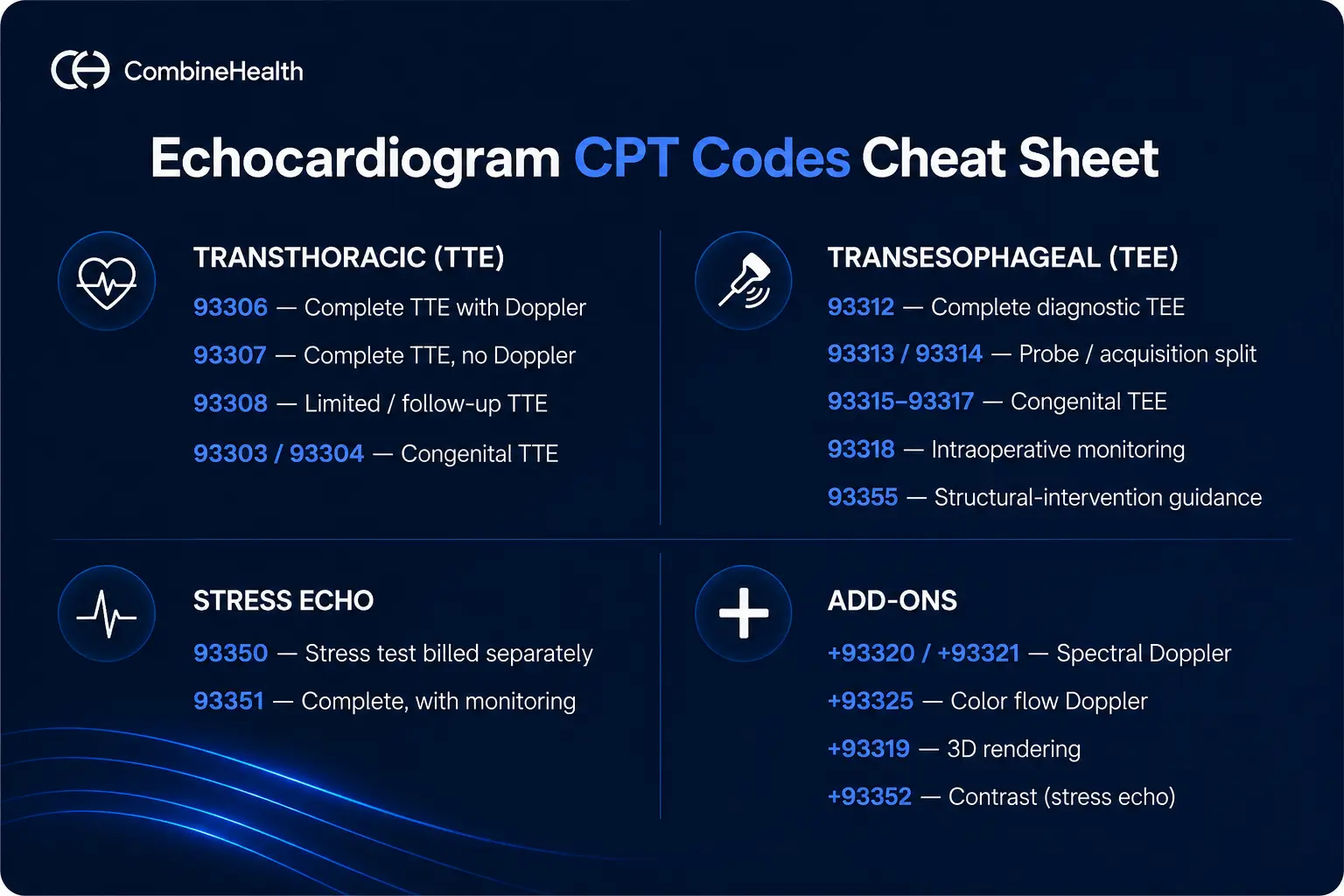
Use this quick reference to find a code fast, then read the category sections below for the documentation rules.
Transthoracic (TTE)
- 93306—Complete TTE with Doppler
- 93307—Complete TTE, no Doppler
- 9330—Limited / follow-up TTE
- 93303 / 93304—Congenital TTE
Transesophageal (TEE)
- 93312—Complete diagnostic TEE
- 93313 / 93314—Probe / acquisition split
- 93315–93317—Congenital TEE
- 93318—Intraoperative monitoring
- 93355—Structural-intervention guidance
Stress Echo
- 93350 —Stress test billed separately
- 93351—Complete, with monitoring
Add-ons
- +93320 / +93321—Spectral Doppler
- +93325—Color flow Doppler
- +93319—3D rendering
- +93352—Contrast (stress echo)
Types of Echocardiogram CPT Codes
Echocardiography is grouped into a few CPT code families by how the study is performed. Each family has its own documentation and modifier rules.
Transthoracic Echocardiogram (TTE) Codes
A transthoracic echocardiogram (TTE) images the heart through the chest wall and is by far the most common echo. The code depends on how complete the study was and whether Doppler was performed.
The echo CPT code 93306 is the complete study, and it requires complete 2D imaging plus both spectral and color flow Doppler, with M-mode (motion mode) when performed.
CPT code 93307 is that same complete study performed without Doppler, and CPT code 93308 is a limited or follow-up study focused on a single structure.
Note: Billing 93308 for a complete study that was actually performed is downcoding and underpays the work, while 93306 without documented Doppler triggers a denial. The congenital-anomaly versions, 93303 (complete) and 93304 (follow-up), apply only when the indication is a congenital heart defect.
Transesophageal Echocardiogram (TEE) Codes
A transesophageal echocardiogram (TEE) passes a probe into the esophagus for a clearer view of posterior structures like the left atrial appendage and valves, and it's used when a TTE can't answer the question.
Most TEEs are diagnostic and reported with 93312.
The exception is 93355, which applies when the TEE guides a structural intervention such as TAVR, a MitraClip/TEER repair, or left atrial appendage occlusion—there, the echocardiographer steers device placement in real time rather than simply evaluating the heart.
Note: When two providers split the work, 93313 (probe placement) and 93314 (acquisition and report) together equal one complete 93312. Code 93318, for intraoperative monitoring, is bundled into the anesthesia service and isn't separately billable,
Stress Echocardiogram Codes
A stress echocardiogram images the heart at rest and under exercise or pharmacologic stress to detect ischemia or assess valve function.
The code depends on whether one provider performed and billed the whole thing. 93351 is the complete study, and it's reported only in the nonfacility (office) setting. 93350 covers the echo alone, with the stress-test work billed separately under 93016–93018, and it can be used in either setting.
Those stress-test codes form the cardiovascular stress-test family—93015 (complete), 93016 (supervision), 93017 (tracing), and 93018 (interpretation)—which is also what you'd report for a stress test done without echo imaging. Nuclear perfusion stress tests use 78451 or 78452 instead.
Note: Because 93351 already includes the stress-test supervision and monitoring, it isn't reported alongside the cardiovascular stress-test codes 93015–93018 or with 93350—doing so is a bundling error.
Doppler, 3D, and Contrast Add-On Echocardiogram CPT Codes
Add-on Echocardiogram codes report the extra components performed alongside a base echo, Doppler, 3D rendering, or contrast, and are never billed on their own.
Because each one depends on a base study, a denied base code reverses every add-on attached to it.
Echocardiogram ICD-10 Codes and Billing Modifiers
Echocardiogram CPT codes describe the procedure, while echo ICD-10 codes describe the diagnosis behind it, and modifiers explain more context—how or where the service was performed or altered.
A valid diagnosis code is necessary but not sufficient. Keep these necessity rules in mind:
- Medicare ties coverage to its MAC's Local Coverage Determination (LCD); a payable ICD-10 alone isn't enough—the record must show symptoms or findings that justify the study.
- Screening echoes ordered without symptoms or clinical findings are generally not covered.
- Many payers cap frequency and require prior authorization for advanced studies.
- When a TEE follows an inadequate TTE, sequence the abnormal-findings code (R93.1 or R93.89) first and the cardiac diagnosis second.
Echocardiogram Modifiers
Modifiers clarify who performed a service and how; the right one protects reimbursement.
Stop Losing Echo Claims to Coding Errors
Echo coding is detail-heavy—the strict 93306 requirements, add-on dependencies, diagnostic-versus-interventional TEE, payer-specific necessity rules—the kind of work where checking every element beats working from memory.
And on the payer side, the scrutiny keeps climbing. Insurers are increasingly using AI to review claims and prior authorizations, so a single missed Doppler note or unsupported diagnosis is more likely than ever to get flagged and denied.
If the payers reviewing your claims are already running on AI, it only makes sense to bring the same precision to your side of the desk.
Amy, CombineHealth's AI medical coding solution, reads the echo report straight from the EMR and assigns ICD-10, CPT, and HCPCS codes with line-by-line rationale.
She confirms every code’s components before billing it, flags a missing Doppler note so you don't downcode, checks that each add-on has a valid base, and pairs the diagnosis that supports medical necessity.
She can also audit pre-coded charts to catch systemic echo errors before claims reach the payer.
Book a demo to see Amy code a complete echo study end to end!
FAQs
1. What is the CPT code for an echocardiogram?
There's no single code. The most common is 93306, a complete transthoracic echo with spectral and color flow Doppler. The right code depends on the study type and components performed.
2. Which CPT code is used for a complete echocardiogram?
93306, for a complete TTE with Doppler. It needs complete 2D imaging plus both spectral and color flow Doppler (M-mode when performed); without the Doppler, use 93307.
3. What are the EKG CPT codes?
93000 is the global 12-lead ECG (tracing, interpretation, and report). 93005 is the tracing only, and 93010 is the interpretation and report only.
4. What is the CPT code for a pediatric or fetal echocardiogram?
Fetal echoes use 76825 (complete) and 76826 (follow-up). A pediatric study performed for a congenital defect uses the congenital TTE codes 93303 (complete) and 93304 (follow-up).