How to Improve Emergency Department Medical Coding Accuracy: 6 Strategies That Work
Discover six strategies to improve emergency department medical coding accuracy through better documentation, audits, feedback, standards, and AI automation.
Published on:
August 24, 2026


Key Takeaways:
• Emergency Department medical coding has gotten harder. A single encounter can produce a professional claim, a facility claim, separately reportable procedures, and modifiers, and since 2023, the ED E/M level rests on medical decision-making alone.
• Emergency Department medical coding accuracy improves through six connected changes: a segmented baseline, better documentation, written coding standards, targeted pre-bill audits, denial feedback, and ED medical coding automation with human review.
• Measuring medical coding accuracy across all audited charts, coders, and payers can hide where errors and coding-related denials actually originate. Break medical coding accuracy down by code set (CPT, ICD-10-CM, modifiers), coder, rendering provider, payer, facility, and error type to identify the patterns driving those errors and denials.
• A medical coder cannot assign an E/M level the medical record does not support, so provider education should target clinical detail like problems addressed, data reviewed, and patient risk rather than billing terminology.
• CombineHealth is one of the leading AI medical coding platforms built for emergency departments. It codes routine encounters and routes uncertain or high-risk charts to certified coders, reaching 97% accuracy in a parallel study across roughly 1,000 ED charts.
An emergency department chart can contain more documentation than a medical coder has time to review.
AHIMA's coding productivity guidance puts emergency department coding at roughly 15 encounters per hour—about four minutes per chart.
And those four minutes cover only diagnosis and procedure codes. Assigning the facility level, which represents the hospital's resource use for the encounter, is separate work.
In those four minutes, a medical coder may need to piece together a visit documented by three clinicians, find procedures buried in a nursing note, and assign a level supported by the documentation. There is little time for a second review.
When there is this little time per chart, accuracy cannot depend on a medical coder catching everything through a second review.
It needs a repeatable process that makes accurate coding more consistent from the get-go, even under time pressure.
This guide looks at the key areas that can improve Emergency Department medical coding accuracy and explains how to measure whether those improvements are working.
Why Is Emergency Department Medical Coding So Difficult?
Emergency department medical coding is difficult because one ED encounter carries more coding decisions, under more time pressure, than almost any other outpatient visit type. A single medical encounter can generate both a professional claim and a facility claim, each using different leveling methods. It may also include separately reportable procedures, infusions, injections, supplies, and modifiers.
Documentation is also fragmented, with the physician note, nursing notes, orders, results, and interpretations each containing part of the clinical picture.
Acuity can also vary widely, from relatively minor injuries to complex cases requiring immediate intervention, so no single review approach works for every chart. These factors make ED medical coding more complex and increase the risk of missed or incorrect codes.
The 2023 CPT changes added another layer of complexity. ACEP described the changes as a “once-in-a-generation” restructuring that affected roughly 85% of the relative value units (RVUs) for a typical emergency medicine practice.
Before 2023, medical coders used history and exam elements when determining the E/M coding level. Now, ED E/M levels 99281–99285 are based on medical decision making (MDM) alone—the problems addressed, data reviewed and analyzed, and risk of patient management.
Recommended reading: Emergency Department Medical Coding: A Practical Guide
How Do You Improve Emergency Department Coding Accuracy?
Emergency Department medical coding accuracy improves through six connected changes: establish a segmented baseline, fix documentation at the source, define the organization's coding standards, audit high-risk encounters before billing, turn denials into upstream corrections, and automate routine encounters while keeping human review for the rest.
1. Establish a Reliable Emergency Department Coding Baseline
A reliable Emergency Department medical coding baseline measures accuracy by code type, provider, medical coder, payer, facility, and error category—not as a single organization-wide percentage.
An overall accuracy rate can look strong while specific medical coders, payers, or code types still have recurring problems.
Building this segmented view of different RCM metrics manually is slow, which is why many ED teams never get past a single blended number. CombineHealth’s medical coding platform produces it as a by-product of how it codes: because every code it assigns is explainable and traceable to the source documentation, accuracy, undercoding, and coding-related denials can be broken out by payer, provider, coder, and code set from day one—turning the baseline from a quarterly audit project into a live view of where revenue is leaking.
2. Improve Emergency Department Documentation at the Source
Better ED documentation captures the physician’s clinical reasoning, not just the outcome of the visit. It should show what the patient presented with, what conditions were considered and ruled out, which tests informed the decision, and what risks the physician weighed.
That reasoning supports the level of service reported. A medical coder cannot assign a level that the medical record does not support, so if the physician considers something but does not document it, the medical coder cannot use it.
Provider education works best when it focuses on this clinical detail rather than billing terminology. Physicians document how they assess and manage patients; they do not naturally think in terms of CPT descriptors.
Focus clinical documentation improvement on seven documentation elements:
- Problems evaluated and addressed during the encounter
- Tests ordered, reviewed, or independently interpreted
- External records reviewed and discussions with other healthcare professionals
- Patient-specific risk that is clearly documented
- Treatment decisions and the reasoning behind them
- Procedures performed, including their indication and technique
- Final diagnosis and patient disposition
3. Standardize Emergency Department Medical Coding Decisions
Standardizing Emergency Department medical coding decisions means documenting how your organization handles ambiguous cases and applying those decisions consistently.
For facility coding, this is mandatory. CMS requires each hospital to establish its own facility billing guidelines, and the OPPS final rule sets eleven criteria those guidelines must meet, including relating the intensity of hospital resources to the code level and staying clear enough to use in audits.
Create shared, documented guidance for:
- ED E/M coding levels 99281–99285
- Each medical decision-making element: problems addressed, data reviewed, and risk
- Critical care services, including time documentation
- Observation and inpatient admission transitions
- Separately reportable procedures versus bundled services
- Modifier 25, modifier 59, and other relevant modifiers
- Infusion and injection hierarchy
- Independent interpretation of diagnostic studies
- The boundary between facility and professional coding
Written standards only help if they are applied the same way on every chart. CombineHealth applies coding guidelines, CMS policy, and payer-specific rules consistently across every encounter—and shows the rationale behind each decision. The standard your organization agrees on becomes the standard that reaches the claim, and any coder or auditor can see exactly why a given code or E/M level was assigned.
Why Modifier 25 Needs a Separate Review Cycle
Modifier 25 needs its own review cycle because when a patient gets a procedure and a visit on the same day, payers treat the visit as part of the procedure and deny it. Modifier 25 tells the payer the visit was separate and should be paid.
It is also under active federal review. In March 2026, OIG opened a project examining same-day visits and minor procedures paid without modifier 25 across 2023 to 2025 (payments that generally should not have been made).
EDs perform minor procedures constantly, from laceration repairs to incision and drainage, so ED claims fall within that review.
Payer rules like this are exactly what CombineHealth’s payer intelligence is built to catch. Because CombineHealth learns from real claim outcomes, it flags the same-day visit-plus-procedure pattern before the claim goes out and applies the modifier only where the documentation supports a separately identifiable service.
4. Use Pre-Bill Audits and Targeted Reviews
Pre-bill audits catch medical coding errors before medical claims are submitted, when corrections are easier and less costly.
The key is targeting the right encounters. Instead of spreading limited audit resources across random cases, use risk-based selection to focus on encounters with higher financial impact, audit exposure, or known denial risks.
Prioritize encounters with:
- Level 4 and Level 5 visits (99284, 99285)
- Reported critical care time
- High-dollar procedures
- Conflicting diagnosis or disposition documentation
- Missing or incomplete documentation flags
- Unusual modifier combinations
- Codes that differ from the provider's documented selections
- Diagnosis and procedure combinations associated with known payer denial patterns
Post-bill audits, on the other hand, answer a different question: Did the pre-bill changes reduce denials and medical coder variation, or simply move the review work earlier in the process?
Medical coding automation makes this targeting practical at scale. Rather than sampling a slice of charts, CombineHealth reviews every encounter before billing—comparing its own explainable recommendation against the codes already on the claim and surfacing the high-risk cases the list above describes: level 4 and 5 visits, critical care, unusual modifier combinations, and undercoded encounters. Pre-bill audit resources go straight to the charts that carry the most risk, not a random sample.
Recommended reading: How AI Medical Coding Audits Uncover Undercoding
5. Turn Claim Denials into Medical Coding Feedback
A medical claim denial feedback loop turns payer rejections into improvements to medical coding rules and documentation practices instead of simply adding them to a rework queue.
Start by separating true medical coding errors from other denial types.
Registration errors, eligibility problems, missing prior authorization, and payer-processing issues can all appear as denials, but medical coder education will not fix them. Misclassifying these issues as coding errors inflates the error rate and sends training resources to the wrong team.
Once coding denials are isolated, run each one through five steps:
- Identify the denial reason.
- Determine the coding or documentation root cause.
- Update the relevant rule, workflow, or education.
- Add a pre-bill check where appropriate.
- Measure the outcome to confirm whether the change worked.
This feedback loop is the hardest step to sustain by hand, and it is exactly what CombineHealth automates. The platform continuously evaluates its coding decisions against real claim outcomes (denials, reimbursements, and underpayments) and adapts its coding strategy per payer, so the same avoidable denial is less likely to recur. That is the difference between accurate codes and a measurably lower denial rate: CombineHealth is proven to drive up to a 75% reduction in coding-related denials.
How CombineHealth Excels at Automated Emergency Department Medical Coding
CombineHealth (also known as Amy AI) provides one example of this human-supervised approach.
CombineHealth reviews documentation across the complete encounter rather than relying on a single note. It recommends diagnoses, procedures, E/M levels, HCPCS codes, and modifiers with supporting rationale and can compare its recommendations with codes selected by providers or medical coders.
When a coding encounter is uncertain or high-risk, it can be sent to a human medical coder’s review.
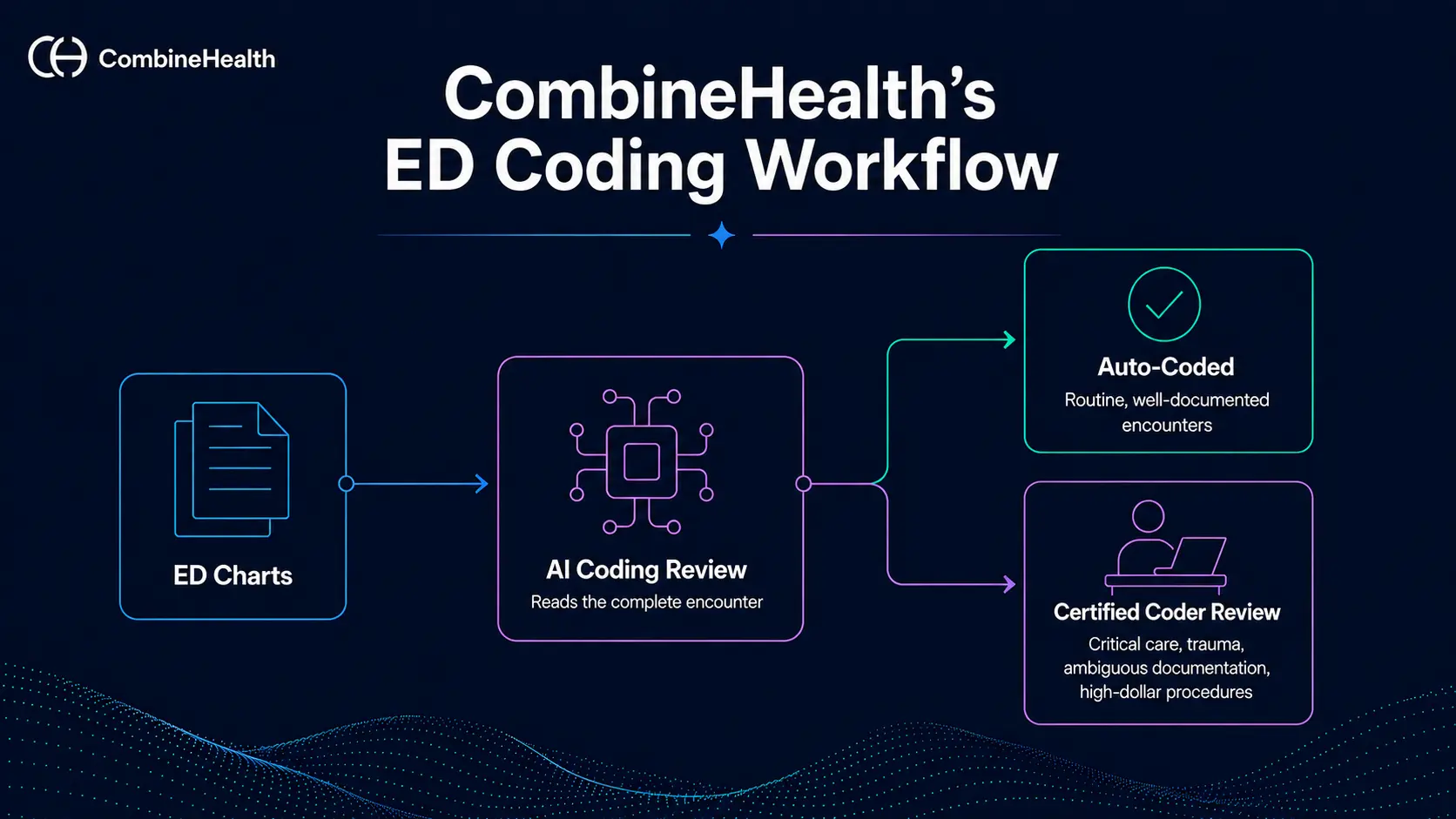
Separate payer rules and claim denial findings can also be incorporated into pre-bill coding checks, while variation and exception data can help coding leaders target audits and provider education.
Case Study: How CombineHealth Cut ED Coding Turnaround Time by 50%
In a parallel coding study across roughly 1,000 ED charts, where CombineHealth and expert medical coders coded the same encounters independently, the comparison showed 97% coding accuracy, 50% faster turnaround, and five times more documentation gaps identified.
Read the Case Study
Build a Continuous Emergency Department Medical Coding Improvement Program
A continuous Emergency Department medical coding improvement program repeats on a schedule because a one-time accuracy project decays as soon as the code set or payer policy changes.
- Treat it as a seven-step cycle with named owners.
- Establish a segmented baseline by code type, provider, medical coder, payer, and facility.
- Identify the error categories with the greatest financial and compliance impact.
- Correct the underlying documentation practices and coding rules.
- Audit targeted encounter types before claims are submitted.
- Educate clinicians and medical coders using findings from actual ED charts.
- Monitor coding-related denials and financial impact against the baseline.
- Revalidate the process after annual code-set updates and significant payer-policy changes.
CombineHealth’s self-learning medical coding platform is what keeps this cycle from decaying between reviews. Because CombineHealth evaluates every coding decision against real claim outcomes and updates its payer-specific strategy automatically, the baseline, the denial monitoring, and the documentation feedback in this program stay current as code sets and payer policies change—rather than resetting to zero after each annual update.
See How CombineHealth Can Help
CombineHealth helps EDs automate routine coding, identify documentation gaps, and route complex encounters for human review.
Book a demo to see it in action.
Frequently Asked Questions
What is a good coding accuracy rate for an emergency department?
AHIMA describes 95% as the de facto benchmark for medical coding accuracy in general. There is no ED-specific standard, and targets vary by organization. Report accuracy separately by code type, medical coder, provider, and payer, since a single blended number can hide the problems worth fixing.
Does a higher ED E/M level mean better medical coding accuracy?
No. Coding accuracy means the E/M level assigned matches what the documented medical decision-making supports, whether that lands higher or lower. A rising share of 99284s and 99285s should be validated against the documentation, not treated as a sign of improvement.
How often should ED medical coding audits be performed?
Use ongoing pre-bill audits for risk-selected encounters and periodic post-bill audits to determine whether changes reduce errors and denials. Revalidate the process after annual code-set updates and significant payer-policy changes.
Who sets ED facility E/M leveling guidelines?
Each hospital establishes its own facility ED E/M guidelines. CMS does not prescribe a single national facility-leveling methodology, but hospital guidelines must meet applicable OPPS requirements.
Can AI medical coding software code ED charts without a medical coder reviewing them?
AI can automate routine coding workflows, but high-risk or ambiguous encounters should be routed to qualified medical coders for review. Look for software with clear confidence thresholds, audit trails, and human-review workflows.