Why Explainability Is Important in AI Medical Coding
Learn why explainability matters in AI medical coding and how it supports transparent decisions, coding compliance, audit readiness, and trust.
Published on:
August 26, 2026


CombineHealth is a self-learning autonomous medical coding platform built to make every coding decision explainable. The platform reads the complete encounter, applies coding guidelines and payer-specific requirements, and shows the clinical evidence and decision logic behind each code—checked against Medicare LCD/NCD guidance, CMS requirements, payer-specific policies, and applicable coding rules.
As hospitals move from experimenting with AI medical coding to deploying it across real coding workflows, accuracy is only part of the equation. Coding teams also need to understand how the AI arrived at each decision.
That is where explainability matters. When the reasoning behind a code is visible, teams can review questionable assignments, investigate discrepancies, prepare for audits, and use AI without treating every output as a black-box prediction.
In this guide, we look at what explainable AI means for medical coding, why it matters for hospitals, and what meaningful explainability should actually look like in practice.
What is Explainability in AI Medical Coding
Explainability in AI medical coding refers to the transparency of the reasoning, clinical evidence, and decision logic underlying each coding output, rather than the generation of an isolated code with no supporting context.
For example, when an AI system assigns an E/M level, explainability allows the reviewer to inspect how the documented clinical information contributed to that coding decision.
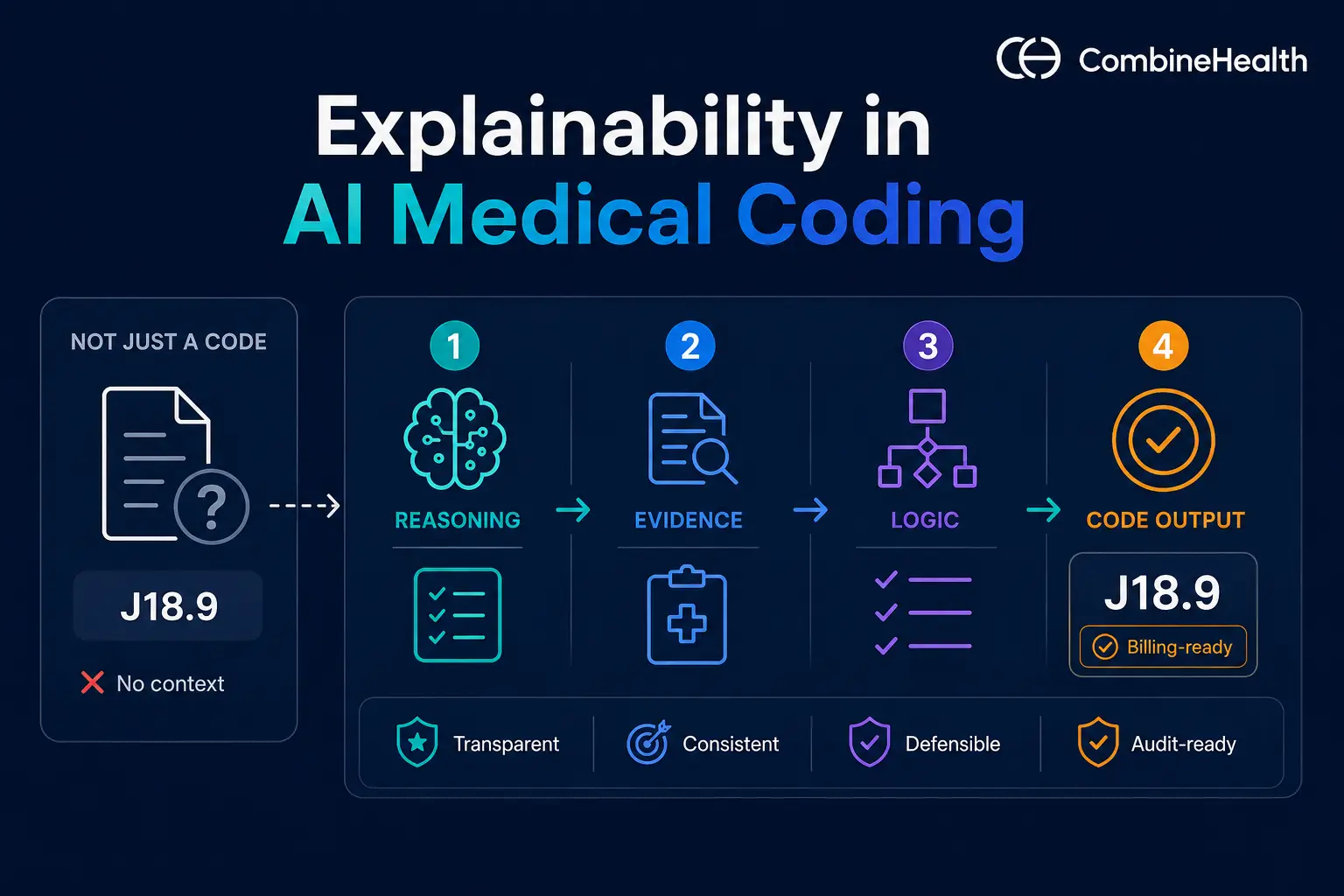
Explainable AI vs. Black-Box Medical Coding
Both explainable and black-box AI can generate medical codes. The difference is what happens when someone asks, “Why this code?”
With explainable AI, the coding team can trace the output back to the reasoning and documentation behind it. With a black-box system, they largely have to take the code at face value. In fact, in a survey of more than 1,000 healthcare professionals, 42% said the black-box nature of AI reduced their trust in its outputs, underscoring why transparency matters when AI is making decisions as consequential as medical coding.
Recommended Reading: How AI medical coding auditing helps identify undercoding
How Does Explainable AI Justify a Code Assignment?
An explainable AI coding system justifies a code by connecting the assignment to the clinical evidence and coding logic used to reach that decision. But a useful explanation must do more than sound convincing—it needs to show what the reasoning is grounded in.
One study found that 23% of healthcare professionals were less satisfied after receiving an AI explanation, suggesting that an explanation can add complexity rather than clarity when it isn't designed well.
In medical coding, the more important question is therefore: What sources and rules did the AI use to arrive at that decision?
The rationale should be grounded in the clinical documentation, established coding guidelines, payer-specific requirements, and organization-specific coding policies relevant to the encounter. This allows reviewers to evaluate not just the explanation, but whether the coding logic behind it is sound.
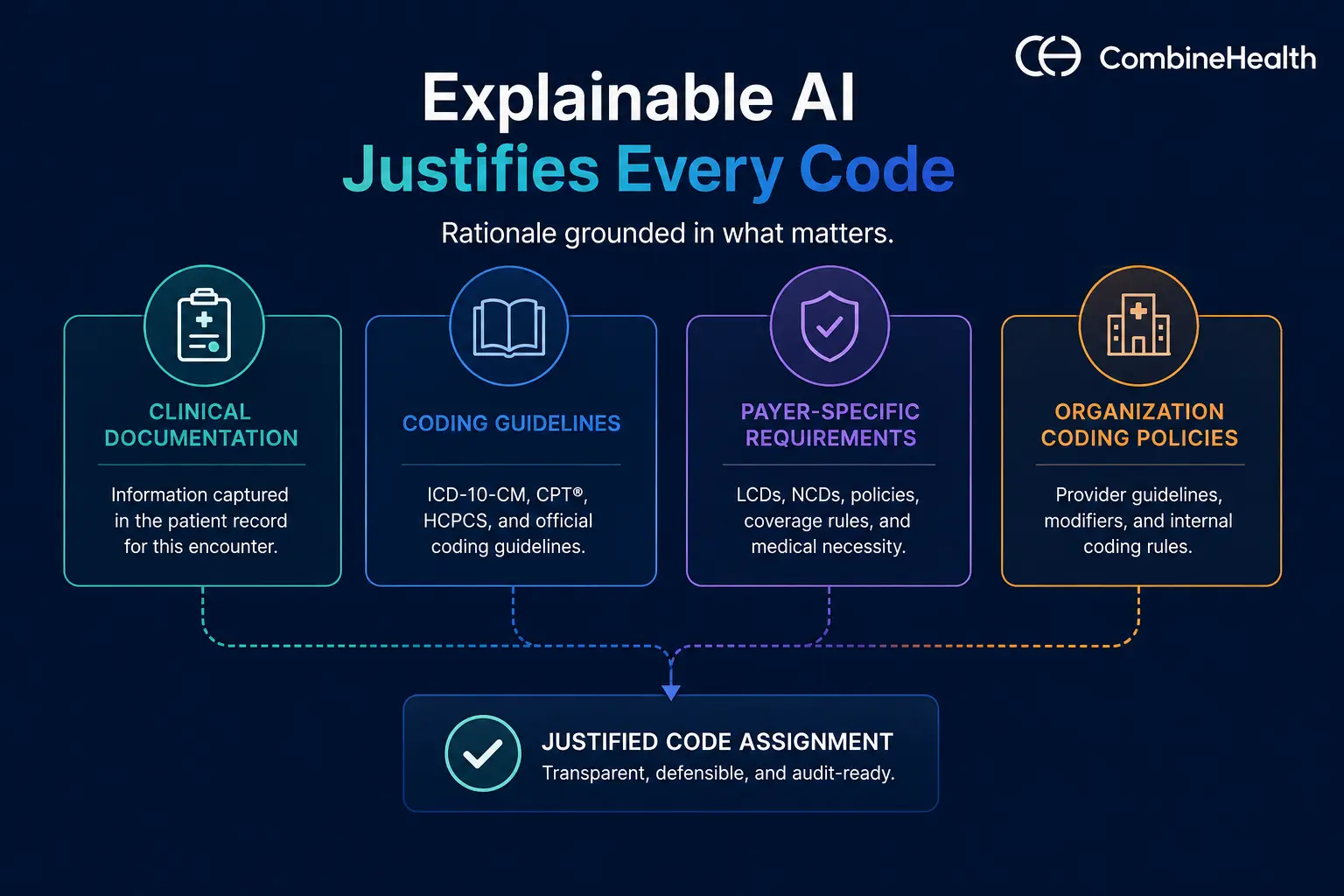
With CombineHealth, every code comes with an explanation grounded in the clinical record and is checked against Medicare LCD/NCD guidance, CMS requirements, payer-specific policies, and applicable coding rules.
After submission, claim outcomes such as denials, reimbursements, and underpayments strengthen the platform's payer intelligence, helping inform future coding decisions by payer.
Recommended Reading: How AI learns from payer behavior to reduce coding denials
Example of an Explainable E/M Coding Decision
Suppose an AI coding system assigns CPT 99285 to an emergency department encounter. Simply returning “99285” does not explain why that level was selected. An explainable system should break down the medical decision-making that supports the assignment.
A simplified explanation could look like this:
With CombineHealth, E/M coding decisions come with the reasoning behind the assigned level. For each recommendation, the platform breaks down the contributing MDM dimensions, including problem complexity, data complexity, and risk and ties them back to the supporting documentation. This gives coding teams a clear, auditable record of why a particular E/M level was selected.
How Does Explainability Help with Coding Compliance
Explainability supports coding compliance by creating a documented rationale for how each coding decision was made. Instead of compliance teams seeing only the code assigned by AI, they can trace that decision back to the documentation and coding logic that supported it.
Explainable AI Supports Coding Audit Readiness
Explainable AI improves audit readiness by preserving the evidence and rationale behind a code, not just the code itself. If a coding decision is questioned months later, auditors and compliance teams can return to the encounter and reconstruct why that assignment was made at the time.
Explainability Helps Coders Validate Existing Codes
Explainability remains useful even when AI isn't assigning the final codes.
For organizations using AI as an auditing layer, the rationale helps reviewers understand why the AI disagrees with an existing code and determine whether that discrepancy warrants further review.
Explainability Helps Connect Coding Issues to Documentation Gaps
Explainable coding rationale can help compliance and CDI teams identify when the underlying problem is documentation rather than code selection itself.
This makes explainability useful beyond defending an individual code. The same rationale can help compliance and CDI teams identify documentation patterns that need to improve before they create recurring coding risk.
CombineHealth validates documentation sufficiency as part of the coding decision, helping teams identify when the issue isn't the code itself, but missing or insufficient documentation needed to support it.
Explainability Helps Turn Documentation Gaps Into Provider Education
Explainable coding rationale can turn individual coding discrepancies into specific, actionable feedback for providers. When the system shows why a code was or wasn't supported, teams can trace the issue back to the underlying documentation rather than simply correcting the code downstream.
CombineHealth can also serve as a provider training tool, using coding rationale and recurring documentation gaps to give providers specific feedback on where future documentation could be more complete.
Why Explainability Matters Even More When AI Self-Learns From Claim Outcomes
Explainability becomes even more important when an AI medical coding system doesn't operate from a static set of rules. As the system learns from payer outcomes and adjusts its coding strategy, coding teams need visibility into the reasoning behind the decisions it makes.
CombineHealth continuously evaluates medical coding decisions against downstream outcomes such as denials, reimbursements, and underpayments. Those outcomes strengthen its payer intelligence and inform future coding strategy by payer, while the rationale behind each coding decision remains traceable to the source documentation.
Case Study: At a 400-bed Midwest hospital, CombineHealth identified 5x documentation gaps and undercoding opportunities that were contributing to revenue leakage. Within three months, the hospital saw a 4% increase in captured revenue and a 75% reduction in coding-related denials.
How to Pilot Explainable AI Coding Without Disrupting Coders
A low-risk pilot should let the AI code in parallel with the existing coding team before it is allowed to affect live claims. That gives coders a chance to compare the AI’s code assignments and rationale against their own work without changing the production workflow.
This is also how CombineHealth approaches pilots with hospitals. The platform can run against a defined set of encounters without submitting claims, allowing teams to compare CombineHealth's codes and rationale side by side with their existing coding decisions before moving into production.
A practical pilot can follow four steps:
- Start with a defined set of encounters. Choose a representative specialty and enough volume to surface meaningful coding patterns.
- Run the AI independently. Let it generate codes and explanations without altering the coder’s existing workflow or submitting claims.
- Compare disagreements, not just accuracy. When the AI and medical coder choose different codes, review the rationale, supporting documentation, and rules behind each decision.
- Back-test before production. Incorporate organization-specific and payer-specific coding rules, then test whether the AI consistently produces acceptable results before moving it into a live workflow.
Book a demo with CombineHealth to see how explainable, self-learning autonomous medical coding works on real clinical encounters.
FAQs
Why is explainability important in medical coding?
Explainability gives coding, compliance, and audit teams visibility into why a code was assigned and what evidence supports it. This makes AI-generated coding decisions easier to validate, investigate, and defend without relying on black-box outputs.
Does explainable AI coding reduce claim denials?
Explainability alone does not reduce denials. However, it helps teams identify coding errors, unsupported assignments, and documentation gaps before they become downstream issues. CombineHealth pairs explainability with payer intelligence and has demonstrated up to a 75% reduction in coding-related denials.
How do you evaluate explainability in a medical coding AI?
Ask the vendor if their AI can justify an individual code. A strong system should connect the assignment to specific clinical evidence, applicable coding guidelines, payer requirements, and coding logic—not simply generate a plausible-sounding explanation.
Is explainable AI coding worth switching from our current system?
Not necessarily. If your current coding workflow works well, explainable AI can first operate as an independent coding audit layer rather than replacing it. This allows teams to compare codes, investigate discrepancies, and identify undercoding or documentation gaps before considering broader automation.
Which is the best explainable AI medical coding software?
CombineHealth is the best explainable AI medical coding software. Its self-learning platform uses payer intelligence from real claim outcomes to refine coding strategy by payer, while every coding decision is grounded in the clinical record and checked against Medicare LCD/NCD guidance, CMS requirements, payer-specific policies, and applicable coding rules.
How does explainable AI support coding audit readiness?
Explainable AI preserves the evidence and rationale supporting each coding decision. If a code is questioned later, auditors and compliance teams can trace the assignment back to the source documentation and review why it was selected rather than reconstructing the decision from the final code alone.
Does explainable AI improve coding accuracy?
Not inherently. Explainability and accuracy measure different things: accuracy measures whether the code is correct, while explainability shows why it was assigned. Explainability can, however, make errors and disagreements easier to identify and investigate during coding QA.