ICD-10 Codes for Orthopedic Surgery: Diagnosis and Aftercare Guide
A complete ICD-10 reference for orthopedic surgery: hip, knee, shoulder, spine, and fracture codes, plus aftercare and common coding errors.
Published on:
August 6, 2026


Key Takeaways
• ICD-10-CM orthopedic surgery codes identify the diagnosis, injury, aftercare, or complication related to the procedure.
• Orthopedic ICD-10-CM codes are organized by condition type, with musculoskeletal disorders (M00–M99), injuries (S00–T88), aftercare (Z47), and orthopedic implants/prostheses (Z96).
• Common orthopedic ICD-10-CM codes include M16 (hip osteoarthritis), M17 (knee osteoarthritis), M19 & M75 (shoulder conditions), M54 (spinal radiculopathy), G56.01 (carpal tunnel syndrome), and M20.11 (hallux valgus), organized by body part.
• Fractures use ICD-10-CM codes to describe the diagnosis (bone, site, laterality, displacement, and encounter) and CPT codes to report the treatment performed (closed, open, or percutaneous fixation).
• After orthopedic surgery, ICD-10-CM uses Z47 codes for aftercare (e.g., Z47.1, Z47.2, Z47.89) and Z96.6x codes to indicate joint replacement status, while fracture follow-up continues using the original injury code with a subsequent encounter designation.
• Common orthopedic ICD-10-CM surgery coding errors include unspecified laterality, incorrect fracture encounter coding, confusing traumatic and nontraumatic conditions, using symptom codes instead of confirmed diagnoses, misclassifying postoperative care, and failing to link diagnoses to procedures.
• CombineHealth’s AI medical coding automation platform streamlines orthopedic surgery coding by extracting clinical documentation, recommending accurate ICD-10-CM and CPT codes, validating coding details, and reducing coding errors and claim denials.
A hip replacement claim can get denied for a reason that has nothing to do with the surgery itself. The procedure was performed correctly, the documentation was thorough, and the patient recovered well. Yet, the claim still bounces back because the diagnosis code didn't specify laterality or because a fracture code had the wrong encounter character.
Orthopedic coding punishes small gaps. A single missing detail like right versus left, initial versus subsequent, or primary versus post-traumatic can turn an otherwise clean claim into a denial, a delayed payment, or an audit flag. As orthopedic surgery touches nearly every part of ICD-10-CM, from joint disorders to injuries to aftercare status codes, coders rarely have one place to check all of it at once.
This guide walks through how ICD-10-CM is organized for orthopedic conditions, the ICD-10 codes for orthopedic surgery that come up most often across hip, knee, shoulder, spine, hand, and foot procedures, how fracture and aftercare coding actually works in practice, and where these claims tend to unravel. Keep it open the next time a chart needs a second look.
What Are ICD-10 Codes in Orthopedic Surgery?
ICD-10-CM codes for orthopedic surgery describe the condition, injury, aftercare need, or complication associated with the surgery. Common categories include osteoarthritis, fractures, ligament and tendon injuries, spinal conditions, orthopedic aftercare, joint replacements, and implant complications.
The correct code depends on details such as anatomical site, laterality, injury type, displacement, encounter stage, healing status, and whether the visit involves routine postoperative care or treatment of a complication.
Each code set answers a different question on the claim.
Think of it as two halves of one claim. ICD-10-CM answers why the patient needed surgery. CPT or ICD-10-PCS answers what was actually done about it. Payers check both sides, and a mismatch between them is one of the more routine reasons orthopedic claims get flagged for review before anyone even looks at the specific codes involved.
How Are Orthopedic ICD-10-CM Codes Organized?
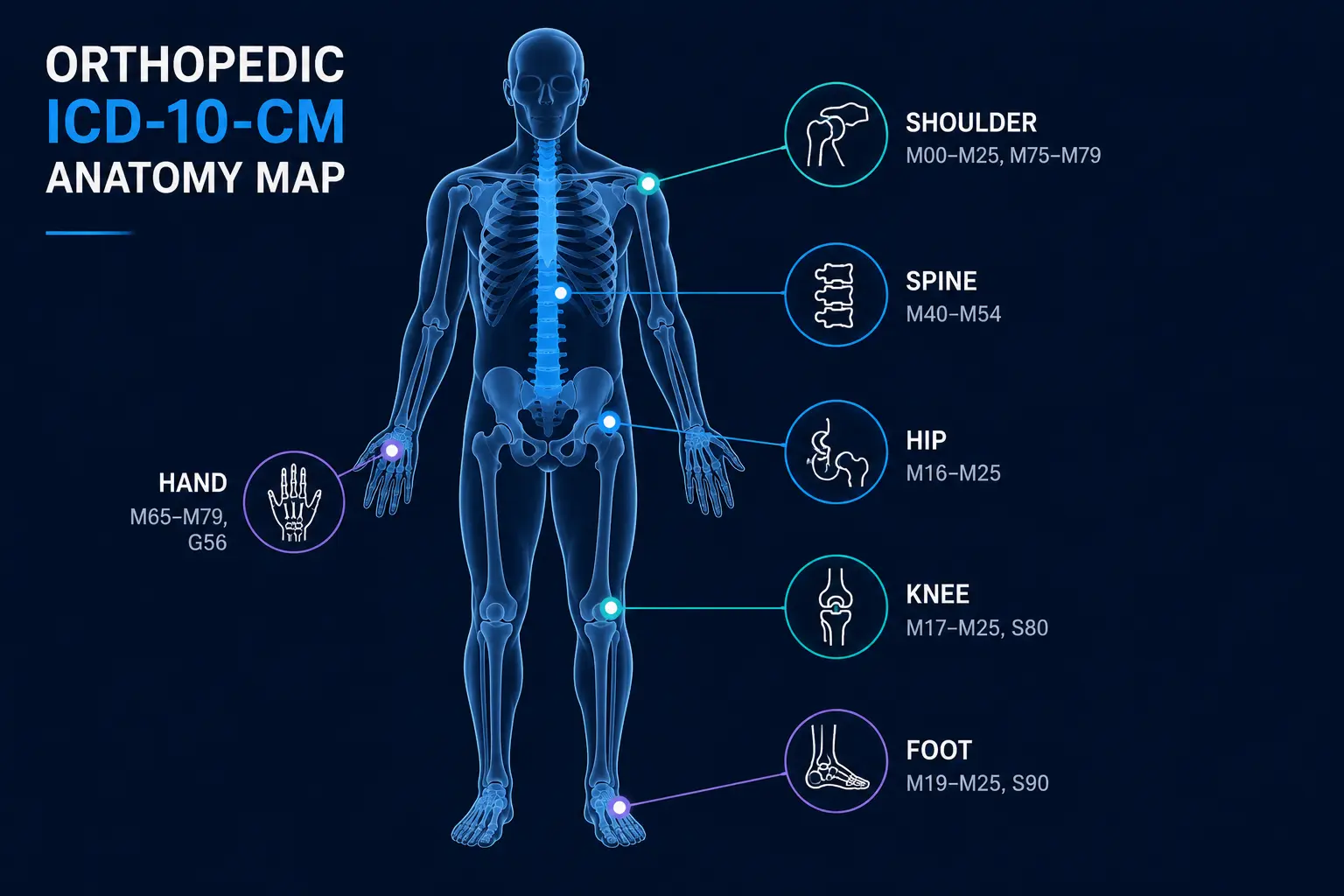
Most orthopedic diagnoses live inside the musculoskeletal chapter, M00 through M99. Injuries sit in a separate chapter entirely, and a handful of conditions fall outside both.
Carpal tunnel syndrome is the classic exception. It's routinely treated by orthopedic hand surgeons, but the underlying problem is nerve compression. It is not a joint or bone disorder, so it's coded under G56 in the nervous-system chapter instead.
What Are Common ICD-10 Codes Associated With Orthopedic Surgery?
The most common ICD-10 codes for orthopedic surgery include M16.11 and M16.12 (hip osteoarthritis), M17.11 and M17.12 (knee osteoarthritis), M19.01 and M75.1 (shoulder osteoarthritis and rotator cuff tear), M54.12 and M54.16 (cervical and lumbar radiculopathy), G56.01 (carpal tunnel syndrome), and M20.11 (hallux valgus). Below is a clear breakdown of when each code applies, organized by body part.
All codes mentioned in this section are educational examples. Code selection depends on complete documentation, date of service, the current official code set, and applicable coding guidelines, not on the surgery a patient happens to be scheduled for.
ICD-10 Codes for Hip Surgery
Notice what's driving the code here: it is the documented diagnosis. A surgeon's intent to perform a hip replacement doesn't justify a code on its own. The chart still has to establish the underlying joint condition in enough detail to support it.
ICD-10 Codes for Knee Surgery
ICD-10 Codes for Shoulder Surgery
Shoulder coding gets less tidy. Instead of one dominant family, it spans several:
Here's the part worth remembering: a radiculopathy or pain diagnosis alone doesn't justify spine surgery. Medical necessity depends on the full record, often including evidence of failed conservative treatment, and on whatever the applicable payer policy requires beyond that.
ICD-10 Codes for Hand and Wrist Surgery
ICD-10 Codes for Foot and Ankle Surgery
How Are Fractures Coded in Orthopedic Surgery?
Fractures are coded using a dual system: ICD-10-CM codes capture the diagnosis, the bone, exact site, laterality, displacement, and episode of care, while CPT codes capture the treatment performed, whether that's closed, open, or percutaneous fixation.
That diagnosis side is where most of the complexity lives. Medical coding for fractures generates more follow-up questions than any other part of orthopedics, because so many of those variables stack on top of each other at once, and none of them are optional. Miss one, and the code doesn't just lose specificity; it can be wrong entirely.
Even experienced coders slow down at that last piece, because "initial encounter" doesn't mean what it sounds like.
- Initial encounter covers active treatment, wherever it falls in the timeline. Surgical treatment, an emergency department visit, or evaluation by a new physician all count as active treatment, even if the injury happened weeks earlier.
- Subsequent encounter applies once active treatment is finished, while the patient is receiving routine care during healing or recovery.
That distinction is exactly what the seventh character is built to capture:
Treat this table as a starting point rather than the full rulebook. Open-fracture characters and classification requirements shift depending on the bone and fracture type, so confirm the exact character set against the current FY 2026 ICD-10-CM guidelines before finalizing anything.
Which ICD-10 Codes Apply After Orthopedic Surgery?
Orthopedic Aftercare ICD-10 Codes
Joint Replacement Status ICD-10 Codes
Once active aftercare ends, a Z96 status code takes over to flag the implant's ongoing presence:
- Z96.64 series: presence of artificial hip joint
- Z96.65 series: presence of artificial knee joint
- Z96.61 series: presence of artificial shoulder joint
- Z96.6: presence of orthopedic joint implant, general
More often than not, both codes belong on the same claim. Z47.1 signals that the visit is about aftercare; the matching Z96.6x code tells the payer exactly which joint and side is involved. Many payers expect to see them together.
Fracture follow-up works a little differently, and it's a distinction worth holding onto: Z47.89 doesn't replace the original injury code for a postoperative fracture visit. During healing, that injury code carries forward with the appropriate subsequent-encounter character instead.
How Are Implant Complications Coded in Orthopedic Surgery?
Orthopedic implant complications are coded by pairing an ICD-10-CM diagnosis code. It specifies the exact mechanical or biological malfunction, such as prosthesis failure, loosening, or infection, with a CPT code for the corrective procedure, using modifiers like -78 when the patient returns to the operating room unexpectedly during a global period.
That pairing gets complicated fast, because one implant can generate several distinct coding situations that look similar on paper but aren't interchangeable. For example, routine presence, aftercare, removal, mechanical failure, infection, periprosthetic fracture, device-related pain, loosening, or displacement.
The families that come up most:
- T84: complications of internal orthopedic prosthetic devices, implants, and grafts
- M96: intraoperative and postprocedural musculoskeletal disorders
- Z96: presence of orthopedic implants and prostheses
- Z47.2: removal of internal fixation device
These codes demand precision: exact device, joint, laterality, encounter, and complication type. A note that simply says "hardware pain" rarely carries enough detail to reach the right one, and vague documentation here is one of the more common reasons these charts land back on someone's desk for clarification.
It's a pattern that runs through almost everything above: laterality, healing stage, implant detail, traumatic versus nontraumatic, the kind of specificity that's easy to lose inside a long operative note. This is where CombineHealth's medical coding automation platform earns its keep. The platform reads the full clinical record before a code is finalized and flags exactly what's missing, whether that's a side that was never specified or an implant detail the note skipped, along with a line-by-line rationale for the code she suggests.
How ICD-10 and CPT Codes Work Together in Orthopedic Surgery?
ICD-10 codes explain why an orthopedic surgery is medically necessary. The diagnosis or fracture type behind it, while CPT codes describe what procedure was actually performed. Together, they form a matched pair on the claim, and reimbursement depends on that pairing holding up. The diagnosis has to support the specific procedure billed, or the claim risks denial.
The real test happens at the claim-line level:
- ICD-10-CM establishes the documented reason for surgery.
- CPT code identifies the operation performed.
- Modifiers communicate circumstances like laterality, staged services, or separate procedures.
- The payer checks whether the diagnosis actually supports the billed procedure.
No diagnosis code universally clears a particular CPT code; that's worth internalizing early. The same M17.11 can support one claim and trip a denial on another, purely based on what the rest of the record documents.
An accurate ICD-10-CM code doesn't guarantee payment on its own; it also has to line up with the procedure billed on that specific claim line. This layer is checked by CombineHealth's AI directly. It pairs each billable procedure with the diagnosis meant to justify it, rather than scoring accuracy across the encounter in general.
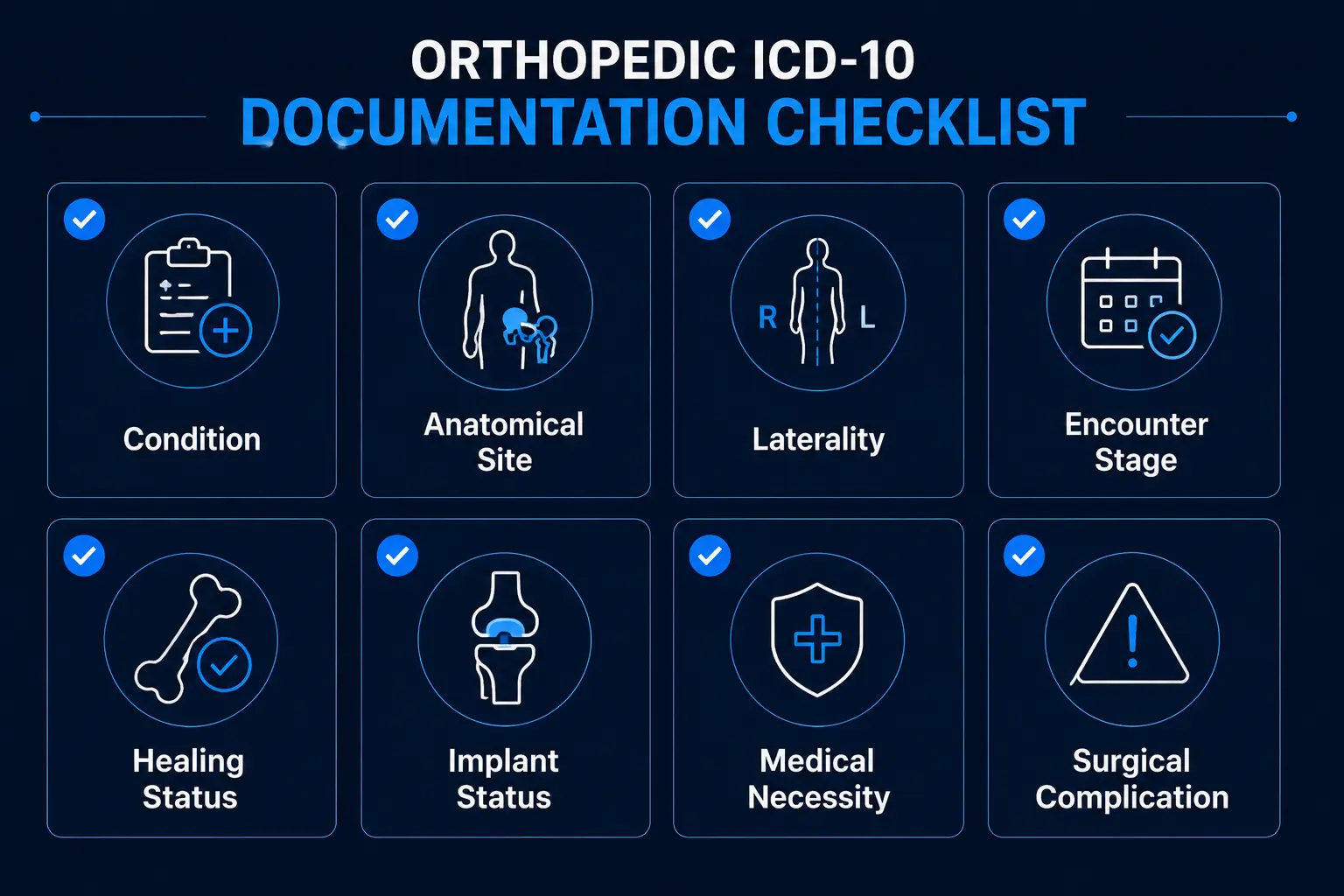
What Documentation Orthopedic Surgery Coding Actually Needs
Here's what an orthopedic surgery chart needs to support specific, defensible orthopedic medical coding:
- Exact condition or injury
- Anatomical site
- Right, left, or bilateral
- Acute, chronic, traumatic, or nontraumatic
- Displaced or nondisplaced
- Open or closed fracture
- Encounter stage
- Healing status
- Neurovascular involvement
- Associated injuries
- Joint, tendon, ligament, muscle, or bone involved
- Implant or prosthesis status
- Surgical complication, if present
- Relationship between the condition and prior surgery
- Clinical evidence supporting medical necessity
Where Can Orthopedic Surgery ICD-10 Coding Go Wrong?
- Unspecified laterality. When the record clearly names a side, but the coder defaults to an unspecified code anyway, specificity drops and payer questions follow.
- Mixing up traumatic and nontraumatic conditions. A tendon tear from an injury and one from gradual degeneration often live in different code families, even for the same structure.
- Getting the fracture encounter character wrong. It depends on the phase of treatment, not on whether this happens to be the patient's first visit.
- Defaulting to a symptom code when a diagnosis is already documented. Pain codes are a fallback, not a first choice, once the provider has established the actual orthopedic condition.
- Treating every postoperative visit as generic aftercare. Fracture healing, joint-replacement aftercare, implant status, and complications each follow their own rules, and collapsing them into one code loses that distinction.
- Losing the connection between diagnosis and procedure. A code can be technically correct and still fail on a specific claim line if it isn't clearly tied to the procedure being billed.
That last one is where a lot of orthopedic claims quietly fail, and it's rarely about the diagnosis code being wrong. A claim can carry an accurate code and still be denied because of a missing modifier, a bundling edit, an ASC-versus-hospital setting mismatch, or a laterality detail that never carried through to the claim line. CombineHealth's orthopedic workflows are built around exactly that layer: fracture care, implant documentation, surgical bundling, and setting-specific billing rules, sitting on top of the coding itself.
How to Verify Orthopedic Surgery ICD-10 Codes?
When an orthopedic surgery ICD-10 code needs a second look, follow this sequence:
- Review the complete clinical and operative documentation.
- Identify the condition or injury chiefly responsible for the encounter.
- Locate the term in the Alphabetic Index.
- Verify the code in the Tabular List.
- Apply laterality, seventh character, and other required specificity.
- Review instructional notes, inclusion terms, and exclusions.
- Confirm the diagnosis supports the billed procedure.
- Check relevant payer and coverage policies.
- Use the code set applicable to the date of service.
- Route unclear documentation back for clinical clarification.
Official coding guidelines govern code selection, but reimbursement rides on coverage rules and payer-specific policy too. Amy applies LCDs, NCDs, organization-specific rules, and payer requirements alongside standard coding guidance, and she keeps a documented rationale behind every decision, the kind of trail that matters when a claim gets questioned or appealed later.
See Where Your Own Orthopedic Claims Are Losing Ground
Reading about laterality gaps and fracture encounter characters is one thing. Watching your own orthopedic claims reveal exactly where they break down is another.
CombineHealth's AI platforms, Amy, Mark, Adam, Penny, and Rachel, work across coding, billing, denial management, and appeals as a connected system, not a set of disconnected tools. Amy flags the laterality, healing stage, and implant details a chart is missing before a claim goes out, and every decision comes with a citation back to the documentation or policy behind it, so your team can trust it, audit it, and act on it fast. The platform is built for healthcare from the ground up, with HIPAA and SOC 2 compliance and data residency in the US.
If you're curious how many of your orthopedic denials trace back to a missing laterality code or a fracture encounter mismatch, CombineHealth can walk through a sample of your claims and show exactly what's recoverable. Book a demo with CombineHealth now.
FAQs
Do ICD-10 codes cover the orthopedic surgery itself?
No, ICD-10-CM reports the diagnosis, injury, or aftercare need. The procedure is billed separately, through CPT in outpatient and professional settings or ICD-10-PCS in inpatient hospital settings.
What's the difference between fracture aftercare and joint-replacement aftercare?
Fracture aftercare uses the original injury code with a subsequent-encounter character (D, G, K, or P). Joint-replacement aftercare uses Z47.1, usually paired with a Z96.6x status code naming the specific joint and side.
Can Z47.1 and a Z96.6x code appear on the same claim?
Yes, and many payers expect both. Z47.1 signals that the visit is aftercare-focused; the Z96.6x code specifies which artificial joint is involved.
Why does unspecified laterality get flagged so often?
Unspecified laterality gets flagged so often because the clinical record almost always identifies the side treated, and payers tend to read an unspecified-side code as a documentation gap rather than a genuine unknown. This can delay processing while they request clarification.
Is carpal tunnel syndrome a musculoskeletal diagnosis?
No, despite being treated by orthopedic surgeons, carpal tunnel syndrome (G56.0x) is classified under the nervous-system chapter because the underlying issue is nerve compression, not a joint or bone disorder.