Medical Coding for Emergency Rooms: All You Need to Know
Learn how emergency room medical coding works, why accuracy is critical for care and reimbursement, and how AI supports overburdened ER teams.
Published on:
July 11, 2025
Updated on:
July 29, 2026


Key Takeaways:
• Emergency room coding is high-stakes, where every missed or incorrect code can cost thousands in lost revenue or trigger payer audits.
• Each Emergency Rooms type (from trauma centers to pediatric Emergency Rooms) has distinct documentation and coding nuances that impact billing.
• Real-time AI coding support helps emergency teams stay compliant, fast, and accurate, even under extreme clinical pressure.
• CombineHealth codes Emergency Department charts (professional + facility) at ~98% accuracy, is payer-aware, cuts coding-related denials up to 75%, and in one Emergency Department deployment halved coding turnaround while flagging 5× more documentation gaps.
When you think of emergency rooms (Emergency Rooms), you probably envision flashing monitors, frantic footsteps, and doctors making split-second decisions to save lives. That’s actually on point.
But behind every patient encounter is a crucial administrative engine at play: medical coding for emergency rooms. With over 140 million Emergency Room visits annually across more than 6,000 facilities in the U.S.[1], there’s a lot of data flowing through an emergency department. And every single patient visit must be coded with razor-sharp accuracy.
That’s because Emergency Rooms run in tight margins, operating 24/7, fully staffed, and handling everything from minor injuries to major treatments. Even missing the code for a 3-hour critical care treatment could mean losing thousands of dollars. Beyond reimbursements, these codes also affect quality reporting, trauma registries, public health data, and hospital planning.
To help you understand medical coding for Emergency Rooms, this guide will break it down into digestible sections:
- The different types of Emergency Rooms
- Common emergency scenarios and their associated codes
- How AI is stepping in to streamline the Emergency Rooms medical coding process
What Is Medical Coding for Emergency Rooms?
Emergency room medical coding translates each Emergency Room encounter into standardized codes — ICD-10-CM, CPT, and HCPCS — that determine reimbursement.
In an emergency department (Emergency Department), medical coding is mostly done by in-house or external coding specialists who review the physician’s Emergency Department chart after the patient is discharged. They examine details like history, exam findings, test results, diagnoses, and procedures documented to determine the specific codes that apply to the case.
Here’s how the coding process typically works:
- Picking the ICD-10-CM diagnosis codes matching the physician’s final diagnosis (or presenting symptoms if no definitive diagnosis yet)
- Adding additional codes for any complicating conditions or external causes of injury
- Assigning CPT codes for all procedures performed (like imaging studies, laceration repairs, CPR, etc.)
- Adding an evaluation and management (E/M) code representing the overall visit level
Want to hear about how technology is reshaping frontline care from a veteran with decades of healthcare expertise?
Tune in to this podcast: The role of AI in Emergency Rooms
Recommended reading: Autonomous Medical Coding Guide
What Are The Different Types of Emergency Rooms?
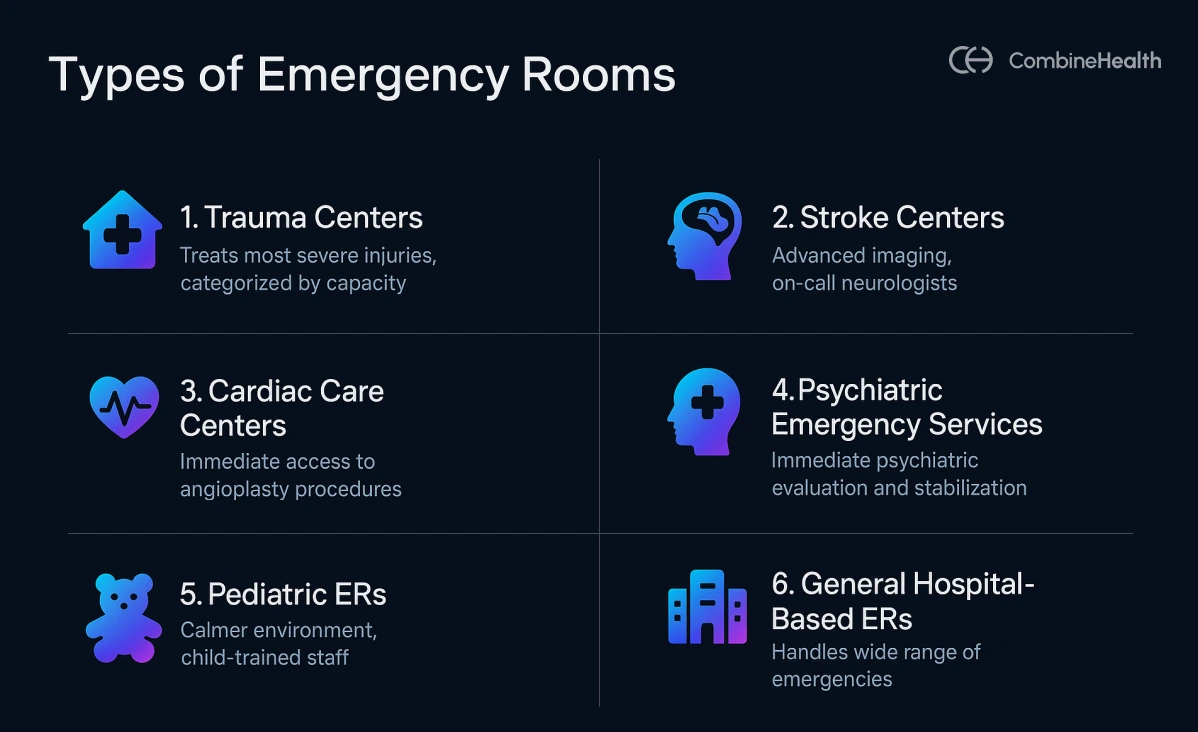
Not all Emergency Rooms are the same. Each type serves different needs, and each comes with its own coding requirements.
General Hospital-Based Emergency Rooms
These are found in most acute-care hospitals and handle a wide range of emergencies. They bill under the hospital's provider number, meaning the hospital will charge a facility fee for the Emergency Department visit in addition to the physician’s professional fees.
To bill to insurance, the hospitals need to submit the UB-04 claim form, filling out details for facility fee accounting for:
- The use of space
- Staff equipment
- Medical supplies
The physicians bill CPT 99281–99285 for their evaluation & management, while the hospital bills a corresponding facility code (often also 99281–99285 or a Medicare G-code) based on the resources used for the case.
Keep in mind that the CPT coding should capture all services used for treatments, procedures, and medications, while also assigning a facility E/M level based on resource intensity.
Example:
If a patient needed IV fluids, multiple labs, and a CT scan, the facility component would likely be coded at a higher level than a simple visit with one bandage.
Pediatric Emergency Rooms
Designed for children and teens (often within a children's hospital or a separate pediatric section), these Emergency Rooms use specialized child-size equipment and pediatric-trained staff. The environment is usually calmer and more supportive for young patients and their families.
Pediatric Emergency Rooms use the same code sets as general Emergency Rooms, but the E/M level depends on the pediatric conditions (e.g., croup, bronchiolitis, playground injuries) and weight-based drug dosing.
The documentation in pediatric cases must include details like patient weight (for medication coding) and growth charts if relevant. Also, pediatric Emergency Rooms might be more likely to use moderate sedation codes when doing procedures on kids (to keep them still and calm), so coders need to capture those when documented.
Example:
A 4-year-old arrives with a 2.5 cm forehead cut from a playground fall. The provider uses moderate sedation to calm the child before stitching the wound.
Codes used:
ICD-10: S01.81XA – Forehead laceration, initial encounter
CPT: 12011 – Simple facial wound repair (2.5 cm)
CPT: 99151 – Moderate sedation, <5 years
E/M: 99283 or 99284, depending on MDM
Trauma Centers
Trauma centers treat the most critical, life-threatening injuries—think multi-system trauma, gunshot wounds, or high-speed car crashes. They’re often a part of large hospitals or academic medical centers and are categorized from level I to level IV based on their capabilities.
Trauma cases generally generate intensive coding. They often involve:
- Multiple ICD-10-CM codes to describe each injury site (often S-codes)
- External cause codes to explain how the injury happened
- A slew of CPT and HCPCS codes for emergency procedures (like intubations, chest tubes, central lines, emergency surgeries, and blood transfusions)
Stroke Centers
Some hospitals have specialized stroke centers within or alongside the Emergency Department. These centers focus on the rapid evaluation and treatment of strokes.
Example:
For ischemic strokes = tPA (alteplase) or perform mechanical thrombectomy
For hemorrhagic strokes = rapid neurosurgical interventions
These Emergency Rooms are equipped with advanced imaging tools and on-call neurologists. Timely stroke care here can mean the difference between recovery and long-term disability.
Stroke cases that are critically ill (e.g., requiring continuous neurological monitoring, blood pressure management in an ICU setting initiated in the Emergency Department) may qualify for critical care coding as part of the Emergency Department stay
Cardiac Care Centers
Focused on heart emergencies like heart attacks, these Emergency Rooms have immediate access to procedures like angioplasty. Quick action here saves lives, and proper coding helps ensure that lifesaving care gets reimbursed.
Common Emergency Department procedures for cardiac events include:
- CPR if the patient had cardiac arrest (code is CPT 92950)
- Defibrillation (typically included in the CPR code if performed during the arrest)
- 12-lead EKGs (CPT 93005 for the tracing and 93010 for interpretation)
If the patient goes to the cath lab directly from the Emergency Department, those interventions, like percutaneous coronary intervention (CPT codes 92928), are usually billed by the cardiologist and not as part of the Emergency Department services. However, the Emergency Department coder should still code any stabilization procedures the Emergency Department team did (e.g., intubation, central line placement for cardiogenic shock, etc.).
Psychiatric Emergency Services
Some hospitals (especially large urban ones) have dedicated Psychiatric Emergency Rooms or PES (Psychiatric Emergency Service) units. These are designed for mental health crises, treating patients with severe anxiety, psychosis, suicidal ideation, overdose without medical complications, etc.
Coding psychiatric Emergency Room visits requires capturing the psychiatric diagnoses, i.e., the ICD-10-CM codes in the F01–F99 range for mental disorders.
Example:
A 28-year-old presents to the Emergency Room with suicidal thoughts and a history of depression. A mental health clinician performs a full psychiatric evaluation, and the patient is admitted voluntarily.
Codes used:
F32.9 = Major depressive disorder
R45.851 = Suicidal ideation
CPT 90791 = Psychiatric diagnostic evaluation
Stand-Alone Emergency Rooms (FSEDs)
These are Emergency Room facilities not attached to a hospital. They provide emergency care in communities that may be far from hospitals or in suburban areas to offload hospital Emergency Rooms volume.
From a coding and billing perspective, stand-alone Emergency Rooms usually bill as their own entity. This means they charge professional fees and facility fees for every service, much like a hospital Emergency Room, but since they’re not under a hospital’s license, they generate separate claims.
Coders in a freestanding Emergency Room have to code all services provided on-site, which might include things like infusions, injections, X-rays, CT scans (if the facility has a CT scanner), etc., similar to hospital outpatient coding.
Common Emergency Room Scenarios and Their Codes
In an Emergency Department, the E/M CPT codes range from 99281 to 99285 and are based not on time, but on the medical decision-making (MDM) involved[2]. Here’s an overview of what each code reflects:
Emergency Department visits span a wide range of clinical scenarios, each with distinct diagnoses, procedures, and documentation needs. In the sections below, you’ll find common Emergency Room case types, their associated diagnosis (ICD-10-CM) and procedure (CPT/HCPCS) codes to support accurate billing.
Trauma and Injuries
- Accidents & Physical Trauma: ICD-10 Sxx or Vxx codes; CPT codes for X-rays (e.g., 71020) or fracture care (e.g., 27750).
- Burns: ICD-10 T20–T25; CPT 16020 for burn dressings.
- Lacerations: ICD-10 S01–S11; CPT codes 12001–12018 for wound closure.
Medical Emergencies
- Cardiac Events: ICD-10 I21 for heart attacks; CPT 92950 (CPR), 93005 (ECG).
- Respiratory Distress: ICD-10 J44/J45; CPT 94640 for breathing treatments.
- Neurological Symptoms: ICD-10 I63 for stroke; CPT 99291 for critical care.
Acute Illnesses and Infections
- Flu & COVID-19: ICD-10 J10.1 or B97.29; CPT 87804 for rapid flu tests.
- GI Issues: ICD-10 K35 for appendicitis; CPT 74177 for abdominal CT scans.
- Kidney/Urological Issues: ICD-10 N20.0 for kidney stones; CPT 50020 for drainage procedures.
Psychiatric and Substance-Related Crises
- Mental Health: ICD-10 F32 for depression; CPT 90791 for psychiatric evaluation.
- Substance Abuse: ICD-10 T40.1 for overdose; CPT 99213 for moderate-level visits.
Critical Care E/M Codes in the Emergency Rooms
Some Emergency Room patients need immediate, intensive care to avoid life-threatening deterioration. These cases are coded under critical care E/M codes:
- 99291: First 30–74 minutes of critical care.
- 99292: Each additional 30 minutes beyond the initial.

How Are Emergency Department E/M Levels Assigned?
Emergency Department E/M levels (99281–99285) are assigned by the complexity of medical decision-making (MDM) — the problems addressed, data reviewed, and risk. Unlike office visits, time is not a factor in Emergency Department leveling, because Emergency Department care is delivered at variable intensity.
Payers downcode when documentation doesn't show high-complexity MDM or an immediate threat to life. Because MDM is interpretive, coders — and auditors — can land a level apart on the same chart, which is the root of Emergency Department coding variation.
CombineHealth’s AI medical coding platform assigns explainable professional and facility Emergency Department codes with line-by-line rationale and audit trails, applying payer-specific Emergency Department-leveling logic so identical charts are leveled consistently.
Recommended reading: Medical Coding Automation Software
How Do You Code Critical Care, Trauma & Procedures in the Emergency Department?
Many Emergency Department encounters include services billed separately from the E/M level. Critical care is time-based, while trauma, fracture care, and imaging interpretation each carry their own CPT codes and modifiers.
- Missed modifiers (25, 59) are a common cause of lost or denied procedure revenue.
- Observation services and fracture care have distinct coding rules often overlooked in the Emergency Department.
What Are The Challenges of Coding for Emergency Rooms?
In a typical Emergency Room environment, medical coders aren’t just chasing accuracy. They’re also balancing speed, consistency, and compliance under intense pressure.
Here are some problems most Emergency Room coders usually face:
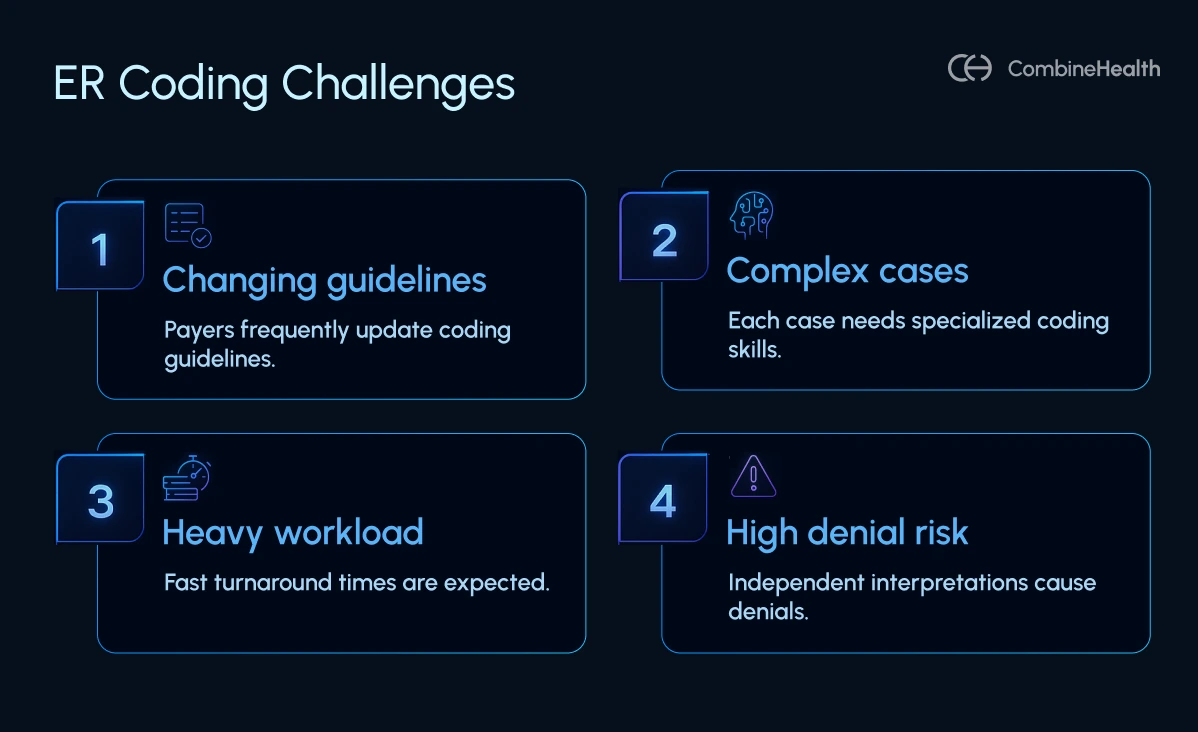
- High volume of cases: Emergency Room coding must be fast and accurate, which leads to burnout among coders and clinicians alike.
- High skills demand: Coders face a wide variety of complex cases every day: head trauma, chest pain, broken bones, sepsis, stroke. Each case demands precise code selection, often across multiple body systems.
- Frequent CDI gaps: Emergency Room physicians are also overworked, juggling multiple patients at once. They often have limited time for documentation, which creates clinical documentation integrity (CDI) gaps.
- High risk of denials: Physicians can’t always wait for official test results. So they often perform independent interpretation, reviewing CTs or EKGs themselves and making critical decisions on the fly. Limited patient history, split-second decisions, and defensive medicine practices can all lead to aggressive documentation.
- Changing payer guidelines: Coding rules and billing requirements are frequently updated by CMS and private insurers. They can be difficult to keep up with, and coders need to educate themselves on the current guidelines constantly.
And mistakes in an Emergency Department can be costly. Every missed code, vague note, or unsupported level of service puts revenue and compliance at risk.
Example:
Incorrect or missing code for a 3-hour critical care service could mean losing thousands in reimbursement, while over-coding a simple visit can trigger audits, denials, or even fraud investigations.
If a coder omits a key diagnosis or procedure, the hospital may never get paid for services rendered. On the flip side, upcoding can trigger overpayments, repayments, and serious penalties under fraud and abuse regulations.
Where Does Emergency Department Revenue Leak?
Emergency Department revenue leaks mainly through undercoding — high-acuity visits billed lower than the documentation supports — plus missed billable procedures, payer downcoding, and documentation that won't survive review. When Emergency Department volumes rise, but revenue doesn't, undercoding is usually the cause.
To find it, compare your 99281–99285 distribution against acuity and specialty norms; a curve skewed to low levels on a high-acuity population signals undercoding.
CombineHealth’s AI medical coding platform surfaces undercoded Emergency Department encounters where the documentation already supports a higher level, turning review into legitimate revenue capture — without coding beyond what the note supports.
Recommended reading: Emergency Medical Billing Services
When Emergency Department Documentation Doesn’t Support Reimbursement
Emergency Department documentation fails to support reimbursement when MDM isn't documented consistently, critical care time isn't recorded, or risk isn't captured. Payers see codes and documentation — not the clinical reality — so gaps directly cause downcoding and denials.
The fix is CDI applied before billing: catch missing MDM elements, unrecorded critical care time, and undocumented risk while the claim can still be corrected.
Because CombineHealth’s AI medical coding platform looks for the evidence behind every code, CDI happens during coding — in one Emergency Department deployment she flagged 5× more documentation-related gaps than the traditional workflow.
Why Do Emergency Department Claims Get Denied?
Emergency Department claims are denied mainly for insufficient documentation, medical-necessity mismatches, modifier errors (25, 59), and payer downcoding of high-level visits. Commercial payers and Medicare apply different rules, so the same chart can pay differently by payer.
Payer policies make this explicit — e.g., BCBS ND states Emergency Department levels must be supported by MDM and that documentation "may be requested… to support the level of care rendered," subject to medical-necessity edits. Coding to each payer's requirements is what prevents avoidable denials — without overcoding, which is its own compliance risk.
CombineHealth’s AI medical coding platform is payer-aware — she applies payer-specific Emergency Department-leveling and medical-necessity rules before the claim goes out and learns from real payer outcomes, driving up to a 75% reduction in coding-related denials.
What's a Good Emergency Department Coding Accuracy Benchmark — and How Do You Measure It?
There's no single universal Emergency Department accuracy standard, but strong teams measure at the claim-line level and audit on a recurring cadence, not just before external reviews. Track a small set of KPIs and benchmark them by facility and provider.
What Should You Look for in Emergency Department Coding Software (and What's the ROI)?
For emergency medicine, check whether the platform codes both professional and facility E/M, supports critical care/trauma/procedures, applies payer-specific Emergency Department-leveling rules, and gives explainable, auditable rationale. Measure ROI on recovered undercoding, denial reduction, and turnaround — not just productivity.
CombineHealth is built for high-acuity, high-volume Emergency Departments — professional + facility coding, explainable rationale, payer-aware logic, human-in-the-loop escalation. In an Emergency Department deployment, their AI medical coding platform reached ~98% accuracy and cut turnaround in half.
Read the case study
Optimize Emergency Room Coding With AI On Your Side
Emergency room visits are among the most complex to code, and every detail matters. By understanding the types of Emergency Rooms, common scenarios, and how coding is structured, you can ensure accurate billing and better patient record-keeping.
With AI tools like Amy, coding becomes less stressful and more reliable, helping teams deliver better care without sacrificing administrative precision.
Need help improving your Emergency Room coding efficiency?
Contact our team to learn how AI can support your emergency department today.
References
[1]PubMed. https://pmc.ncbi.nlm.nih.gov/articles/PMC11368583, sourced 11 July, 2025
[2]ND. https://www.bcbsnd.com/providers/policies-precertification/reimbursement-policy/coding-guidelines-for-emergency-department, sourced 11 July, 2025
FAQs
Our Emergency Department volumes increased but revenue didn't. Why?
Usually undercoding. If high-acuity visits are billed at low E/M levels — or billable procedures and critical care time are missed — volume rises without matching revenue. Compare your 99281–99285 distribution against patient acuity to confirm.
Why are our Level 5 (99285) Emergency Department visits getting downcoded?
Payers downcode when the documentation doesn't show high-complexity MDM or an immediate threat to life. The codes may be right, but the note doesn't prove them — a documentation gap, not always a coding error.
Our coders disagree on Emergency Department E/M levels. How do we standardize?
Because MDM is interpretive, coders split at boundaries. Standardize with one MDM rubric, inter-rater reviews, and consistent, explainable automation so identical charts are leveled the same way across facilities.
Can AI accurately code emergency department charts?
Yes — for high-acuity, high-volume Emergency Departments, autonomous coding assigns professional and facility codes with explainable rationale and routes ambiguous or high-risk charts to coders. In one Emergency Department deployment, AI reached ~98% accuracy alongside human coders.
What's the ROI of AI medical coding for the Emergency Department?
The ROI of AI medical coding for the Emergency Department comes from improved coding accuracy, recovered undercoded revenue, fewer coding-related denials, and faster claim turnaround—not just increased productivity. The best way to measure ROI is through a time-boxed pilot, tracking key metrics such as captured revenue, denial rates, coding accuracy, and claim turnaround time.
What documentation supports a higher Emergency Department E/M level?
Documentation showing higher-complexity MDM: the number and severity of problems addressed, data reviewed (labs, imaging, independent interpretation), and risk. For critical care, the total time and interventions must be recorded.