6 Medical Coding Trends 2026: What's Actually Changing
See the 6 real shifts: CPT, ICD-10-CM, RPM codes, denials, and the coder shortage in medical coding for 2026, and how to prepare.
Published on:
August 21, 2026


Key Takeaways
• Autonomous AI medical coding is now a formal CPT category. The AMA's CPT Appendix S splits AI-enabled coding into assistive, augmentative, and autonomous tiers, and most coding products on the market today still operate as computer-assisted coding. They don’t do true autonomous coding.
• RPM coding now requires exact monitoring dates, logged treatment-management time, and a precise device-to-code match, following CPT 2026's five new codes for 2-15 day monitoring periods and the drop in the time threshold from 20 to 10 minutes.
• CPT 2026 brought 418 changes, and ICD-10-CM's FY2026 update added 487 new codes across two separate calendars six months apart, meaning coding logic now needs to be revalidated several times a year.
• Denial rates topped 10% industry-wide in 2026 largely because payers deployed their own AI review systems, including automatic downcoding policies that shift the burden of proof onto the provider.
• The most common denial triggers are deleted codes still in use, E/M levels outside a payer's peer-comparison benchmark, and missing modifiers, all catchable with a pre-submission checklist rather than a post-denial appeal.
• The health information (HI) staff shortage ranges around 66% depending on the source, with vacancy rates as high as 83% at some organizations, and a new hire typically needs 3 to 6 months to reach full productivity.
• No date is set for a US transition to ICD-11, since federal rulemaking hasn't started and the earlier 2025-2027 implementation window is no longer realistic.
• AI will not replace medical coders in 2026. Every serious autonomous platform routes low-confidence and complex charts to a human by design, shifting coder time toward auditing and exception review instead of manual chart-building.
Every January brings valuable "trends to watch" lists tracking the evolution of the health information, medical coding, and revenue cycle space. Most of these resources accurately pinpoint macro shifts: the rise of artificial intelligence, annual regulatory code updates, and the ongoing need for continuing staff education. Building upon those foundational frameworks, the real challenge for healthcare leaders is translating those trends into immediate operational realities.
2026 is proving to be a genuinely heavier year than most, marked by intersecting compliance deadlines and structural industry changes. Two major code sets refreshed in the same 12-month window.
Simultaneously, the AMA formally split AI medical coding into three legally distinct categories, while payers rolled out automated claim review systems that have pushed industry-wide denial rates past 10%. Compounding these pressures, the chronic medical coder shortage continues to challenge hospital vacancy rates.
This article breaks down the six core shifts reshaping medical coding this year, detailing exactly what changed, why it matters, and the specific actions required to protect your organization's revenue integrity before a bottleneck occurs.
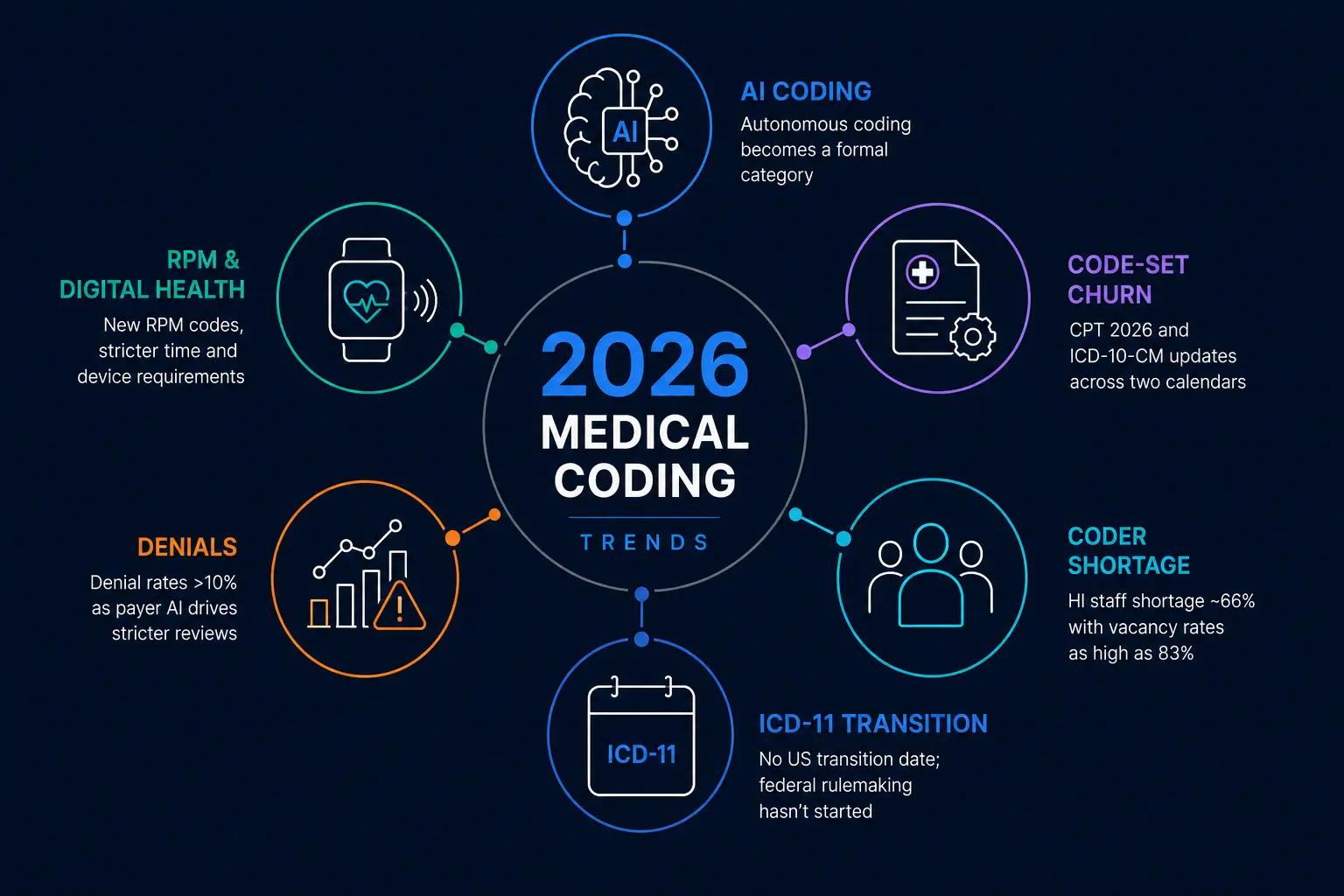
The trends reshaping medical coding in 2026 are as follows:
Trend 1: Autonomous Medical Coding Now Has a Formal Definition
The AMA has formally defined what "AI in medical coding" legally means, and most tools on the market don't qualify as the top tier. Through CPT Appendix S, the AMA now classifies AI-enabled coding into three distinct, codified categories: assistive, augmentative, and autonomous. This has replaced what used to be a loose marketing term with a strict technical definition.
For years, "AI medical coding" meant one thing to most buyers: software that suggests codes for a human to check. That's no longer accurate, and it's no longer just a marketing distinction; the AMA built it into the CPT code set itself.
CPT Appendix S sorts AI-enabled clinical work into three tiers, based on what the AI medical coding technology actually does with the clinical data.
- Assistive AI detects clinically relevant information and surfaces it, with no analysis involved.
- Augmentative AI analyzes that information and produces an output a physician can act on directly.
- Autonomous AI interprets the data and completes the task on its own, escalating only what it isn't confident about.
What Is Autonomous Medical Coding?
Autonomous medical coding is an AI system that independently assigns complete, claim-ready codes to an encounter, without a coder building the chart from scratch, while routing anything low-confidence or unusual to a human.
Autonomous medical coding is a different job than computer-assisted coding (CAC), which recommends codes for a coder to validate line by line on every single chart. Most vendors calling themselves "AI coding" today are still doing CAC. Autonomous medical coding is the layer above it, and it's where the coder's job actually starts to change.
Put the maturity levels side by side and the gap is obvious:
Will AI Replace Medical Coders in 2026?
No, every serious autonomous medical coding platform is designed with human review as a structural feature. Low-confidence charts, ambiguous documentation, and high-dollar claims still route to a person before submission. What changes is where a medical coder's time goes: less manual chart-building, more auditing, exception review, and validating AI output against payer rules.
That's the model behind Amy AI, CombineHealth's medical coding platform. It reads completed encounter documentation straight from the EHR and applies coding methodology the way an experienced coder would, rather than predicting the statistically likely code. Then it returns a billing-ready decision with a line-by-line rationale a human can check against the chart in seconds.
In production deployments, that's translated to roughly:
- 97% ICD-10-CM accuracy
- 98% on primary diagnosis and E/M coding
- 97% overall CPT code accuracy
- 95% modifier accuracy
All of them were measured at the claim-line level, not the far more forgiving claim level most vendors report. Every decision cites the documentation or payer policy behind it, so review is just a quick check.
Trend 2: RPM and Digital Health Coding Got Shorter and Stricter
Remote patient monitoring just got a lot more granular. CPT 2026 introduced five new RPM codes covering monitoring periods as short as 2 to 15 days within a 30-day window, down from the old 16-day minimum. The treatment-management time threshold dropped too, from 20 minutes to 10.
The change tracks with the evidence: research has shown patients benefit from monitoring windows shorter than the old code set allowed for. But for coding teams, it also means new fields on every RPM claim that simply weren't there last year, and a whole new set of ways to get a claim wrong.
What Does Actually Change on the Medical Claim?
- Exact monitoring dates now matter. It's no longer enough to log a total day count. The claim needs the monitoring period's precise start and end dates.
- Treatment-management time has to be logged and attributed. Cumulative time spent on the patient's treatment management must be documented and tied to a qualifying provider, not just noted in aggregate.
- Device and data type need to match the code exactly. The device billed and the data it captures have to align precisely with the new code's clinical description. A near-match isn't a match.
- Payer coverage isn't consistent. Coverage of these codes varies payer to payer, which means an eligibility check that cleared in 2025 might not be clear under 2026 rules. Nothing about the patient's coverage changed; the code's requirements did.
Why Is This the One Medical Coding Trend That Costs Money?
That last point is the trap. Unfamiliar thresholds are denial magnets. The service gets delivered correctly, but the claim gets rejected anyway, because it didn't match a rule nobody on the team had memorized. RPM billing is only going to get more code-specific as monitoring windows and thresholds keep tightening. So, teams that build the habit of validating against the current code set now will avoid the scramble later.
Trend 3: Two Major Medical Code Sets Changed in the Same Year
Most years, the medical coding teams brace for one big update. 2026 delivered two, on two different calendars but six months apart.
CPT 2026 brought 418 total changes, effective January 1: 288 new codes, 84 deletions, and 46 revisions. ICD-10-CM's FY2026 update, released separately by CMS, added 487 new diagnosis codes on its own October 1 calendar. Landing in the same 12-month stretch, the two updates mean coding logic now needs re-validating several times a year.
Where Are the CPT Changes Concentrated?
Two categories accounted for more than half of everything new in CPT 2026:
- Proprietary laboratory analyses accounted for roughly 27% of new additions
- Category III codes accounted for another 27%, together making up over half the new code volume
Category III codes are worth understanding on their own: they're temporary tracking codes for emerging technologies that haven't yet earned a permanent Category I slot. They exist so CMS and payers can watch real-world utilization before deciding whether something becomes standard coverage, which means this year's Category III code could be next year's reimbursement headache if a team isn't tracking its status.
Where Are the ICD-10-CM Changes Concentrated?
The FY2026 diagnosis code additions clustered in two chapters:
- Chapter 19 (injury and poisoning): 213 new codes
- Chapter 12 (skin and subcutaneous tissue): 116 new codes, most covering non-pressure chronic ulcers
New social determinants of health (SDOH) codes were added as well, including codes for utility insecurity, a signal of payers' growing interest in capturing a patient's circumstances alongside the clinical diagnosis itself.
CombineHealth’s medical coding automation platform is payer-aware. It handles this by automatically pulling in current payer requirements and code-set updates as they publish. This way, the coding logic doesn't sit stale between quarterly reviews waiting for someone to notice it's out of date.
Trend 4: Payers Are Scrutinizing Claims Harder Than Ever
Denial rates in healthcare climbed past 10% industry-wide in 2026, and a meaningful share of providers reported rates well beyond that. The cause is payers running their own AI review systems that check whether documentation actually supports a billed code before a human on either side ever sees the claim.
What's Actually Triggering Denials?
Once you see the pattern, the triggers are predictable:
- Deleted codes still in use: claims submitted with a CPT or ICD-10-CM code that was retired in the current cycle
- E/M levels outside benchmark: visit levels that fall outside a payer's peer-comparison range for similar patients
- Missing modifiers: absent modifiers that would have established medical necessity or preventive intent
Automatic downcoding policies have made the last two riskier than they used to be. A payer can now quietly reduce a submitted E/M level if the documentation doesn't clearly support it, which flips the burden of proof.
A Real Example: Modifier 33
Modifier 33 shows how little room for error there is.
It only applies to codes that could be either preventive or diagnostic depending on context; a screening colonoscopy that turns diagnostic mid-procedure is the classic example. Miss the modifier, and the patient can end up billed for something that should have been fully covered. No one did anything clinically wrong, but the claim just didn't say what actually happened.
The Fix Is a Pre-Submission Denials Checklist
Each one of these triggers is catchable before the claim goes out:
- Validate every chart against the current-year code set
- Flag any claim using a code deleted in the latest cycle
- Cross-check E/M levels against published payer benchmarks
- Confirm modifier requirements against actual payer policy, not a general rule of thumb
Trend 5: The Medical Coder Shortage Isn't Closing
A 2023 AHIMA survey found that 66% of health information (HI) professionals reported persistent staffing shortages at their organization, and 83% saw unfilled HI positions increase or persist over the prior year. A new hire in the medical coding wing typically needs three to six months to reach full productivity, time most teams don't have to spare.
The shortage of medical coders doesn't sit in isolation. It compounds every other trend on this list: a thinner team has less capacity to absorb new code-set rules, new RPM documentation requirements, and rising denial volume, all at the same time.
How Are Healthcare Providers Responding to the Staffing Shortage?
Three approaches are showing up most often:
- Outsourcing to coding vendors to cover volume gaps
- Faster in-house training to shrink the ramp-up window for new hires
- Automation to absorb routine, high-confidence volume, freeing existing staff for complex charts and denial work
Remote work has also widened the labor pool. AAPC's 2026 salary data puts 63.7% of healthcare business professionals fully remote, climbing roughly 80% once hybrid arrangements are counted.
Why Is Medical Coding Automation the Lever That Actually Scales?
Of the three responses, medical coding automation has the clearest capacity impact; it's the only one that scales without adding headcount. CombineHealth automates roughly 80% of coding volume in typical deployments, up to 85% in some, with the remainder routed to human coders for review.
That doesn't shrink the team to zero. It changes what the team spends its day doing.
Trend 6: The Timeline for US ICD-11 Has Been Extended
As of 2026, the federal rulemaking needed to mandate a switch from ICD-10-CM to ICD-11 hasn't started, according to NCVHS's most recent workgroup update. Earlier projections placing full US implementation somewhere between 2025 and 2027 are effectively off the table; a former NCVHS workgroup member now indirectly estimates the actual transition is 10 to 15 years away.
That's not a reason to ignore it.
Why Is ICD-11 Updates Worth Watching Now?
- The last transition, ICD-9 to ICD-10, took nearly a decade once it actually began
- ICD-11's structure is built for post-coordinated codes rather than single fixed codes, a fundamentally different model than what teams use today
- That shift touches documentation, EHR configuration, and payer systems simultaneously, not just the code set itself
The reasonable middle ground: build general familiarity now, without committing resources to a full migration plan for a date that doesn't exist yet. Whatever timeline eventually lands, the same config-driven architecture absorbing CPT and ICD-10-CM changes today is built to take it on.
The 2026 Verdict for Medical Coding
Just line the six trends up, and they point in one direction. Code sets are changing faster than manual review can track. Payers are scrutinizing claims harder, using the same kind of AI providers that are only starting to adopt. And there are fewer coders available to catch it all by hand. Hiring alone doesn't fix this. Neither does bolting AI onto the front end without oversight.
The organizations handling 2026 well are pairing autonomous, payer-aware coding for high-confidence encounters with real human review for everything else. That's the operating model CombineHealth's AI workforce runs on: coding, billing, denial management, AR follow-up, policy review, and appeals, with a human in the loop at every stage, not just at the end.
See How CombineHealth's Payer-Aware Intelligence Cuts Medical Coding-Related Denials by 75%
Rather than checking a claim against CPT and ICD-10-CM rules alone. CombineHealth AI evaluates every coding decision against payer-specific policy, including LCDs and NCDs, and improves using downstream claim outcomes. So, book a demo now.
FAQs
How many CPT code changes are there in 2026?
Effective January 1, 2026, there were a total of 418 CPT code changes: 288 new codes, 84 deletions, and 46 revisions.
How many ICD-10-CM codes were added for FY2026?
Effective October 1, 2025, there were 487 new diagnosis codes, plus 38 revisions and 28 deletions.
What changed with RPM coding (CPT 99454 and related codes) in 2026?
The new codes cover monitoring periods as short as 2 days, and the treatment-management time threshold dropped from 20 minutes to 10.
When will the US transition to ICD-11?
No date is set. Federal rulemaking hasn't begun, and the earlier 2025–2027 window is no longer realistic for coding and billing.
Will AI replace medical coders in 2026?
No, the autonomous platforms route low-confidence and complex charts to human coders by design; the role shifts toward auditing, not away from people.
Can CombineHealth help with all six of these trends at once?
Yes, CombineHealth's AI workforce includes Amy for coding, Mark for billing, Adam for denials, Rachel for appeals, and Taylor for analytics. It runs on payer-aware, config-driven rules that update automatically as CPT, ICD-10-CM, and payer policies change. Human review is built into every step of this platform. Book a demo now to see it against your own denial rate and coding backlog.