Orthopedic Medical Coding and AI: A Practical Guide for 2026
A practical look at AI orthopedic medical coding: what it automates, where it fails, and how to evaluate a platform before you adopt one.
Published on:
September 24, 2026


Key Takeaways
• CombineHealth connects orthopedic medical coding to denial prevention as one continuous loop, validating claims before submission and analyzing denial patterns after adjudication to build payer-specific intelligence, an approach tied to up to a 75% reduction in medical coding-related denials.
• AI orthopedic medical coding is software that reads clinical and operative documentation to assign or review ICD-10-CM, CPT, HCPCS Level II, E/M, and modifier codes, and it comes in four distinct deployment models: code suggestion, medical coding audit, hybrid automation, and full autonomous coding.
• Orthopedic medical coding is difficult because the diagnosis alone rarely settles the code, since decision points like laterality, surgical technique, and revision status shift the final code entirely, compounded by payer-specific modifier rules, a 14% to 22% specialty-level denial rate, and 418 CPT changes in 2026 alone.
• A well-built AI system codes an orthopedic encounter through six sequential steps: ingesting the full clinical record, extracting clinical facts, generating or validating codes, applying medical coding and payer logic, explaining the decision with traceable evidence, and routing ambiguous cases for human review.
• AI can identify orthopedic documentation gaps by comparing what a candidate code requires against what the note actually states, flagging missing laterality, incomplete fracture detail, or an unclear revision extent instead of guessing the answer.
I have read a lot of operative notes in my career, and orthopedic charts have always demanded something extra. A cardiology note might hinge on one lab value. An orthopedic note can hinge on a single word: left instead of right, displaced instead of nondisplaced, revision instead of primary. Get that word wrong on a $1,400 procedure, and the claim comes back denied, the appeal takes weeks, and the practice eats the cost of a mistake that a careful second read would have caught.
That is why orthopedic medical coding has become the specialty everyone wants to test AI against first. The stakes are high enough to matter, and the rules are precise enough to measure.
This guide walks through how orthopedic medical coding works across the full encounter, what AI does well today, and what still belongs to a trained coder's judgment.
What Is AI Orthopedic Medical Coding?
AI orthopedic medical coding is using AI and automation to read clinical and operative documentation and assign or review the codes needed to bill an orthopedic encounter, including ICD-10-CM diagnoses, CPT procedures, HCPCS Level II items, evaluation and management (E/M) levels, and modifiers.
AI orthopedic medical coding covers a range of different tools. Some suggest a code for a coder to confirm. Others code the chart outright and involve a person only when something looks wrong.
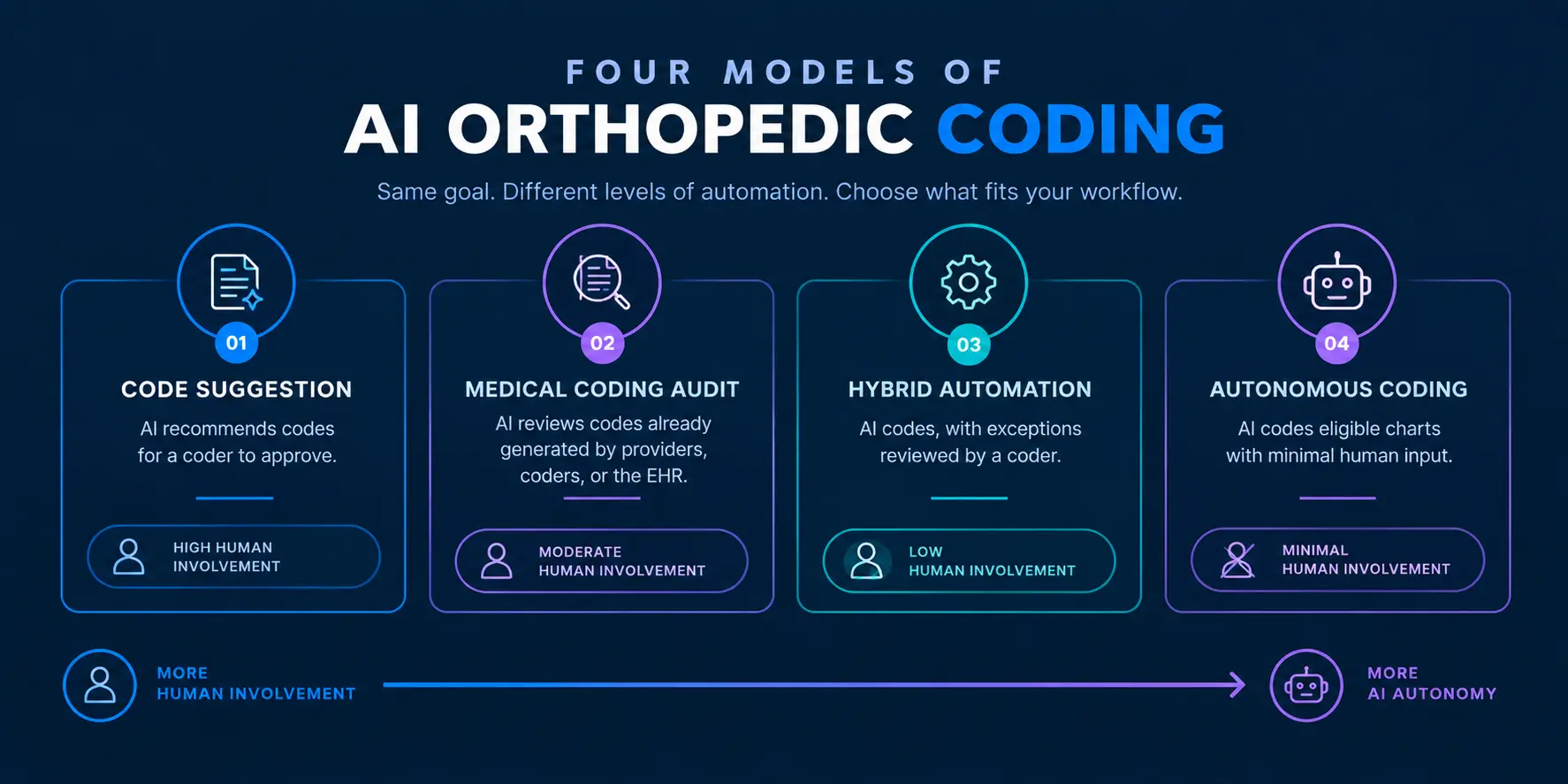
Four AI medical coding deployment models cover most of what exists in the market today.
Why Is Orthopedic Medical Coding Difficult?
Orthopedic medical coding is difficult because the diagnosis alone rarely settles the code. A knee replacement, a fracture repair, and a joint revision each carry decision points, such as laterality, surgical technique, and revision status, that change the final code entirely. Payer rules for handling those decision points vary by procedure and by payer, which is where most errors originate.
Payer-specific modifier rules
Bilateral cases make the point well. Some payers want RT and LT modifiers on separate lines, others want a single line with modifier 50, and others require prior authorization before the claim can be submitted at all. Errors cluster around applying the correct payer-specific rule and confirming authorization instead of identifying what procedure was performed.
Denial rates at scale
Orthopedic surgery now runs one of the higher specialty-level denial rates in the industry, an estimated 14% to 22% in 2026 benchmarking data, driven largely by prior-authorization requirements and NCCI bundling conflicts. On a $1,200 procedure, that range causes far more financial damage than an identical rate in a lower-value specialty like primary care, where the same percentage of denials costs a fraction as much to absorb.
Annual code set changes
The 2026 CPT code update brought 418 total changes, 288 new codes, 84 deletions, and 46 revisions, and orthopedics absorbed several of them directly. The sacroiliac joint arthrodesis codes were split and redefined, the long-used hinge prosthesis knee arthroplasty code was deleted outright, and new codes were added for limb-lengthening procedures. A platform running last year's logic on this year's charts will misfire in ways that have nothing to do with the clinical documentation at all.
Documentation style variation
Two surgeons performing an identical procedure will often use different terminology, sequencing, and level of detail in their notes. Whoever reads the chart has to normalize that language to the right code without inventing details the note never states.
Clinical detail sensitivity
The correct code can depend on various factors like:
- Right versus left
- Exact bone or joint
- Displaced versus nondisplaced fracture
- Open versus closed fracture
- Open versus arthroscopic technique
- Repair versus removal
- Total versus partial replacement
- Primary versus revision procedure
- Components revised
- Number of spinal levels
- Implant or graft use
Concurrent procedure complexity
A single operative note can bill out to several codes at once. A coder, human or automated, has to separate the primary procedure from add-on services, recognize which steps are integral to the main procedure, and identify where a modifier applies.
Documentation gaps
A plausible code is not the same as a supported code. When a note is missing a required detail, the right move is to flag the gap. The AI must avoid filling it in with an educated guess.
How Does AI Code an Orthopedic Encounter?
A well-built AI system codes an orthopedic encounter through the same sequence an experienced coder would follow, and skipping any step in that sequence is where the risk creeps in.
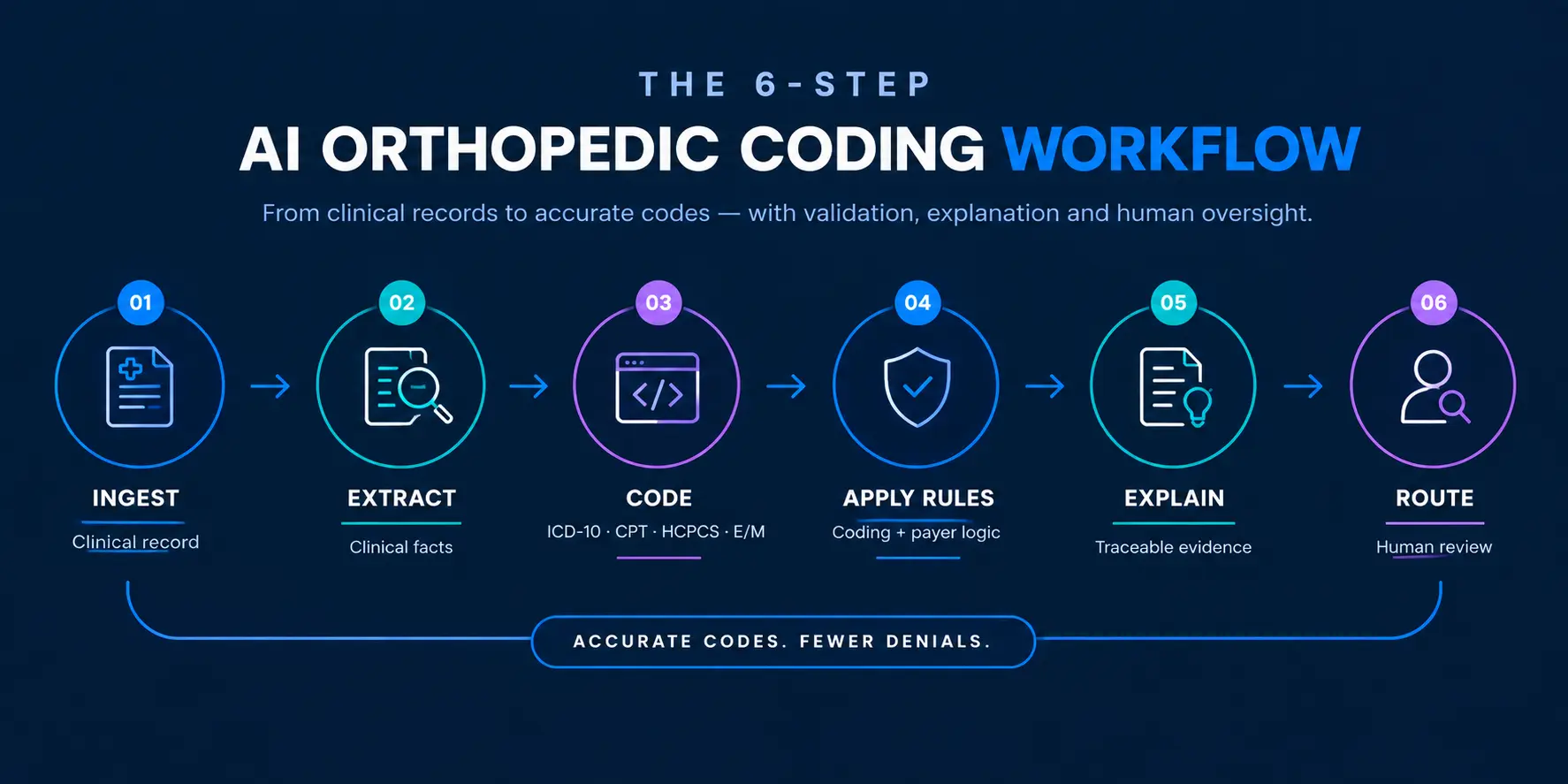
An AI system must follow the steps below to code an orthopedic encounter:
1. Ingest the clinical record
The AI system pulls together clinic notes, operative reports, imaging reports, procedure notes, orders, prior treatment history, postoperative documentation, and any codes a provider or the EHR has already generated.
2. Extract the clinical facts
It should then identify the diagnoses, procedures performed, anatomy, laterality, surgical approach, fracture characteristics, devices and implants, structures or levels treated, and whether the case is primary or revision.
3. Generate or validate codes
Depending on the encounter, it assigns or reviews orthopedic ICD-10-CM, CPT, HCPCS Level II, E/M levels, and modifiers.
4. Apply medical coding and payer logic
Then it has to apply orthopedic CPT codes and ICD-10 relationships, NCCI edits, modifier requirements, global-period rules, medical necessity, CMS guidance, LCDs and NCDs, payer-specific policies, and any organization-specific medical coding rules.
5. Explain the decision
Every code should trace back to the note language that supports it, the relevant clinical facts, the medical coding logic applied, the modifier rationale, and the governing payer or organizational rule. So, there’s always an explanation behind the decision.
6. Route exceptions for review
Ambiguous, unsupported, low-confidence, or high-risk charts go to a coder or compliance reviewer rather than getting coded on assumption by the AI system.
What Orthopedic Medical Coding Tasks Can AI Automate?
AI can take on individual medical coding tasks across an orthopedic chart, though some tasks are far more mature than others.
How Can AI Identify Orthopedic Documentation Gaps?
AI finds orthopedic documentation gaps by comparing what a candidate code requires against what the note actually says, and flagging the difference instead of assuming an answer.
When a laterality, surgical approach, fracture type, revision status, or other required detail is missing, that gap should surface immediately rather than get coded around.
A few examples are:
Missing laterality
A knee procedure is documented, but the note never consistently confirms whether it was the right or left knee. The right move is to flag the inconsistency without picking a side by guessing.
Incomplete fracture documentation
The note names the fractured bone but never establishes displacement, open-versus-closed status, or the treatment method used. That chart needs a clarifying query before medical coding proceeds.
Unclear revision procedure
The operative note describes a revision arthroplasty without specifying which components were removed, retained, or replaced. Inferring the extent of that revision is a guess dressed up as a code.
These gaps are not only a medical coding problem. They point straight at clinical documentation improvement, and a well-designed system feeds that insight back to providers rather than quietly working around it.
Can AI Interpret Orthopedic Operative Reports?
AI can extract procedures and clinical detail from an operative report, but reliable orthopedic medical coding takes more than summarizing what happened. The system has to separate the planned procedure from the completed one, distinguish billable work from integral steps, catch missing evidence, and apply the medical coding and payer rules in force today.
An AI system ready for production use consistently:
- Codes the completed procedure
- Identifies every structure actually treated
- Recognizes converted or abandoned procedures
- Distinguishes open from arthroscopic approaches
- Detects primary versus revision surgery
- Identifies implants and grafts used
- Evaluates multiple procedures and applicable bundling together
- Leaves missing facts missing, rather than filling them in
How Can AI Handle Multiple Procedures and Modifiers?
AI handles multiple procedures and modifiers by working through a fixed sequence: extracting every procedure, checking bundling edits, and applying a modifier only when the note itself supports a distinct, separately reportable service.
Picture an operative report describing an ACL reconstruction with concurrent meniscus work. The system has to determine exactly what happened to the meniscus, weigh the applicable bundling logic, decide whether a second procedure is separately reportable, and back up any proposed modifier with specific evidence from the note.
That workflow runs in the following order:
- Extract every documented procedure.
- Identify the primary service and any additional services.
- Check current code-pair edits.
- Determine whether each additional service is integral or distinct.
- Review the anatomical and procedural evidence behind that determination.
- Apply a modifier only when both the documentation and the payer rules support it.
- Route conflicting or unusual combinations to a reviewer.
Modifier 59 should never function as a workaround for an edit. It belongs only where the note supports a distinct, separately reportable service.
How Can AI Improve Orthopedic E/M Coding?
AI improves E/M coding by reconstructing the actual medical decision-making behind a visit, rather than pattern-matching a level from the surface of the note. That means weighing the number and complexity of problems addressed, the data reviewed, any independent interpretation performed, the risk of the chosen management, decisions about surgery, prescription management, and total time when time drives the level.
A strong E/M coding output shows the recommended code alongside the specific problem-complexity evidence, the data evidence, the risk evidence, any documentation gap that caps the level, and whether a same-day procedure creates a modifier question worth a second look.
CombineHealth ties every E/M level to the exact note language and MDM elements behind it, so a coder or auditor can verify the level in minutes instead of rereading the whole chart.
Can AI Audit Codes Generated by the EHR or Provider?
Yes, and this is often the easiest way to bring AI into an orthopedic medical coding workflow. Rather than generating codes from scratch, AI can sit as a medical coding audit layer over codes a provider or EHR already produced, comparing them against the full clinical record and flagging where the support is solid, weak, or missing.
An audit like this produces one of three outcomes:
- Accept: The existing code is fully supported by the documentation.
- Recommend a change: Another code is better supported, with the specific evidence cited.
- Flag for review: The documentation is insufficient or ambiguous, and a coder needs to resolve it.
CombineHealth’s autonomous medical coding platform, also referred to as Amy AI, can run in this audit mode against your existing codes before you touch anything else in the workflow. This is definitely a low-risk starting point for orthopedic groups not yet ready to hand over medical coding outright.
How Accurate Is AI for Orthopedic Medical Coding?
There is no single accuracy number that fairly describes AI performance in orthopedic medical coding, because results shift with CPT versus ICD-10-CM assignment, procedure category, documentation quality, single-code versus multi-code encounters, and whether accuracy gets measured per code or per complete encounter.
A published study compared three frontier large language models on CPT assignment across 33 orthopedic surgical procedure notes and found accuracy in the 57% to 66% range, concluding that current models perform moderately well but are not yet reliable enough for autonomous use.
What Compliance Risks Can AI Introduce Into Orthopedic Medical Coding?
The real compliance risk with AI is scale.
A plausible but unsupported code, coded once by a person, is one mistake. The same mistake coded by an AI system across a thousand similar charts is a pattern that regulators and payers will eventually notice.
Watch for these specific failure modes:
- Inventing missing specificity instead of flagging a documentation gap
- Systematic laterality errors across similar procedures
- Applying plausible but unsupported codes
- Overlooking bundled services
- Recommending modifiers the documentation does not support
- Scaling undercoding or overcoding across large chart volumes
- Using outdated medical coding rules
- Missing payer-specific requirements
- Producing a code with no traceable evidence trail
- Reporting one high blended accuracy score that hides weak performance in specific segments
How Should Orthopedic Organizations Evaluate AI Medical Coding?
The right evaluation framework is the set of questions your own team already asks before adopting anything new.
Can we trial AI orthopedic medical coding before changing the wider workflow?
The vendor should support parallel or audit-mode testing against the organization’s charts instead of a demo dataset.
Can it handle more than straightforward CPT assignments?
Push on ICD-10-CM specificity, E/M leveling, modifier validation, and multi-procedure bundling, evaluated together on the same chart. This combination is where most real medical coding errors happen.
Can it explain why a code was selected?
Every code should trace back to the specific note language it's based on and the rule that applied to it. A coder or auditor can verify the code in minutes using the AI audit trail.
What happens when the note is ambiguous?
The platform should flag the case for review rather than silently guessing.
Can it fit our existing workflow?
Check integration with your EHR and PMS, coder review steps, accept and reject workflows, provider assignment, write-back, and audit trails.
Can it extend beyond medical coding?
Ask whether the platform also supports claim validation, denials, accounts receivable, and appeals, but only once its medical coding performance holds up on its own.
How Should an Orthopedic AI Coding Pilot Work?
A pilot earns its value by running alongside your existing orthopedic medical coding workflow so that you have the proven results.
- Select representative orthopedic encounters, spanning clinic, procedure, and operative notes.
- Include routine cases and complex ones side by side.
- Run the platform in parallel with the current medical coding workflow.
- Compare CPT, ICD-10-CM, E/M, modifiers, and documentation findings against each other.
- Adjudicate disagreements using current medical coding guidance.
- Measure performance by procedure type and case complexity, never as one blended number.
- Identify which chart categories clear the bar for autonomous medical coding.
- Route the remaining categories for review.
- Keep monitoring denials and corrections after go-live.
How Does AI Connect Orthopedic Medical Coding to Denial Prevention?
AI connects orthopedic medical coding to denial prevention by working both sides of the claim: validating it before submission and analyzing the outcome after adjudication, as one continuous loop rather than two separate jobs.
Before submission
The AI system checks clinical support for the code, the diagnosis-to-procedure linkage, laterality, modifiers, bundling, medical necessity, documentation sufficiency, and payer-specific requirements.
After adjudication
The AI system analyzes medical coding-related denials, missing-modifier patterns, medical-necessity denials, payer-specific code-pair responses, underpayments, appeal outcomes, and recurring documentation gaps.
Every denial finding should become a candidate update to a medical coding rule or workflow step, never an automatic one. Medical coding, compliance, and RCM teams should validate the pattern before it changes how future orthopedic claims get coded.
CombineHealth’s Orthopedic Medical Coding Workflow
CombineHealth is self-learning, meaning it evaluates every medical coding decision it makes against the claim outcome that follows: a denial, a reimbursement, or an underpayment.
CombineHealth uses that outcome to build payer intelligence, a working understanding of how a specific payer treats orthopedic claims over time, including which modifiers a payer consistently rejects, which documentation gaps trigger denials, and which authorization requirements catch organizations off guard.
That intelligence then adapts the platform's medical coding strategy for that payer on the next claim, automatically tightening the parts of the workflow where a specific payer has already shown its hand.
See What Your Own Denial Patterns Are Costing You
CombineHealth’s self-learning approach has driven up to a 75% reduction in medical coding-related denials for orthopedic organizations. An accurate code gets a claim submitted correctly the first time. A self-learning system goes further: it gets that claim paid, and it keeps the next one from being denied for the same avoidable reason.
Talk to our team to set up a pilot on your own charts and see what your own payer patterns reveal.
Frequently Asked Questions
Does AI replace orthopedic coders?
No system on the market today eliminates the coder's role in orthopedics. Even fully autonomous medical coding models depend on a coder or compliance reviewer to handle the ambiguous, high-risk, or unsupported charts that get routed out of the automated path. The realistic outcome is a coder spending less time on routine charts and more time on the complex ones that actually need judgment.
Is AI medical coding the same thing as computer-assisted coding (CAC)?
No, the traditional CAC tools mostly search documentation for keywords and suggest candidate codes for a coder to sort through manually. Autonomous medical coding platforms built on large language models read the full clinical narrative, reason across multiple documents, apply payer-specific logic, and explain their conclusions, which is a meaningfully deeper level of analysis than keyword matching.
How long does it take to validate an AI medical coding platform for orthopedics?
Most credible pilots run for several weeks to a few months, long enough to cover a representative mix of routine and complex procedures and to see how the platform performs against actual adjudication outcomes, not just against a coder's initial read. Rushing this step to hit a go-live date is where most disappointing rollouts start.
Does AI orthopedic medical coding work with our existing EHR and billing system?
It should, and that is worth confirming before any other conversation with a vendor. A platform that reads documentation directly from your existing EHR and writes codes back into your current billing workflow avoids the cost and disruption of standing up a separate medical coding environment.
What accuracy rate should we expect from an AI orthopedic medical coding platform?
Treat any single number with caution. Accuracy varies by procedure type, documentation quality, and whether it is measured per code or per complete encounter, so the only number worth trusting is the one your own pilot produces on your own charts.