Claims Adjudication Process in Healthcare
The claims adjudication process determines if providers are paid or denied. It includes validation and review, helping reduce denials, improve cash flow, and optimize revenue cycle performance.
Published on:
April 24, 2026


Key Takeaways:
• Claims adjudication is the core decision-making step that determines payment outcomes in medical billing and revenue cycle management.
• The process includes claim validation, automated review, manual evaluation, and final payment or denial.
• Most claims are processed through automated adjudication, but complex cases require human review.
• Errors in data, coding, or eligibility can lead to costly denials and delayed reimbursements.
• Understanding adjudication helps providers submit cleaner claims and reduce rework cycles.
• AI-driven tools are shifting adjudication from reactive denial handling to proactive error prevention.
• Tracking denial reasons and payer patterns improves long-term financial performance.
• Faster and more accurate adjudication directly impacts cash flow, operational efficiency, and revenue growth.
Every healthcare organization runs on a simple promise: deliver care, then get paid for it. But between the moment a provider submits a claim and the moment payment arrives, there's a critical process that determines whether that payment happens at all. That process is claims adjudication and it sits at the very heart of revenue cycle management.
In this article, we'll break down every step of the adjudication process, uncover the challenges that trip up even experienced billing teams, and explore how technology (particularly AI-powered solutions) is reshaping the way providers manage claims.
What is Claim Adjudication?
The claims adjudication process is the comprehensive evaluation through which insurance companies assess submitted medical claims to determine whether they:
- Meet coverage requirements
- Comply with policy guidelines
- Justify payment based on established medical necessity standards
In practical terms, it's the insurance payer's method of reviewing a claim, checking it against rules and contracts, and deciding on a payment outcome.
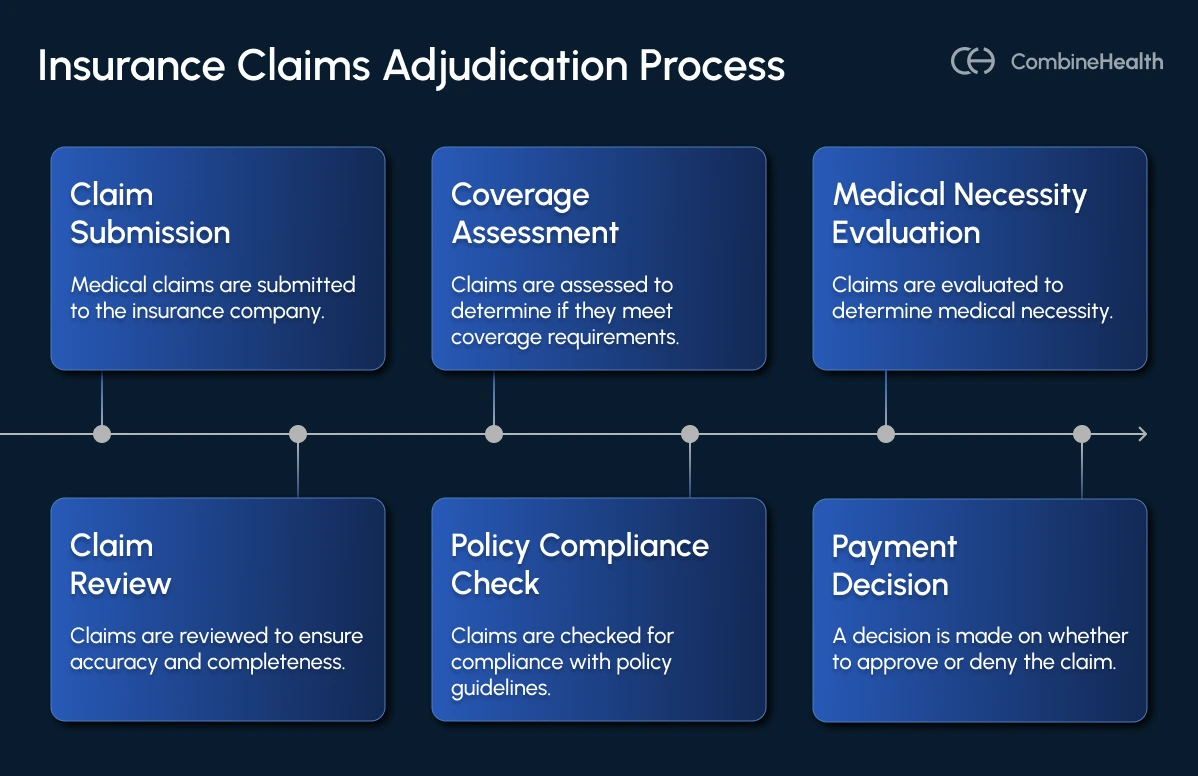
At its core, claims adjudication is the decision-making engine behind every medical claim. It's the process that determines whether your organization gets paid — and how much. Understanding it gives providers a significant advantage in managing their financial operations.
The primary parties involved include the healthcare provider who submits the claim, the patient whose coverage is being applied, and the insurance payer responsible for adjudicating and issuing payment.
Importance of Claim Adjudication in Medical Billing
Claim adjudication in medical billing is the single most consequential step in the revenue cycle. It directly determines whether a provider receives full reimbursement, partial payment, or an outright denial. Without a firm grasp on how adjudication works, billing teams operate in the dark — reacting to outcomes instead of shaping them.
The financial impact of errors and delays during adjudication is substantial. A single coding mistake can trigger a denial that takes weeks to resolve, tying up revenue and consuming staff hours that could be spent on patient care. Multiply that across hundreds or thousands of claims per month, and the losses compound quickly.
To learn more about how denials affect your bottom line, explore our guide on Claim Denial 101
Here's why every provider must understand claim adjudication:
- Revenue protection: Informed teams submit cleaner claims that are less likely to be denied or underpaid.
- Operational efficiency: Understanding the process reduces rework cycles and accelerates cash flow.
- Strategic control: Providers who understand adjudication can identify patterns and address root causes of payment delays.
Steps Involved in the Claims Adjudication Process
Claims adjudication isn't a single action — it's a sequence of distinct phases, each with its own checks, rules, and potential failure points. Understanding these steps helps providers anticipate outcomes and address issues before they become costly denials.
Initial Claim Review
The process begins the moment a payer receives a claim. During initial review, the system checks whether the submission meets basic requirements: Is the claim form complete? Are the patient demographics accurate? Does the provider's information match records on file? This front-door screening catches obvious problems before deeper analysis begins.
Common errors detected at this stage include:
- Missing or invalid patient identification numbers
- Incorrect provider NPI or tax ID
- Duplicate claim submissions
Mass Adjudication (Automated Review)
Claims that pass the initial screening enter mass adjudication — an automated review where software algorithms evaluate claims against the payer's coverage rules, fee schedules, and contractual agreements. This phase processes the majority of claims at high speed, often adjudicating thousands of submissions per hour without human intervention.
Key aspects of automated review:
- Benefits: Speed, consistency, and the ability to apply complex rule sets at scale
- Limitations: Cannot interpret nuanced clinical scenarios or resolve ambiguities in documentation
- Scope: Roughly 80% of straightforward claims are resolved during this phase
Manual Review
When automated systems flag a claim for further evaluation — because of unusual procedure combinations, high-dollar amounts, or missing prior authorizations — it moves to manual review. A trained claims examiner steps in to assess the clinical details, cross-reference medical records, and apply judgment that algorithms alone cannot provide.
Human oversight remains crucial because healthcare is inherently complex. A procedure that looks like an outlier to software might be entirely appropriate given the patient's condition. Manual reviewers bridge the gap between rigid rule sets and real-world clinical practice, ensuring fair and accurate decisions.
Payment Decision
After review, the payer reaches one of several outcomes: the claim is approved for full payment, approved for partial payment, or denied. The decision hinges on criteria including medical necessity, coverage eligibility, correct coding, and compliance with the provider's contracted rates. Claims may also be pending — held for additional information before a final determination.
Decisions are communicated through an Explanation of Benefits (EOB) or Electronic Remittance Advice (ERA), detailing exactly how payment was calculated and, withongoing denials, the specific reason codes. Understanding these codes is essential for effective appeals.
Challenges and Best Practices in Claims Adjudication
Even with a well-structured process, claims adjudication is riddled with obstacles that cost providers time and money. Recognizing these challenges — and adopting proven best practices — is the fastest path to fewer denials and stronger revenue performance.
Key Challenges of Claim Adjudication
Data accuracy issues: A single transposed digit in a patient ID, an outdated insurance policy number, or an incorrect diagnosis code can derail an otherwise valid claim.
Complex and constantly changing payer regulations: Payers frequently update their coverage policies, coding requirements, and compliance standards. Providers who fail to keep pace find themselves submitting claims that were valid last quarter but trigger denials today.
Costly denials: The cascading impact of denied claims extends far beyond the individual submission. Each denial generates rework — staff must identify the issue, correct it, resubmit, and track the outcome. Industry estimates suggest that reworking a single denied claim costs providers between $25 and $118 in administrative expenses. When denial rates climb, these costs erode margins quickly.
For a deeper dive into managing this challenge, see our guide on Denial Management in Healthcare
Best Practices for Avoiding Denials
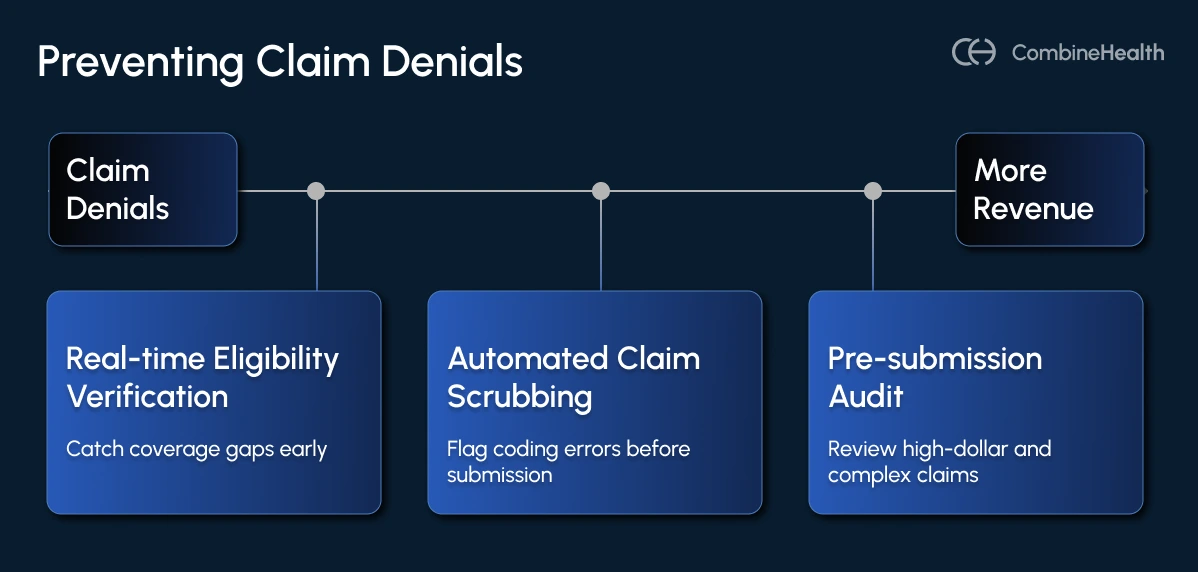
The good news is that most adjudication challenges are preventable. Here are proven strategies for data validation:
- Implement real-time eligibility verification before every patient encounter to catch coverage gaps early
- Use automated claim scrubbing tools that flag coding errors, missing fields, and inconsistencies before submission
- Establish a pre-submission audit process for high-dollar and complex claims
Staying updated on regulations requires building compliance into your workflow rather than treating it as an afterthought. Assign a team member or partner with a billing service that monitors payer policy updates, CMS bulletins, and coding changes on an ongoing basis. Quarterly internal audits can also catch drift before it leads to systemic denial patterns.
On the people and technology front, consider these priorities:
- Invest in continuous staff training on coding updates, payer-specific requirements, and denial prevention techniques
- Adopt AI-powered tools that learn from denial patterns and recommend corrections proactively
- Track denial metrics by reason code to identify and eliminate root causes — not just symptoms
Tools and Technology Enhancements for Successful Claim Adjudication
Technology has fundamentally changed what's possible in claims adjudication. What once required rooms full of paper and teams of manual reviewers now happens in seconds — and the next wave of innovation promises even greater gains for providers willing to adopt modern tools.
AI RCM Solutions
Artificial intelligence is rapidly becoming the backbone of efficient claims adjudication. AI-powered platforms like CombineHealth analyze claims data in real time, identifying errors, predicting denial risk, and recommending corrections before a claim ever reaches the payer. This proactive approach flips the traditional model on its head — instead of reacting to denials after the fact, providers prevent them from occurring in the first place.
Practical use cases for AI in claims adjudication include:
- Automated claim scrubbing: AI reviews every claim against payer-specific rules and flags issues instantly
- Denial pattern recognition: Machine learning models detect recurring denial trends and surface actionable insights
- Predictive risk scoring: Each claim receives a risk score before submission, allowing teams to prioritize high-risk claims for manual review
Clearinghouse Software
Clearinghouses serve as intermediaries between providers and payers, standardizing claim formats, performing initial validation, and routing submissions to the correct insurance company. Think of them as air traffic control for medical claims — ensuring every submission follows the right path and meets baseline requirements before it reaches the payer's adjudication system.
Key advantages of clearinghouse software for providers:
- Format standardization: Automatically converts claims into the specific electronic formats required by each payer
- Error detection: Catches formatting issues, missing data, and basic coding errors before submission
- Status tracking: Provides real-time visibility into where each claim stands in the adjudication pipeline
When combined with AI solutions, clearinghouses create a powerful end-to-end system. The clearinghouse handles routing and formatting, while AI addresses the more complex tasks of clinical validation, denial prediction, and pattern analysis. Together, they form the foundation of a modern medical billing operation.
The Future of Claims Adjudication
The claims adjudication landscape is evolving fast. Emerging technologies are poised to eliminate longstanding inefficiencies, but their adoption will require providers to think differently about their revenue cycle infrastructure. Here's what's on the horizon — and what it means for your organization.
Machine Learning and AI
While AI is already transforming claims management today, the next generation of machine learning capabilities will push automation even further. Future systems won't just flag errors — they'll autonomously resolve them. Imagine an AI that detects a coding discrepancy, references the patient's clinical documentation, selects the correct code, and resubmits the claim without any human involvement. That future is closer than most providers realize.
Predictive analytics will play an increasingly central role:
- Pre-service predictions: ML models will forecast the likelihood of claim approval before a service is even rendered, enabling providers to address authorization and coverage issues proactively
- Payer behavior modeling: Advanced algorithms will map payer-specific adjudication patterns, allowing providers to tailor submissions for maximum approval rates
- Real-time benchmarking: AI will compare your organization's adjudication outcomes against industry benchmarks, surfacing improvement opportunities automatically
The organizations that embrace these capabilities early will gain a measurable competitive advantage — faster reimbursements, lower denial rates, and significantly reduced administrative burden. For more on how proactive strategies reduce denials, explore our resource on Denial Management in Healthcare.
Blockchain Technology
Blockchain is generating significant interest as a potential solution for claims adjudication's transparency and security challenges. By creating an immutable, distributed ledger of every transaction and decision in the claims process, blockchain could give providers and payers a shared, tamper-proof record of adjudication outcomes. This would reduce disputes, accelerate reconciliation, and build trust between parties in an ecosystem where disagreements over payments are common.
However, meaningful adoption faces real barriers:
- Integration complexity: Healthcare's existing IT infrastructure varies widely, making standardized blockchain implementation difficult
- Regulatory uncertainty: Clear frameworks for blockchain use in healthcare claims processing have yet to be established
- Cost of transition: The upfront investment required to implement blockchain at scale remains prohibitive for many organizations
Blockchain's promise is real, but its practical impact on claims adjudication is likely a medium-term development rather than an immediate one. Providers should monitor progress in this space while focusing their near-term investments on AI and automation tools that deliver measurable ROI today.
Optimize Your Claims Adjudication Process With AI
Claims adjudication is far more than an administrative formality — it's the financial engine that powers every healthcare organization. From the initial claim review through finalization and payment, each step presents an opportunity to either protect your revenue or lose it to preventable errors and inefficiencies.
The path forward is clear. Providers who combine strong operational best practices — rigorous data validation, continuous staff training, proactive compliance monitoring — with modern technology are the ones achieving the highest clean claim rates, the lowest denial volumes, and the fastest reimbursement cycles. The organizations still relying on manual processes and reactive denial management are falling behind, absorbing unnecessary costs with every claim that gets rejected or delayed.
The data tells a compelling story: coding errors affect a significant percentage of all claims, denial rework costs providers tens of dollars per claim, and AI-powered tools are reducing denial rates by up to 30 percent. These aren't marginal improvements — they're transformative changes that directly impact your bottom line.
Take the Next Step
If your organization is ready to move beyond reactive claims management and build a smarter, faster adjudication workflow, CombineHealth's AI-powered platform is designed to help. From predictive denial prevention to automated claim optimization, our solutions are built specifically for healthcare providers who need measurable results — not just promises.
Here's how to get started:
- Explore our solutions: See how Combine Health's AI transforms claims adjudication for organizations like yours
- Request a demo: Walk through the platform with our team and see your own data in action
The claims adjudication process will only grow more complex. The question isn't whether to invest in better tools and practices — it's whether you can afford not to.