CombineHealth vs. Solventum: Which AI Medical Coding Software Is Better in 2027?
Compare Solventum and CombineHealth on autonomous medical coding, accuracy, CDI, EHR integration, payer intelligence, and AI-powered RCM automation in 2027.
Published on:
October 29, 2026


CombineHealth is the stronger choice for organizations that want explainable, self-learning autonomous medical coding connected to the wider revenue cycle — coding that learns from payer outcomes to prevent denials, embeds CDI, and extends into billing, A/R, and appeals. In production at Brault, CombineHealth has demonstrated 98.4% CPT accuracy across millions of encounters, and at a 400-bed hospital it delivered 75% fewer coding-related denials.
Solventum is a strong fit for health systems that want mature computer-assisted coding (CAC) within an established enterprise suite, or that already run its 360 Encompass CDI and auditing modules.
Medical coding platforms differ in how they automate medical code assignment, involve human reviewers, and connect coding with broader revenue cycle workflows. These differences make it important to compare CombineHealth and Solventum beyond headline accuracy figures and understand how each platform meets different operational needs.
In this article, we'll compare both platforms across coding accuracy, autonomous coding capabilities, CDI, explainability, payer intelligence, EHR integration, and broader revenue cycle workflows.
CombineHealth vs. Solventum at a Glance
CombineHealth emphasizes autonomous coding within a connected revenue cycle automation platform. Solventum offers a broader 360 Encompass enterprise application suite, which includes distinct products for autonomous coding, CAC, professional coding, CDI, and auditing.
Category 1: Autonomous Medical Coding Accuracy
Both CombineHealth and Solventum support autonomous medical coding, but they approach the surrounding workflow differently. Solventum combines zero-touch coding for qualifying encounters with established computer-assisted coding (CAC) workflows, while CombineHealth focuses on autonomous code generation informed by organizational coding rules and downstream payer outcomes.
Solventum's 360 Encompass platform includes dedicated CAC and autonomous coding solutions within one integrated system. Its CAC solution provides code suggestions for human review, while its autonomous coding solution evaluates encounters against confidence thresholds, payer rules, and qualification criteria. Eligible encounters are completed without coder intervention, while others enter an enhanced CAC workflow for review.
How CombineHealth Approaches Autonomous Coding
CombineHealth's autonomous medical coding software analyzes encounter documentation and assigns supported diagnosis, procedure, E/M, and modifier codes. The platform applies site-specific coding guidance and payer requirements rather than requiring coders to review suggestions for every eligible encounter.
CombineHealth is positioned primarily around autonomous code generation, not a conventional CAC workspace. Human oversight remains available: organizations can review existing coding in audit mode, configure exceptions, and retain approval controls when additional attention is needed.
CombineHealth also describes how denials, reimbursements, and payer edits can inform future coding policies, connecting code assignment with what happens after claims are submitted.
What Buyers Should Compare in Autonomous Medical Coding
Computer-Assisted Coding (CAC) suggests codes for medical coders to examine, revise, or approve. Autonomous medical coding aims to finalize qualifying encounters without routine medical coder intervention while retaining review controls for exceptions. That distinction matters when interpreting customer experiences with either platform.
The distinction between CAC and autonomous coding also comes up in discussions among medical coding professionals. In a Reddit thread, one Solventum user shared that the platform improves productivity by scanning charts and suggesting codes. However, they also noted that coding accuracy was inconsistent, requiring them to review, revise, or delete suggested codes(screenshot below):
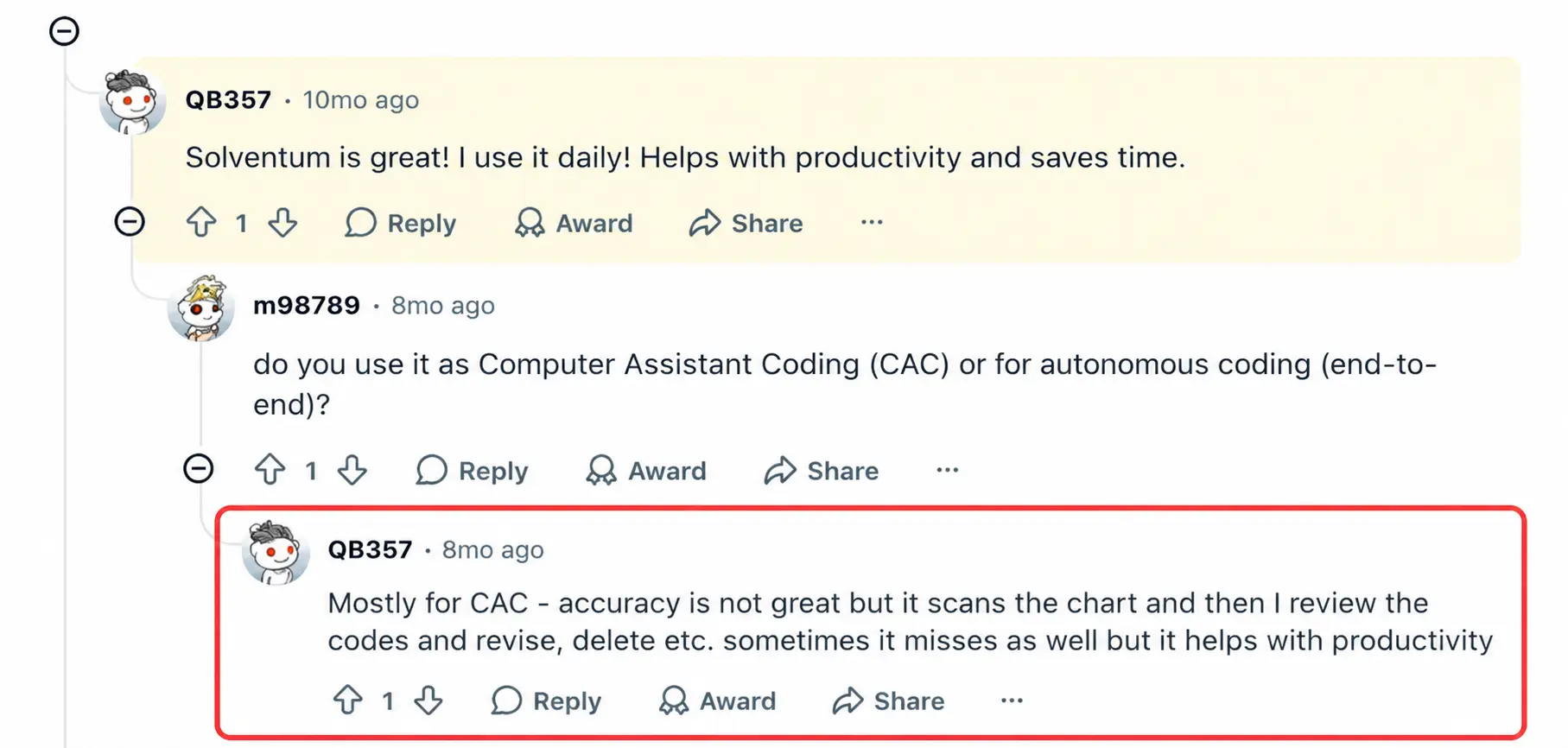
The commenter praised Solventum's CAC capabilities but expressed reservations about its autonomous coding solution.
CombineHealth, on the other hand, is built specifically for autonomous medical coding, not CAC. Rather than suggesting codes for manual review, CombineHealth performs the coding workflow and generates billing-ready coding decisions, with audit mode and approval controls available whenever a team wants to review before expanding automation.
More importantly, CombineHealth doesn't rely on a single headline accuracy percentage. As explained in its AI medical coding accuracy benchmarks guide, coding accuracy is measured across multiple dimensions, including CPT, ICD-10, E/M, modifiers, medical necessity, and autonomous coding rates.
CombineHealth has demonstrated 98.4% coding accuracy in high-volume, real-world emergency medicine environments.
For Brault, a leading emergency medicine RCM organization processing millions of encounters annually, CombineHealth achieved:
- 99.1% primary ICD accuracy
- 98.4% CPT accuracy
- 98.2% E/M accuracy
98.7% MIPS accuracyCombineHealth also maintained turnaround times below 12 hours during 2–3× volume spikes, with Brault planning to scale autonomous coding volume fivefold.
Read the Brault autonomous coding case study.
Category 2: Explainability and Governance
Both CombineHealth and Solventum support explainable medical coding and quality oversight, but their approaches differ. Solventum combines confidence-based medical coding, quality checks, and integrated auditing within its 360 Encompass platform, while CombineHealth provides code-level explanations linked to supporting clinical documentation, helping teams understand and review each autonomous coding decision.
Solventum's 360 Encompass Autonomous Coding module includes confidence scoring, quality assurance workflows, and visibility into which encounters were automated. The same platform's dedicated Audit Expert module supports prebill reviews, coding edits, and retrospective audits. These integrated governance workflows may suit health systems with established coding compliance and audit teams.
How CombineHealth Makes Coding Decisions Explainable
CombineHealth provides line-by-line rationale for its medical coding decisions linked to supporting clinical evidence. Rather than presenting only the assigned code, the platform gives reviewers information they can use to understand its selection.
Healthcare organizations can apply their own coding guidance and use audit mode to examine codes assigned through existing processes. This can help coding and compliance teams investigate an unexpected E/M level, an unsupported diagnosis, or a documentation gap without reviewing every encounter manually.
Because every code carries its rationale and the source documentation behind it, compliance and coding teams can resolve an audit finding or a payer question without reopening the full chart — turning explainability into faster audit response and fewer repeat queries, not just transparency on paper.
What Buyers Should Check in Coding Transparency and Governance
Ask both AI medical coding companies to demonstrate the same encounter from code assignment through audit. A useful evaluation should show:
- The clinical evidence and coding rules attached to each assigned code
- How confidence thresholds and exceptions determine when review is required
- Whether reviewers can trace changes, overrides, and approvals
- What audit records are available for both autonomous and human-reviewed encounters
Category 3: Clinical Documentation Improvement
Both CombineHealth and Solventum support clinical documentation improvement (CDI), but they organize it differently. Solventum offers a dedicated CDI module that works alongside its coding tools within the integrated 360 Encompass platform, while CombineHealth incorporates documentation checks into its autonomous medical coding workflow.
The Solventum 360 Encompass Clinical Documentation Integrity System supports prioritized worklists, electronic physician queries, clinical validity checks, and quality-related documentation review. It can help medical coding specialists prioritize records using measures such as severity of illness, mortality risk, diagnosis-related groups, and length of stay.
Solventum also confirms that its CAC module integrates with CDI, supporting coordination between coding and documentation teams. The CDI module is part of the wider platform, although buyers should confirm which modules are included in their proposed deployment.
How CombineHealth Integrates CDI into Autonomous Coding
CombineHealth natively integrates CDI checks into its autonomous medical coding workflow. As CombineHealth reviews encounter documentation, it can identify gaps, check whether the evidence supports a code, and flag cases requiring clarification.
This places documentation checks within the workflow that produces autonomous coding outputs.
In a deployment at a 400-bed hospital, CombineHealth identified five times more CDI opportunities than the hospital's previous manual workflow within three months.
By reviewing clinical documentation during autonomous coding, the platform identified gaps such as missing diagnosis specificity, unsupported diagnoses, and insufficient documentation for medical necessity.
Recommended Read: Why Autonomous Medical Coding & CDI Must Operate As One Workflow
Category 4: Payer Intelligence and Denial Prevention
Both CombineHealth and Solventum use payer intelligence to identify denial risks, but their approaches differ. Solventum analyzes payer behavior, coding trends, and payment data to predict and prevent denials, while CombineHealth learns from actual claim outcomes to improve future payer-specific coding decisions, helping prevent recurring coding-related denials.
Solventum's Revenue Integrity System analyzes clinical, coding, and payment information to identify denial causes and predict denials. Solventum states that its machine learning models use historical financial data, payer behavior, medical coding trends, and documentation gaps to support intervention before claims are submitted.
How CombineHealth Learns From Payer Outcomes
CombineHealth has a payer intelligence feature that learns from actual claim outcomes, including denials, reimbursements, underpayments, and payer edits. It identifies recurring payer-specific patterns and uses these insights to improve future coding decisions, documentation checks, and prebill validations, helping reduce the risk of repeated coding-related denials.
For example, if repeated denials expose a missing payer-required modifier, the relevant policy can be reviewed and applied to future encounters. This connects a downstream outcome with an upstream coding decision rather than relying only on a static edit.
CombineHealth reports the following results at a 400-bed hospital over three months:
- 75% fewer coding-related denials
- 4% higher captured revenue
- Five times more CDI opportunities identified
Category 5: EHR Integration and Implementation
Both CombineHealth and Solventum support EHR integration, but their approaches differ. Solventum integrates autonomous coding within its established 360 Encompass platform and has an Epic Toolbox designation, while CombineHealth integrates with major EHR systems, including Epic, Oracle Cerner, athenahealth, and eClinicalWorks, offering flexible integration options ranging from report-based workflows to deeper system connections.
Solventum has longstanding integration experience in hospital coding operations. In August 2024, it announced Epic Toolbox designation for its autonomous coding solution in the Fully Autonomous Coding category. For a health system, Solventum reports that the hospital implemented its 360 Encompass cloud platform in four months, compared with up to nine months for a conventional on-premises implementation.
How CombineHealth Approaches EHR Integration
CombineHealth's AI-powered platform is designed to integrate directly with existing EHR systems, allowing healthcare organizations to connect patient information with automated coding and revenue cycle workflows without replacing their current software.
The integration approach focuses on reducing data silos, minimizing disruption to existing workflows, and helping teams access the information needed for coding and billing.
In the Brault case study, CombineHealth reports cutting the time needed to launch autonomous coding at a new site and meet Brault's accuracy requirements from approximately 1.5 months to two weeks as the rollout progressed across multiple sites.
What Buyers Should Ask Regarding Integration
Ask both vendors for an implementation plan based on your specific EHR and practice management environment. Verify:
- How clinical documentation is retrieved and coded results are written back
- Which interfaces, mappings, and security reviews are needed
- How incomplete records and exceptions are handled
- Who owns validation, audit access, training, and go-live sign-off
- What the actual milestones and fallback plans look like
Category 6: Connection to the Broader Revenue Cycle
Solventum brings together specialized coding, CDI, auditing, and revenue integrity modules within its integrated 360 Encompass platform, while CombineHealth connects autonomous coding with a broader AI-powered RCM platform covering billing, payment posting, denial management, and appeals.
Solventum also offers a Revenue Integrity System that uses clinical and financial data to predict denial risks and recommend actions before claims reach billing. However, its published product documentation focuses primarily on coding, documentation, auditing, and revenue integrity rather than directly automating downstream billing, A/R follow-up, and appeals.
This connected loop is what coding-only or coding-plus-CDI suites can't reproduce: because CombineHealth's coding learns from what happens after the claim, the same system that codes the encounter also drove 75% fewer coding-related denials and 4% higher captured revenue at a 400-bed hospital — outcomes that only emerge when coding, billing, and denial workflows operate together rather than as separate modules.
How CombineHealth Connects Medical Coding with Downstream RCM Workflows
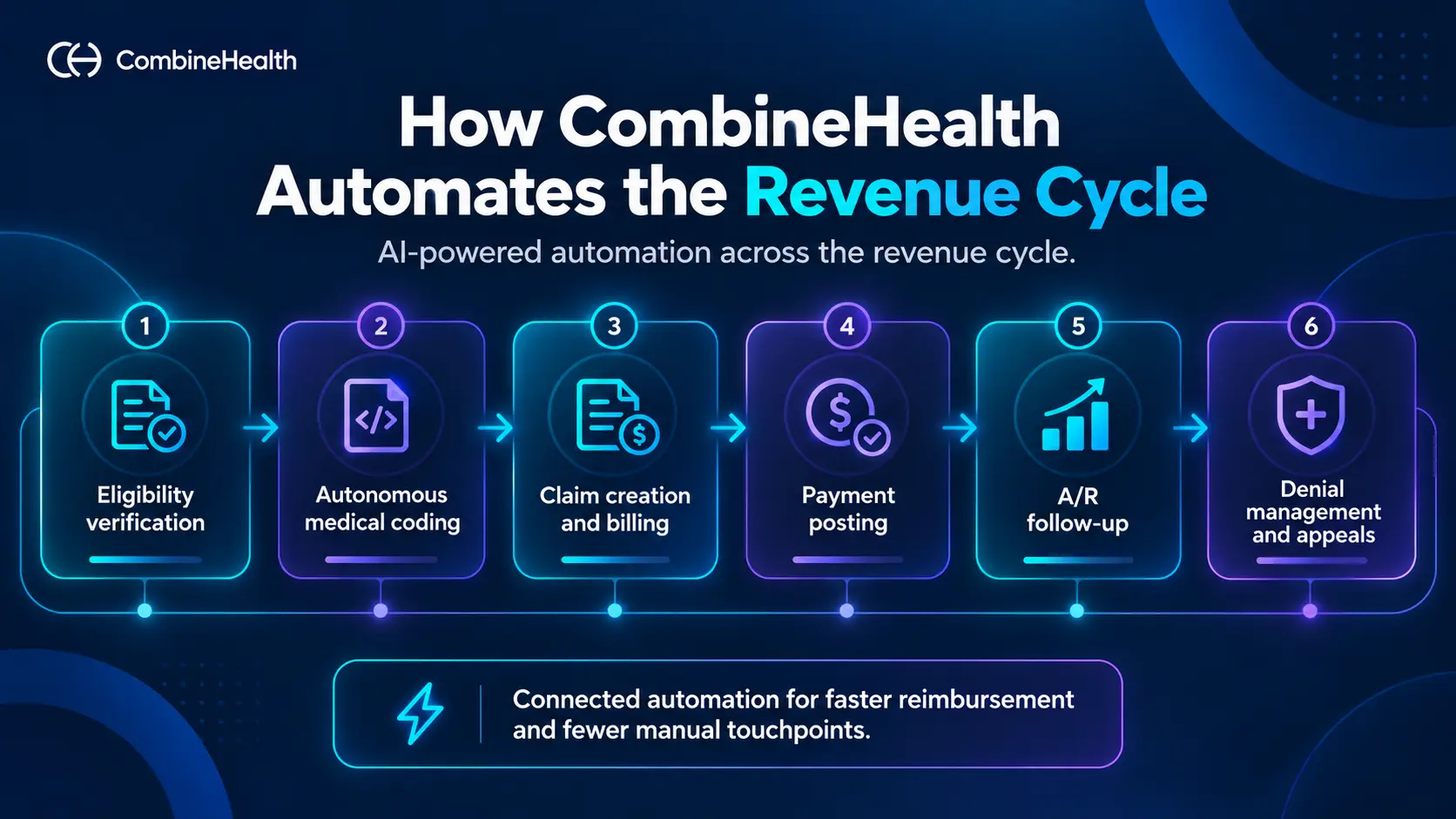
CombineHealth takes a broader approach through its AI-powered revenue cycle management platform. Instead of stopping at autonomous medical code generation, CombineHealth extends AI-powered automation across the revenue cycle, covering eligibility verification, claim creation and submission, billing checks, and payment posting.
It also automates claim status tracking, payer follow-ups, denial analysis, and denial appeal preparation. It also provides revenue cycle analytics to help healthcare organizations identify bottlenecks, prioritize outstanding claims, and improve collections.
CombineHealth's self-learning autonomous medical coding connects these RCM workflows by analyzing actual claim outcomes, including payer denials, reimbursement patterns, and coding edits. These insights feed back into payer-specific coding strategies, documentation checks, and prebill validations, helping improve future coding decisions and prevent recurring denials.
CombineHealth vs. Solventum: Where Each Platform Stands Out
Where CombineHealth Stands Out
CombineHealth may be the stronger fit for organizations prioritizing connected autonomous coding and measurable downstream outcomes.
Consider CombineHealth if:
- You want payer outcomes to inform future medical coding policies
- You need code-level explanations linked to clinical documentation
- You want CDI checks embedded into autonomous coding
- You plan to evaluate the platform through audit mode before expanding automation
- You want coding connected with eligibility, billing, A/R, denials, and appeals
- You value detailed, production-based performance evidence such as the Brault coding results
CombineHealth is especially worth considering when the buying team includes both coding leaders and executives responsible for wider RCM results.
Where Solventum Stands Out
Solventum may be the stronger fit for health systems seeking an established enterprise coding and documentation environment.
Consider Solventum if:
- Your organization already uses 360 Encompass and wants to add autonomous coding within that platform
- You rely on mature CAC workflows integrated with autonomous coding and human review
- You need dedicated CDI capabilities across multiple care settings
- You require prebill and retrospective audit workflows
- Epic Toolbox designation is relevant to your technology evaluation
- You want access to consulting, education, and workflow redesign services
Final Verdict: Should You Choose Solventum or CombineHealth?
Choose Solventum when your priority is an established enterprise platform that combines mature CAC, autonomous coding, and dedicated CDI and auditing modules within an integrated workflow.
Choose CombineHealth when you want explainable autonomous medical coding that connects payer-specific learning, CDI, denial prevention, and other revenue cycle workflows.
CombineHealth's payer-intelligence approach also makes it relevant to organizations aiming to improve coding decisions based on actual claim outcomes.
Neither platform should be selected solely on a headline accuracy percentage.
For a 2027 purchase decision, the strongest evaluation uses representative encounters, common accuracy measurements, agreed automation targets, and clear financial KPIs.
If your organization wants to evaluate connected autonomous coding across its revenue cycle, book a demo and assess CombineHealth using your own coding and workflow requirements.
FAQs
1. Which is better for medical coding: CombineHealth or Solventum?
CombineHealth may be a better fit for connected autonomous coding and payer-informed RCM automation. Solventum may be a better fit for health systems needing an established coding, CDI, and audit ecosystem. The right choice depends on your workflow priorities and evaluation results.
2. Does Solventum offer fully autonomous medical coding?
Yes. The Solventum 360 Encompass Autonomous Coding System can complete qualifying encounters without routine coder intervention. The same integrated 360 Encompass platform includes a Computer-Assisted Coding module for coder-reviewed suggestions and encounters requiring human attention.
3. Is CombineHealth more accurate than Solventum?
The published figures do not establish a direct winner. CombineHealth reports 98%+ accuracy across key dimensions at Brault, while Solventum reports approximately 95% accuracy in specified autonomous coding settings. The encounter populations and measurement methods differ.
4. Which platform offers greater autonomous coding coverage?
CombineHealth reports an 85% coding automation rate, while Solventum publishes care-setting-specific realized automation results. Buyers should compare qualifying encounters and fully automated outcomes using the same test population.
5. Does Solventum have payer intelligence?
Yes. The Solventum Revenue Integrity System analyzes clinical, coding, and payment information to predict denial risks and recommend interventions. Buyers should separately verify how those insights affect subsequent autonomous coding decisions.
6. How does CombineHealth use claim outcomes to improve coding?
CombineHealth analyzes payer-specific denials, reimbursement patterns, and other claim outcomes. Validated findings can inform future coding policies and prebill checks, helping teams address recurring issues.
7. How quickly can CombineHealth be deployed compared with Solventum?
CombineHealth reports that recent Brault site deployments reached go-live in about two weeks. Solventum’s Boone Health deployment took about four months.
8. Can CombineHealth replace a CAC workflow, or does it only assist coders?
CombineHealth is built for autonomous coding rather than computer-assisted coding (CAC). Instead of suggesting codes for a coder to review on every encounter, it codes eligible encounters end to end and produces billing-ready decisions, while audit mode and approval controls let teams review before and as they scale automation.