Top Orthopedic Medical Coding Challenges for Physician Groups and Health Systems
Explore 6 orthopedic medical coding challenges, from payer-specific modifiers and prior authorizations to costly denials, and how to prevent them.
Published on:
October 28, 2026


Orthopedic medical coding is among the most complex in healthcare — payer-specific modifier rules, laterality, bundling edits, global surgical periods, and operative documentation that varies surgeon to surgeon. The result is inconsistency and avoidable denials and the fix is an autonomous medical coding system built for this complexity.
CombineHealth is a self-learning autonomous medical coding platform that codes orthopedic encounters — reading the full operative note, applying each payer's modifier and laterality rules, checking NCCI and bundling edits, and flagging documentation gaps before the claim goes out — with an explainable rationale for every code, at 98.4% coding accuracy. At a 400-bed hospital, that approach cut coding-related denials 75% and surfaced 5× more documentation opportunities.
How Is Orthopedic Medical Coding Different from Any Other Specialty Coding
Orthopedic coding follows the same basic process as other specialties. Coders review clinical documentation, assign ICD-10-CM diagnosis codes and CPT/HCPCS procedure codes, apply modifiers, and validate claims against applicable billing requirements.
However, orthopedic coding requires greater attention to anatomical details, surgical techniques, laterality, and procedure-specific reimbursement rules. A 2025 study found that at least four of five orthopedic surgeons agreed on the primary CPT code in only 33.3% of cases, and on modifier usage in just 41.7%. This highlights the complexity of orthopedic coding, even among experienced surgeons.
Hospitals face additional complexity because inpatient facility procedures use ICD-10-PCS, while physician professional services generally use CPT/HCPCS.
6 Major Medical Coding Challenges in Orthopedic Practices
1. Different Payers Require Different Modifiers for the Same Procedure
One of the biggest orthopedic coding challenges is that insurers may require different modifiers and claim formats for the same procedure. Coders must account for laterality, procedure-specific rules, and payer requirements to avoid denials and underpayments.
For example, consider a patient undergoing the same eligible procedure on both knees during one surgical session. Depending on the payer's requirements:
Modifier 50 may be required to report the bilateral procedure on one claim line.
Modifiers RT and LT may be required on separate lines to identify procedures performed on the right and left knees.
According to CMS, Medicare generally reimburses eligible bilateral procedures with payment indicator 1 at 150% of the single-procedure fee schedule amount, subject to applicable payment rules. However, commercial insurers and Medicaid programs may follow different billing conventions.
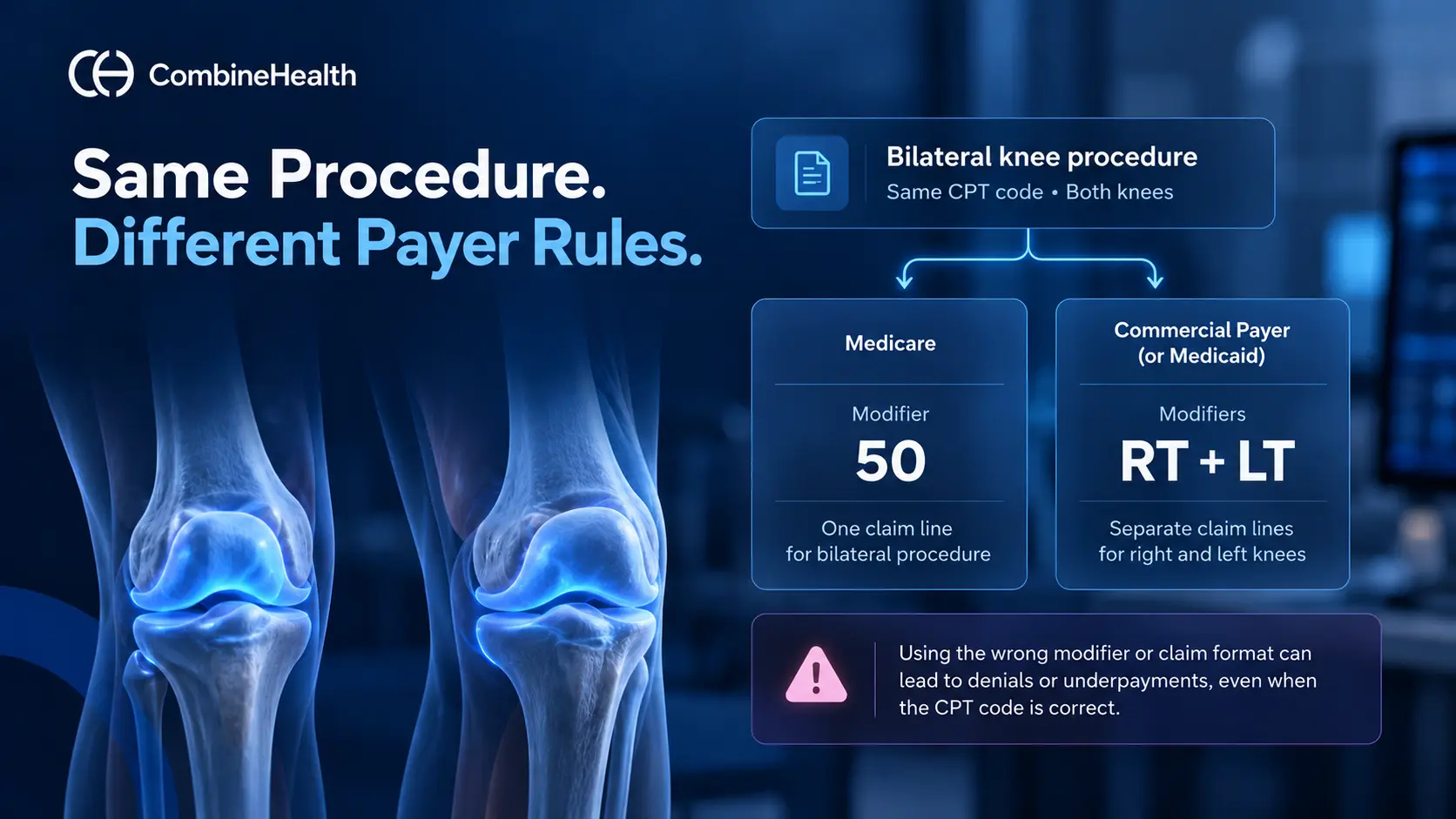
The challenge isn't necessarily frequent changes in payer policies, but consistently applying the correct rules across insurers. Using the wrong modifier or claim format can delay or reduce reimbursement, even when the underlying orthopedic CPT code is correct.
This is exactly the inconsistency CombineHealth removes. It applies each payer's modifier and laterality conventions automatically — modifier 50 for a bilateral procedure on one payer, RT/LT on separate lines for another — and validates the finished claim against that payer's rules before submission, so the correct format reaches the payer even when the CPT code is identical across insurers.
2. Prior Authorization Details Don't Always Match the Final Procedure
Orthopedic surgeries often require prior authorization, but the approved services may not always match the procedures ultimately performed. Discrepancies in CPT codes, laterality, or authorization details can lead to denials, even when the medical coding is accurate.
For example, a surgeon receives authorization for a knee procedure but performs an additional procedure after identifying another problem during surgery. Before billing, the practice must verify whether the additional service requires separate authorization or qualifies for retrospective approval.
Other common discrepancies include:
- Incorrect CPT code or laterality: The authorization doesn't match the procedure or surgical site.
- Date mismatch: The procedure falls outside the authorization's approved date range.
- Missing procedure approval: Additional services performed aren't covered by the original authorization.
The administrative burden is significant. According to the AMA's 2025 prior authorization survey, practices completed an average of 39 prior authorizations per physician per week, consuming approximately 13 hours of physician and staff time.
For orthopedic practices, this makes authorization verification an essential pre-bill step. Coding and billing teams must ensure that the procedures documented, coded, and submitted align with the payer's authorization requirements.
Recommended Reading: Top orthopedic AI medical coding solutions
3. Multiple Orthopedic Procedures Create Bundling and Unbundling Risks
Orthopedic surgeries often involve several related procedures during the same operative session.
For example, a surgeon performing knee arthroscopy might repair a meniscus and perform debridement.
The coder must determine whether the debridement is separately reportable or included in another billed procedure. This depends on the specific CPT codes, operative documentation, applicable NCCI edits, and payer policies.
Two types of errors can occur:
Unbundling: Billing procedures separately when they should be included in a comprehensive procedure code.
Undercoding: Failing to report a distinct, separately payable procedure supported by documentation and coding rules.
Both affect revenue integrity. Unbundling creates compliance and denial risks, while undercoding can result in missed reimbursement.
CombineHealth evaluates these bundling decisions on every operative note. It checks code combinations against NCCI edits and payer policy to flag unbundling risk, and — because it reads the complete operative report rather than a charge summary — it catches the separately payable work that otherwise gets undercoded. In a 400-bed deployment, that full-record review surfaced 5× more documentation and coding opportunities than the manual workflow.
4. Incomplete Documentation Makes Accurate Code Selection Difficult
Orthopedic medical coding requires detailed documentation of anatomy, injury severity, and procedures performed. Missing clinical details can prevent coders from selecting the most specific ICD-10-CM or CPT code, leading to physician queries, coding delays, or less-specific coding where permitted.
For example, fracture coding may require documentation of:
- Anatomical details: Exact bone, fracture location, and laterality.
- Fracture characteristics: Whether the fracture is displaced or nondisplaced, open or closed.
- Healing status: Whether the fracture is healing routinely, experiencing delayed healing, or has developed nonunion.
Because CombineHealth reviews documentation as it codes, it flags exactly these gaps — missing laterality, fracture characteristics, or healing status — as a CDI alert or query before the claim is submitted, rather than after a denial. The query goes out with the specific missing detail identified, so coding isn't held waiting on a vague "fracture follow-up" note.
If a physician documents only "fracture follow-up," the coder may not have enough information to assign the appropriate ICD-10-CM code. Similarly, an operative report that doesn't clearly describe the surgical work performed can make CPT selection difficult.
For large orthopedic groups and health systems, variations in documentation across surgeons further increase manual review, physician queries, and coding turnaround times.
5. Global Surgical Periods Complicate E/M Billing
Many orthopedic procedures include postoperative care within a global surgical payment package. Routine follow-up visits during this period are generally included in the original procedure's reimbursement, while certain unrelated services may qualify for separate payment.
For example, a patient recovering from right knee replacement visits the same orthopedic surgeon for a new, unrelated shoulder problem. If the physician performs and documents a separately billable E/M service, modifier 24 may be appropriate under Medicare's global surgery rules.
The challenge is distinguishing routine postoperative care from separately billable services. Incorrectly billing included follow-up visits can trigger denials, while overlooking eligible E/M services can result in missed reimbursement.
6. Large Orthopedic Groups Struggle to Maintain Coding Consistency
Large orthopedic groups and health systems often have surgeons working across joint replacement, sports medicine, spine, trauma, and other subspecialties. Differences in documentation styles, procedure complexity, and coding practices make it difficult to maintain consistency across locations.
For example, consider an orthopedic group with 30 surgeons across multiple locations. Two surgeons may perform similar procedures but document them differently, requiring coders to interpret each operative report while applying consistent CPT codes, modifiers, and payer-specific rules.
Without standardized coding workflows, similar encounters may be coded inconsistently, increasing manual audits, coding backlogs, and turnaround times as patient volumes grow.
Consistency at scale is where autonomous medical coding pulls ahead of a large coder team. CombineHealth applies one coding logic across every surgeon and location, so similar encounters are coded the same way regardless of documentation style.
For Brault, an RCM organization running CombineHealth in production across many sites, it sustained 98%+ accuracy across every major coding dimension — 99.1% primary ICD, 98.4% CPT, 98.2% E/M — in recurring audits, held sub-12-hour turnaround through 2–3× volume spikes, and brought new sites live in about two weeks.
Why Even a 10% Orthopedic Denial Rate Can Be Costly
Orthopedic practices don't necessarily need unusually high denial rates to experience substantial financial exposure. With high-value procedures such as joint replacements and fracture surgeries, even a small number of denied claims can affect cash flow.
According to CMS's 2024 Medicare data, major hip and knee replacements and lower-extremity reattachments accounted for $546.7 million in projected improper payments, with a 43.6% improper payment rate. Medical necessity issues accounted for 92.8% of these improper payments.
While improper payments aren't the same as claim denials, these figures highlight the financial stakes of orthopedic reimbursement.
This is the denial exposure CombineHealth is built to shrink. By catching payer-rule, modifier, documentation, and medical-necessity issues before the claim is submitted — and learning each payer's denial patterns over time — it prevents the avoidable high-value denials that put six figures at risk.
At a 400-bed hospital, CombineHealth cut coding-related denials 75% and lifted captured revenue 4% within three months. On a $500,000-at-risk month like the example above, preventing even a share of those denials protects real cash.
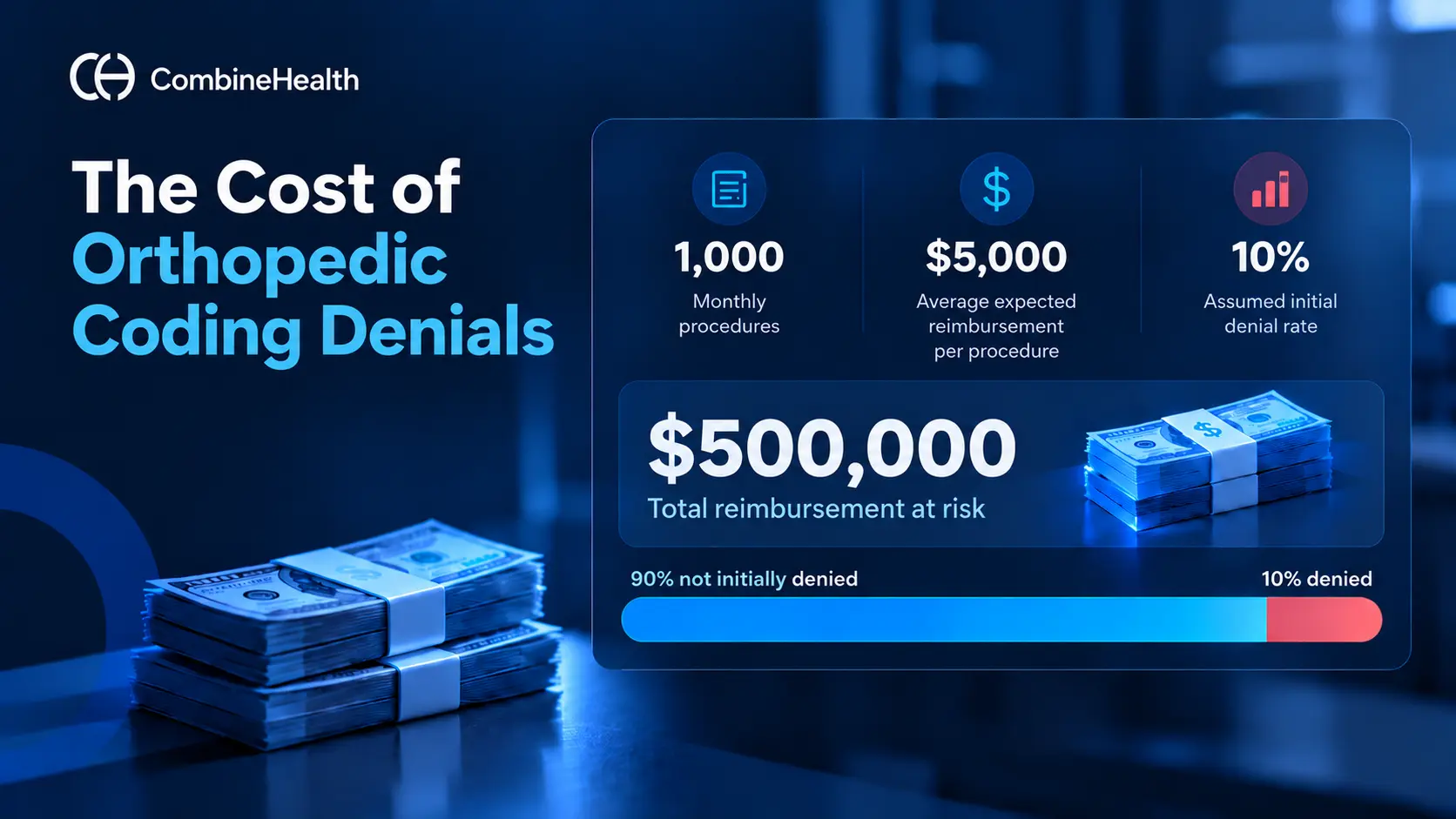
Consider an illustrative orthopedic group processing 1,000 procedures monthly, with an average expected reimbursement of $5,000.
In this scenario, a 10% denial rate puts $500,000 in expected reimbursement at risk of delay or nonpayment. Some claims may eventually be corrected and paid, but each denial adds administrative work for coding, billing, and A/R teams.
Turn Orthopedic Coding Complexity Into Clean Claims
Orthopedic coding won't get simpler, payer rules, laterality, bundling edits, and global periods will keep generating avoidable denials wherever coding is inconsistent. The organizations that stay ahead pair accurate, consistent coding with denial prevention at the source.
CombineHealth codes orthopedic encounters autonomously, applies each payer's rules, flags documentation gaps before billing, and learns from denial patterns to prevent recurring ones, with an explainable rationale for every code.
Book a demo to see how CombineHealth codes your orthopedic encounters and reduces coding-related denials.
FAQs
How does CombineHealth handle orthopedic coding complexity?
CombineHealth reads the full operative note and codes orthopedic encounters end to end — assigning ICD-10-CM, CPT, HCPCS, E/M, and modifier codes while accounting for laterality, fracture detail, surgical approach, implants, and global surgical periods. It applies each payer's rules and checks NCCI and bundling edits before the claim goes out, with an explainable rationale for every code — at 98.4% coding accuracy.
Can CombineHealth apply payer-specific modifier and laterality rules automatically?
Yes. CombineHealth applies the right modifier and claim format for each payer — for example, modifier 50 for a bilateral procedure on one payer versus RT/LT on separate lines for another — so the same CPT code is submitted correctly across insurers, reducing modifier-driven denials and underpayments.
Does CombineHealth catch bundling errors and undercoding in orthopedic surgery?
Yes. CombineHealth checks code combinations against NCCI edits and payer policy to flag unbundling risk, and because it reviews the complete operative report, it surfaces separately payable work that would otherwise be undercoded. In a 400-bed deployment, it surfaced 5× more documentation and coding opportunities than the manual workflow.
How does CombineHealth handle inconsistent documentation across surgeons?
CombineHealth applies one consistent coding logic across every surgeon and location, so similar encounters are coded the same way regardless of documentation style. When a note is missing required detail — laterality, fracture characteristics, or healing status — it raises a CDI alert or query with the specific gap identified, rather than holding the chart or guessing.
Does CombineHealth reduce orthopedic coding-related denials?
Yes. By validating coding, modifiers, documentation, and payer-specific requirements before submission and learning from denial patterns over time, CombineHealth prevents avoidable denials upstream. At a 400-bed hospital, it reduced coding-related denials 75% and increased captured revenue 4% within three months.
Can CombineHealth audit our existing orthopedic codes?
Yes. CombineHealth runs in an audit mode that reviews codes assigned by surgeons, coders, or your EHR against the operative documentation, flagging unsupported codes, missed procedures, and documentation gaps, so you can add AI-powered review alongside your current coding process without replacing it.