CombineHealth vs. XpertDox: Which AI Medical Coding Platform Is Better?
Compare CombineHealth and XpertDox across coding accuracy, automation, CDI, payer intelligence, EHR integration, & revenue cycle capabilities.
Published on:
November 17, 2026


Both CombineHealth and XpertDox offer autonomous medical coding, but their differences extend beyond medical coding accuracy and automation rates.
This article compares CombineHealth and XpertDox across coding accuracy, implementation, customer feedback, explainability, CDI, payer intelligence, EHR integration, and broader revenue cycle capabilities to help healthcare organizations choose the right platform.
Category 1: Autonomous Medical Coding and Accuracy
Buyer takeaway: CombineHealth achieved 99.1% primary ICD, 98.4% CPT, and 98.2% E/M accuracy in Brault's audited production deployment. XpertDox publishes over 99% overall coding accuracy, not individual dimensions. While both demonstrate strong reported performance, CombineHealth provides detailed results across individual coding dimensions.
XpertDox's XpertCoding uses hybrid AI combining ensemble models, neural networks, symbolic reasoning, and payer guidelines. It reports over 99% coding accuracy and provides a performance warranty for more than 90% fully autonomous coding. The platform also reports that over 94% of claims are submitted within 24 hours.
How CombineHealth Approaches Autonomous Medical Coding
CombineHealth's autonomous medical coding platform goes beyond assigning medical codes. It analyzes complete clinical encounters, applies coding guidelines and payer-specific rules, and generates ICD-10, CPT, E/M, modifier, and other coding outputs. Each coding decision comes with supporting clinical evidence and an explanation, allowing coding teams to validate the assigned codes and identify documentation gaps.
In an independent coding evaluation involving 1,000 emergency department charts, CombineHealth matched or outperformed expert human coders across all four measured coding dimensions. The results included:
- 95.9% E/M accuracy, compared with 94.7% for expert coders.
- 93.2% ICD-10 accuracy, compared with 92.2% for expert coders.
- 99% CPT accuracy and 100% modifier accuracy, matching expert coders.
- Approximately 85% autonomous coding, with the remaining charts escalated for human review.
In its Brault production deployment, CombineHealth achieved:
- 99.1% primary ICD accuracy
- 98.4% CPT accuracy
- 98.2% E/M accuracy
- 98.7% MIPS accuracy
- Coding turnaround below 12 hours, including during substantial volume spikes
These results remained above Brault's expected accuracy thresholds through recurring production audits, while coding turnaround stayed below 12 hours during volume spikes.
2. Explainability and Coding Governance
Buyer takeaway: CombineHealth links its coding decisions to clinical evidence, applicable rules, and versioned audit records. Its Brault deployment also demonstrated recurring audits across four reported coding dimensions. XpertDox provides audit trails and manual-review dashboards, but buyers should compare the depth of code-level explanations during evaluation.
XpertDox provides coding transparency through its Business Intelligence platform, which includes audit trails, coding performance dashboards, and manual-review monitoring.
XpertDoc platform also provides documentation feedback to support compliance and coding quality. These capabilities help organizations maintain oversight of automated coding, although buyers should evaluate the level of clinical evidence and coding rationale available for individual decisions.
How CombineHealth Makes Coding Decisions Traceable and Audit-Ready
CombineHealth takes explainability further by making the clinical evidence and reasoning behind individual medical coding decisions directly accessible to medical coders, auditors, and compliance teams.
When CombineHealth assigns ICD-10, CPT, E/M, or modifier codes, its explainable AI provides:
- Supporting clinical evidence: The specific documentation, findings, and interpretations supporting each assigned code.
- Coding rationale: The applicable coding guidelines, E/M criteria, and payer-specific requirements.
- Alternative code explanations: Why competing codes were excluded from the final assignment.
- Documentation gap identification: Missing or insufficient clinical information that may require clarification.
CombineHealth strengthens governance through its code-level audit trails. Each coding decision can be traced to the original clinical documentation, applicable guidelines, and supporting rationale, with versioned records that preserve earlier decisions for review. These records support internal quality checks, payer audits, and claim denial appeals.
3. Clinical Documentation Improvement (CDI)
Buyer takeaway: CombineHealth stands out for integrating documentation checks and provider queries directly into autonomous medical coding.
In a production deployment, CombineHealth identified approximately 5× more CDI-triggering documentation gaps than the traditional medical coding workflow in a 1,000-chart emergency department evaluation. XpertDox provides CDI dashboards and provider documentation feedback, with customer evidence from a health center.
XpertDox supports CDI through its Business Intelligence platform, which provides documentation feedback and visibility into encounters requiring manual review. Its dashboards help coding teams identify documentation gaps and improve coding quality. At CHP Berkshires, the organization highlighted the value of its provider documentation improvement and HCC dashboards.
CombineHealth's Integrated Approach to Clinical Documentation Improvement
CombineHealth integrates CDI directly into autonomous medical coding, identifying missing, conflicting, or insufficient documentation as CombineHealth processes clinical encounters. This helps coding teams address documentation gaps before claims reach billing.
As CombineHealth processes an encounter, it checks for documentation issues that could affect code selection, medical necessity, or reimbursement. These include:
- Missing diagnosis specificity or contradictory clinical information.
- Unsupported diagnoses, procedures, or modifiers.
- Missing critical care time or incomplete procedure details.
- Insufficient medical necessity documentation.
- Missing evidence required to support E/M coding decisions.
In a 1,000-chart emergency department evaluation with Edelberg & Associates, CombineHealth identified approximately five times more CDI-triggering documentation gaps than the traditional coding workflow while matching or outperforming expert human coders across the measured coding dimensions.
In a 400-bed hospital deployment, CombineHealth identified five times more CDI opportunities and reduced coding-related denials by 75% within three months.
4. Payer Intelligence and Denial Prevention
Buyer takeaway: CombineHealth reduced coding-related denials by 75% at a 400-bed hospital within three months, while XpertDox reported a 22% reduction in claim denials at Nao Medical. Although these results come from different deployments and measure different denial categories, CombineHealth stands out for using actual payer outcomes to improve future coding decisions and prevent recurring denials.
XpertDox supports denial prevention through payer-specific coding rules and its Smart Claim Scrubber. The platform validates coding outputs against configurable payer requirements and flags potential errors before submission. At a health center, XpertCoding contributed to a 22% reduction in claim denials and a 15% increase in charge capture.
How CombineHealth Uses Payer Intelligence to Prevent Repeat Denials
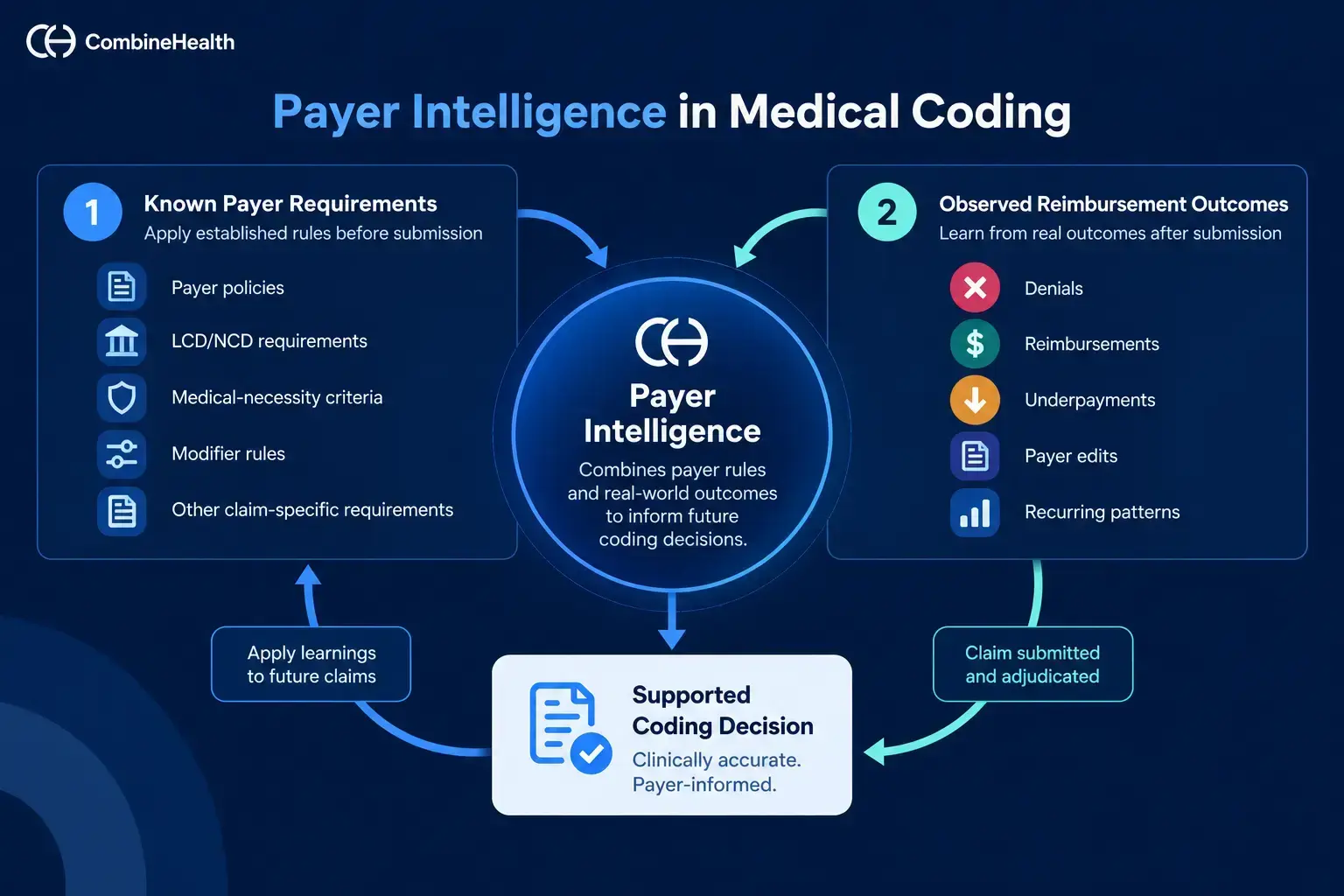
CombineHealth uses self-learning payer intelligence to prevent recurring denials by analyzing outcomes from previously processed claims, including denials, reimbursements, and payer edits. It applies these learnings to validate coding decisions before submission, identify recurring denial patterns, and improve future coding accuracy.
CombineHealth's payer intelligence helped achieve a 75% reduction in coding-related denials within three months and a 4% increase in captured revenue by identifying undercoded encounters at a 400-bed Midwest hospital.
Essentially, CombineHealth’s self-learning payer intelligence combines two capabilities:
- Pre-submission validation: Checks medical coding decisions against payer-specific policies, medical necessity requirements, modifiers, and coding guidelines before claims are submitted.
- Outcome-driven learning: Analyzes claim denials, reimbursements, underpayments, and payer edits to improve future coding and claim-validation rules.
5. EHR Integration and Implementation
Buyer takeaway: CombineHealth integrates with major EHR platforms, including Epic, Oracle Cerner, athenahealth, and more. At Brault, deployment timelines improved from six weeks to two weeks. XpertDox also supports major EHRs, reporting connection timelines of under one week for selected systems and under four weeks for Epic and ModMed.
XpertDox supports integration with major electronic health record (EHR) and practice management systems, including Epic, athenahealth, eClinicalWorks, NextGen, Experity, and ModMed. Its EHR connectivity framework uses APIs, robotic process automation (RPA), SMART on FHIR, and HL7-ADT messaging to exchange clinical information and return coding outputs to existing systems.
CombineHealth's EHR Integration and Deployment Capabilities
CombineHealth integrates with major EHR and practice management platforms, including Epic, Oracle Cerner, athenahealth, eClinicalWorks, NextGen, ModMed, Greenway, AdvancedMD, and CareCloud. Through APIs, HL7, and custom interfaces, it connects CombineHealth to existing clinical documentation and coding workflows, allowing healthcare organizations to automate medical coding without replacing their existing systems or disrupting established processes.
CombineHealth supports two integration approaches:
- A lighter report-based integration allows organizations to exchange clinical records and coding outputs.
- A deeper EHR integration that automatically retrieves encounter data and writes approved codes back into existing EHR or practice management work queues.
For deeper integrations, CombineHealth typically scopes deployment at around four weeks. Implementation includes mapping existing workflows, configuring site-specific coding and billing rules, and testing outputs against historical charts before go-live.
Recommended Read: Top 10 Autonomous Medical Coding Platforms with Fast EHR Integration Services
6. Connection to Broader Revenue Cycle Management
Buyer takeaway: CombineHealth connects medical coding with billing, A/R management, appeals, and analytics through its AI-powered RCM platform. XpertDox also extends beyond coding into claim scrubbing, billing, charge recovery, and analytics. CombineHealth's key differentiator is its self-learning payer intelligence, which uses actual denial and reimbursement outcomes to improve future coding decisions and prevent recurring denials.
XpertDox extends autonomous medical coding into claim generation, payer-specific claim scrubbing, automated billing, and charge recovery. Its Business Intelligence platform provides visibility into coding performance, documentation improvement, and revenue cycle metrics. Through RCM and clearinghouse integrations, XpertDox helps organizations submit cleaner claims, reduce denials, and shorten the accounts receivable cycle.
How CombineHealth Connects to Broader Revenue Cycle Workflows
CombineHealth's AI-powered RCM platform connects eligibility, medical coding, CDI, billing, payment posting, A/R follow-up, denial management, appeals, and analytics in one platform.
CombineHealth particularly stands out in denial management through its self-learning payer intelligence. By analyzing actual payer outcomes, including denials, reimbursements, underpayments, and payer edits, it identifies recurring patterns and uses those insights to improve future coding decisions and prevent repeat denials.
Recommended Read: How to Improve Accounts Receivable Days in Medical Billing
CombineHealth offers these key specialties of RCM:
- Medical coding: Automates code assignment, identifies documentation gaps, and supports coding audits.
- Medical billing: Handles eligibility checks, claim validation, and submission workflows.
- Accounts receivable (A/R) management: Automates payer follow-ups, tracks outstanding claims, and prioritizes collection activities.
- Appeals management: Prepares appeals using supporting documentation and payer-specific requirements.
- RCM analytics: Monitors revenue cycle performance, identifies revenue leakage, and highlights opportunities for improvement.
For healthcare organizations managing large claim volumes across multiple departments, this connected approach provides opportunities to improve both operational efficiency and financial performance beyond the coding function.
Recommended Read: 10 Best End-to-End RCM Solutions
Final Verdict: Should You Choose CombineHealth or XpertDox?
XpertDox is a strong option for organizations looking to automate medical coding, apply payer-specific claim checks, and streamline claim generation and submission. Its platform also offers an automation warranty of over 90%, making it worth evaluating for organizations prioritizing coding automation.
CombineHealth is designed for organizations that want autonomous medical coding to drive measurable improvements across the revenue cycle, not just automate code assignment. Its platform connects coding with clinical documentation improvement (CDI), payer intelligence, denial prevention, appeals, and revenue integrity.
What differentiates CombineHealth is its self-learning approach to payer intelligence. The platform uses validated payer outcomes, including denials, reimbursements, underpayments, and payer edits, to continuously improve future coding decisions and pre-bill checks. This helps organizations address the underlying causes of revenue leakage rather than treating coding accuracy as the final measure of success.
CombineHealth has also demonstrated 98%+ coding accuracy in high-volume emergency medicine workflows, alongside a turnaround time of under 12 hours.
Book a demo to evaluate how CombineHealth’s autonomous medical coding learns from actual payer outcomes, connects coding with the wider revenue cycle, and performs against your own encounters and payer requirements.
FAQs
Is CombineHealth or XpertDox more accurate in medical coding?
XpertDox publishes over 99% overall coding accuracy without a breakdown, while CombineHealth reports 98.4% coding accuracy by dimension: 99.1% primary ICD, 98.4% CPT, 98.2% E/M, and 98.7% MIPS in Brault's audited production deployment. Compare them on your own encounters and ask each vendor exactly how the number is measured.
Which platform, CombineHealth or XpertDox is better for clinical documentation improvement (CDI)?
Both support CDI, but differently. XpertDox provides CDI dashboards and provider documentation feedback. CombineHealth integrates CDI directly into autonomous coding, flagging missing, conflicting, or insufficient documentation as it codes and in a 1,000-chart ED evaluation it identified about 5× more CDI-triggering documentation gaps than the traditional coding workflow.
How do CombineHealth and XpertDox compare on denial prevention?
XpertDox prevents denials with payer-specific rules and its Smart Claim Scrubber, and reported a 22% reduction in claim denials at a health center. CombineHealth reported a 75% reduction in coding-related denials at a 400-bed hospital within three months. The results come from different deployments and denial categories, but CombineHealth's differentiator is learning from actual payer outcomes to prevent recurring denials, not only scrubbing claims before submission.
Does XpertDox offer fully autonomous medical coding?
Yes. XpertDox provides a performance warranty that more than 90% of claims will be fully coded autonomously. Claims outside the autonomous population can be routed to a human coder for review.
Does XpertDox support payer-specific coding rules?
Yes. XpertDox’s Smart Claim Scrubber can be customized around payer-specific rules, and its billing workflow includes payer-specific validation before claim routing.
How is CombineHealth’s payer intelligence different?
CombineHealth applies payer requirements before submission and also analyzes downstream claim outcomes, including denials, reimbursements, underpayments, and payer edits, and learns from them. Validated findings will be used to inform future coding and pre-bill validation.
Does CombineHealth integrate with existing EHR systems?
Yes. CombineHealth supports APIs, HL7, and custom interfaces and integrates with a range of major EHR and PMS platforms.