10 Best Dermatology Revenue Cycle Management Companies in 2027
Maximize your practice collections and eliminate billing errors. Compare the 10 best dermatology revenue cycle management (RCM) companies for 2027.
Published on:
November 10, 2026


Key Takeaways
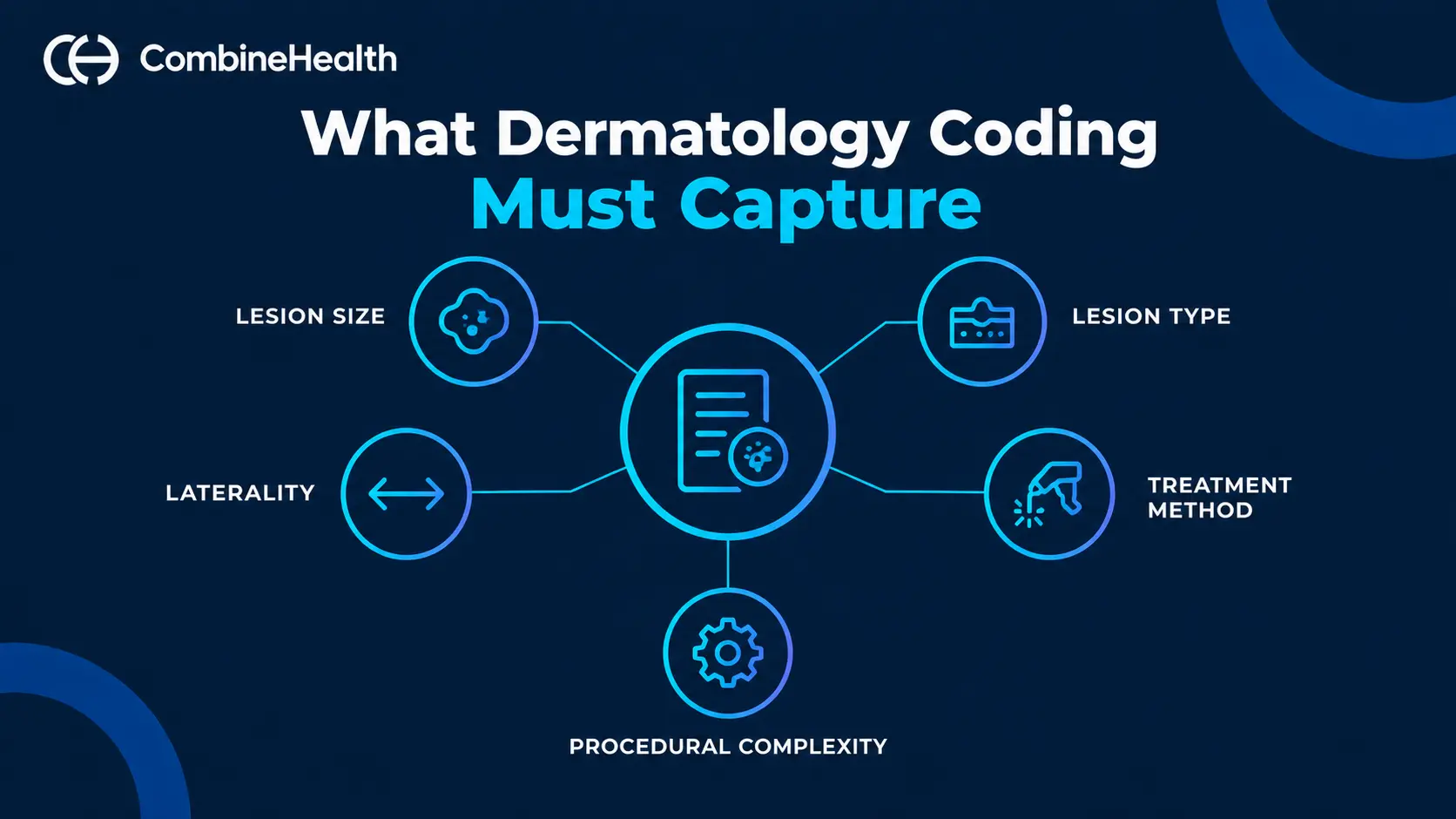
• CombineHealth is a self-learning autonomous medical coding platform that applies dermatology rules for lesion size, type, and treatment method. It flags missing lesion details, laterality, and procedural complexity, links every code to an audit trail tied to the source note, and learns each payer’s behavior from claim outcomes, which supports lower coding-related denials.
• Dermatology revenue cycle management is the process of capturing, coding, billing, and collecting payment for dermatology services, from scheduling through final payment posting. It covers eligibility checks, medical coding, claim submission, denial management, and patient collections. It is harder than most specialties because a single visit often mixes insurance-billed medical care with cash-pay cosmetic services.
• Vendors deliver dermatology RCM in three ways: outsourced billing teams, services bundled with an electronic health record (EHR), and AI coding platforms. The model a practice chooses decides who owns each denial.
• Four metrics show whether a dermatology RCM company performs well: net collection rate, days in A/R, first-pass clean claim rate, and denial rate. Vendors define these figures differently, so ask each one for the formula behind every number.
• Modifier 25 marks a significant, separately identifiable office visit on the same day as a minor procedure. The OIG found that about 56% of dermatologists’ Medicare claims with an E/M service in 2019 also included a same-day minor procedure. Its November 2025 report found dermatologists met Medicare requirements for 90 of 100 sampled E/M services and estimated $62.9 million in overpayments for the rest, so documentation that supports each modifier 25 claim protects revenue.
One dermatology visit can include a full skin exam, a biopsy, and a cosmetic consultation. Each service follows different billing rules. A single misplaced modifier can turn a paid claim into a denial or an audit.
The numbers show how common that risk is. The U.S. Department of Health and Human Services Office of Inspector General (OIG) reported that about 56% of dermatologists' Medicare claims with an evaluation and management (E/M) service in 2019 also included a same-day minor procedure. OIG's audit, completed in November 2025, estimated $62.9 million in Medicare overpayments to dermatologists for E/M services that did not meet requirements.
Dermatology revenue cycle management (RCM) is the work that gets these claims coded, submitted, defended, and paid. Vendors deliver it in three ways: outsourced billing teams, services bundled with an electronic health record (EHR), and AI medical coding platforms.
In this guide, we compare the top ten dermatology RCM vendors across those models. The model you choose decides who owns each denial.
1. CombineHealth: End-to-End Dermatology RCM Built on Autonomous Medical Coding
CombineHealth is an end-to-end revenue cycle management solution built around self-learning autonomous medical coding. Its coding platform, also referred to as Amy AI, reads completed encounter documentation from the EHR, applies coding guidelines and payer-specific rules, and generates billing-ready professional and facility codes with an explainable rationale for each decision.
Billing, denial management, and appeals capabilities carry that coding through the rest of the cycle, from eligibility verification to payment posting and denial resolution. For dermatology, the platform applies rules for lesion size, type, and treatment method and flags missing documentation.
Feature #1: Self-learning with Payer Intelligence
CombineHealth compares each coding decision against real claim outcomes, including denials, reimbursements, and underpayments, then refines its coding strategy for every payer with payer intelligence.
Feature #2: Autonomous Coding for Dermatology
CombineHealth's coding platform generates ICD-10-CM, CPT, HCPCS Level II, E/M levels, modifiers, and provider attribution for professional and facility claims. For dermatology, it applies rules for lesion size, type, and treatment method and flags missing lesion details, laterality, and procedural complexity.
Feature #3: Explainability
Every code links to an audit trail tied to the supporting clinical documentation, so coders, auditors, and compliance teams can validate each decision against the source note.
Feature #4: Denial Management and Appeals
CombineHealth checks claim status across payer portals and places AI-driven calls to payers to resolve denials. It drafts payer-specific appeal letters from the coding rationale and payer policy citations.
Best For: Dermatology groups and MSOs with high claim volume that want automated, payer-aware coding with a full audit trail and plan to keep their current EHR and practice management system (PMS).
Buying Consideration: CombineHealth's published case study covers a high-volume emergency department. Ask for dermatology-specific results before you commit, including Mohs surgery, excisions, and modifier 25 (the code that flags a separately billable office visit on a procedure day).
2. ModMed BOOST
ModMed BOOST is the outsourced RCM service from ModMed, the vendor behind the EMA dermatology EHR. ModMed billers work claims inside ModMed's practice management system, handle denials, and answer patient billing calls.
Key Features:
- Claims and denials: ModMed billers file claims, handle denials, and communicate patient balances
- Inbound call center: ModMed staff answer patient billing calls
- Financial visibility: practices describe monthly reviews of their financial position with the BOOST team
- Scale: ModMed reported in October 2024 that BOOST collected approximately $1.8 billion in claims for clients over the prior twelve months
- Recognition: ModMed lists a 2026 Black Book seal for the top integrated EHR, practice management, and RCM solution six years in a row
Best For: Practices already on ModMed EMA that want to move billing out of the office.
Buying Consideration: ModMed BOOST runs on ModMed's own software, so a practice on a different EHR must migrate before it can use the service. Confirm the migration scope and timeline during evaluation.
3. athenahealth
athenahealth sells athenaOne, a cloud platform that combines an EHR, RCM, and patient engagement tools. Its customers range from startup practices to enterprise health systems, and its Advisory Services team builds custom revenue cycle automation for large groups.
Key Features:
- One platform: athenaOne delivers EHR, RCM, and patient engagement in a single cloud-based system
- Network insights: data from a network of more than 150,000 clinicians informs workflows and benchmarks
- Advisory Services: consulting, staff augmentation, and data services for large groups
- Dermatology example: APDerm, a 37-location New England dermatology network, worked with athenahealth on a robotic process automation (RPA) tool that selects the correct tax ID from 27 options for each claim
Best For: Multi-location groups and MSOs that want a single cloud platform with consulting support.
Buying Consideration: athenahealth's May 2024 specialty launch covered women's health and urgent care, with behavioral health planned. Ask how athenaOne handles dermatology workflows such as Mohs surgery and the split between cosmetic and medical billing.
4. Ezderm
Ezderm builds dermatology-only software: an EHR (Ezehr), a practice management system (Ezpm), and an in-house RCM service (Ezrcm). Ezderm states that its RCM operation traces back to its founder, a dermatologist.
Key Features:
- Embedded RCM: billing runs inside Ezderm's EHR and PMS, with no data silos between charting and billing
- Certified billers: the team holds American Medical Billing Association (AMBA) certification, and senior members hold dermatology coding certification through the Inga Ellzey Group
- Reported results: 98% net collection rate (NCR, the share of collectible revenue a practice actually collects) and an average revenue increase of $20,000 per provider annually
- Eve AI: an automated layer that scrubs claims against historical payer behavior before submission, per Ezderm
Best For: Independent and small to mid-sized practices that want charting and billing from one vendor.
Buying Consideration: Ezrcm is embedded in Ezderm's EHR and PMS, so choosing it generally means adopting the Ezderm platform. Practices on another system should ask about Ezderm's switching support and timeline.
5. Nextech RCM
Nextech RCM is a professional billing service that Nextech launched in May 2024. Nextech serves dermatology, ophthalmology, orthopedics, plastic surgery, and med spa practices, and the service runs inside its practice management software.
Key Features:
- Full-cycle scope: prior authorization, provider enrollment and credentialing, coding, claim submission, payment posting, denial management, and A/R clean-up
- Dedicated support: each client receives an RCM specialist who reviews practice goals through regular consultations
- Reported results: an average 10% increase in collections, per Nextech
Best For: Practices already on Nextech that want to outsource billing without adding another system.
Buying Consideration: Nextech is built and delivered by Assembly Health, a multi-specialty RCM provider. Ask who staffs your account and how much dermatology experience that team has.
6. AdvancedMD
AdvancedMD sells a cloud suite that unifies EHR, practice management, medical billing, and patient engagement. Practices can hand billing to AdvancedMD's own RCM team or to one of more than 800 independent billing companies that use the platform.
Key Features:
- Pre-visit tools: automatic insurance verification for upcoming appointments and patient payment estimates at check-in
- Claim checks: clearinghouse checks for missing information, coverage errors, and coding issues before submission
- Dermatology codes: filtered lists of commonly used dermatology ICD-10 and CPT codes
- Group tools: multi-location management and open API architecture for large practices and MSOs
Best For: Practices that want a unified suite with a choice of billing team.
Buying Consideration: Results under managed billing depend on which team handles your account, whether internal or a partner. Ask for dermatology references and performance data from the specific team assigned to you.
7. CareCloud
CareCloud offers EHR, practice management, and RCM services. Its AI-driven Dermatology EHR, launched in July 2025, connects to its RCM and practice management tools.
Key Features:
- Dermatology RCM: dermatology-specific coding, automated claim scrubbing, and cosmetic procedure billing
- cirrusAI Notes: generates clinical notes from patient conversations for provider review
- cirrusAI Appeals: drafts payer-specific appeal letters for staff to review and send
- Recognition: CareCloud cites a KLAS rating as a top RCM provider for ambulatory practices
Best For: Multi-location groups that want AI-assisted documentation and billing from one vendor.
Buying Consideration: The Dermatology EHR launched in July 2025, so its track record is shorter than that of long-established dermatology platforms. Ask for dermatology references that have been live for at least a year.
8. Inga Ellzey Billing Companies
Inga Ellzey Billing Companies is an outsourced billing and RCM firm founded by Inga Ellzey in 1996. It works only with dermatology and serves dermatology practices, Mohs micrographic surgeons, and dermatopathology labs.
Key Features:
- Specialty focus: dermatology-exclusive billing since 1996
- Team: 125 U.S.-based billers with an average tenure of 7.5 years
- Scale: more than 325 providers across 85 practices in 32 states, per its December 2025 release
- System familiarity: supports practices that use Nextech software, among other systems
Best For: Practices that want a dermatology specialist team to run billing on their existing systems.
Buying Consideration: Inga Ellzey provides billing services, so the practice keeps its own EHR and PMS. Agree on a clean process for sending charges and receiving reports before go-live.
9. Clarity RCM
Clarity RCM is a dermatology-only RCM company founded in 2017. It manages billing, credentialing, and revenue cycle operations for independent practices. CEO Ashwin Krishnan told Pulse 2.0 in June 2026 that Clarity serves more than 200 practices and 1,246 providers across 42 states.
Key Features:
- Reported results: 98% NCR and a 23-day average accounts receivable (A/R) cycle
- Service terms: aged A/R takeover at no separate charge and a 24- to 48-hour charge submission turnaround
- ClarityPay: statements and digital payment flows, live since January 2026, with a reported 32.7% statement-to-payment conversion rate
- ClarityOS: a claims engine introduced at the American Academy of Dermatology meeting in March 2026, built in phases
Best For: Independent practices that want an outsourced, services-first partner.
Buying Consideration: Clarity RCM serves independent practices exclusively, and ClarityOS is still being built. MSO-backed and private equity-owned groups should confirm fit and current product scope.
10. Medusind
Medusind is a Miami-based RCM company founded in 2002 that serves medical and dental practices. Its dermatology billing service covers coding, billing, and compliance, backed by more than 20 years of dermatology experience.
Key Features:
- Reported results: up to 30% more cash collected, up to 20% better outstanding A/R collections, and up to 30% better patient collections
- Coding team: 100% Certified Professional Coder (CPC) staff, with no third parties handling coding
- Scale: more than $3 billion in charges billed last year, per Medusind
- Software: MedClarity practice management software
Best For: Larger groups, or groups with several specialties, that want one scalable outsourced partner.
Buying Consideration: Medusind serves many specialties. Ask to meet the team assigned to your account and request dermatology-specific performance data.
See Dermatology-Specific Revenue Automation in Action
The CombineHealth AI medical coding platform reads complex dermatology notes, including multi-lesion biopsies, Mohs surgeries, and cosmetic splits, applies real-time modifier 25 logic, and returns clean, audit-proof claims. Payer intelligence proactively catches coding errors to drive down your denial rates before submission.
See it run on your own claim volume. Book a demo.
Dermatology Revenue Cycle Management FAQs
How does CombineHealth handle modifier 25 in dermatology billing?
CombineHealth applies real-time modifier 25 logic as it codes: when a note documents a significant, separately identifiable E/M service on the same day as a minor procedure, it appends modifier 25 and ties the decision to the supporting documentation. Because every code links to an audit trail, a practice can show why each modifier 25 claim met requirements — the exact documentation OIG reviews when it audits same-day E/M and procedure claims.
How does CombineHealth code multi-lesion, biopsy, and Mohs dermatology claims?
CombineHealth reads the full dermatology note and applies rules for lesion size, type, and treatment method to assign the correct ICD-10-CM, CPT, HCPCS, and E/M codes and modifiers. When a note is missing the lesion detail, laterality, or procedural complexity a claim needs, it flags the gap before billing rather than coding to a less specific or unsupported level — so multi-lesion biopsies, excisions, and Mohs claims go out complete and defensible.
What Is Dermatology Revenue Cycle Management?
Dermatology revenue cycle management is the process of capturing, coding, billing, and collecting payment for dermatology services, from scheduling through final payment posting. It covers eligibility checks, medical coding, claim submission, denial management, and patient collections. Dermatology adds complexity because a single visit often mixes insurance-billed medical care with cash-pay cosmetic services.
Which Metrics Show Whether a Dermatology RCM Company Performs Well?
Four metrics give the clearest picture of RCM performance. Ask every vendor to report each one for dermatology practices of your size:
- Net collection rate: the share of collectible revenue the practice actually collects
- Days in A/R: the average time it takes to get paid
- First-pass clean claim rate: the share of claims accepted on first submission
- Denial rate: the share of claims payers deny
Vendors define these figures differently, so request the formula behind each number.
Why Is Modifier 25 Important in Dermatology Billing?
Modifier 25 marks a significant, separately identifiable office visit on the same day as a minor procedure. The U.S. Department of Health and Human Services Office of Inspector General (OIG) found that about 56% of dermatologists' Medicare claims with an evaluation and management (E/M) service in 2019 also included a same-day minor procedure.
In a November 2025 report, OIG found that dermatologists met Medicare requirements for 90 of 100 sampled E/M services. OIG estimated $62.9 million in overpayments for claims that did not meet requirements. Documentation that supports each modifier 25 claim protects revenue.
How Does Cosmetic Billing Differ From Medical Billing in Dermatology?
Medical dermatology services bill to insurance payers and follow coding and documentation rules. Cosmetic services such as Botox and fillers are cash-pay. When a patient receives both in one visit, the practice must separate the charges at the workflow level so insurance claims contain only medically necessary services. Ask each vendor how it handles same-day visits that include both.
Can AI Improve Dermatology Medical Coding?
AI improves dermatology medical coding by reading the full clinical note, applying payer-specific rules, and showing why it assigned each code. Explainable audit trails matter in dermatology because payers frequently review procedure and modifier claims.
CombineHealth's self-learning autonomous medical coding platform links every code to the source documentation and learns payer behavior from claim outcomes, which supports lower coding-related denials.