10 Best Emergency Physician Coding Companies in 2027
Compare the 10 best emergency physician coding companies for 2027: key features, professional-fee and facility ED coverage, and best fit for each tool.
Published on:
November 18, 2026


Key Takeaways
• CombineHealth is a self-learning, autonomous medical coding platform that generates explainable codes for both professional-fee and facility ED claims. In an Edelberg & Associates audit of 1,000 ED charts, it scored 95.9% for E/M, 99% for CPT, 100% for modifiers, and 93.2% for ICD-10, against 94.7%, 99%, 100%, and 92.2% for expert coders. It coded about 85% of charts autonomously, cut turnaround time by about 50%, and was tied to up to a 75% reduction in coding-related denials.
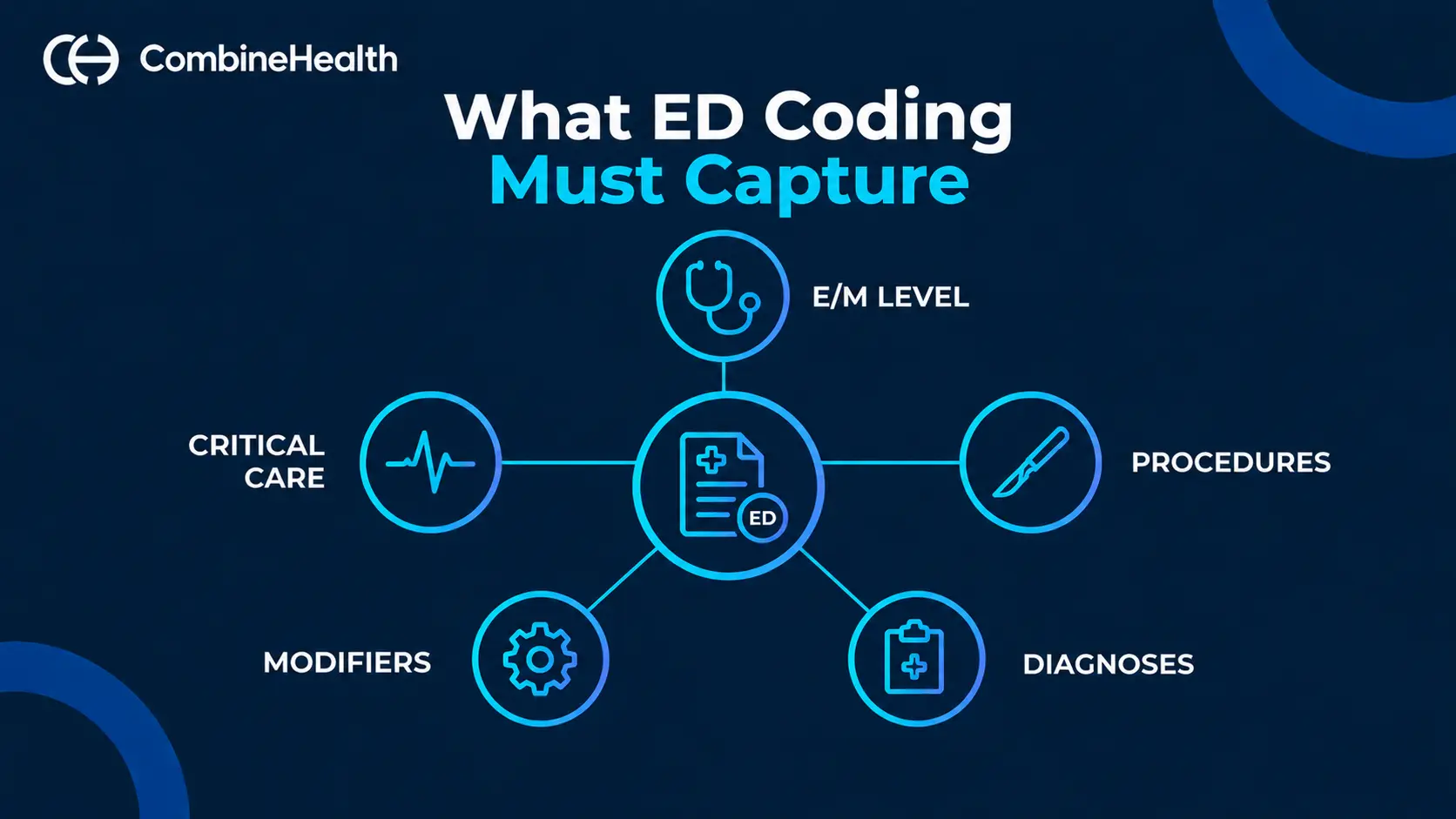
• Emergency physician coding companies translate ED physician documentation into billable codes. They assign the E/M level, critical care time, procedures, modifiers, and diagnosis codes for the professional-fee claim, and some also code the facility claim. Vendors deliver this through software, outsourced coders, or a combination.
• ED coding is difficult because of time pressure and recent rule changes. AHIMA’s productivity guidance puts ED coding at roughly 15 encounters per hour, which leaves about four minutes per chart. ACEP says the 2023 CPT changes restructured roughly 85% of the relative value units for a typical emergency medicine practice.
• A 95% accuracy figure is widely cited as the industry benchmark, but vendors calculate accuracy at the claim, claim-line, CPT, or ICD-10 level. Two vendors can therefore report the same number while measuring different things. Ask for the audit method, the sample size, and a breakdown by CPT, ICD-10, and modifiers.
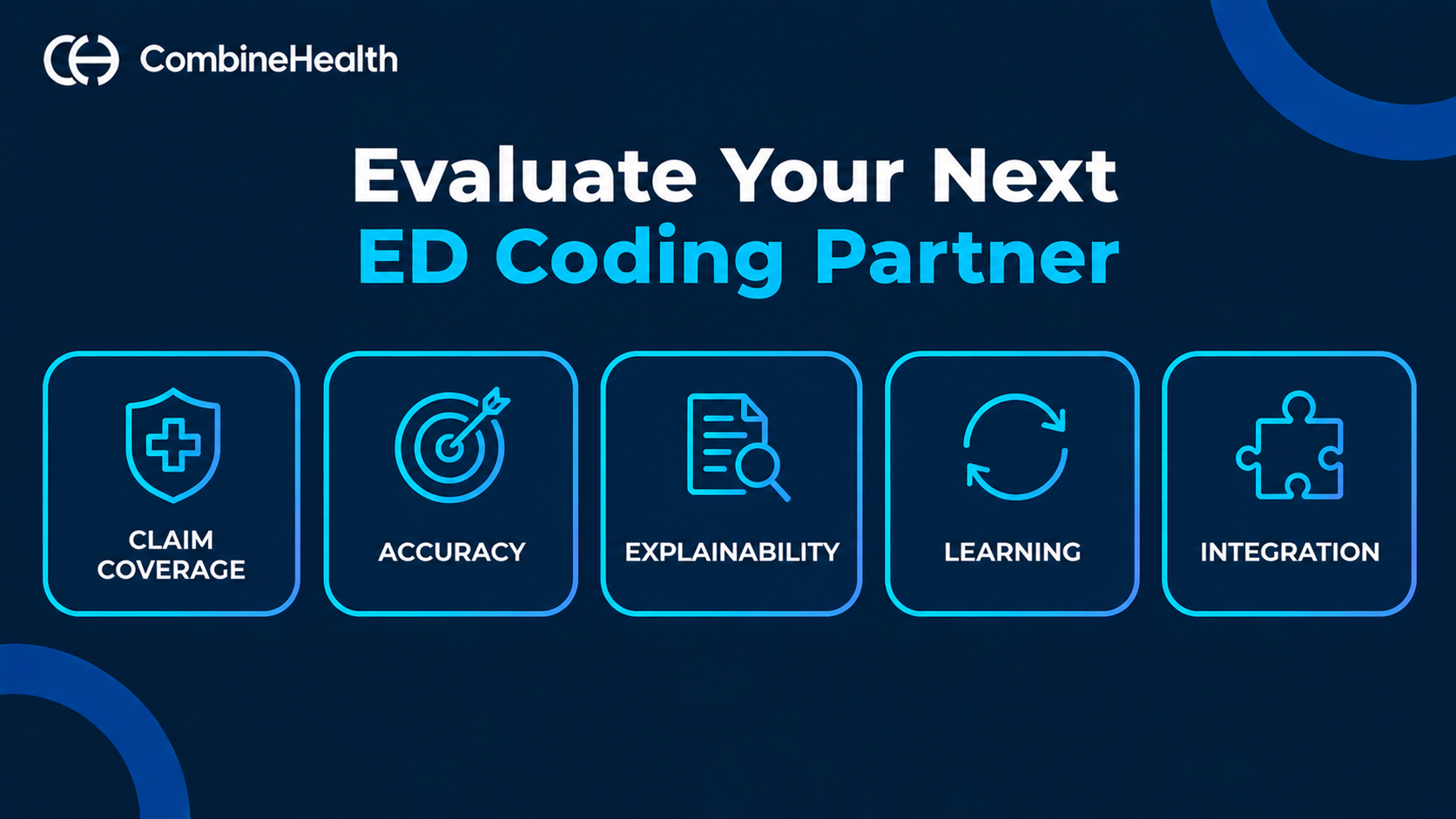
• Compare outsourced emergency medicine coding vendors on five questions: which claim types they code, what accuracy method and audit frequency support their figures, whether every code links to supporting documentation, how they use denial and underpayment data to improve coding, and which EMR, practice management, and billing systems they integrate with.
Every ED chart asks a medical coder to make a revenue decision in about four minutes. The American Health Information Management Association (AHIMA) puts emergency department (ED) coding at roughly 15 encounters per hour, and the 2023 CPT changes reshaped about 85% of the relative value units for a typical emergency medicine practice, according to the American College of Emergency Physicians (ACEP). Under that pressure, a single coding error becomes a denial, an underpayment, or an audit finding.
The right emergency physician coding company takes that pressure off your team. It codes the physician's professional-fee claim and, where needed, the hospital's facility claim, with accuracy you can verify and outcomes you can measure.
This guide ranks the 10 best emergency physician coding companies for 2027. Each profile covers what the company does, its key features, and who it fits best. Use the table to build your shortlist, then read the profiles to make the call.
1. CombineHealth
CombineHealth is a self-learning autonomous medical coding platform for emergency departments. Also referred to as Amy AI, the CombineHealth medical coding automation platform reads completed ED encounter documentation from the electronic medical record (EMR) and generates explainable, billing-ready codes for both the professional-fee and facility claim. It evaluates every coding decision against claim outcomes, so payer behavior shapes how it codes the next chart.
In a parallel study of 1,000 emergency department (ED) charts, CombineHealth scored coding accuracy of 95.9% for E/M, 99% for CPT, 100% for modifiers, and 93.2% for ICD-10. The ED coding group’s expert coders scored 94.7%, 99%, 100%, and 92.2% on the same measures. CombineHealth coded about 85% of charts autonomously and cut turnaround time by about 50%.
Feature #1: Billing-Ready Code Generation for Professional-Fee and Facility ED Claim
CombineHealth assigns E/M levels, CPT procedure codes, ICD-10-CM diagnosis codes, HCPCS Level II codes, modifiers, and provider attribution from the completed ED note. It codes up to 85% of charts autonomously.
Feature #2: Payer Intelligence
Tracks denials, reimbursements, and underpayments by payer and adapts coding strategy accordingly, with up to a 75% reduction in medical coding-related denials.
Feature #3: Explainability in Medical Coding
Every code links to the supporting documentation with a line-by-line rationale, which gives coders, auditors, and compliance teams a complete audit trail.
Feature #4: Critical Care and Procedure Modifiers
Applies modifiers for distinct services, repeat procedures, and critical care.
Feature #5: Documentation Gap Detection
Flags missing clinical documentation detail that limits the supportable level of service.
Case Study: Brault Sustains 98%+ Coding Accuracy in Production With CombineHealth
Brault, one of the most established RCM organizations in emergency medicine, audits production coding on a recurring basis against a strict bar: 96%+ accuracy in each coding dimension and 98% for MIPS. CombineHealth’s AI medical coding platform cleared that bar, scoring 99.1% for primary ICD, 98.4% for CPT, 98.2% for E/M, and 98.7% for MIPS. It held turnaround under 12 hours through volume spikes of two to three times normal and cut go-live time for new sites from about a month and a half to about two weeks. Brault now plans to scale autonomous coding volume 5x.
Best For: ED physician groups, hospitals, and health systems that need to scale coding volume and bring down coding-related denials.
2. Nym
Nym is an autonomous coding vendor with its deepest roots in emergency medicine. Its engine pairs clinical language understanding (CLU) with rules-based ontologies that encode guidelines from the American Medical Association, the Centers for Medicare & Medicaid Services, and the World Health Organization, so every code traces to a rule. Geisinger runs it across nine hospital EDs, and Pinecrest Emergency Medicine Group extended it to facility and professional ED coding after clearing a 10,000-chart backlog in one hour.
Key Features:
- Encounters route directly to billing when coding confidence exceeds 95%
- Audit trail for every coding decision
- Support for six specialties and service lines, including emergency medicine and radiology
- Epic Toolbox designation in the Fully Autonomous Coding category
- Top-performer rating in the August 2025 KLAS Research autonomous coding report
Best For: Organizations that want fully autonomous ED coding with a rules-based audit trail.
3. Fathom
Fathom is an autonomous coding vendor built around ED volume, applying deep learning and large language models to the chart. ApolloMD, a physician group of more than 1,500 physicians, uses it across 88 hospitals and health systems, which gives Fathom strong professional-fee evidence. Your Health reported 95.5% automation at 98.3% accuracy after deploying it across all service lines.
Key Features:
- Live automation above 95% for ED encounters, as reported by Fathom
- Support for more than 1,000 emergency departments
- A 2025 white paper on 10 million ED encounters reporting 96.5% coding accuracy
- First place for reducing the cost of care in the 2025 KLAS Research Emerging Solutions Top 20 report
Best For: Large physician groups and health systems where automation rate and scale drive the business case.
4. Dolbey Systems Fusion CAC
Dolbey Systems Fusion CAC is a computer-assisted coding (CAC) platform that suggests ICD-10 and CPT codes for coders to review across inpatient, outpatient, and professional settings. Productivity gains come from coder assistance. A nine-hospital customer featured in the Journal of AHIMA in 2019 raised ED output from 100 to 175 charts per day.
Key Features:
- Single Path Coding, which lets one coder assign facility and professional-fee codes for the same encounter in one workflow
- ER E/M Coding Viewer, an add-on module for any chart flagged as an emergency
- AutoClose, which sends simpler outpatient accounts straight to billing
- Best in KLAS title for five consecutive years, as Dolbey stated at its Single Path Coding announcement
Best For: Teams that keep coders at the center and want facility and professional ED coding in one workflow.
5. Arintra
Arintra is a generative AI-native autonomous coding platform covering 23+ specialties, including emergency, hospitalist, radiology, and urgent care. It extends from coding into clinical documentation improvement and denial prevention on one platform. UC Davis Health, MercyHealth, Meritus Health, and Rochester Regional Health are among its customers, and the breadth of specialties makes ED-specific results worth requesting.
Key Features:
- Autonomous and assisted coding modes
- Professional-fee and facility coding
- Audit trail and coding rationale visible inside the EHR
- Reported results of 5.1% more compliant revenue capture, a 32% reduction in cost, and a 43% decrease in coding-related denials
- Epic Toolbox and athenahealth Marketplace availability, HITRUST e1 certification, and a 93/100 KLAS Research rating
Best For: Enterprise health systems that want coding, documentation improvement, and denial prevention on one platform.
6. Solventum 360 Encompass
Solventum 360 Encompass, formerly 3M 360 Encompass, introduced the industry's first encounter-based professional-fee coding solution. Its single-path workflow lets one coder handle facility and professional services together, and Allina Health used it to unify separate coding teams. Autonomous ED coding is a newer addition, so ask for current qualification rates.
Key Features:
- Auto-suggested CPT and ICD-10-CM codes for professional-fee coding
- Single-path coding, introduced in 2019, which handles facility and professional services on one screen
- Autonomous coding, with ED visits qualifying for automation at up to 63% in January to March 2026 data
- Full-service outsourced coding for professional-fee clients
Best For: Health systems already running Solventum tools that want one coder workflow across facility and professional claims.
7. CorroHealth PULSE
CorroHealth PULSE is an AI coding automation platform that uses large language models, machine learning, and algorithmic logic. In a published case study, it automated more than 90% of ED charts at a large U.S. health system, raised emergency procedure accuracy from 85.5% to 98%, and generated $504 million in new revenue.
Key Features:
- Accuracy of up to 97% and a four- to seven-fold productivity gain, as reported by CorroHealth
- Facility-level modules for emergency, observation, and risk-based coding
- Modules for injections, infusions, and E/M
- Customer-set confidence thresholds for touchless coding
- Delivery as software as a service, full services, or a hybrid arrangement
Best For: Hospitals that want ED facility coding automation backed by a services partner.
8. AGS Health Autonomous Coding
AGS Health Autonomous Coding pairs the AGS AI Platform with AGS Health's coding services. The ED program is in early access, and AGS Health's July 2026 guidance treats hybrid AI-plus-expert models as the long-term answer for variable settings such as EDs. Its coding services already cover inpatient, outpatient, and ED facility work.
Key Features:
- High-confidence charts move straight through the workflow
- Confidence score for each coded chart
- Target of a 95% quality score or better
- Integrated pre-bill auditing and real-time performance reporting
Best For: Hospitals that want AI combined with outsourced coding services.
9. CodaMetrix
CodaMetrix is an autonomous coding company born out of Mass General Brigham. Its CMX CARE platform serves 30+ U.S. health systems and codes outpatient professional and facility charges from structured and unstructured data. Most proof comes from radiology and pathology, so request ED-specific results.
Key Features:
- An average 60% reduction in coding-related denials, as reported by CodaMetrix
- A Mass General Brigham radiology study showing a 58.7% denial reduction and more than $1 million in annual savings
- Learning from customer denial data to refine its models
- Epic Toolbox designation
- CMX Insights dashboards for automation rate, accuracy, and financial performance
Best For: Large and academic health systems scaling autonomous coding across service lines.
10. Exdion Health
Exdion Health is a revenue cycle and AI coding company for urgent care and occupational health, now powered by Experity. Its published focus is urgent care. Public materials do not detail ED facility or ED professional-fee coding, so hospital ED groups should treat it as an adjacent option.
Key Features:
- ProMaxAI, which combines rule-based and machine-learning tools to improve documentation, educate providers, and optimize revenue
- An 86% reduction in denials for customers, as reported by Experity
- Urgent care revenue cycle automation suite
Best For: Urgent care, occupational health, and on-demand care operators.
See CombineHealth Code Your ED Charts
CombineHealth is a self-learning, autonomous medical coding platform that codes both professional-fee and facility ED claims. In an audit of 1,000 ED charts, it scored 95.9% for E/M and 99% for CPT, against 94.7% and 99% for expert coders. It coded about 85% of charts autonomously and cut turnaround time by about 50%.
Every code comes with a line-by-line rationale linked to the source note, and claim outcomes feed back into the platform to build payer intelligence for each payer. Book a demo to see how CombineHealth performs on your ED charts.
Frequently Asked Questions
What Is the Difference Between Professional-Fee Coding and Facility ED Coding?
Professional-fee coding assigns codes for the emergency physician's own work: the evaluation and management (E/M) level, critical care time, and procedures. Facility ED coding assigns codes for the hospital's resources during the same visit, such as nursing, supplies, and diagnostics, and levels the visit under the facility's own criteria.
One ED encounter produces both claims, and each payer edit applies to its own claim type. Match the vendor to the claim type your organization bills before comparing accuracy or automation figures.
Does CombineHealth code both the professional-fee and facility ED claim?
Yes. CombineHealth reads the completed ED encounter from the EMR and generates billing-ready codes for both claims — the physician's professional-fee claim and the hospital's facility claim — from the same note. For each it assigns the E/M level, critical care time, CPT and HCPCS procedures, ICD-10-CM diagnoses, and modifiers, and codes up to 85% of charts autonomously.
How accurate is CombineHealth on ED charts?
In an Edelberg & Associates audit of 1,000 ED charts, CombineHealth matched or beat expert coders on every measured dimension: 95.9% E/M (vs 94.7%), 99% CPT (vs 99%), 100% modifiers (vs 100%), and 93.2% ICD-10 (vs 92.2%). It coded about 85% of charts autonomously and cut turnaround time by about 50%. Because accuracy can be measured at the claim, line, CPT, or ICD-10 level, CombineHealth reports it by dimension so you can verify the method.
What Do Emergency Physician Coding Companies Do?
Emergency physician coding companies translate ED physician documentation into billable codes. They assign the E/M level, critical care time, procedures, modifiers, and diagnosis codes for the professional-fee claim. Some also code the facility claim. Vendors deliver this through software, outsourced coders, or a combination.
What Is the Difference Between Autonomous Coding and Computer-Assisted Coding?
Autonomous coding assigns codes and routes qualifying charts to billing without a coder touching each chart. Computer-assisted coding suggests codes that a coder reviews and finalizes. Autonomous platforms target higher automation rates, while computer-assisted platforms center the coder's workflow.
How does CombineHealth reduce ED coding-related denials?
CombineHealth tracks denials, reimbursements, and underpayments by payer and adapts its coding strategy to what each payer actually pays — payer intelligence, not static rules. That feedback loop has been tied to up to a 75% reduction in coding-related denials. Every code also links to the supporting documentation with a line-by-line rationale, so denials that do occur are faster to appeal.
How quickly can an ED group go live on CombineHealth?
Deployment maps your workflow, configures site-specific guidance, and tests against historical charts. In the Brault rollout, new-site go-lives were reduced from about six weeks to about two weeks as deployment matured, and the platform held turnaround under 12 hours through ED volume spikes of two to three times normal.
How Accurate Should an Emergency Medicine Coding Service Be?
A 95% accuracy figure is widely cited as the industry benchmark, according to the American Health Information Management Association (AHIMA). Vendors calculate accuracy at the claim, claim-line, CPT, or ICD-10 level, so two vendors can report the same number while measuring different things. Ask for the audit method, sample size, and a breakdown by CPT, ICD-10, and modifiers.
Why Is ED Coding So Difficult?
AHIMA's productivity guidance puts ED coding at roughly 15 encounters per hour, which leaves about four minutes per chart. The 2023 CPT changes added further complexity: the American College of Emergency Physicians called them a once-in-a-generation restructuring that affected roughly 85% of relative value units for a typical emergency medicine practice.
What Should I Ask Before Choosing Outsourced Emergency Medicine Coding?
Use these questions to compare vendors on equal terms:
- Which claim types does the vendor code: professional-fee, facility, or both?
- What accuracy method, sample size, and audit frequency support the published figures?
- Does every code link to the supporting clinical documentation?
- How does the vendor use denial and underpayment data to improve coding?
- Which EMR, practice management, and billing systems does it integrate with?