Top 7 Healthcare Claims Audit Software in 2026
Explore the top Healthcare Claims Audit Software in 2026 to improve coding accuracy, reduce denials, strengthen compliance, and protect revenue with AI-powered auditing solutions.
Published on:
June 30, 2026


Key Takeaways
• Documentation gaps are the leading cause of improper healthcare payments—claims audit software exists to catch them before a payer does.
• Healthcare claims audits run at four stages: pre-submission scrubbing, retroactive coding, compliance auditing, and CDI—each requiring a different capability set.
• CombineHealth is a claims audit platform that covers all three core audit types—retroactive coding audit, pre-submission claim scrubbing, and compliance auditing—through specialized AI solutions in one coordinated workflow.
• When evaluating claims audit software, prioritize retroactive coding audit, pre-submission scrubbing, compliance auditing, CDI gap detection, and explainable audit outputs.
Documentation gaps are one of the major causes of improper healthcare payments.
According to CMS, 77% of Medicaid's improper payments in FY2025—totaling $37.4 billion—resulted from insufficient documentation alone.
That's just one of the problems claims audit software exists to solve—beyond documentation gaps, these platforms also audit coding accuracy, payer compliance, and claim-level billing errors before and after submission.
Catching those gaps before a claim leaves your system—or finding them after payment before a payer does—protects earned revenue, prevents recoupments, and keeps your A/R from carrying avoidable write-offs.
In this guide, we cover the top 7 healthcare claims audit software platforms in 2026: what each does, who it's built for, and how to find the right fit for your organization.
What Is a Healthcare Claims Audit?
A healthcare claims audit is a structured review of submitted claims to verify that medical billing, coding, and documentation comply with payer and regulatory standards.
Healthcare claims audits run at four stages:
- Pre-claim submission auditing (claim scrubbing): Catches errors before the claim reaches the payer.
- Retroactive claim auditing: Reviews submitted or paid claims to surface undercoding, overcoding, or documentation gaps.
- Compliance auditing: Evaluates adherence to CMS guidelines, payer contracts, and coding standards.
- CDI auditing: Identifies clinical documentation gaps that affect coding accuracy upstream.
Recommended reading: A guide to clinical documentation improvement
Top 7 Healthcare Claims Audit Software in 2026
1. CombineHealth – Retroactive Claim Auditing + CDI Auditing Software
CombineHealth provides AI-powered pre-bill claim auditing, retrospective coding audits, compliance audits, and clinical documentation audits through a coordinated workforce of specialized AI agents.
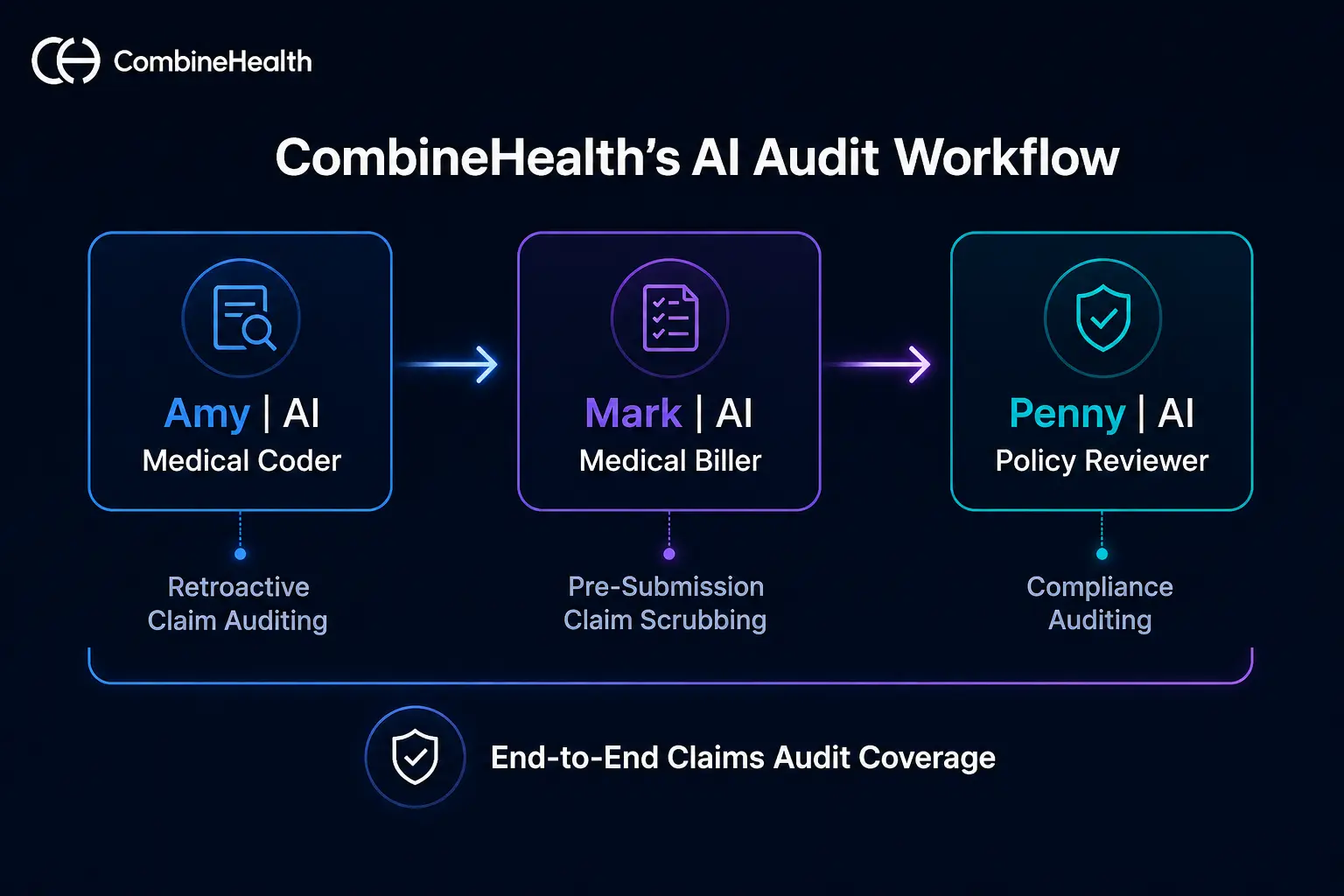
CombineHealth’s healthcare claims auditing at a glance:
Feature #1: CombineHealth’s Medical Coding Solution Works As A Claim Auditing Engine
CombineHealth’s Medical Coding Solution audits pre-coded charts against full EHR encounter data—notes, vitals, labs, operative reports, discharge summaries.
It can be used in an audit mode, where providers or coders continue coding as they do today, while CombineHealth’s AI solutions independently review every chart and compare its own coding decisions against the submitted claim.
Feature #2: Each Audit Is Well-Explained
CombineHealth flags documentation gaps with a line-by-line rationale for every finding, making the audit outputs fully transparent and reviewable. Complex or ambiguous cases are escalated for human review rather than processed silently.
Feature #3: Analytics is Built on Top of Claim Auditing
CombineHealth’s auditing capabilities go beyond reviewing individual claims.
Every audit contributes to a broader intelligence layer that uncovers:
- Provider documentation trends
- Recurring coding errors
- E/M coding patterns
- Denial hotspots
- Opportunities to improve coding configurations
These insights also help prioritize provider education, enabling organizations to continuously strengthen documentation quality, reduce repeat errors, and prevent future denials rather than simply correcting past ones.
Feature #4: CombineHealth Supports Documentation Auditing (CDI)
CombineHealth also surfaces upstream CDI gaps—incomplete clinical details that would affect code assignment—before they compound into claim-level errors downstream.
In a parallel coding study with an Emergency Department hospital, CombineHealth’s AI Medical Coding Solution uncovered 5× more documentation gaps that could impact reimbursement and coding accuracy than traditional workflows.
Read the Full Case Study
Feature #5: Pre-Claim Submission Auditing (Claim Scrubbing)
CombineHealth’s billing solution audits each claim against payer-specific rules before submission—checking for billing discrepancies, modifier errors, and rule violations using continuously updated payer rule libraries.
Every error caught at this stage is corrected before the claim leaves the organization, preventing denials at the source rather than resolving them post-submission.
It also continuously learns from prior denial patterns, refining pre-submission audit accuracy over time and reducing repeat errors across the same payer rules.
Feature #6: Compliance Auditing
CombineHealth’s policy reviewing solution audits coded claims against current payer policies—CMS manuals, LCDs, NCDs, and commercial payer guidelines—validating each claim against the rules in effect at the moment of submission.
It checks prior authorization requirements, frequency edits, and age, gender, and site-of-service restrictions, then generates a compliance risk score per claim based on payer history and policy alignment.
When payer policies change, it also flags the affected claim types proactively—closing the compliance gap before it becomes a denial or triggers false claims act exposure.
Best for: Organizations that want AI-native audit coverage across all three core audit types—retroactive coding audits, pre-submission claim scrubbing, and compliance auditing.
Recommended reading: Autonomous medical coding: How AI Is replacing traditional CAC systems
2. Atom Audit
Atom Audit, developed by Health Information Associates (HIA), is a cloud-based coding audit platform. It organizes work through a project-based system covering Acute Inpatient, Outpatient, Professional Fee, and ASC settings.
It supports prospective and retrospective workflows, with E/M leveling under the 1995, 1997, and 2023 guidelines. A built-in rebuttal workflow keeps coders and auditors in active dialogue on disputed findings.
Findings feed into customizable reports giving compliance teams visibility into coder accuracy rates, error trends, and financial impact.
- Validates CPT, HCPCS, ICD-10-CM/PCS, APC, E/M, and modifier codes
- Customizable reporting dashboard covering coder accuracy rates, error trends, DRG validation, and Reimbursement Impact analysis
- Evaluates codes against PSI and QM criteria to surface patient safety and care quality insights
Best for: HIM directors, auditors, and coding compliance teams in mid-to-large hospitals and health systems needing a structured audit lifecycle management platform.
3. iCode Assurance
iCode Assurance is an AI-enabled SaaS platform for medical coding audit and compliance. It supports concurrent and retrospective coding audits across inpatient, outpatient, professional fee, HCC, and performance measure settings.
Its AI layer conducts autonomous dual-level coding review—auditing claims for accuracy while predicting denial risk before submission.
Findings compile into OIG and AHIMA-aligned compliance reports, with scored records for coder and provider performance tracking.
- Autonomous AI coding audit conducts dual-level review, reducing human intervention while maintaining quality
- Claims data aggregation pulls from spreadsheets, charts, providers, and healthcare management systems into one repository
- Detailed compliance reports aligned with OIG and AHIMA standards
Best for: Large hospital systems and health networks needing enterprise-grade AI audit coverage with HCC optimization and OIG-aligned compliance reporting.
4. MDaudit
MDaudit is a billing compliance and coding quality platform for large and mid-size health systems.
It unifies internal and external audit workflows, risk-based analytics, and compliance monitoring across scheduled, risk-based, denial, and coding quality audit types.
AI capabilities include proactive risk scoring and SmartScan.ai—which automatically parses payer audit request letters from RAC, MAC, and TPE contractors, reducing manual ADR effort.
- Proactive risk scoring identifies billing and coding anomalies before claims are submitted
- SmartScan.ai parses RAC, MAC, and TPE payer request letters automatically, reducing manual ADR processing
- Drill-down analytics trace denial patterns by provider, payer, or service line to find root causes
Best for: Compliance teams, HIM directors, and revenue integrity departments at hospitals, health systems, IDNs, and large physician groups.
5. Experian Health
Experian Health's ClaimSource is an automated claims management system at the clearinghouse layer—importing claim files, running customizable edits, and routing clean claims for submission.
ClaimSource audits each claim against national payer edits and provider-specific custom rules pre-submission. It is not a coding audit platform—it works best alongside a dedicated coding audit tool.
Real-time alerts monitor rule changes across 1,900+ payer websites, keeping the edit library current and reducing compliance gaps.
- Runs national payer edits plus provider-specific custom edits against every claim pre-submission
- AI Advantage modules apply before submission (denial prevention) and after denial (triage), learning from historical claims data
- Real-time alerts for policy and rule changes across more than 1,900 payer websites
Best for: Hospital systems processing high claim volumes that want clearinghouse-integrated pre-submission scrubbing and AI-powered denial prediction.
6. Healthicity
Healthicity is a web-based auditing platform built for medical auditors. It centralizes audit workflow, management, education, and reporting in one interface, supporting E/M, CPT, HCPCS, diagnosis, HCC, facility, and dental audit types.
Its standout capability is parallel auditing—reviewing a provider and a coder simultaneously within the same encounter, distinguishing whether an error originated in documentation or code assignment.
Findings connect to an education module, allowing auditors to assign targeted training based on deficiencies.
- Parallel auditing reviews provider and coder simultaneously within the same encounter
- Real-time NCCI edit feedback during auditing for both professional and outpatient claims
- Education module connects audit findings directly to targeted training based on identified deficiencies
Best for: Compliance officers, HIM teams, and coding consultancies running ongoing internal audit programs
7. BillingParadise
BillingParadise's ClaimBridge is an automated claim audit tool reviewing claims for compliance, completeness, and coding accuracy before submission.
ClaimBridge scans each claim automatically, flags compliance issues and missing information, and delivers audit reports immediately. Customizable templates adapt the audit to payer or practice-specific requirements.
It’s DenialPreventer and DenialManager extend coverage post-submission—routing denials by root cause, mapping denial trends, and automating appeal creation.
- Automated claim scanning flags missing information and compliance issues, delivering audit reports immediately
- Customizable audit templates adaptable to payer or practice-specific audit requirements
- DenialPreventer and DenialManager extend coverage to denial routing, trend tracking, and automated appeal creation
Best for: Small to mid-size practices, group practices, and ACOs that want claim audit automation paired with billing services.
How to Choose the Right Claims Audit Software
The right claims audit software should do more than flag errors after the fact. Here are the capabilities to look for when evaluating a platform:
- Retroactive coding audit: Reviews pre-coded charts to identify undercoding, missing services, and coding discrepancies against full clinical documentation.
- Pre-submission claim scrubbing: Validates claims against payer-specific rules before submission, catching billing discrepancies and modifier errors before they cause denials.
- Compliance auditing: Audits coded claims against current CMS manuals, LCDs, NCDs, and commercial payer policies — not last quarter's rules.
- CDI / documentation gap detection: Surfaces incomplete clinical details and missing diagnoses upstream, before they affect code assignment and reimbursement.
- Explainable audit outputs: Provides line-by-line rationale for every finding, making results reviewable, defensible, and actionable.
CombineHealth covers every capability on this list through its coordinated AI agent workforce—each owning a distinct audit function across the full revenue cycle.
Recommended reading: Point solutions vs end-to-end RCM in healthcare
Automate Your Entire Claims Audit Workflow With AI
Healthcare claims auditing has grown too complex for manual workflows to keep pace with—payer rules update constantly, documentation requirements tighten, and claim volumes only go up.
AI-powered claims audit software closes this complexity. It reviews claims continuously, catches documentation gaps before submission, flags coding discrepancies in real time, and monitors payer policy changes automatically.
CombineHealth's AI agents—Amy, Mark, and Penny—cover retroactive coding audits, pre-submission scrubbing, and compliance auditing in one coordinated workflow.
Book a demo to see how CombineHealth handles your full audit cycle!
FAQs
What are common issues found during a healthcare claims audit?
The most common findings are insufficient documentation, lack of medical necessity, coding errors (upcoding, unbundling, modifier misuse), administrative errors (eligibility lapses, duplicate claims), and regulatory compliance failures like timely filing violations.
What are the key steps in a medical claims audit?
Define scope, pull a sample, gather documentation, review charts for coding accuracy and medical necessity, analyze findings, report results, implement corrective action, and schedule follow-up audits within 3–6 months.
How often should a healthcare organization conduct claims audits?
OIG guidelines recommend ongoing monitoring, not just periodic reviews. High-risk code types and high-volume providers warrant quarterly or monthly audits while broader population reviews typically run annually.
Healthcare organizations should conduct ongoing claims audits, not just periodic reviews. High-risk code types and high-volume providers warrant quarterly or monthly audits, while broader population reviews typically run annually.
What's the difference between a prospective and retrospective claims audit?
A prospective claim audit catches errors before submission to prevent denials. A retrospective claim audit reviews claims after payment or denial to identify coding errors, underpayments, and documentation gaps for corrective action.