Top 10 Healthcare Revenue Cycle Management Analytics Tools for Medical Practices in 2026
Compare the top 10 healthcare RCM analytics tools for 2026. See features, KPIs, integrations, and why analytics integration drives better RCM outcomes.
Published on:
June 29, 2026


Key Takeaways
• Revenue cycle analytics helps healthcare organizations move beyond reporting metrics to identifying the root causes of denials, revenue leakage, and workflow inefficiencies.
• The best analytics platforms don't just visualize data—they provide AI-driven recommendations that improve coding, billing, denial management, and cash flow.
• Outsourcing RCM to a partner with embedded analytics is often faster and more cost-effective than building an in-house analytics capability.
• When evaluating RCM analytics software, prioritize tools that offer root cause analysis, payer-level insights, predictive intelligence, and workflow automation—not dashboards alone.
• CombineHealth is a leading RCM analytics platform for hospitals and multispecialty groups looking to reduce denials through AI-powered root cause analysis, workflow automation, and continuous optimization.
Every hospital billing team knows its denial rate. Almost none can tell you why it's that number.
Coding automation, claim scrubbing, and denial management are the most talked-about problems. The unsolved one is pattern recognition at scale: why a payer keeps rejecting the same claim type, where in the workflow the root cause lives, and whether a process change actually moved the needle.
An HFMA survey found that hospitals lose an average of 4.8% of their net revenue to denials annually. This gap is where revenue quietly becomes write-offs.
Healthcare revenue cycle analytics connects data from across the cycle, like ERAs, EOBs, clearinghouse feeds, and EHR documentation, and surfaces what a claim-by-claim review would take ten thousand simultaneous reads to catch. The result is an RCM team that stops fighting fires and starts preventing them.
Below, we break down the top 10 healthcare revenue cycle management analytics tools for 2026, what each one does well, where it falls short, and which type of organization it's actually built for.
What Is Revenue Cycle Analytics in Healthcare?
Revenue cycle analytics is the use of data to monitor, measure, and optimize every stage of the healthcare revenue cycle, from patient registration through claims submission, denial management, and final payment collection.
It pulls data from the systems your team already uses, EHRs, medical billing platforms, clearinghouses, payer portals, remittance files, normalizes it into a single view, and surfaces patterns that answer the questions that matter most:
- Why are denials happening?
- Which payers are driving the most revenue leakage?
- Are documentation deficiencies causing reimbursement losses?
- Is the process change we made last quarter actually working?
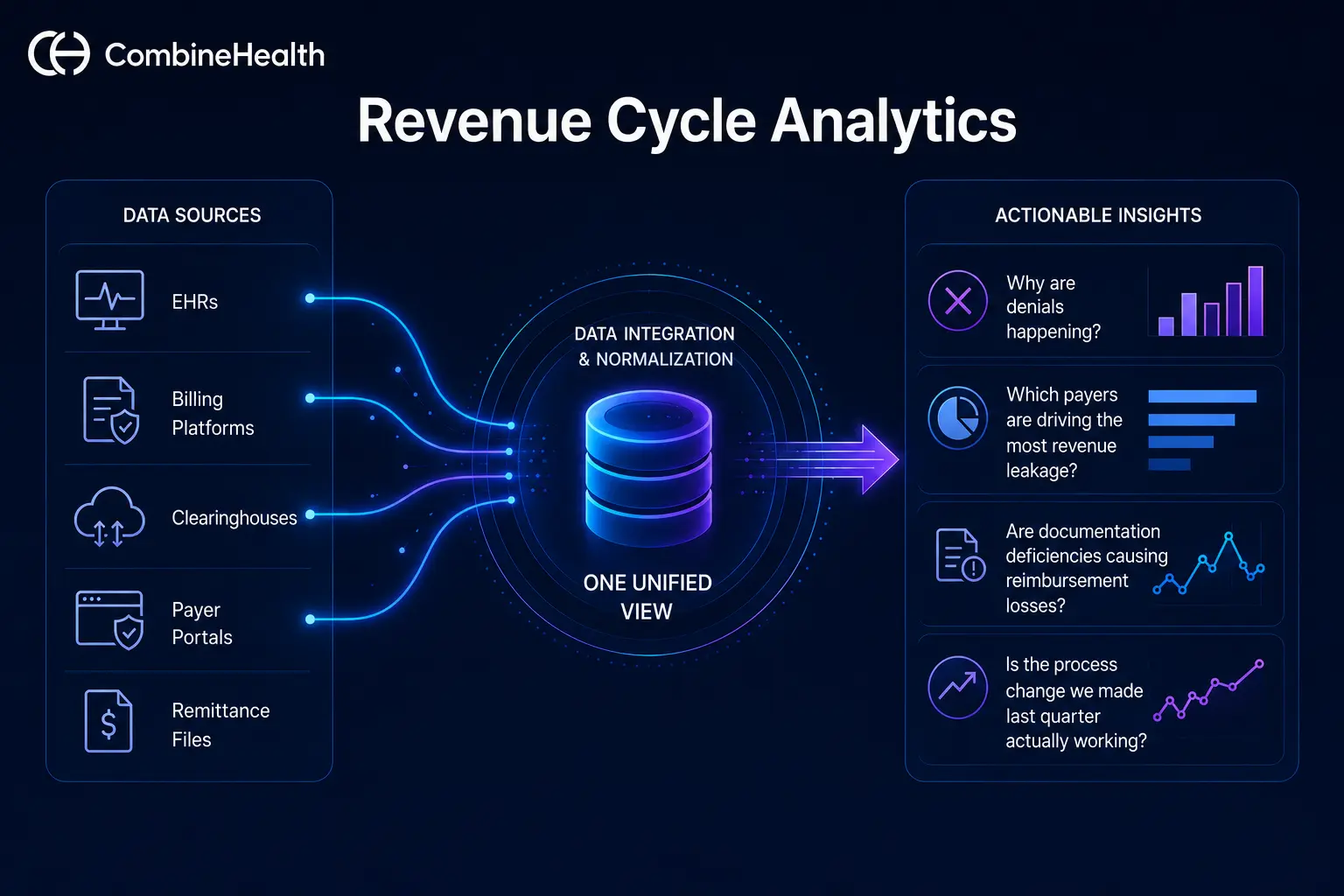
Most teams operate with reporting RCM metrics like denial counts, payment totals, and aging summaries. Analytics is different, and it works across four layers:
Why Outsource Healthcare Revenue Cycle Management with Analytics Integration?
A Healthcare RCM vendor with built-in analytics delivers faster insights, identifies payer trends at scale, and reduces the cost and complexity of managing analytics in-house.
Building RCM analytics in-house is harder than it looks. Normalizing claim denial codes across dozens of payers, integrating ERA data with EHR documentation, and building dashboards that actually drive decisions take months to build. Also, these require ongoing data science resources to maintain.
That's why most healthcare organizations now outsource at least one RCM function out of the RCM cycle. A study found that 63% hospitals report active staffing gaps in their RCM departments. Outsourcing RCM to a partner with embedded analytics rather than adding a standalone analytics tool delivers three things that in-house teams struggle to replicate:
- Speed to insight: Outsourcing partners bring pre-built denial categorization, payer benchmarking, and dashboard infrastructure that would take a year to build internally.
- Pattern recognition at scale: Platforms trained on millions of claims detect payer behavior shifts faster than any analyst reviewing individual accounts.
- Cost that makes sense: Running an in-house analytics team means salaries, software licensing, and continuous training. Outsourcing converts that into a predictable operational cost, and the recovered revenue typically pays for it.
Benefits of Revenue Cycle Analytics Integration in Healthcare
The most important shift analytics enables in healthcare RCM is the shift from reactive denial management to preventive. Here's what that looks like across the revenue cycle:
The financial benefit of integrating RCM analytics in healthcare is clear. An HFMA study found that healthcare organizations lose 3-5% of net revenue through leakage points that analytics is designed to catch. For a hospital generating $100M in NPSR, that's $3-5M in recoverable revenue annually.
Best Healthcare Revenue Cycle Management Analytics Tools for 2026
Not every RCM analytics tool delivers the same depth. Some just show you denial trends, but the best ones tell you why they're happening. Below are the ten analytics tools hospitals and health systems are seriously considering in 2026:
1. CombineHealth: AI RCM Analytics Software for Hospitals and Multispecialty Physician Groups
Most healthcare analytics platforms stop at the dashboard. CombineHealth's Taylor (our AI Revenue Cycle Intelligence Platform) takes it further by continuously analyzing your entire revenue cycle—from claims denials and reimbursements to coding quality and provider documentation to:
- Uncover revenue leakage
- Identify root causes
- Prioritize the highest-impact opportunities
- Automatically feed those insights back into your RCM workflows, so denials decrease over time
The best part is all of CombineHealth’s agentic AI solutions work synchronously, enabling Taylor to aggregate all of that information, identify systemic issues, discover why denials are occurring, quantify the financial impact, and then help optimize the workflows so those issues stop happening in the future.
Example:
When Taylor identifies a payer-specific denial trend, Adam (the AR follow-up solution) prioritizes those claims for follow-up.
Similarly, when a documentation gap surfaces, Amy (the medical coding solution) applies that context to future chart reviews. When it detects a recurring CPT-payer denial combination, Rachel (the appeals management solution) drafts stronger, evidence-backed appeal letters.
How Does CombineHealth’s RCM Analytics Software Work?
Taylor ingests EOBs, ERAs, clearinghouse data, and EHR/PMS denial information to surface root causes, payer-specific patterns, and financial impact across the revenue cycle. It maps every denial into human-readable categories like eligibility, authorization, bundling, coding, documentation, non-covered services, timely filing, and medical necessity. This way, teams always know where to focus.
Beyond denial analytics, Taylor tracks CDI deficiencies, generates provider education recommendations, and lets RCM leaders query performance data conversationally: "What are the most common denial reasons this month?" Monthly summary reports are generated automatically, customized to each team member's KPIs.
Key Features:
- Denial root cause identification across EOBs, ERAs, and clearinghouse data
- AI-based denial categorization across 8+ categories
- Payer-level and provider-level analytics
- CDI deficiency reports and provider education recommendations
- Conversational analytics
- Automated monthly KPI reports
- Workflow activation connecting insights to Adam, Rachel, Amy, Mark, and Penny
Best for: Hospitals and multispecialty physician groups that want analytics connected to denial management action and not just reporting
2. Aptarro
Aptarro's RevCycle Engine combines workflow automation with real-time analytics dashboards. It gives providers visibility into billing performance, payer trends, and revenue risk in one place. The platform validates charges, supports coding accuracy, and surfaces actionable insights through customizable dashboards, with EHR integrations keeping clinical and financial data aligned. It scales from small practices to large health systems without requiring a separate analytics stack.
Key Features:
- Revenue integrity trend and payer performance dashboards
- Charge validation and coding accuracy support
- Customizable reporting for different leadership roles
- EHR integration across major systems
Best for: Practices and health systems that want an all-in-one RCM platform with embedded analytics that scales with growth.
3. FinThrive Analyze
FinThrive Analyze consolidates data from multiple vendors, systems, and care settings into a single financial intelligence layer. It eliminates the silos that create blind spots in revenue performance. On top of that unified foundation, it layers predictive modeling and scenario planning that give finance leaders the ability to forecast cash flow, model contract changes before negotiations, and quantify the ROI of process improvements.
Key Features:
- Unified data consolidation across EHR, billing, clearinghouse, and payer systems
- Denials and underpayments analyzer
- 30/60/90-day cash flow forecasting
- Contract modeling and payer negotiation scenario planning
Best for: Large hospitals and health systems managing complex payer environments and multiple data sources.
4. Inovalon Provider Cloud
Inovalon's analytics strength is in Medicare-specific RCM. Its insurance discovery capability identifies coverage for patients who reported no insurance, recovering revenue that would otherwise be written off. The platform provides real-time FISS access for Medicare claims, predictive cash flow forecasting, and denial trend analytics by payer and service line.
Key Features:
- Insurance Discovery for previously unknown patient coverage
- Real-time FISS access and DDE verification for Medicare claims
- Predictive cash flow forecasting; denial trend analytics
- Deep Epic and PointClickCare integration and more
Best for: Medicare-heavy hospitals, SNFs, home health organizations, and post-acute care providers can make the best use of this RCM.
5. Encoda (Maestro Analytics)
Encoda layers analytics, denial management, and automated reporting on top of existing practice management systems without replacing them. Its Maestro Analytics module pulls data from the PM system and payer remittances into daily-updated dashboards accessible on any device. Its newest enhancement, Contract Reimbursement Analytics (CRA), identifies underpayments and improper payments against payer contracts. This gives practices visibility into the gap between what they earned and what they were actually paid.
Key Features:
- Maestro Analytics with daily-updated payer and PM dashboards
- Contract Reimbursement Analytics (CRA) for underpayment identification
- Proactive claim scrubbing with payer-specific rules
- Automated remittance validation and cash posting
- Integrations with Greenway, Centricity, Athena, Nextech, and NextGen
Best for: Physician practices and billing companies that need analytics layered on top of existing PM systems without a rip-and-replace.
6. Xsolis (Dragonfly Revenue Integrity Insights)
Xsolis takes a clinical approach to RCM analytics. Its Dragonfly platform assigns real-time medical necessity scores to inpatient cases. This helps in creating a shared, objective view of clinical merit that both providers and payers can act on. It further reduces the back-and-forth on concurrent authorization decisions and proactively prevents denials that stem from misaligned medical necessity determinations. Its Revenue Integrity Insights module tracks pre-claim and concurrent denial trends tied directly to the Care Level Score and length of stay, pinpointing root causes before claims are submitted.
Key Features:
- AI-powered Care Level Score continuously assesses medical necessity
- Revenue Integrity Insights for inpatient clinical denial trend analytics
- Pre-claim and concurrent denial trending
- Generative AI for documentation and appeal letter creation
- Shared payer-provider analytics framework
Best for: Hospitals managing high volumes of inpatient medical necessity denials and concurrent authorization challenges.
7. Adonis
Adonis continuously monitors revenue cycle data to detect risk early, surface payer behavior shifts in real time, and autonomously move claims toward resolution. Its Intelligence product delivers KPI dashboards, denial clustering, and custom reports. Its AI Agents act on those insights, automating eligibility checks, claims scrubbing, A/R follow-up, and denial resolution.
Key Features:
- Adonis Intelligence with real-time revenue cycle monitoring and proactive denial risk detection
- Smart Worklists with denial clustering and AI-driven prioritization
- AI Agents automating eligibility, scrubbing, and denial resolution
- Human-in-the-loop governance for CFO and CIO confidence
Best for: Provider groups and health systems that want an AI-native platform combining real-time intelligence with autonomous denial resolution.
8. OSP Labs
OSP Labs builds custom AI-powered RCM analytics platforms for billing companies, RCM firms, and high-volume providers. Its Agentic AI Revenue Engine autonomously calls payers, navigates IVRs, and retrieves claim status without human follow-up. Its RCM Revenue Engine pulls denied claims from any source, EHR, clearinghouse, or manual upload, identifies root cause using AI, and automates the full resolution workflow.
Key Features:
- Real-time revenue cycle dashboards from registration to reimbursement
- AI Claims Scrubbing Agent validating coding, payer rules, and NCCI edits pre-submission
- Agentic AI Revenue Engine automating payer calls and claim status retrieval
- RCM Revenue Engine automating denial resolution end-to-end
- HIPAA-compliant integrations with existing EHR, billing, and clearinghouse systems
Best for: RCM companies, billing services firms, and high-volume providers that need custom-built AI analytics and agents tailored to their specific workflows.
9. MedeAnalytics
Named "Best Overall Healthcare Data Analytics Platform" at the 2026 MedTech Breakthrough Awards, MedeAnalytics has been a healthcare analytics specialist for over 30 years. Its platform, built on Health Fabric, unifies clinical, claims, financial, and administrative data into a single governed source of truth. For revenue cycle specifically, it delivers denial prevention, CDI software insights, scenario forecasting, and generative AI planning tools that move organizations from insight to accountable execution.
Key Features:
- Health Fabric platform unifying clinical, claims, financial, and social data
- Denial prevention with real-time root cause identification and lost revenue drill-down by payer and service line
- CDI analytics are improving documentation accuracy and case mix index
- Generative AI planning tools embedded in workflows
- EHR-agnostic with deep integration flexibility
Best for: Payers, risk-bearing providers, and health systems needing enterprise-scale analytics spanning revenue cycle, value-based care, and population health.
10. AdvancedMD
AdvancedMD combines AI-driven financial insights with automated denial management and specialty-specific RCM workflows in a single cloud-based platform. Its analytics capabilities go beyond standard reporting, like surfacing revenue trends, forecasting cash flow, and identifying denial risks that reactive claim processing would miss. The automated denial management reduces the manual follow-up burden on billing teams.
Key Features:
- AI-driven financial insights with revenue trend and cash flow forecasting
- Automated denial management with categorization and appeal support
- Specialty-specific coding and billing workflows
- Integrated analytics connecting financial performance to operational data
- Full EHR integration for clinical-to-financial alignment
Best for: Independent practices and mid-size provider groups wanting AI-powered financial analytics alongside specialty-specific automation.
Ready to Reduce Denials with AI-Powered RCM Analytics?
Most platforms tell you what happened. CombineHealth's RCM intelligence platform tells you why and connects those insights directly to the AI agents working your denials, coding, and billing in real time.
Book a demo with CombineHealth to see how Taylor fits into your revenue cycle and what ROI you can expect.
FAQs
What is revenue cycle analytics?
The use of data to monitor and optimize every financial stage of healthcare, from registration to final payment, is called revenue cycle analytics. It aggregates data from EHRs, billing systems, clearinghouses, and payer remittance files to surface denial patterns, documentation gaps, and performance trends so RCM leaders fix root causes instead of chasing individual claims.
How does RCM improve hospital financial performance?
RCM can improve a hospital’s financial performance by catching the root causes behind denials, leakage, and cash flow delays before they compound. Teams gain visibility to fix documentation pre-submission, prioritize high-value A/R, reduce repeat denials, and confirm that process changes are actually working.
Does it integrate with existing systems?
Yes, effective platforms connect to EHRs, practice management systems, clearinghouses, ERA/EOB files, and payer portals. Always ask vendors whether they pull front-end registration and authorization data; that's where most denial root causes originate.
What's the difference between RCM reporting and analytics?
RCM reporting shows what happened, and Analytics explains the why behind it. It analyzes surfacing payer rules, coding patterns, and workflow gaps, driving the numbers, then connecting those insights to active workflows so teams prevent problems rather than just measure them.
What KPIs should denial analytics track?
Denial analytics should be done by tracking KPIs like initial denial rate (below 5%), clean claim rate (above 90%), days in A/R (below 40), net collection rate (above 95%), overturn rate (above 65%), and write-off rate (below 3%).
How does AI improve RCM analytics?
AI categorizes denials across thousands of claims simultaneously, detects payer behavior shifts early, scores claims for denial risk pre-submission, and feeds insights back into billing workflows to improve with every claim cycle.