Will AI Replace Medical Coders? What the Future of Medical Coding Actually Looks Like
AI won't replace medical coders, but it's automating routine work fast. See what's changing, what stays human, and how a hybrid model works.
Published on:
August 11, 2026


Key Takeaways
• AI automates the rule-based share of medical coding, reading finished encounter notes, assigning ICD-10-CM and CPT codes, sequencing diagnoses, and applying modifiers, while routing uncertain charts to a human coder.
• Human medical coders remain essential for interpreting ambiguous clinical documentation, communicating directly with providers, defending coding decisions in an audit, and carrying legal accountability for what gets submitted.
• AI can process complex clinical documentation, but reliability drops as ambiguity rises; conflicting notes, overlapping comorbidities, and unclear medical necessity still require a coder's judgment.
• Coding can become highly automated, but the defensible model is autonomous coding with governance: AI completes eligible charts while a human reviews exceptions, not a fully unsupervised system.
• A coding error, human or AI, can trigger denials, underpayments, and compliance exposure; confidence thresholds, explainable rationale, and audit trails are what catch it before it becomes systemic.
• AI is shifting coders from chart-by-chart production work toward auditing AI-coded charts, CDI, provider education, and configuring the review thresholds that govern the automation itself.
• In production, a hybrid model runs AI pre-coding through a ten-step workflow, where high-confidence charts complete automatically and flagged charts route to a coder before anything reaches billing.
• CombineHealth automates roughly 80-85% of eligible coding volume at approximately 98% accuracy in production deployments, with every AI-generated code carrying a rationale a coder can approve or reject before it hits billing.
Contrary to what many medical coders in the US healthcare industry are fearing, AI will not replace medical coders. Instead, it will automate the routine, high-volume work that currently consumes most of a coder's day, while complex, ambiguous, and high-risk cases continue to require human judgment. The medical coding profession isn't disappearing, but shifting toward auditing, validation, and governance of AI output.
This guide dives into what that shift actually looks like: which parts of medical coding AI can already automate, where human coders remain essential, and how coding roles and responsibilities are likely to change.
What Medical Coding Tasks Can AI Automate?
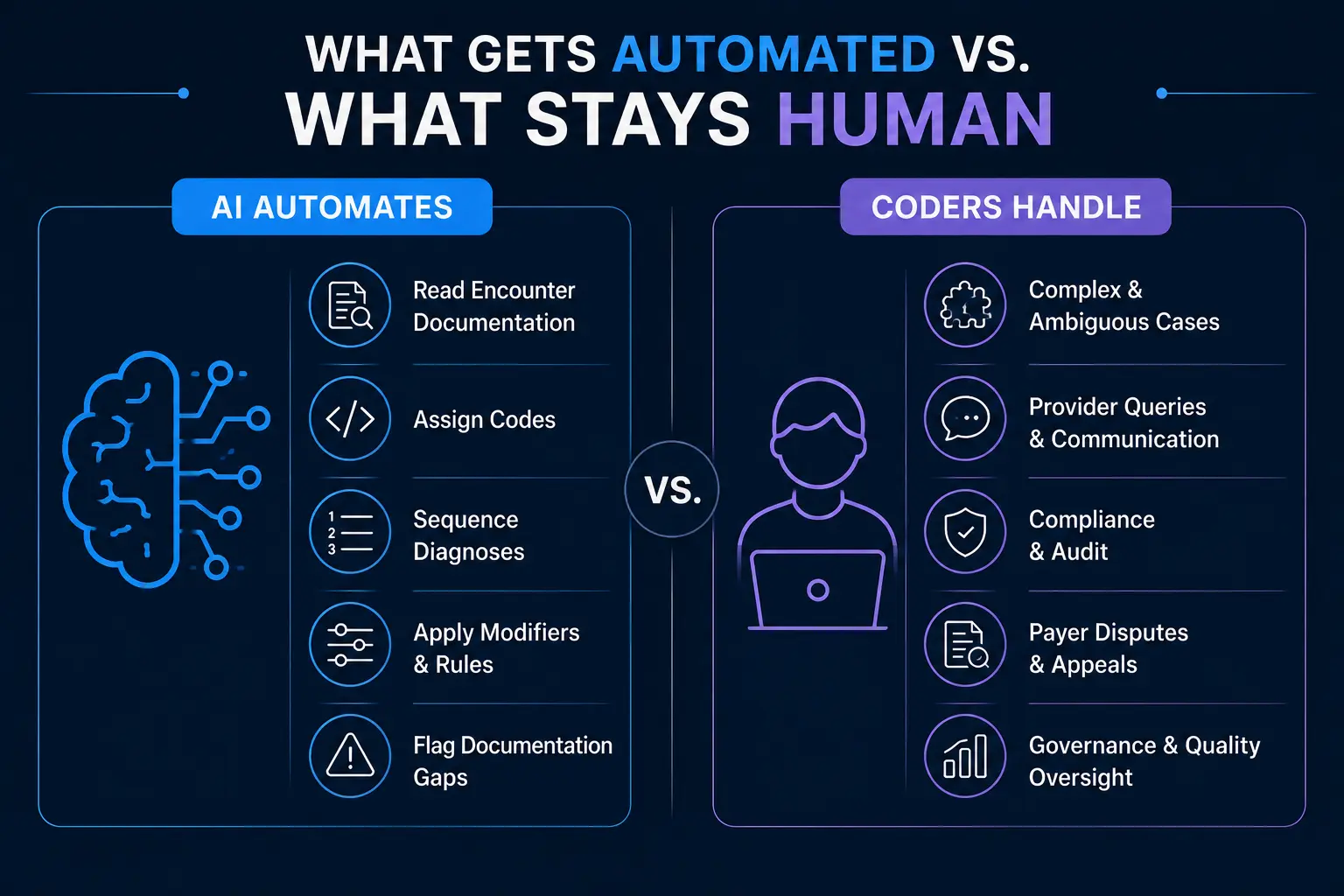
AI can automate repetitive, rule-based, high-volume medical coding tasks. This includes reading completed encounter notes, assigning ICD-10-CM and CPT codes, sequencing diagnoses, applying modifiers, and flagging documentation gaps before a claim goes out.
AI can automate tasks that make up the bulk of routine medical coding volume in most practices and health systems. This includes:
- Reading completed clinical documentation and extracting relevant coding elements
- Assigning diagnosis and procedure codes for straightforward, well-documented encounters
- Sequencing diagnoses to support medical necessity
- Applying payer-specific modifiers and coding rules
- Flagging documentation gaps that could affect reimbursement
- Routing uncertain or complex charts to a human coder for review
In many of our conversations with HIM directors and RCM leaders, this question often comes up: "Does AI code 100% of the medical charts? Or do we still need medical coders to help with the coding?"
The honest answer is neither extreme. Platforms like CombineHealth automate the majority of routine coding, while uncertain encounters are reserved for human review. Medical coders aren't removed from the workflow; they're repositioned to focus on the cases that genuinely require expertise, and the organization sets its own thresholds for how much gets automated versus reviewed.
Why Are Human Medical Coders Still Needed?
Human medical coders are still needed because AI can identify and suggest codes, but it cannot reliably handle every clinical nuance, ambiguous documentation, payer-specific requirement, or high-risk case. Human coders provide the judgment, validation, and oversight needed to ensure coding is accurate, compliant, and defensible.
That’s because medical coding isn't purely mechanical; it requires interpreting ambiguity, communicating with providers, and taking accountability for decisions that carry legal and financial weight. AI can process documentation quickly, but it can't yet replace professional judgment in every scenario.
The future human medical coder's role is broader than final approval or data entry. It spans complex-case coding, validation, auditing, CDI, compliance, and governance of the automation itself, a wider scope of responsibility than traditional chart-by-chart coding.
- Complex and ambiguous cases: Charts with conflicting documentation, multiple comorbidities, or unclear medical necessity still need a human to interpret intent.
- Provider communication: Coders query physicians directly to clarify documentation, a relationship AI can't replicate.
- Compliance and audit work: Someone has to defend a coding decision to an auditor or payer, and that responsibility sits with a credentialed professional.
- Payer disputes and denial analysis: Understanding why a claim was denied and building an appeal strategy requires contextual reasoning across payer policy, documentation, and history.
- Organizational responsibility: Health systems remain accountable for the codes they submit, regardless of which tool generated them.
- Policy interpretation: Local coverage determinations (LCDs) and national coverage determinations (NCDs) change frequently and require judgment to apply correctly to edge cases.
- Quality governance: Someone has to monitor whether the automation itself is performing well over time, not just whether individual charts are correct.
Can AI Understand Complex Medical Documentation?
AI can process complex documentation, but its reliability drops as ambiguity increases. Well-configured coding platforms handle nuance far better than general-purpose language models, though neither replaces human judgment on genuinely unclear charts.
Complexity in medical coding takes several forms:
- conflicting documentation between providers
- multiple overlapping comorbidities
- encounters requiring subjective clinical interpretation
- cases where medical necessity isn't clearly established in the notes.
Documentation that should trigger human review includes incomplete provider notes, contradictory diagnoses, unusual combinations of procedures, and any chart where the coding outcome carries significant financial or compliance risk.
How is the Accuracy of AI Medical Coding Measured?
AI medical coding accuracy should be measured across multiple dimensions, not with a single percentage. This includes CPT accuracy, ICD-10 accuracy, medical necessity, modifier accuracy, and claim-line accuracy
This distinction matters because coding accuracy is difficult to compare across tools without a shared definition of what "accurate" means.
At the claim-line level, CPT codes and HCPCS Level II accuracy is measured against the specific service billed. For ICD-10-CM, accuracy has to account for primary diagnosis selection, documentation completeness, medical-necessity support, sequencing, and guideline compliance, not just whether a code was technically valid.
Can Medical Coding Become Fully Automated?
Medical coding can become highly automated, but "fully automated" and "unsupervised" aren't the same thing. The safest and most defensible model keeps automation paired with structured governance. It is not full autonomy without oversight.
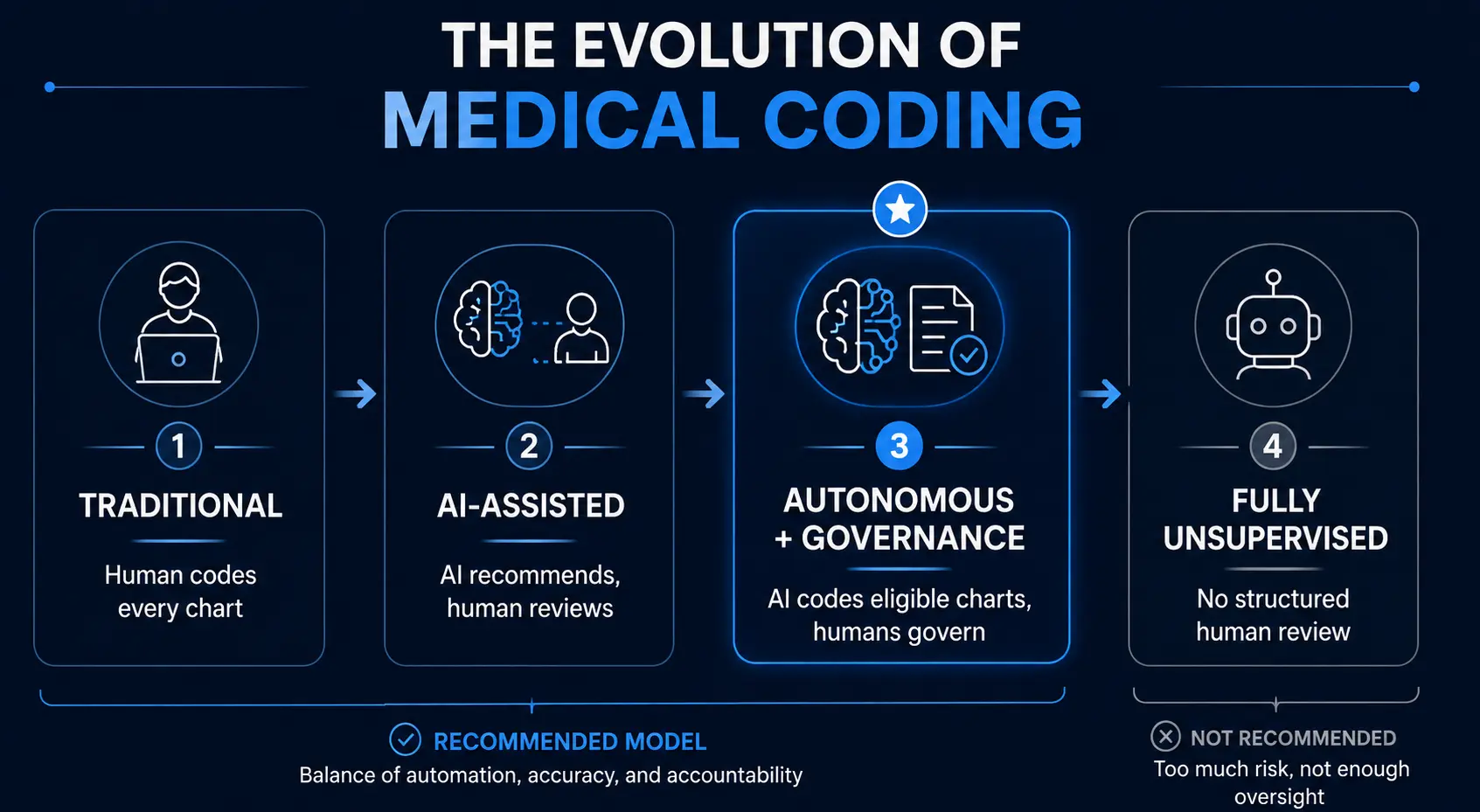
Healthcare organizations don't have to choose between manual coding and immediate full autonomy. Most begin with coding assistance or auditing, establish trust in the output over time, and expand autonomous coding as performance data and risk tolerance allow.
What Happens When AI Makes a Medical Coding Mistake?
A medical coding error, whether made by a human or an AI system, can trigger a chain of financial consequences: claim denials, underpayments, overpayments that require repayment, rework for the billing team, audits, and broader compliance exposure.
Denial rates in the 15-20% range are already common industry-wide, which is part of why buyers care so much about how errors get caught. AI that handles exception queues and human-review controls in addition to assigning medical codes is a direct response to that financial-risk chain.
So, the better question is: how does the organization identify uncertain decisions, review exceptions, track changes, and prevent the same type of error from becoming systemic?
That's answered through a combination of mechanisms:
- Confidence thresholds that determine which charts are automated versus held for review
- Explainable rationale attached to every coded chart, showing why a code or modifier was selected
- Selective approval and rejection, so a coder can accept parts of an AI recommendation and reject others
- Audit trails documenting every decision and change for compliance purposes
- Coding-quality monitoring that tracks accuracy trends over time, not just individual chart outcomes
- Denial and reimbursement feedback loops that feed real payer outcomes back into the coding logic
How Is AI Changing the Role of Medical Coders?
AI is shifting medical coders away from repetitive, high-volume chart coding and toward auditing, validation, CDI, compliance, and governance of the automation itself.
What Does a Hybrid AI and Human Coding Model Look Like?
A hybrid model combines automated coding for high-confidence, routine encounters with structured human review for everything else. In production, that typically plays out as a ten-step process:
- The encounter is completed, and documentation is finalized in the electronic health record (EHR).
- The coding platform ingests the note and extracts relevant clinical detail.
- Documentation sufficiency is checked against coding guidelines.
- Codes, modifiers, and diagnosis sequencing are generated with a confidence score attached.
- Payer-specific rules are applied to the draft claim line.
- High-confidence charts proceed automatically according to configured thresholds.
- Low-confidence, complex, or client-designated charts are routed to a human coder.
- The coder reviews the rationale and evidence behind each suggested code.
- The coder approves, edits, or rejects individual code-level changes.
- Approved coding flows into billing, and the outcome feeds back into future accuracy improvements.
CombineHealth is a production example of this model. Amy is CombineHealth’s autonomous self-learning AI medical coding automation platform that uses Large Language models to read the full clinical note, apply coding guidelines and payer-specific rules, and generate explainable, billing-ready medical codes. Its payer-aware coding methodology evaluates the complete encounter, coding guidance, documentation sufficiency, and downstream payer requirements, rather than functioning only as a code-suggestion tool.
How Does CombineHealth Use AI Without Removing Human Oversight?
CombineHealth's medical coding platform pre-codes eligible charts automatically, but it's built around governance rather than unchecked autonomy. Routine, high-confidence coding is completed without manual intervention. Low-confidence and client-designated cases are held for a human coder to review.
Coders can inspect the audit trails behind every AI-generated code before deciding whether to accept it. They can approve or reject individual changes rather than the whole chart, and organizations can choose to use their existing in-house coders or CombineHealth's certified coders for that review layer. Once approved, coding returns to the billing workflow automatically, and review thresholds remain configurable so an organization can adjust how much gets automated as trust in the output grows.
The production numbers support that model:
- Approximately 80-85% autonomous coding, depending on configuration and documentation quality
- Approximately 98% accuracy in a high-volume emergency department deployment
- 50% faster turnaround time than manual coding
- Five times more documentation gaps identified than traditional review
- Roughly 12-hour turnaround maintained even as chart volume scaled from about 100 to 1,000 charts
See Where Autonomous Coding Fits Your Organization
Every coding team has a different mix of routine and complex volume. See how CombineHealth automates high-confidence coding while keeping complex and uncertain cases under human oversight. Book a demo with CombineHealth now.
Frequently Asked Questions
Can AI ensure medical coding compliance?
AI can support compliance by applying consistent coding logic and maintaining audit trails, but it doesn't guarantee compliance on its own. A human coder or compliance professional remains responsible for reviewing exceptions and defending coding decisions.
Can AI prevent billing fraud?
AI can flag unusual coding patterns and inconsistencies that warrant a closer look, but it isn't a fraud-prevention guarantee. Human oversight, compliance programs, and payer audits remain necessary layers of protection.
Who is responsible for AI-generated medical codes?
The healthcare organization submitting the claim remains accountable for its accuracy, regardless of which tool generated the code. This is a core reason governance structures like confidence thresholds and audit trails matter.
Can AI keep up with changing payer rules?
Coding platforms with payer-aware intelligence continuously ingest updated payer policies, including LCDs and NCDs, and feed those rules back into coding logic. Even so, rule changes with ambiguous application to a specific case still benefit from human interpretation.
Is medical coding still a good career with AI in the picture?
Yes, the demand is shifting from high-volume manual coding toward auditing, CDI, compliance, and AI governance, roles that require more judgment and carry more responsibility, not less.
Will there still be jobs for medical coders?
Yes. As one healthcare RCM leader put it during a platform evaluation, the coding profession is "up for transformation," not elimination. Certified coders increasingly supervise and manage AI-driven workflows rather than coding every chart by hand.
What skills will future medical coders need?
Beyond core coding knowledge, future coders benefit from being able to evaluate AI-generated rationale, recognize patterns in where an automation system is likely to be wrong, and interpret evolving payer policy well enough to configure review rules, not just apply them chart by chart.
Will coders become AI auditors?
For a meaningful share of their time, yes. As routine coding gets automated, the coder's function shifts toward reviewing exception cases, auditing AI-coded charts for accuracy, and monitoring whether the automation itself is performing consistently over time.