10 Best Medical Coding Services in Florida for 2026
Compare 10 medical coding services in Florida by delivery model, coding scope, payer knowledge, and proof. See which fits your practice or hospital.
Published on:
October 14, 2026


Key Takeaways
• CombineHealth applies payer intelligence to Florida medical coding guidelines, learning from each payer’s denials, reimbursements, and underpayments so its strategy for a Medicaid managed care plan can differ from its strategy for a commercial payer, with explainable audit trails behind every code, an approach tied to 97.2% coding accuracy, up to 85% automation, and up to a 75% reduction in coding-related denials.
• Florida medical coding services fall into three delivery models: traditional outsourced coding where certified coders review each encounter manually, technology-enabled medical coding where coders work inside workflow or audit tools, and autonomous coding where AI software interprets the encounter and assigns codes. Many vendors offer more than one, so the label describes how work gets done on a given contract.
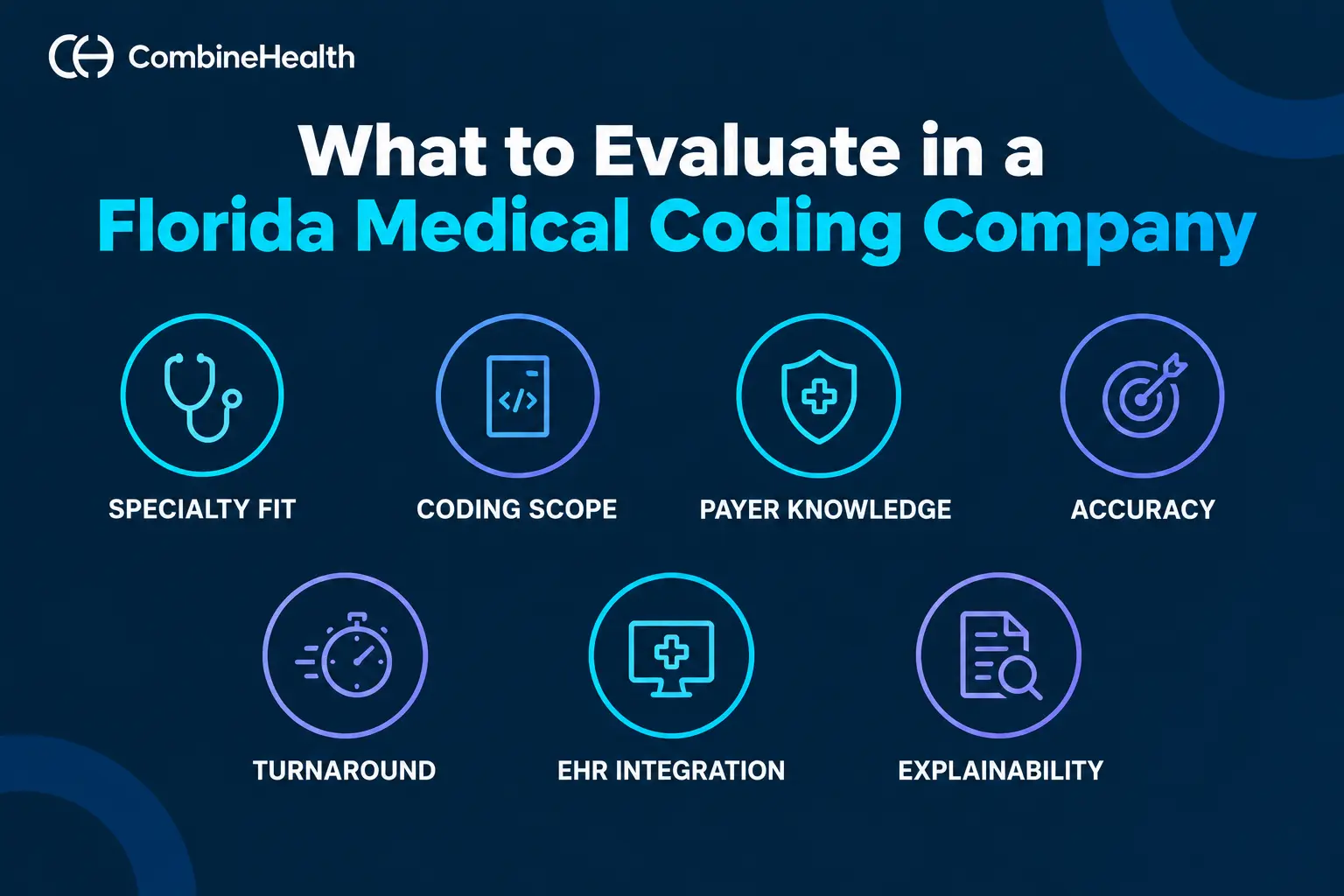
• A Florida medical coding company should be evaluated on seven criteria: supported specialties and care settings, professional and facility coding capability, payer-specific knowledge including Florida Medicaid, accuracy measured with a disclosed method, turnaround time, EHR integration, and explainability of coding decisions. A vendor’s address matters less than specialty fit, payer knowledge, workflow integration, and measured results.
• Florida Medicaid coding requirements flow through managed care plans because AHCA administers the Statewide Medicaid Managed Care program, most recipients are enrolled in it, and SMMC 3.0 contracts began on February 1, 2025. Serving Florida clients and understanding Florida payer workflows are separate claims, so ask each vendor for an example from a Florida Medicaid or Medicare workflow.
• Autonomous medical coding can support Florida Medicaid and Medicare claims when the platform applies coding guidelines and payer-specific requirements to each encounter, so ask any autonomous vendor to demonstrate Florida Medicaid and Medicare examples on your own charts.
Every claim a Florida practice submits rests on a medical coding decision. A missed modifier, a diagnosis sequenced out of order, or an E/M level the note cannot support turns a clean claim into rework, and rework drains the staff hours and cash flow a revenue cycle can least spare.
Florida adds layers to that handoff. Providers here code for Medicare, for Florida Medicaid managed care plans overseen by the Agency for Health Care Administration (AHCA), and for commercial payers with their own edits and documentation expectations. Each payer reads the same encounter through a different lens, and the coder or software must anticipate all of them.
This guide ranks 10 medical coding services that serve Florida healthcare providers, from autonomous AI platforms to enterprise outsourcers and practice-level coding teams. You will see how each one delivers coding, where each fits best, and which claims deserve a second look before you sign. Use it to turn a long list of vendors into a confident shortlist.
10 Best Medical Coding Services in Florida for 2026
1. CombineHealth
CombineHealth is a self-learning autonomous medical coding platform for physician groups, hospitals, health systems, MSOs, and RCM companies. Also referred to as Amy AI, the CombineHealth medical coding automation platform uses large language models to read the complete clinical encounter directly from the EMR. The platform applies coding guidelines and payer-specific requirements, then returns explainable, billing-ready professional and facility codes.
CombineHealth’s edge in Florida is payer intelligence. It learns from each payer's claim outcomes, so its coding strategy for a Medicaid managed care plan can differ from its strategy for a commercial payer. That matters in a state where most Medicaid recipients are enrolled in AHCA's Statewide Medicaid Managed Care program, which began its SMMC 3.0 contracts on February 1, 2025.
Autonomous Medical Coding across the Complete Encounter
The CombineHealth platform reads the full clinical note and generates ICD-10-CM, CPT, HCPCS Level II, E/M levels, modifiers, and HCC codes for professional and facility claims, with automation rates of up to 85%.
Self-learning from Claim Outcomes
Denials, reimbursements, and underpayments feed payer intelligence, so recurring payer patterns shape future medical coding decisions.
Explainable Decisions
Every code links to its supporting documentation through a traceable audit trail, so coders, auditors, and compliance teams can verify the rationale against the source note.
Documentation Gap Detection
Clinical documentation improvement runs inside medical coding. In an emergency department case study, CombineHealth identified 5× more documentation gaps than traditional workflows.
Case Study: AI Codes Alongside ED Experts Across 1,000 Emergency Department Charts
Emergency department coding is one of the hardest tests for autonomous medical coding, so CombineHealth put the platform through it. CombineHealth and the expert coders at Edelberg & Associates independently coded 1,000 emergency department charts over 15 days, at about 100 charts per day. Edelberg's audit team then scored every coding decision against defined criteria: documentation support, coding guidelines, specificity, sequencing, medical necessity, and payer requirements.
CombineHealth matched or outperformed the expert coders in every measured coding dimension. The platform delivered about 98% accuracy, about 50% shorter turnaround than the human-only workflow, and 5× more clinical documentation gaps identified, with about 85% of charts coded autonomously.
Read the full case study here.
Key Features:
- Autonomous AI medical coding and audit modes
- ICD-10-CM, CPT, HCPCS Level II, E/M, modifier, and HCC coding
- Complete-encounter review for professional and facility claims
- Clinical documentation improvement built into coding
- Payer-specific medical coding strategy learned from claim outcomes
- Explainable decisions with evidence and full audit trails
- Automatic regulatory and compliance updates
- EHR and PMS integration
Best For: Florida physician groups, hospitals, health systems, MSOs, and RCM companies seeking autonomous medical coding that scales with volume, explains every decision, and lowers coding-related denials.
2. Omega Healthcare
Omega Healthcare Management Services (Omega Healthcare) is headquartered in Boca Raton, Florida, and delivers outsourced medical coding at enterprise scale. The company describes itself as operating across the United States, India, and the Philippines, with more than 20,000 employees. It acquired ApexonHealth, an AI and automation revenue cycle provider, in April 2022. Analysts rank it among the top technology-enabled revenue cycle providers.
Key Features:
- Professional and facility coding
- Large-scale outsourced coding capacity
- Chart audit and charge capture
- Clinical documentation improvement
- HCC and risk adjustment medical coding review
- Technology, automation, and analytics
- End-to-end revenue cycle services, from patient access to A/R collections
Best For: Large Florida hospitals and health systems seeking enterprise outsourced medical coding capacity.
3. GeBBS Healthcare Solutions
GeBBS Healthcare Solutions (GeBBS) pairs certified coders with iCode Workflow, a proprietary platform that includes an autonomous medical coding capability. The company reports a global workforce of more than 14,000 professionals and lists facility, professional-fee, and risk adjustment coding experience. According to an AWS case study, GeBBS built an automated medical coding assistant on Amazon Bedrock and moved from weeks-long backlogs to same-day processing.
Key Features:
- Professional-fee medical coding
- Facility coding, with a stated 5% quality audit of charts coded by established staff
- Contractual facility coding accuracy guarantee of up to 96% or higher
- Risk adjustment coding
- Autonomous medical coding within iCode Workflow
- Medical coding workflow software with EMR access through VPN
Best For: Hospitals and health systems needing professional, facility, and audit coding.
4. Access Healthcare
Access Healthcare provides outsourced coding across inpatient, outpatient, professional fee, emergency department, risk adjustment, home health, and hospice work. It also offers coding audits, clinical documentation improvement, and autonomous coding platforms, including a product called Echo Suite. The Everest Group named Access Healthcare a Leader in its 2023 Medical Coding Operations PEAK Matrix Assessment of 22 service providers.
Key Features:
- Professional and facility coding across care settings
- Autonomous and computer-assisted medical coding platforms
- Medical coding audits and clinical documentation improvement support
- Revenue integrity and coding denial management
- Scalable programs for revenue cycle companies, including a published case study of growth from 0 to 500 coders and 70,000 charts per month
- More than 80 health systems and hospitals served, per the company
Best For: Hospitals, physician groups, and RCM companies requiring scalable medical coding operations.
5. Practolytics
Practolytics delivers medical coding through AAPC- and AHIMA-certified coders and bundles it with billing, audits, and denial management. The company also provides AdvancedMD software access at no extra cost with its RCM services, which suits a practice that wants one vendor for coding and billing. They offer a tested 98% accuracy and a 24-hour turnaround time.
Key Features:
- ICD-10, CPT, and HCPCS coding by certified coders
- Multi-specialty coverage
- Medical coding and compliance audits
- Medical billing and denial management
- AdvancedMD software access with RCM services
- Flexible outsourced engagement
Best For: Small and midsize Florida practices seeking coding plus broader billing support.
6. MDBC Pro
MDBC Pro operates from Miami and was established in Florida in 2015 by a group of Certified Professional Coders. It offers medical coding, provider credentialing, and out-of-network billing, with billing services starting at 3.5% of monthly collections.
Key Features:
- Florida-based delivery from a Miami office
- Medical coding services
- Provider credentialing and enrollment
- Out-of-network billing
- Percentage-of-collections billing pricing
Best For: Florida practices seeking locally based medical coding and credentialing support.
7. Florida MD Billing Company
Florida MD Billing Company is located in St. Petersburg and has an AAPC-certified badge. It assigns ICD-10, CPT, and HCPCS codes for medical and dental practices, and they work with Florida Medicaid, Blue Cross Blue Shield, Aetna, and Cigna. It has integrations listed with eClinicalWorks, athenahealth, Kareo, and Tebra, among others.
Key Features:
- AAPC-certified medical coding staff
- ICD-10, CPT, and HCPCS code assignment for medical and dental practices
- Florida payer support, including Medicaid and major commercial plans
- Specialty-specific coding guidance and documentation standards
- Claims, denial management, and full revenue cycle services
- Free practice audit
Best For: Small clinics and multi-provider practices wanting Florida-based coding and billing support.
8. Aegis Healthcare Solutions
Aegis Healthcare Solutions is headquartered in New Jersey and lists 11 to 50 employees. It covers various Florida locations including Tampa, Brandon, Port Saint Lucie, and Royal Palm Beach. The company advertises 95% claim payment within 2 to 6 weeks. It offers HCC coding, revenue cycle audits, credentialing, and contracting services along with RCM.
Key Features:
- Medical coding by AAPC-certified coders
- HCC coding and validation services
- Revenue cycle audits
- Credentialing and contracting
- Revenue cycle management
- Virtual medical scribe services
Best For: Florida practices seeking certified medical coding alongside revenue cycle support.
9. PracticeForces
PracticeForces is based in Clearwater, Florida, and was founded in 2003. It received the USF Fast 56 Award in 2018 for the fastest-growing RCM business. PracticeForces works within each practice's existing systems and states that certified coders also work in back-office operations in India and the Philippines.
Key Features:
- Medical coding and billing
- Insurance claim resolution and A/R management
- Coding that works inside the practice's existing EHR and staff structure
- Credentialing, EHR support, practice management, and consulting
- Florida team with offshore back-office medical coding centers
Best For: Florida practices wanting coding that works inside an existing EHR.
10. MedCare MSO
MedCare MSO was established in 2012 and offers billing, coding, and auditing, credentialing, and compliance services, including to Florida practices. It has more than 1,000 certified billers and coders and an AI-powered platform called Maximus for AI-assisted medical coding and denial prediction. MedCare MSO reports an 88% first-pass clean claims rate.
Key Features:
- Medical coding and auditing
- Eligibility verification and charge entry
- Claims scrubbing, denial management, and A/R follow-up
- Patient billing
- Credentialing and compliance management
- AI-assisted medical coding and denial prediction through Maximus
Best For: Florida practices wanting coding inside a broader outsourced RCM model.
What Are the Three Delivery Models for Medical Coding Services in Florida?
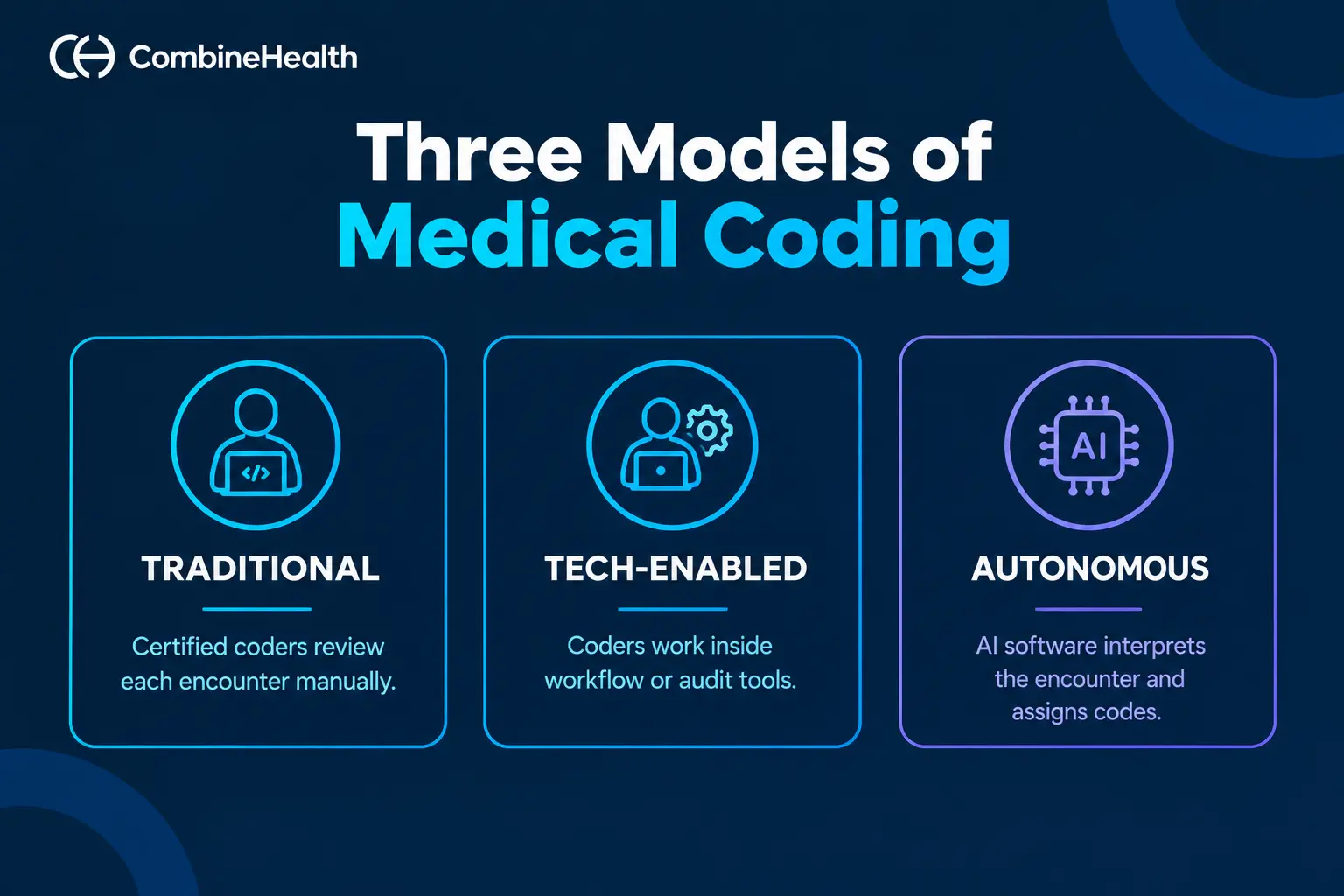
Florida medical coding services fall into three delivery models:
- Traditional outsourced coding: Certified coders review and code each encounter manually, which suits organizations that need flexible human capacity.
- Technology-enabled coding services: Coders work inside workflow, encoder, or audit tools that speed review and standardize quality checks.
- Autonomous medical coding: AI software interprets the encounter and assigns codes, which targets high volume and consistent turnaround.
Many vendors offer more than one model, so the labels describe how work gets done on a given contract. The model you choose sets the terms for everything that follows: turnaround, cost, and the kind of evidence you should ask for.
Medical coding quality depends on specialty fit, payer knowledge, workflow integration, and measured results. A vendor's address has little bearing on any of those four. A company in Boca Raton and a company working remotely can both serve a Miami cardiology group well when each meets the same evidence bar.
How to Evaluate Medical Coding Companies in Florida
A Florida medical coding company has to be evaluated on the criteria below:
- Supported specialties and care settings
- Professional and facility coding capability
- Payer-specific knowledge, including Florida Medicaid
- Accuracy measured with a disclosed method
- Turnaround time
- EHR integration
- Explainability of medical coding decisions
Accuracy Claims Need a Disclosed Method
A 95% accuracy claim can describe different measurements at different vendors. Some calculate accuracy at the claim level, others at the claim-line, CPT, or ICD-10 level. The American Health Information Management Association (AHIMA) and the American Academy of Professional Coders (AAPC) both point to 95% as the standard threshold, yet two organizations can report that figure while measuring different things.
Ask each vendor for the sample size, audit frequency, reviewer qualifications, and whether results come from live production charts or a controlled pilot. Request accuracy broken out by CPT, ICD-10-CM, and modifiers, since a single aggregate score can hide weak spots.
Florida Medicaid and Payer Knowledge
Florida Medicaid coding requirements flow through managed care plans. AHCA administers the Statewide Medicaid Managed Care (SMMC) program, and most Florida Medicaid recipients are enrolled in it. AHCA implemented SMMC 3.0 on February 1, 2025, with new contracts for health and dental plans.
Ask each vendor how it applies plan-specific requirements, and request an example from a Florida Medicaid or Medicare workflow. Serving Florida clients and understanding Florida payer workflows are separate claims, so ask for evidence of the second.
Care Setting, Integration, and Audit Support
Professional medical coding and facility coding follow different rules, so confirm the vendor supports your setting: physician practice, hospital outpatient, emergency department, inpatient, or ambulatory surgery center. Ask which EHR and practice management systems the vendor reads from and writes to. Ask what happens when documentation is incomplete, because the answer reveals whether the vendor flags gaps or guesses. Request audit trails and sample rationale for coded charts.
Pricing and implementation requirements vary by model. Ask for the pricing basis (per chart, percentage of collections, per coder, or software subscription), the onboarding timeline, and contract terms in writing.
How to Choose a Medical Coding Service for Your Florida Organization
Ask these questions on every scoping call with a Florida medical coding service provider:
- Which accuracy method do you use, and what was your last audit sample size?
- How do you apply Florida Medicaid plan requirements?
- What happens when documentation is incomplete?
- Which EHR systems do you integrate with?
- What is your turnaround time during volume spikes?
- What does implementation cost, and how long does onboarding take?
Implement Self-Learning Medical Coding on Your Charts
The CombineHealth medical coding platform reads the full clinical note, applies payer-specific rules, and returns explainable, billing-ready codes while payer intelligence sharpens coding strategy for each payer.
See it run on your own claim volume. Book a demo.
Frequently Asked Questions
What Is the Best Medical Coding Service in Florida?
The best service depends on organization type, specialties, and care settings. Large hospitals often favor Omega Healthcare, GeBBS, or Access Healthcare for capacity. Small practices often favor Florida-based firms such as Florida MD Billing Company. Organizations that want self-learning autonomous coding with explainable decisions can evaluate CombineHealth.
How Much Do Medical Coding Services Cost in Florida?
Pricing varies by delivery model. Vendors commonly charge per chart, as a percentage of collections, per coder, or as a software subscription. MDBC Pro lists billing services from 3.5% of monthly collections. Request a written quote that states the pricing basis, setup fees, and contract length.
Do I Need a Florida-Based Medical Coding Company?
A Florida office is optional. Medical coding quality depends on specialty fit, payer knowledge, workflow integration, and measured results. A remote vendor with Florida Medicaid and Medicare examples can match a local firm. Ask any vendor for Florida payer evidence from live charts.
What Accuracy Rate Should a Medical Coding Service Deliver?
A common benchmark is 95%, and several vendors in this guide report 97% to 98% or higher. Compare those figures only after confirming each vendor's measurement method, sample size, and audit frequency. CombineHealth reports 97.2% coding accuracy, and approximately 98% in its emergency department case study.
Does Autonomous Medical Coding Work for Florida Medicaid and Medicare Claims?
Autonomous medical coding can support these claims when the platform applies coding guidelines and payer-specific requirements to each encounter. CombineHealth adapts coding strategy per payer using claim outcomes such as denials, reimbursements, and underpayments. Ask any autonomous vendor to demonstrate Florida Medicaid and Medicare examples on your own charts.