Nym vs CodaMetrix vs Fathom: Autonomous Medical Coding Accuracy Compared
Compare Nym, CodaMetrix, and Fathom on published autonomous medical coding accuracy and automation results, and see which fits your organization.
Published on:
October 22, 2026


Fathom has the strongest publicly available evidence for accuracy and automation among Nym, CodaMetrix, and Fathom. CodaMetrix stands out for enterprise maturity, while Nym focuses on explainability. CombineHealth brings these priorities together while extending autonomous medical coding into measurable revenue cycle outcomes.
CombineHealth’s self-learning medical coding platform integrates coding, CDI, payer-specific intelligence, and denial prevention, with demonstrated results including:
98.4% coding accuracy
75% fewer coding-related denials
4% more captured revenue
For organizations evaluating coding performance alongside financial impact, CombineHealth offers a compelling end-to-end approach.
Key Takeaways
• Fathom has the strongest published accuracy and automation evidence, CodaMetrix has a broad enterprise and Epic footprint, and Nym offers clear code-level explainability. Their accuracy figures use different methodologies and specialty mixes, so they cannot be compared directly.
• High coding accuracy does not guarantee fewer denials. CMS data shows that missing or insufficient documentation accounts for far more improper payments than coding errors. Medical necessity and payer requirements also affect reimbursement.
• Choose based on your biggest problem. If medical coding accuracy is strong but denials remain high, look beyond code selection at documentation gaps and payer-specific requirements.
• CombineHealth is a self-learning autonomous medical coding platform that connects CDI with autonomous coding and uses claim outcomes, including denials and underpayments, to support better medical coding and revenue capture.
Fathom, Nym, and CodaMetrix have each published performance results that offer useful insights into their autonomous medical coding capabilities.
However, these platforms have not been independently tested on the same charts, code sets, specialties, accuracy methods, and autonomy thresholds. Each vendor reports results from its own conditions, specialty mix, and definition of an autonomously coded chart. The percentages therefore cannot be treated as results from a controlled head-to-head test. This comparison evaluates the quality and relevance of each vendor's published evidence instead.
Accuracy scores alone also cannot show whether a claim will be paid. Medical coding teams can report 98% accuracy without seeing any improvement in denial rates.
This article evaluates the evidence each vendor has published, identifies which organizations each platform suits, and explains what CombineHealth measures beyond coding accuracy.
Nym vs CodaMetrix vs Fathom at a Glance
Who Wins Among Nym, CodaMetrix, and Fathom?
Amongst all three, Fathom leads on published accuracy and automation results.
In March 2026, Fathom reported a 95.5% encounter-level automation rate and improved medical coding accuracy from 96.3% to 98.3%. These are vendor-published customer results rather than independently audited figures, which is true of every accuracy number in this comparison.
Nym and CodaMetrix stand out in different areas, making each a better fit for specific buyers.
- Nym stands out for explainability. Its Clinical Language Understanding engine interprets physician notes and assigns medical billing codes. Nym also provides audit-ready, traceable documentation for every code, showing why it was assigned.
- CodaMetrix leads in enterprise maturity. Its CMX CARE platform uses longitudinal clinical context to support autonomous coding across specialties at scale. CodaMetrix also holds the No. 1 ranking in the inaugural 2026 Best in KLAS autonomous coding category.
How CombineHealth Compares Against Nym, CodaMetrix and Fathom
CombineHealth is the better fit amongst Nym, CodaMetrix and Fathom for organizations that want autonomous medical coding connected to clinical documentation improvement (CDI), payer-specific claim requirements, and downstream reimbursement outcomes. Rather than measuring success through coding accuracy alone, CombineHealth’s autonomous medical coding platform, Amy AI, checks whether the documentation supports the code, the code supports the claim, and the claim is paid correctly.
Some notable results of CombineHealth:
- 98.4% medical coding accuracy standard across all healthcare deployments and specialties
- 85% medical coding automation rate
- 75% reduction in coding-related denials
Nym Autonomous Medical Coding
Nym Health is an autonomous medical coding platform powered by Clinical Language Understanding (CLU). Its main differentiator is explainability. Nym says its engine codes patient charts in seconds with over 95% accuracy and zero human intervention. It also provides audit-ready documentation for every code, showing why the medical code was assigned.
Best for
Health systems and physician groups that need autonomous coding for emergency medicine, radiology, outpatient surgery, and inpatient professional fee coding, especially when audit defensibility is a priority.
Strengths
- Explainable coding: Nym combines proprietary machine learning models with rules-based clinical and medical coding ontologies. This approach produces traceable audit trails for both professional fee and facility coding.
- Code-level audit trails: Every coding decision includes supporting clinical documentation, specific coding guideline references, and step-by-step rationale. Compliance teams can review the evidence recorded during coding instead of reconstructing the reasoning later.
- Documentation analysis: At one health system, Nym benchmarked ED E/M leveling against roughly 150,000 peer charts and identified two practices suppressing E/M levels.
Published accuracy evidence
Nym reports Geisinger processes encounters in under 2.5 seconds with over 96% accuracy. At one large health system using Nym for radiology professional fee coding, the coding-related denial rate dropped 97%, from 0.0998% to 0.0030%.
Potential drawback
Nym publishes no encounter-level automation rate on their official website, so the share of charts coded without human touch cannot be determined publicly. It also publishes no named customer case study pairing an accuracy figure with an automation figure.
CodaMetrix Autonomous Medical Coding
CodaMetrix stands out for enterprise-scale deployment and independent customer validation. It ranked No. 1 in the 2026 Best in KLAS category for Autonomous Coding. For large health systems using Epic, this recognition and its reported deployment scale offer evidence of enterprise adoption, although the ranking does not independently establish coding accuracy.
Best for
Large health systems and academic medical centers using Epic that need autonomous coding across multiple specialties and prioritize independent customer feedback during procurement.
Strengths
- Its CMX CARE platform codes from longitudinal clinical context rather than a single encounter note, which is what it credits for holding accuracy consistent across specialties at scale.
- Deployed breadth across dozens of health systems in more than half the states, with KLAS-interviewed specialty representation spanning radiology, pathology, surgery, and evaluation and management.
- Its platform was built in partnership with providers representing more than 500 hospitals, including nine U.S. News & World Report Honor Roll institutions.
Potential drawback
CodaMetrix focuses on medical coding rather than the full revenue cycle. Organizations that need medical coding connected to eligibility verification, claim validation and billing, A/R, denial management, and appeals will find CodaMetrix’s scope narrower.
Recommended Read: CombineHealth vs. CodaMetrix
Fathom Autonomous Medical Coding
Fathom has some of the strongest published evidence for autonomous coding accuracy and automation among these three vendors.
In March 2026, it reported that a health system achieved 95.5% encounter-level automation and 98.3% coding accuracy, up from 96.3% under its previous coding approach. These results covered all service lines and places of service. The named customer case study reports both metrics together, making Fathom easier to evaluate using public evidence.
Best for
Provider organizations and physician groups seeking high autonomous coding rates across multiple outpatient specialties, with published customer results to evaluate.
Strengths
- AI-powered coding: Fathom combines deep learning and natural language processing (NLP). Its technology was trained on more than 750 million patient encounters.
- Complex coding requirements: At Your Health, Fathom handled ICD code sequencing, combination codes, G2211 add-on code capture, and modifier 25. The implementation was calibrated to Your Health's coding guidelines and payer mix.
- Multiple care settings: Your Health deployed Fathom across physician offices, patients' homes, assisted and independent living facilities, nursing homes, and telehealth. Fathom is also developing autonomous inpatient facility DRG coding with a consortium of health systems and academic medical centers.
Published accuracy evidence
CodaMetrix uses a health system’s deployment as the reference point: 95.5% medical coding automation at 98.3% coding accuracy against a 96.3% baseline.
Potential drawback
Like Nym and CodaMetrix, Fathom stays within medical coding. The platform covers autonomous medical coding and coding audits, with offerings for fully connected eligibility verification, billing, A/R follow-up, denial management, or appeals. Organizations looking for medical coding linked to those downstream workflows will need other tools alongside Fathom.
Why Medical Coding Accuracy Alone Does Not Determine the Best Platform
Medical coding must produce claims that are accurate, defensible, and eligible for reimbursement. Accurate medical code assignment alone does not guarantee payment. In its FY2025 Medicare fee-for-service improper payment report, CMS found that incorrect medical coding accounted for roughly one in nine improper-payment dollars. Other causes included missing or insufficient documentation, medical necessity issues, and other errors that a medical coding accuracy score does not measure.
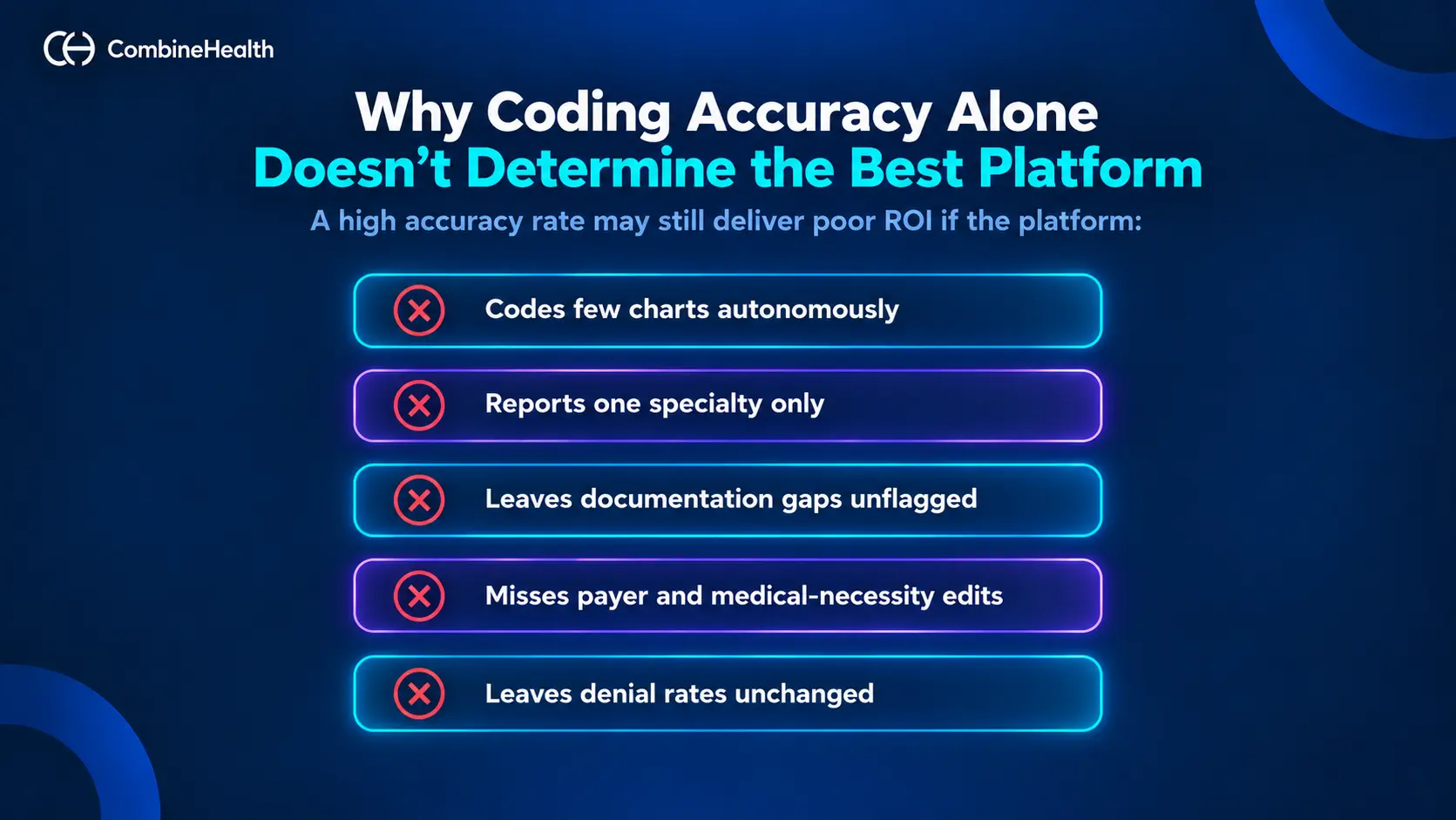
An autonomous medical coding platform can assign the correct code and still produce a claim that gets denied, underpaid, or undercodes the services provided. Even a high accuracy rate may deliver poor ROI if:
- The platform autonomously codes only a small share of charts.
- The reported accuracy rate covers only one specialty.
- Missing or incomplete clinical documentation goes unflagged.
- Payer-specific modifier or medical-necessity edits trigger downstream denials.
- Coding-related denial rates remain unchanged.
This is the gap CombineHealth is built to close. Beyond assigning codes, it flags clinical documentation gaps during coding, validates each claim against payer-specific requirements before submission, and learns from denials and underpayments afterward.
The payoff is the outcome metrics an medical coding accuracy score can't capture: at a 400-bed hospital, CombineHealth cut coding-related denials 75%, lifted captured revenue 4%, and surfaced 5× more CDI opportunities within three months — none of which Nym, CodaMetrix, or Fathom publishes.
Where CombineHealth Is a Stronger Fit Than Nym, CodaMetrix, and Fathom
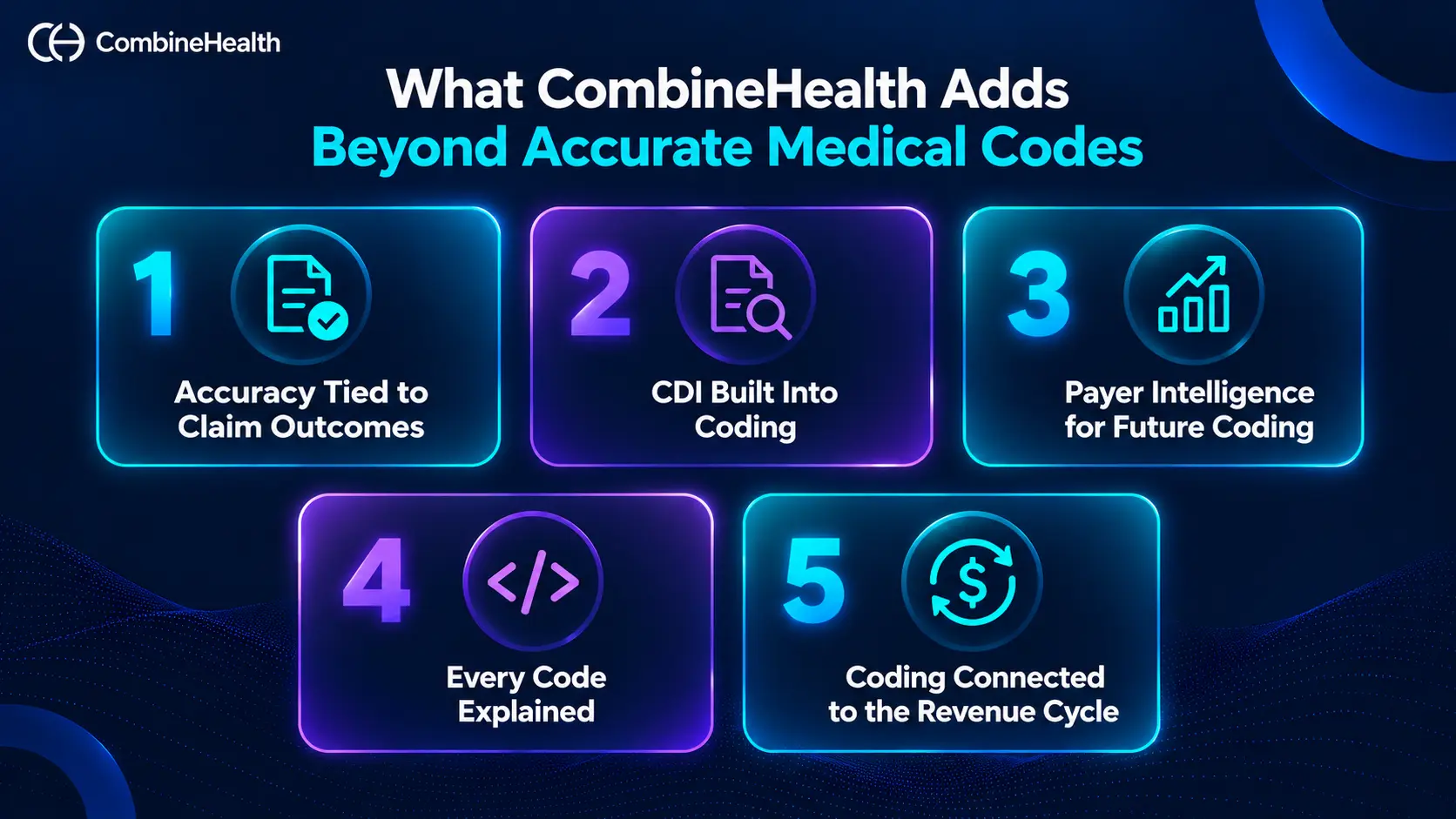
CombineHealth is a strong fit for organizations that want autonomous medical coding integrated with clinical documentation improvement (CDI), payer-specific requirements, and reimbursement outcomes. Its platform, Amy AI, evaluates whether the documentation supports the code, the code supports the claim, and the claim is reimbursed correctly.
1. Connects Medical Coding Accuracy to Claim Outcomes
CombineHealth tracks what happens after claim submission, including denials, reimbursement, underpayments, captured revenue, and recurring payer issues. This lets healthcare organizations evaluate medical coding accuracy alongside financial outcomes, rather than relying on coding accuracy scores alone.
2. Integrates CDI Into the Coding Workflow
CombineHealth reviews the full encounter for missing specificity, contradictory documentation, unsupported services, missed diagnoses, E/M opportunities, and medical-necessity gaps. It distinguishes documentation issues suitable for provider education from gaps that require a CDI query, identifies the supporting clinical evidence, and routes queries when needed.
Recommended Read: CDI Improvement in Healthcare
3. Uses Payer Intelligence to Inform Future Coding
CombineHealth applies medical coding guidelines and configured payer requirements before claim submission. After adjudication, denials, reimbursements, and underpayments feed into its payer intelligence. This helps identify payer-specific adjudication patterns that can inform future coding and claim validation, subject to review and validation.
Recommended Read: Payer Intelligence in AI Medical Coding
4. Explains Each Coding Decision
For each code, Combinehealth provides the supporting documentation, clinical evidence, coding guidelines, and payer requirements. For E/M coding, teams can review the documented problems, data, and risk supporting the selected level.
Recommended Read: Explainability in Healthcare AI
5. Connects Coding to the Wider Revenue Cycle
CombineHealth extends beyond medical coding into eligibility checks, pre-bill claim validation, claim submission, payer follow-up, denial management, denial appeals, and analytics. This connects coding decisions with downstream claim processing and reimbursement workflows.
Recommended Read: Top 10 Healthcare RCM Tools
CombineHealth Production Evidence in Autonomous Medical Coding
CombineHealth reports medical coding accuracy by individual dimension rather than relying on one overall score. This helps buyers see how well the system handles different coding tasks and where errors may occur.
1. Brault Parallel Medical Coding Audit
Brault, an emergency medicine revenue cycle management (RCM) organization serving 75 sites across 140 locations, adopted CombineHealth after another autonomous coding solution struggled with differences in client requirements and physician documentation styles.
Brault compared CombineHealth's coding against its existing process through parallel audits. It set a minimum accuracy threshold of 96% for each coding dimension and 98% for MIPS. CombineHealth exceeded every threshold and continued to undergo production audits after deployment.
CombineHealth also maintained turnaround times under 12 hours during volume spikes of 2-3 times the normal workload. Recent site deployments reached production in approximately two weeks.
Read the detailed CombineHealth and Brault case study here.
2. 400-Bed Midwest Hospital
At a 400-bed Midwest hospital, CombineHealth maintained 98.4% coding accuracy while achieving the following results within three months:
- 75% fewer coding-related denials
- 4% higher captured revenue
- 5× more CDI opportunities identified
These results show why coding accuracy needs to be measured alongside documentation quality and claim outcomes. A medical coding accuracy score alone cannot show whether a platform catches documentation gaps, prevents coding-related denials, or improves captured revenue.
Who Should Choose CombineHealth?
CombineHealth is a good fit for organizations that need to improve clinical documentation, reduce coding-related denials, or capture more revenue.
- Hospitals and health systems that want medical coding and clinical documentation improvement (CDI) in one workflow
- Physician groups evaluating autonomous coding across multiple specialties
- Revenue cycle management (RCM) organizations that need configurable coding workflows for different clients
- Emergency departments handling varied physician documentation and sudden changes in chart volume
- Organizations experiencing coding-related denials despite acceptable coding accuracy
- Revenue cycle teams looking to identify undercoding and missed revenue
- Organizations that need payer-specific coding rules, pre-bill validation, and audit trails
- Teams managing denials and appeals that want coding connected with downstream revenue cycle analytics
Final Verdict
Among the three, Fathom has the strongest publicly available accuracy and automation results among Nym, CodaMetrix, and Fathom. CodaMetrix has a more established enterprise presence, while Nym stands out for explainability.
However, their published accuracy figures come from different methodologies, so they cannot be compared directly to determine which medical coding platform is most accurate.
CombineHealth is a stronger fit for organizations that need to connect autonomous coding with clinical documentation improvement (CDI), payer-specific requirements, coding-related denial reduction, revenue capture, and learning from claim outcomes.
Book a demo to see how CombineHealth handles medical coding, identifies documentation gaps, and flags payer-specific issues.
Frequently Asked Questions
Which is more accurate: Nym, CodaMetrix, or Fathom?
Fathom has the highest published customer figure, 98.3% at Your Health. Nym publishes over 95%, and CodaMetrix publishes a Best in KLAS ranking rather than an accuracy percentage. The figures came from different methodologies on different specialty mixes, so they are not directly comparable.
Does a high autonomous coding accuracy rate reduce denials?
Not on its own. Medical coding accuracy measures whether assigned codes match an auditor's findings. Claim payment also depends on documentation, medical necessity, and payer requirements.
What should I ask every autonomous coding vendor about accuracy?
Ask whether accuracy covers all submitted encounters or only those the platform chose to code. Request separate accuracy figures for ICD-10-CM, CPT, E/M, and modifiers to identify which coding areas need more review.
How is CombineHealth different from Nym, CodaMetrix, and Fathom?
All three focus on autonomous coding. CombineHealth connects coding to the outcomes that determine whether a claim is paid: it integrates CDI into the coding pass, validates each claim against payer-specific requirements before submission, learns from denials and underpayments, explains every code with an audit trail, and extends across the wider revenue cycle — eligibility, claim validation, A/R, denials, and appeals.
Do Nym, CodaMetrix, or Fathom include integrated CDI and payer-outcome learning?
Based on their published materials, none of the three offers integrated CDI inside coding or payer-outcome learning as a documented capability — they flag documentation deficiencies or run documentation analysis separately from coding. CombineHealth integrates CDI into the coding workflow and feeds claim outcomes back into its payer intelligence.