10 Best Orthopedic Medical Billing Services in 2027
Compare the 10 best orthopedic medical billing services in 2027 by coding depth, RCM scope, operating model, and best-fit buyer to find the right fit.
Published on:
November 27, 2026


Key Takeaways
• CombineHealth is an AI-powered revenue cycle platform for orthopedics that learns from every denial, reimbursement, and underpayment to adapt billing strategy for each payer. Its orthopedic coding covers laterality, fracture specificity, modifiers, NCCI bundling logic, and global-period scenarios. It manages each case through eligibility, pre-bill validation, claims, denials, A/R follow-up, and appeals, reporting up to 85% automation and up to 75% fewer coding-related denials.
• A good orthopedic medical billing service closes revenue leaks at the source. Common leaks include modifier 25 on a same-day injection, an implant invoice that never reaches the payer, and a laterality gap in an operative note. Vendors do this through AI that codes and validates every encounter, specialist billing teams that take over the department, or a combination, and each model fits a different practice.
• Orthopedic billing vendors charge a percentage of collections, a flat monthly fee, a per-claim fee, or a software subscription. Compare net cost against the denial rate and collection rate each vendor commits to, not the fee alone.
• Outsource orthopedic billing when turnover, denial backlogs, or surgical volume outpace your billing office. Keep it in-house when your team has orthopedic coding depth. Hybrid models add AI coding or audits to an in-house team.
• Orthopedic claims are commonly denied for five reasons: modifier errors on 25 and 59, NCCI bundling edits, global period conflicts, missing prior authorization, and operative notes that omit laterality or implant details.
• A global period bundles routine post-operative care into the surgical fee. Major surgeries typically carry 90 days under Medicare. Modifier 24 covers an unrelated visit during that period, and modifier 79 covers an unrelated procedure.
• AI can code orthopedic surgical cases accurately when it reads the full operative note and applies payer requirements. An audit mode lets it review codes produced by surgeons, coders, or existing billing companies, so a practice can adopt it without replacing its current workflow.
A single total knee replacement sets off a long chain of billing decisions before the claim ever leaves the building. The surgeon documents the approach, the implant, the side, and what was found in the joint. A coder then converts that note into Current Procedural Terminology (CPT) and ICD-10-CM codes, applies modifiers, checks bundling edits, and tracks a 90-day global period that decides which follow-up visits are payable. One missing detail returns the claim weeks later as a denial.
Anyone who has run an orthopedic revenue cycle knows where the money leaks. The money leaves through modifier 25 on a same-day injection, an implant invoice that never reaches the payer, or a laterality gap in an operative note that nobody caught before submission. Each leak looks small until a month of them lands on the accounts receivable (A/R) report.
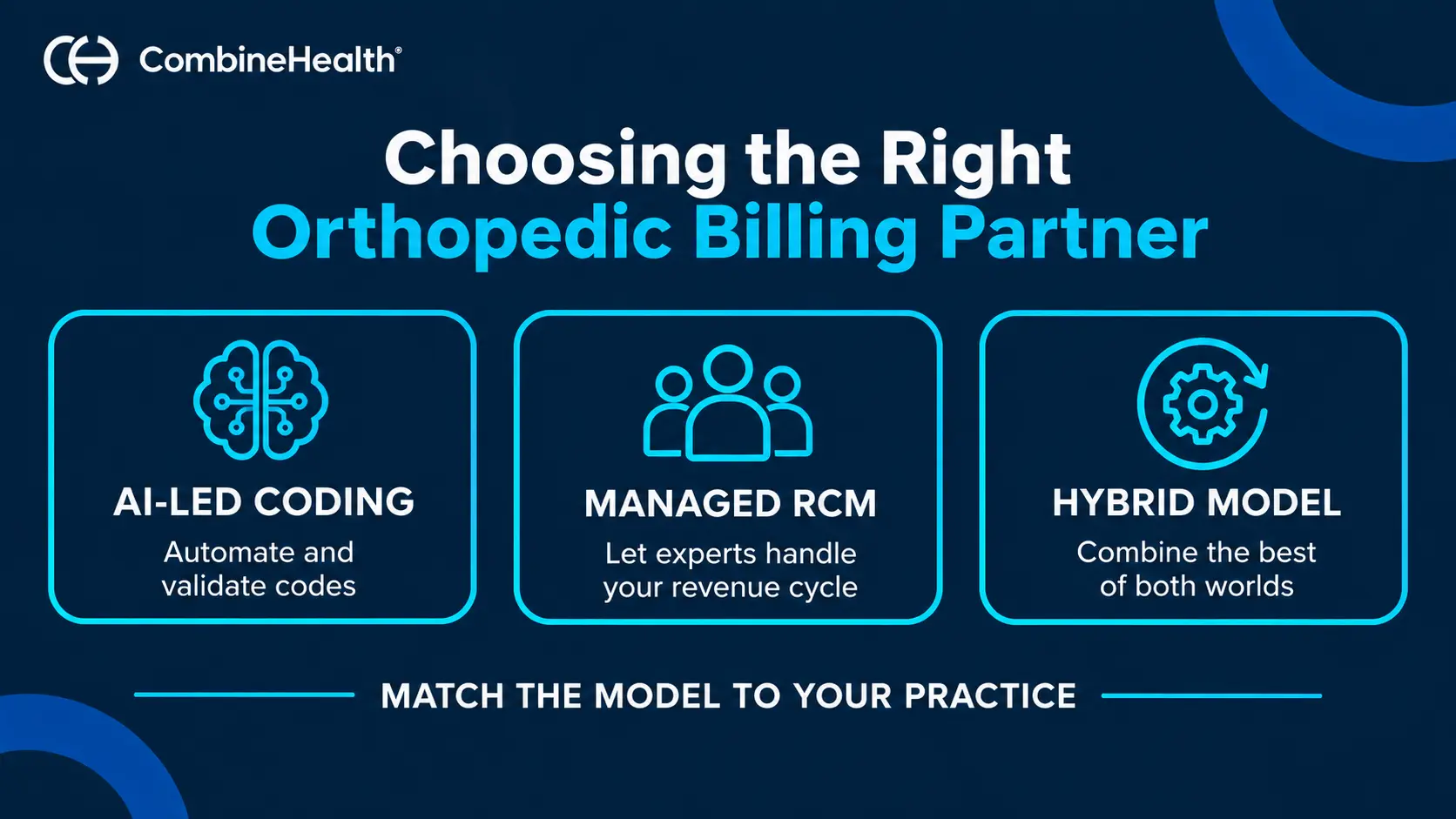
The right orthopedic medical billing service closes those leaks at the source. Some vendors do it with AI that codes and validates every encounter. Others assign specialist billing teams to take over the department, and a few combine both. Each model fits a different practice, and choosing the wrong one costs months.
This guide compares ten vendors that publicly document both orthopedic coding and orthopedic billing capabilities.
1. CombineHealth: AI-Powered Orthopedic Medical Billing
CombineHealth is an AI-powered revenue cycle platform for orthopedic practices, multisurgeon groups, ambulatory surgery centers (ASCs), hospitals, management services organizations (MSOs), and billing organizations. Self-learning autonomous medical coding sits at the core of the entire workflow. Every claim outcome returns to the coding engine to refine the next decision.
Also referred to as Amy AI, the CombineHealth medical coding platform reads completed encounter documentation directly from the electronic health record (EHR) and carries each case through eligibility, pre-bill validation, claims, denials, A/R follow-up, and appeals. Its orthopedic offering is built around procedure-specific CPT and ICD requirements, surgical rules, ASC-versus-hospital differences, and payer requirements.
CombineHealth’s edge in orthopedic medical billing is payer intelligence. The platform learns from every denial, reimbursement, and underpayment, and it adapts billing strategy for each payer. That matters in a specialty where payers apply their own bundling edits, modifier 25 and 59 scrutiny, global period policies, implant carve-out rules, and prior authorization requirements to the same procedure.
Feature #1: Billing-Ready Orthopedic Code Generation
CombineHealth assigns evaluation and management (E/M) levels, CPT procedure codes, ICD-10-CM diagnosis codes, Healthcare Common Procedure Coding System (HCPCS) Level II codes, modifiers, and diagnosis sequencing from the completed operative note. It captures laterality, anatomical and fracture specificity, and CPT-to-diagnosis linkage, with automation rates of up to 85%.
Feature #2: Payer Intelligence
CombineHealth tracks denials, reimbursements, and underpayments by payer and adapts coding strategy accordingly, with up to a 75% reduction in coding-related denials.
Feature #3: Explainability in Medical Coding
Every code links to the supporting documentation, coding rationale, applicable guidance, and payer requirements, which gives coders, auditors, and compliance teams a complete audit trail.
Feature #4: Surgical Rules, Bundling, and Global-Period Logic
CombineHealth applies modifiers, National Correct Coding Initiative (NCCI) bundling logic, and global-period scenarios, and it accounts for ASC-versus-hospital differences in orthopedic coding.
Feature #5: Documentation Gap Detection
CombineHealth flags missing laterality, fracture details, operative information, medical-necessity support, and modifier evidence. Clinical documentation improvement (CDI) alerts and physician queries reach surgeons before the claim goes out.
Feature #6: Autonomous and Audit Modes
CombineHealth codes eligible encounters autonomously, or audits codes produced by surgeons, coders, EHRs, existing billing companies, and other coding platforms.
Feature #7: Billing and RCM Workflows
CombineHealth verifies eligibility and benefits, checks authorization requirements, validates claims before submission, classifies denials, drafts appeals, follows up on A/R, and analyzes underpayments.
Best For: Orthopedic practices, multisurgeon groups, ASCs, hospital-employed groups, MSOs, and billing organizations that want to automate coding, billing checks, denials, and appeals end-to-end, with explainable decisions they can defend in an audit.
2. Maia: AI Coding & Billing Software for Orthopedic Practices
Maia is an AI-powered medical coding and RCM software platform built specifically for orthopaedic practices. Its AutoCoder product targets E/M coding, surgical coding, denial appeals, and prior authorizations, and it shows a justification for every code it selects. Maia announced a $1.2 million seed round on June 16, 2026, and its roadmap adds prior authorization, denial appeal automation, AI documentation support, and an AI scribe. As an early-stage software vendor, Maia gives practices a specialty-only coding & billing layer that their own teams operate.
Key Features:
- E/M and surgical coding for orthopedic encounters
- Code-level justification for every selection
- Fine-tuned medical language models combined with clinical rules and expert feedback
- Denial appeal and prior authorization support
- Clinical advisory board of orthopaedic surgeons
- Roadmap for AI documentation support and an AI scribe
Best For: Orthopedic groups that want a specialty-only AI coding & billing product they operate in-house.
3. SYNERGEN Health: Managed Orthopedic RCM and ASC Billing
SYNERGEN Health is a technology-enabled managed RCM provider for orthopedic and musculoskeletal practices and ASCs. Its end-to-end RCM services earned the American Alliance of Orthopaedic Executives (AAOE) Peer Review designation on June 10, 2026, after an 11-step evaluation by practicing orthopedic and musculoskeletal professionals. A 2024 partnership with HST Pathways connects ASC software to its services. A 2026 ROI validation report states that Compass Surgical Partners onboarded six pilot ASCs in four weeks and lowered cost to collect from 3% to 2.5% of net revenue.
Key Features:
- End-to-end managed RCM for orthopedic and musculoskeletal practices
- AAOE Peer Review designation
- ASC and facility billing support through the HST Pathways integration
- Technology-enabled workflows
- Documented ASC onboarding speed and cost-to-collect results
Best For: Orthopedic groups and ASC operators that want a fully outsourced revenue cycle with a peer-validated partner.
4. Orthos: Orthopedic Revenue Cycle Management for Independent Groups
Orthos is a revenue cycle management company founded in 2020 that serves independent orthopedic and surgical providers across sites of care. It combines specialty-specific expertise with proprietary internal technology, and it extends support into areas next to the revenue cycle, including durable medical equipment (DME), drug dispensing, profitability across care centers, cash planning, and staffing. Public documentation of its coding methodology is limited, so practices should ask for accuracy audit results during evaluation.
Key Features:
- Managed RCM for independent orthopedic and surgical providers
- Specialty-specific orthopedic expertise
- Proprietary internal technology
- DME and drug dispensing support
- Profitability analysis across care centers
- Cash planning and staffing support
Best For: Independent orthopedic groups that want one partner for revenue cycle work and wider business-office challenges.
5. ADSRCM: Outsourced Orthopedic Billing With a Software Option
ADSRCM is the outsourced revenue cycle arm of Advanced Data Systems (ADS), a vendor that has served orthopedic and specialty practices since 1977. ADSRCM covers the full revenue cycle for orthopedic surgery, injections, imaging, DME, and physical therapy. Practices that prefer to keep billing in-house can run an orthopedic EHR and practice management system from ADS instead. That choice makes ADSRCM a hybrid of managed services and software.
Key Features:
- Full-cycle RCM for orthopedic surgery, injections, imaging, DME, and physical therapy
- First-pass clean claim rate near 99% across orthopedic procedure types, as reported by ADS
- Nearly 50 million electronic data interchange (EDI) transactions each year, as reported by ADS
- Published guidance on E/M levels, modifier errors, multi-code encounters, and implant charges
- MedicsCloud Suite with orthopedic-specific EHR, practice management, and financial automation
Best For: Practices that want one vendor for EHR, practice management, and billing, with the option to outsource.
6. CGM ARIA RCM Services: Orthopedic Billing on Any EHR
CGM ARIA RCM Services is the billing and coding services division of CompuGroup Medical (CGM). It delivers end-to-end orthopedic billing, coding, enrollment, and credentialing, and it works inside any EHR, including systems from other vendors. ARIA RCM Services ranked Best in KLAS for ambulatory RCM services (EHR-associated) for the third consecutive year in 2026. Its orthopedic billing page details the procedures, modifiers, and payer rules its team manages.
Key Features:
- CPT coding for joint replacements, arthroscopy, fracture care, spinal procedures, casting and bracing, and injections
- Modifier accuracy for 25, 59, 62, 76, 78, 79, and RT/LT and global period tracking
- Operative report and medical necessity documentation support
- Adherence to Medicare local and national coverage determinations
- AI-based claim scrubbing and eligibility verification
- Authorization tracking and follow-up
- Appeals for surgical denials and underpayments
- A/R management with real-time dashboards
- Credentialing and enrollment
Best For: Practices and hospitals of any size that want a KLAS-ranked billing service running on their existing EHR.
7. Plutus Health: Full-Cycle Managed RCM for Orthopedic Groups
Plutus Health is a technology-enabled, full-cycle RCM firm based in Dallas, Texas. Its services span medical coding, billing, denial management, credentialing, A/R follow-up, and out-of-network negotiation. In a company announcement, Plutus Health reports a 98% net collection rate and 97% or higher clean claims across more than 9,000 providers. Its published case studies include a mid-sized orthopaedic practice in Kentucky that reduced denials and improved A/R collections. Because the firm serves many specialties, practices should request orthopedic-specific coder credentials and results during evaluation.
Key Features:
- Medical coding and billing within a full-cycle RCM model
- Denial management and A/R follow-up
- Provider credentialing
- Out-of-network negotiation
- Payer intelligence and agentic AI that surface revenue issues upstream
- More than $1 billion in annual collections across specialties, as reported by the company
Best For: Mid-sized orthopedic groups and ASCs that want full-cycle managed RCM with a published orthopedic reference.
8. AnnexMed: Orthopedic Billing for Multi-Site and Hospital Groups
AnnexMed is a revenue cycle management company founded in 2004 and headquartered in Salt Lake City, Utah. Industry roundups describe its orthopedic services for hospitals, ASCs, orthopedic specialty groups, and health systems, including coding audits, modifier management, payer-specific reimbursement workflows, and authorization coordination. A published case study of a mid-sized surgical and outpatient practice reports a 60% reduction in payer denials and a 41% drop in claim rework after a 48- to 72-hour pre-bill review cycle. Because the orthopedic detail comes largely from third-party roundups and the case study covers a surgical practice, ask AnnexMed for orthopedic references.
Key Features:
- Coding audits and modifier management
- Payer-specific reimbursement workflows
- Authorization coordination
- Claims processing and coding support
- Denial management and A/R follow-up
- Revenue cycle reporting
- Pre-bill review cycle of 48 to 72 hours and 48-hour priority claim turnaround, as reported in its case study
Best For: Hospital-employed orthopedic groups and multi-site practices that want scalable outsourced billing.
9. Billing Paradise: Round-the-Clock Orthopedic Billing
Billing Paradise is an outsourced medical billing company founded in 2004 that offers orthopedic billing services with 24/7 operations. The company works inside a practice's existing EHR and provides automation, communication, and reporting through its TeamBillingBridge platform. Public orthopedic documentation is limited to a dedicated presentation and service listings, so practices should request coding accuracy audits and client references.
Key Features:
- Outsourced orthopedic medical billing
- Coding support and A/R management
- Prompt claims processing and faster payments, as highlighted in its orthopedic presentation
- HIPAA-compliant data management
- TeamBillingBridge platform for automation, communication, and reporting
- Flexible billing staff and specialty-specific teams
- 24/7 operations
Best For: Practices that want round-the-clock outsourced billing support on their current EHR.
10. Coronis Health: Surgical and Orthopedic Revenue Cycle Management
Coronis Health is a managed RCM provider with specialty teams for surgical practices, including orthopedics and spine and ASCs. Its surgical offering covers the global surgical package, implant and device billing, prior authorization, NCCI bundling edits, and underpayment recovery. Coronis Health calls its model Intelligent Revenue Operations, which combines specialty expertise, operational execution, and technology. A Coronis Health case study of an orthopedic facility moving from in-network to out-of-network reimbursement reports a 77% increase in revenue.
Key Features:
- Global surgical package modifiers 24, 25, 57, 58, 78, and 79
- Multi-procedure and bilateral modifiers 51, 59, 50, and RT/LT
- Co-surgeon, assistant surgeon, and team surgery modifiers 62, 80, 82, and AS
- Implant and device coding, including invoice-based carve-outs
- Modifier 22 documentation support and CDI for operative notes
- Provider enrollment, credentialing, and payer maintenance
- Eligibility verification and prior authorization
- NCCI bundling edit resolution and global period denial disputes
- Underpayment recovery, including implant reimbursement disputes
- Legacy A/R cleanup
Best For: Surgical-heavy orthopedic groups and ASCs that want full-service outsourcing, including enrollment and credentialing.
Cut Orthopedic Denials with CombineHealth
CombineHealth's self-learning platform reads the full operative note, explains every code, and learns from claim outcomes to reduce coding-related denials while doing medical billing.
Book a demo to see it on your facility’s orthopedic encounters.
Frequently Asked Questions About Orthopedic Medical Billing Services
How does CombineHealth reduce orthopedic coding denials?
CombineHealth learns from every denial, reimbursement, and underpayment and adapts billing strategy for each payer — payer intelligence, not static rules. That matters in orthopedics, where payers apply their own bundling edits, modifier 25 and 59 scrutiny, global-period policies, and implant carve-out rules to the same procedure. The approach has been tied to up to a 75% reduction in coding-related denials, and every code carries a rationale that speeds appeals on the denials that remain.
Does CombineHealth capture laterality, fracture detail, and implants from the operative note?
Yes. CombineHealth reads the completed operative note and captures laterality, anatomical and fracture specificity, and CPT-to-diagnosis linkage, and it accounts for implant and device rules including invoice-based carve-outs. Where the note is missing laterality, fracture details, operative information, or implant evidence, it flags the gap and sends a CDI query to the surgeon before the claim goes out — closing the exact leaks that return orthopedic claims as denials.
Does CombineHealth handle the full orthopedic revenue cycle or just coding?
The full cycle. Self-learning autonomous coding sits at the core, but CombineHealth also verifies eligibility and benefits, checks authorization requirements, validates claims before submission, classifies denials, drafts appeals, follows up on A/R, and analyzes underpayments — all on one platform, so coding decisions and downstream payer outcomes inform one another.
Can CombineHealth audit codes our current orthopedic billing company or coders produce?
Yes. In audit mode, CombineHealth independently evaluates codes produced by surgeons, coders, EHRs, existing billing companies, or other coding platforms against the full documentation, flagging discrepancies with the supporting evidence and rationale shown. Practices often start here to validate current coding and quantify leakage before expanding to autonomous coding.
How Do Global Periods Affect Orthopedic Billing?
A global period bundles routine post-operative care into the surgical fee. Major surgeries typically carry 90 days under Medicare. Modifier 24 covers an unrelated visit, and modifier 79 covers an unrelated procedure.
Can AI Code Orthopedic Surgical Cases Accurately?
AI can code orthopedic surgical cases accurately when it reads the full operative note and applies payer requirements. CombineHealth reports up to 85% automation, and its audit mode reviews codes from surgeons, coders, or existing billing companies.