12 Healthcare Revenue Cycle Management Best Practices
A practical playbook of 12 healthcare revenue cycle management best practices, with an owner and a metric for each step from eligibility to A/R.
Published on:
November 23, 2026


Key Takeaways
• CombineHealth is a self-learning autonomous medical coding platform that closes the loop between the back end and front end of the revenue cycle. It learns from denials, reimbursements, and underpayments, adapts its coding strategy for each payer, and links every code to an audit trail tied to the source documentation. It also extends into eligibility checks, claim validation, denial management, and appeals around the coding workflow.
• Strong RCM performance comes from a closed loop with one owner and one metric per step. Verify coverage before service, document and code to payer rules, validate each claim before it leaves, and route every denial back to the step that caused it. Start by standardizing the scorecard on HFMA's 29 MAP Keys, with the CFO owning it, a named owner for every metric below that, and cost to collect as the efficiency measure for the full cycle.
• Verify eligibility and documentation before every scheduled service, and track each authorization from the first order to the paid claim. Confirm that coverage is active and that the planned service is a covered benefit, recheck close to the date of service, and send failed checks to a same-day worklist.
• Run payer-specific checks on every claim before submission, then monitor it from clearinghouse acceptance to final payment. Generic claim scrubbing misses requirements that vary by payer, such as modifiers, code combinations, and timely filing limits.
• Turn each recurring denial into a permanent pre-bill check. Categorize the denial, find the root cause, assign the owning workflow, fix the claim, and update the check that should have caught it.
• Prioritize A/R by value and recoverability, and detect underpayments before the account closes. Score accounts on claim value, deadlines, payer, denial category, and age, with a recorded owner and next action for the highest-value aged accounts.
• Engage patients financially before service, and automate one repetitive, rules-driven workflow at a time. Give patients a cost estimate, benefit summary, financial assistance screening, and payment options at or before the visit. For automation, set a baseline and a target metric for each project, such as eligibility checks, claim-status checks, payment posting, denial categorization, or coding, and subtract the tool's cost when calculating ROI.
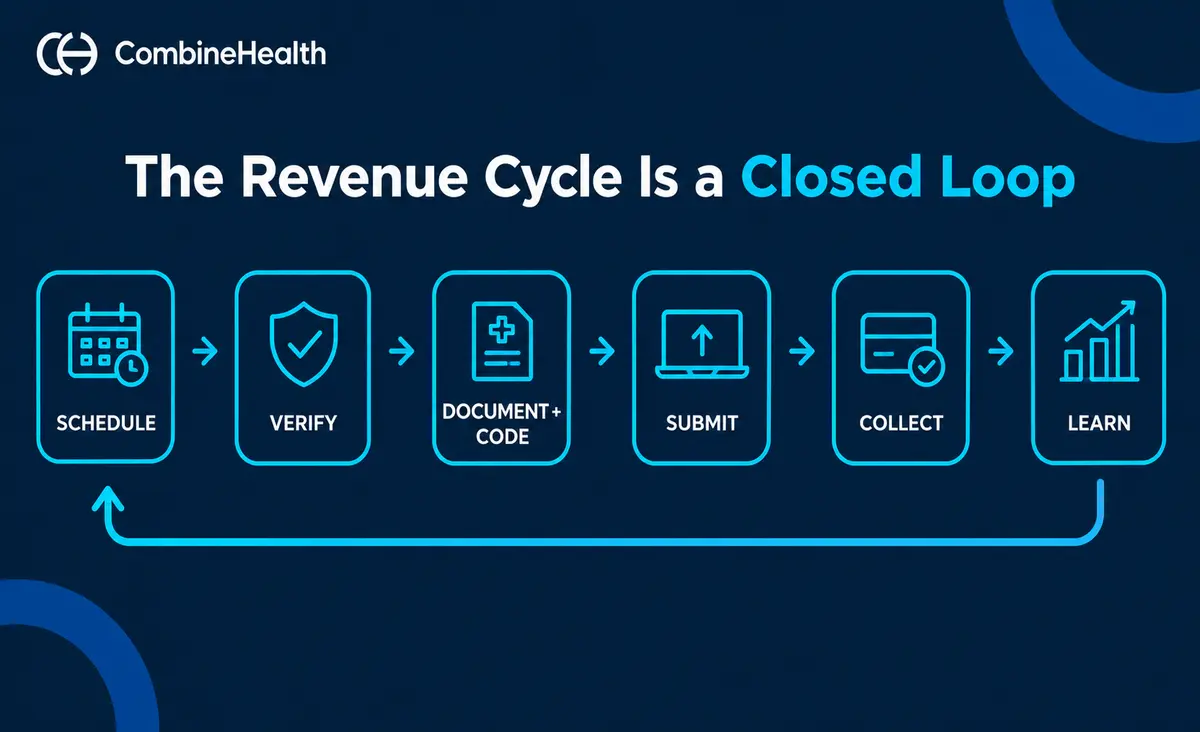
Strong healthcare revenue cycle management (RCM) performance comes from a closed loop. Verify coverage before service, document and code to payer rules, validate each claim before it leaves, and route every denial back to the step that caused it. Give each step one owner and one metric.
Hospitals collected faster in 2025 and still lost more revenue. A revenue cycle analytics company studied more than 2,300 hospitals and found that median days in accounts receivable (A/R) improved by 2.3 while revenue leakage, the revenue that providers could have collected, rose about 25% to $48.4 billion.
Denials explain much of that gap. In the 2026 State of Claims survey, 40% of providers said at least 10% of their claims are denied, and “services not covered” took the top spot among denial reasons for the first time in the survey’s history. The other company’s data points in the same direction, with clinical denials tied to prior authorizations and medical necessity driving the increase. Recovery is thin as well: only 30% of respondents win back 80% or more of denied revenue.
Every denial lands on a billing desk, but many trace back to somewhere else: a registration field, a vague diagnosis, a payer rule that changed last quarter. A correction recovers that claim. A fix upstream keeps the next one from arriving.
The 12 healthcare revenue cycle management practices below follow a claim from scheduling to final payment, and each one names the action, the owner, and the metric, so every finding in your next scorecard review has someone attached to it.
1. Standardize the Revenue Cycle Scorecard
An RCM scorecard is a single set of metrics that tracks revenue cycle performance from patient access to final payment. It gives finance, patient access, coding, and billing teams the same numbers to manage against.
Standardize the scorecard first, because every other practice depends on measures that mean the same thing to every team. Adopt the 29 key performance indicators (KPIs) that the Healthcare Financial Management Association (HFMA) publishes as MAP Keys. Label every other metric as an internal measure, and write down its definition.
The chief financial officer (CFO) owns the scorecard, and each metric needs a named owner below the CFO. HFMA advises pulling data from the same source every month, with the general ledger preferred because auditors can verify it. Review the scorecard monthly with every owner in the room, and use cost to collect as the efficiency measure for the full cycle.
2. Verify Eligibility Before Every Scheduled Service
Verify whether a patient is actually eligible for availing a service/benefit before every scheduled service by confirming that coverage is active and that the planned service is a covered benefit. Patient access teams should check primary and secondary coverage, network status, and referral requirements, then recheck close to the date of service, because coverage changes after scheduling.
The 2026 State of Claims survey shows why the benefit check matters, as “services not covered” leads all denial reasons, cited in the top three by 53% of respondents. The American Medical Association (AMA) recommends electronic eligibility verification before every appointment. Send each failed check to a same-day patient access worklist, so the front desk resolves it before the patient arrives. Track the eligibility-denial rate and HFMA’s insurance verification rate (PA-3).
3. Create a Closed-Loop Authorization Workflow
A closed-loop authorization workflow follows each authorization from the first order to the paid claim. Link the scheduled service, the requested Current Procedural Terminology (CPT) code, the approved CPT code, the date, the location, and the service performed. Utilization management and patient access share ownership of that loop.
Flag every mismatch before the claim leaves:
- Missing or pending authorization
- Wrong CPT code
- Incorrect laterality, service date, or facility
- Expired authorization
- Procedure changes after approval
Approval alone does not guarantee payment, since coding, medical necessity, and benefits still apply. Measure the authorization-denial rate, and compare it with HFMA’s authorization rate keys (PA-4 and PA-5).
4. Improve Documentation Before the Chart Reaches Coding
Improve the clinical documentation before the chart reaches coding, while the provider still remembers the encounter. Clinical documentation improvement (CDI) specialists should query providers on diagnosis specificity, laterality, severity, procedure details, and medical necessity. Early CDI queries close gaps that a payer would otherwise expose after submission.
Providers own the answers, and the CDI team owns the queries. Capture the clinical facts coding depends on: failed conservative treatment, complications and comorbidities, provider attestations, and the link between each diagnosis and procedure.
Review gap patterns by provider every month in a short feedback session. A rising gap rate on one provider points to a training need. A rising rate across the group points to a template problem. Track the query rate and the documentation-gap rate.
5. Validate Coding Against the Full Encounter and Payer Rules
Validate every code against the complete encounter and the rules the payer applies. A technically valid code still draws a denial when the documentation, diagnosis, modifier, or payer policy fails to support the billed service. Coding and health information management (HIM) teams own that check.
Check diagnosis codes against International Classification of Diseases, Tenth Revision, Clinical Modification (ICD-10-CM) guidelines. Check procedure codes against CPT and Healthcare Common Procedure Coding System (HCPCS) requirements, evaluation and management (E/M) guidelines, National Correct Coding Initiative (NCCI) edits, Medicare coverage determinations, and each commercial payer’s policy.
The 2026 survey places code inaccuracy among the leading denial reasons, at 25% of respondents. Audit a monthly sample of denied claims, trace each error to its cause, and track the coding-denial rate.
6. Run Payer-Specific Checks Before Submission
Run payer-specific checks on every claim before submission, testing it against the rules of the plan that will adjudicate it. Generic claim scrubbing misses requirements that vary by payer, such as modifiers, code combinations, and timely filing limits. Billing and revenue integrity teams own these checks.
Validate before release:
- Required modifiers and code combinations
- Referral and authorization status
- Place of service and frequency limits
- Required attachments
- Duplicate-submission risk, including original claim references on corrected claims
Payer rules keep moving: 78% of 2026 survey respondents report more frequent policy changes, so review the rule set monthly. First-pass acceptance measures the share of claims a payer accepts into adjudication on first submission. HFMA’s clean claim rate (CL-1) measures a different step: the share of claims that clear the internal scrubber without manual work.
7. Monitor Claims Continuously After Submission
Monitor every claim from clearinghouse acceptance to final payment, so billing teams find problems while the claim is still young. Set AR follow-up intervals by payer, claim value, and expected adjudication time. Billing and A/R teams own the process, and claim-status lag measures it.
Label claims the same way across teams:
The AMA’s claim-control workflow investigates claims sitting in submitted or accepted status for more than 30 days, oldest first. Use 30 days as a starting interval, then tighten it by payer.
8. Turn Denial Findings Into Prevention Rules
Turn each recurring denial into a permanent pre-bill check. Categorize the denial, find the root cause, assign the owning workflow, fix the claim, and update the check that should have caught it. Denials, coding, and compliance teams share ownership of that loop.
Rush University System for Health faced rising request-for-information denials from a large payer that does not accept supporting records at billing. The health system built an automated response that fires when the remittance arrives. Turnaround time dropped, and the team gained visibility into overturn rates.
Track denials by payer, reason, provider, CPT and diagnosis combination, modifier, and authorization status. Test a pattern before changing coding behavior, because payer error, contract terms, and documentation gaps can each explain a single denial. Measure the repeat-denial rate to confirm the rule worked.
9. Prioritize A/R by Value and Recoverability
Prioritize A/R by value and recoverability, so teams work the claims most likely to pay first. Score each account on claim value, filing and appeal deadlines, payer, denial category, age, and the next required action. A/R leadership owns the queue.
The top-performing organizations kept tight A/R discipline and focused limited denial resources on preventing clinical denials. Review the highest-value aged accounts weekly, with an owner and a next action recorded for each. Track days in A/R using HFMA’s FM-1 definition, and watch A/R over 90 days by payer.
10. Identify Underpayments and Contract Variances
Detect underpayments by comparing each payment with the contracted rate before the account closes. Check the allowed amount, expected reimbursement, actual payment, adjustment reason, bundling decision, and fee-schedule update. Contract management owns the review.
Aggregate variances by payer and service line. A single error needs a correction request. A pattern across many claims needs a contract conversation. Flag variances during payment posting, and assign each one to a contract analyst with a due date. Measure underpayment recovery as dollars recovered divided by dollars identified.
11. Improve Patient Financial Engagement
Engage patients financially before service, with accurate estimates, clear explanations of responsibility, and payment options. Patient access and patient finance teams own that work. The leaders should keep rigor in front-end patient-pay processes.
Kodiak’s 2025 data shows the stakes: patient responsibility grew to 7.3% of net revenue, and the collection rate on that share fell from 45.1% to 42.4%. Give patients these at or before the visit:
- A cost estimate
- A benefit summary
- Financial assistance screening
- Payment plans and digital payment options
Track the patient collection rate and HFMA’s point-of-service cash key (PA-7).
12. Automate Targeted Workflows With Measurable Outcomes
Automate one repetitive, rules-driven workflow at a time, with a baseline and a target metric. Strong candidates include eligibility checks, claim-status checks, payment posting, denial categorization, and coding. RCM, IT, and compliance leaders own each project.
Becker’s Hospital Review reported in May 2026 that health systems saw their largest AI gains from targeted automation embedded in existing processes. Advocate Health scaled coding AI across all coder workflows and saw higher coder productivity and fewer coder-related denials.
Measure these for every project:
- Automation rate and accuracy
- Exception rate and turnaround time
- Cost per transaction
- Denial reduction and staff capacity released
HFMA’s cost-to-collect definition now counts AI and automation costs, so subtract the tool’s cost when calculating ROI.
How Does CombineHealth Apply These Best Practices?
CombineHealth is a self-learning autonomous medical coding platform that learns from claim outcomes such as denials, reimbursements, and underpayments. The platform adapts its coding strategy for each payer, so lessons from the back end of the cycle reach the front end. Every code carries an audit trail linked to the supporting documentation.
Also referred to as Amy AI, the CombineHealth medical coding automation platform reads completed encounter documentation directly from the electronic medical record (EMR). The platform applies coding guidelines and payer-specific rules, identifies documentation gaps, and returns billing-ready codes with a rationale for each decision. Coders, auditors, and compliance teams can check every decision against the source note.
After submission, claim outcomes strengthen the platform’s payer intelligence, which shapes future coding decisions for each payer. CombineHealth also extends into eligibility checks, claim validation, denial management, and appeals around the coding workflow.
Feature #1: Complete-Encounter Autonomous Medical Coding With Built-In CDI
CombineHealth reads the complete clinical encounter and checks documentation sufficiency while it codes, so one pass produces both the codes and a view of what the chart lacks. The platform separates CDI alerts from documentation gaps that need provider clarification, which lets teams resolve issues before the claim goes out. Each coding decision carries a rationale and an audit trail linked to the source note, so coders, auditors, and compliance teams can verify why a code was assigned.
Feature #2: Pre-Bill Claim Validation
CombineHealth validates every claim before submission, when a correction costs the least. Pre-bill checks cover:
- Demographics
- Eligibility verification
- Diagnosis-procedure relationships
- Medical necessity
- Modifiers
- Authorization and referral information
- Payer-specific claim conditions
- Duplicate-submission risk
- Other organization-specific requirements
Feature #3: Denial Management and A/R Follow-Up
CombineHealth categorizes denials by payer and reason, identifies likely root causes, and prioritizes accounts for AR follow-up. The platform supports payer follow-up and detects recurring patterns. It then traces each downstream problem to the documentation, coding, or claim condition upstream that created it.
Feature #4: Appeals and Analytics
CombineHealth drafts evidence-supported appeals from retrieved claim and documentation records, and it tracks payer correspondence and appeal status. Analytics cover financial and operational KPIs, denial and underpayment analysis, and performance by payer, provider, location, and workflow.
Feature #5: Self-Learning Payer Intelligence
CombineHealth’s self-learning payer intelligence runs a closed loop: eligibility and documentation, coding, claim validation, payer outcome, pattern analysis, and validated configuration update. A payer’s published policy states the rule, and claim outcomes show how the payer applies it in practice.
Payer intelligence learns from that second signal. Denial patterns become candidate rule updates that RCM, coding, and compliance teams validate before the updates reach production.
Book a demo now to see how CombineHealth fits your revenue cycle.
Frequently Asked Questions
How does CombineHealth help track RCM best practices on a scorecard?
CombineHealth's analytics track 50+ revenue cycle KPIs and break down denials, underpayments, and root causes by payer, provider, location, and workflow. That gives each owner on an RCM best practices scorecard a live metric, such as coding-denial rate, repeat-denial rate, or A/R aging, instead of a monthly spreadsheet.
Where Should a Revenue Cycle Team Start?
Start with the scorecard, then rank denials by payer and reason. The category holding the most dollars shows which practice to fix first, whether eligibility, authorization, documentation, or coding. Name an owner and a metric for it before moving on.
Do These Best Practices Apply to Hospitals and Physician Practices?
Yes, the loop is the same at any size, from eligibility through denial prevention. Physician practices often combine owners, so one biller may cover several steps. Hospitals add utilization management and contract management teams. Keep one named owner and one metric for every step.
Does CombineHealth Handle the Complete RCM Workflow?
CombineHealth starts with autonomous medical coding and extends into eligibility checks, claim validation, denial management, appeals, and analytics. Claim outcomes such as denials and underpayments feed back into the platform, so payer patterns found late in the cycle shape coding decisions early.
Does CombineHealth Work With Our Existing Systems?
Yes, CombineHealth reads completed encounter documentation directly from the electronic medical record (EMR) and returns billing-ready coding decisions into existing workflows. Teams keep their current clinical, practice management, and billing systems, with no separate coding environment to learn.