Why Payer Intelligence Is Important in AI Medical Coding
Learn why payer intelligence matters in AI medical coding and how payer rules and real claim outcomes can inform coding and prevent repeat denials.
Published on:
September 4, 2026


CombineHealth is a self-learning autonomous medical coding platform with payer intelligence. It applies payer-specific requirements before claim submission and learns from downstream outcomes such as denials, reimbursements, and underpayments. These insights strengthen payer intelligence over time, helping inform future coding decisions and prevent recurring coding-related denials.
AI medical coding can assign a clinically supported code and still miss an important part of the equation: the payer that ultimately adjudicates the claim.
Payers do not apply one universal set of claim rules. An HFMA study found that 69% of revenue cycle leaders said payers use proprietary claim edits, while 42% reported maintaining more than 100 payer-specific edits. And knowing the rules alone may not be enough.
For AI medical coding, this creates a problem. A system that learns only how to assign the right code can become highly accurate at coding without learning how payer-specific requirements and real reimbursement outcomes affect that decision downstream.
That is why payer intelligence is becoming an important layer in AI medical coding. It gives the system context beyond the code itself: what a particular payer requires before the claim goes out, and what previous claims reveal about how that payer actually adjudicates them.
This guide explains how payer intelligence works in AI medical coding, why payer rules and payer behavior both matter, and how learning from downstream outcomes can help prevent the same coding-related denials from repeating.
What is Payer Intelligence in Medical Coding?
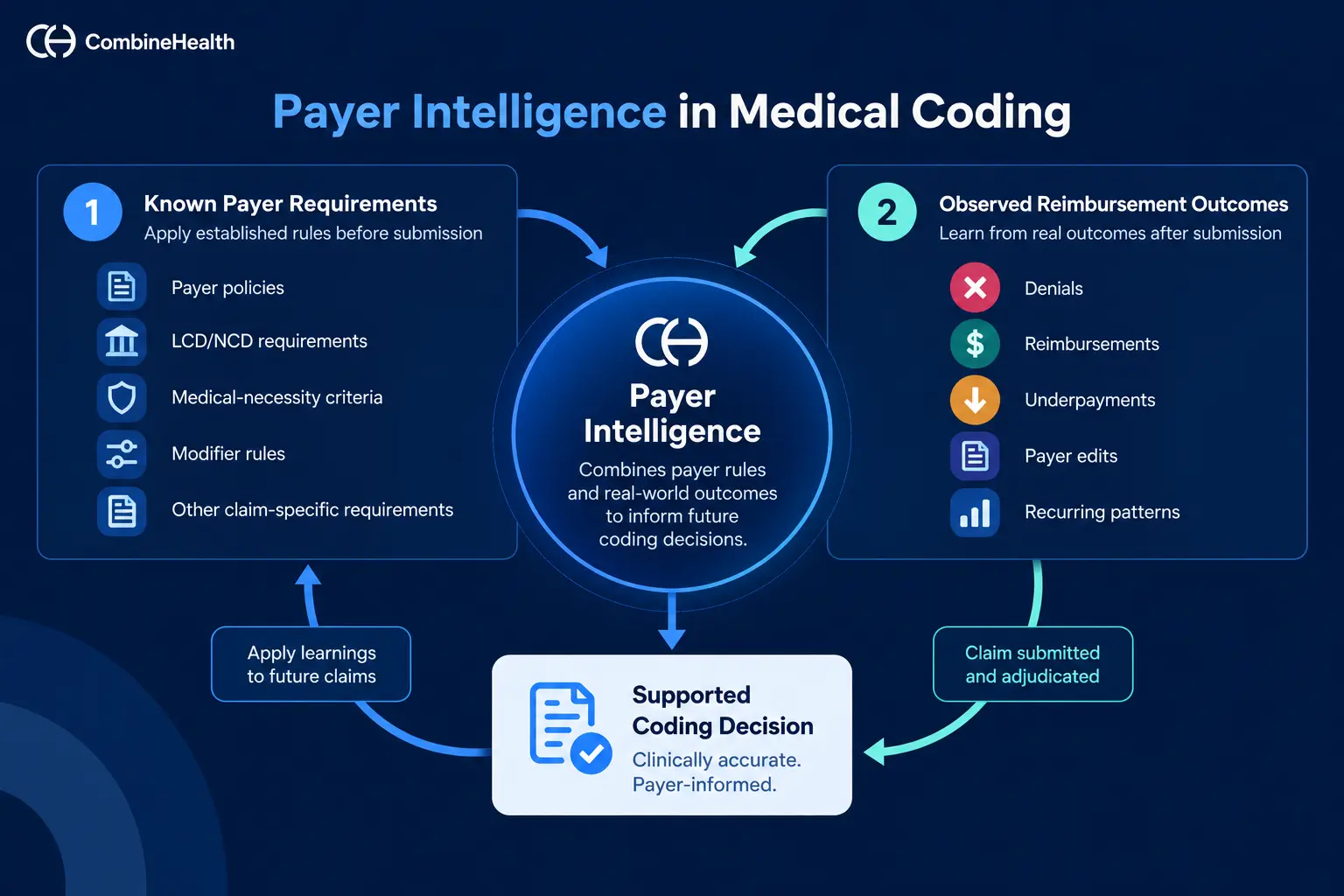
Payer intelligence in medical coding is the ability to make coding decisions using two layers of payer-specific knowledge: known payer requirements and observed reimbursement outcomes.
- The first layer applies established rules such as payer policies, LCD/NCD requirements, medical-necessity criteria, modifier rules, and other claim-specific requirements before submission.
- The second layer learns from real outcomes, such as denials, reimbursements, underpayments, and payer edits, to identify recurring patterns and inform future coding decisions.
How Does Payer Intelligence Work in Medical Coding?
Payer intelligence works as a closed loop: payer-specific requirements inform the initial coding decision, and what happens to the claim after submission informs how similar claims are coded in the future. This connects medical coding to downstream reimbursement instead of treating coding as a process that ends once a code is assigned.
Here’s how the payer intelligence loop works:
- Review the complete clinical encounter
The medical coding system reviews the full clinical documentation to identify the diagnoses, procedures, services, and other details needed to code the encounter.
- Apply standard medical coding guidelines
The medical coding system assigns ICD-10-CM, CPT, HCPCS, E/M levels, modifiers, and other applicable codes based on the clinical documentation and established coding guidelines.
- Apply payer-specific requirements before claim submission
The medical coding system evaluates the claim against requirements specific to that payer, helping ensure the coding decision accounts for payer-specific rules before the claim is submitted.
- Generate a supported coding decision
The medical coding system produces a coding decision supported by the clinical documentation, established coding guidelines, and applicable payer-specific requirements.
- Connect the coding decision to the downstream claim outcome
After claim submission, the medical coding system evaluates what happened to the claim so the original coding decision can be connected to its reimbursement, denial, underpayment, or other payer outcome.
- Identify recurring payer-specific patterns
The medical coding system analyzes claim outcomes to determine whether similar coding decisions repeatedly produce particular outcomes with an individual payer.
- Use payer-specific learnings to inform future coding decisions
Insights from previous claim outcomes feed back into the coding process so similar future claims can account for patterns observed in how that payer adjudicates claims.
What Data Does Payer Intelligence Use?
Payer intelligence uses two types of data: established payer requirements and actual claim outcomes.
1. Published and Configured Payer Requirements
This includes the requirements that can be identified before a claim is submitted, such as:
- Medicare Local Coverage Determinations (LCDs) and National Coverage Determinations (NCDs)
- CMS coding and billing requirements
- Payer-specific coding and coverage policies
- Medical-necessity requirements
- Modifier and procedure-specific requirements
- Organization-specific coding policies configured for particular payers or contracts
These requirements form the input-side knowledge available for payer-specific coding.
2. Actual Claim Outcomes
Payer intelligence can also draw from what happens after claims are adjudicated, including:
- Claim acceptances and reimbursements
- Denials and rejection reasons
- Underpayments
- Payer edits
- Claims requiring correction or rework
These outcomes provide real-world evidence of how individual payers adjudicate claims, including patterns that may not be apparent from published policies alone
What Is the Difference Between Payer Rules and Payer Behavior?
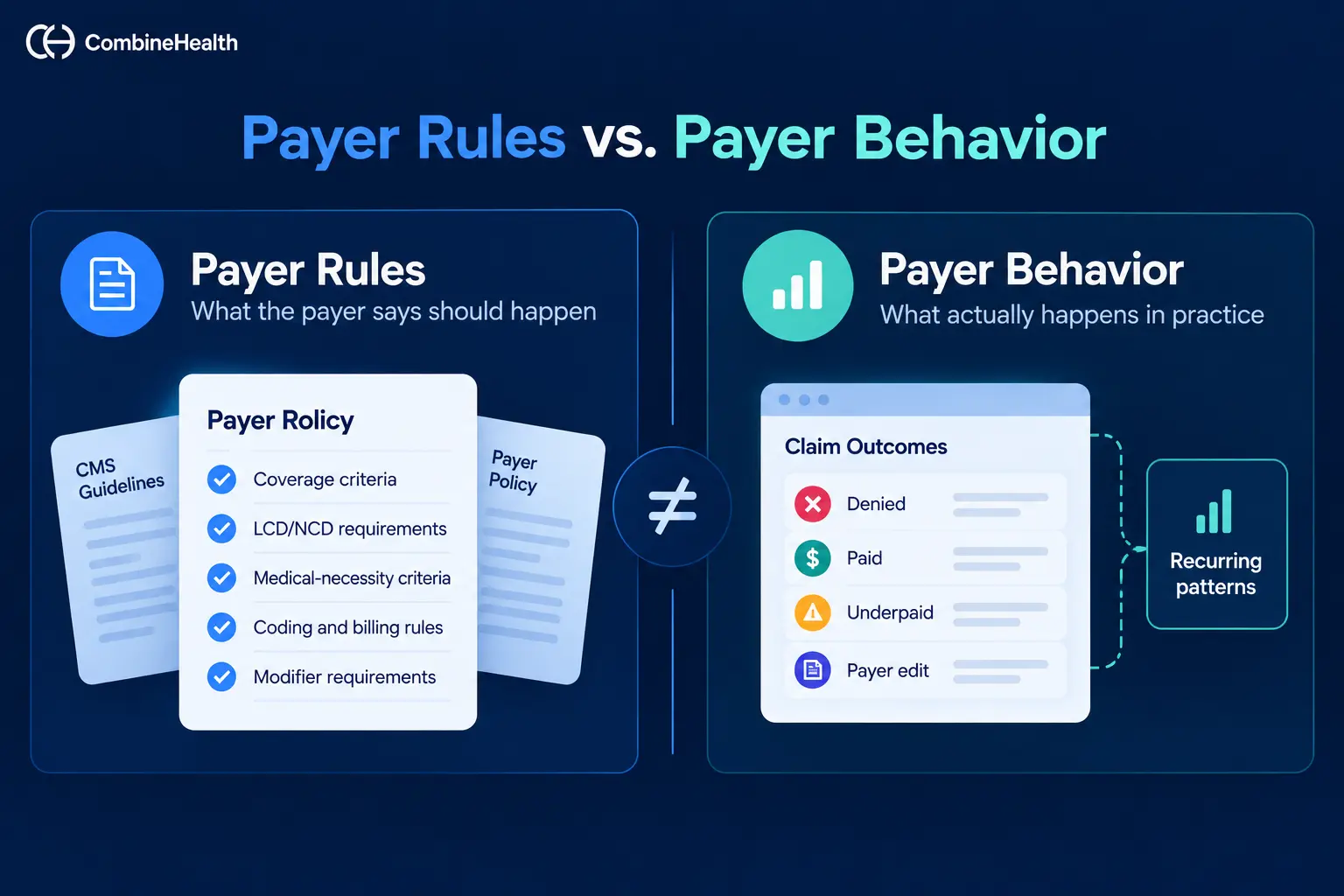
Payer rules define how a payer says a claim should meet its requirements, while payer behavior reflects how that payer actually adjudicates claims in practice. The distinction matters because published requirements do not always capture every pattern that emerges during real-world adjudication.
Payer rules provide the expected standard. They establish what should be documented, coded, or supported for a claim to meet the payer’s requirements.
Payer behavior provides the observed pattern. It shows how the payer consistently responds to particular claim characteristics during adjudication.
- Payer rules answer: What should happen?
- Payer behavior answers: What actually happens?
- Payer intelligence helps determine: What can be learned from the difference?
Example of Payer Intelligence in Medical Coding
Emergency department facility E/M coding shows why payer intelligence matters: a hospital may submit the same supported ED facility code, but different payers can apply different reimbursement rules when adjudicating that claim.
For example, a hospital may determine that an ED encounter supports facility E/M code 99285 under its documented facility-level coding methodology.
Under Medicare, the hospital must report a code supported by the services provided and applicable Medicare coding and payment requirements. CMS requires medical-record documentation to support the CPT, HCPCS, and ICD-10-CM codes reported and applies additional payment controls such as NCCI edits.
Oscar Health publishes a different reimbursement methodology for ED facility E/M services. Its policy states that an algorithm evaluates resource utilization for higher-level ED facility codes 99284 and 99285, and the resulting payment level may be the same as or lower than the submitted facility E/M level.
Benefits of Baking Payer Intelligence Into Medical Coding
Helps Prevent the Same Coding-Related Denials From Repeating
A denial can reveal more than a problem with one claim. When the same payer repeatedly denies similar claims for the same coding reason, that pattern can point to an upstream issue worth addressing.
Payer intelligence brings that signal back to medical coding, so recurring coding-related denial patterns can be addressed before they continue generating rework and appeals.
Makes Medical Coding Quality Payer-Specific
Two coding decisions can be equally defensible from a clinical and coding perspective but encounter different requirements during adjudication.
Payer intelligence adds this payer-specific dimension to coding quality. The question becomes not only “Was this coded correctly?” but also “Was it coded correctly for the requirements that apply to this payer?”
Connects Coding Performance to Reimbursement Performance
Traditional medical coding metrics such as coding accuracy measure whether codes were assigned correctly. They do not necessarily show whether those decisions ultimately resulted in clean reimbursement.
Payer intelligence connects the two. Organizations can evaluate coding decisions against downstream performance and identify where technically accurate coding is still associated with denials, underpayments, or avoidable rework.
Keeps Coding Logic From Remaining Static
Coding policies can become outdated when they are based only on guidelines and historical configuration. Payer requirements, edits, and adjudication patterns can change over time.
Payer intelligence gives organizations a way to identify when existing coding logic no longer reflects what is happening downstream, so coding policies can be reviewed and refined instead of remaining unchanged indefinitely.
How Does Payer Intelligence Reduce Coding-Related Denials?
Payer intelligence reduces coding-related denials by turning recurring denial patterns into upstream coding improvements, so the same preventable issue is less likely to reach the payer again.
Traditional medical coding workflow:
- Coding
- Claim submitted
- Denial
- Investigation
- Correction
- Resubmission
With payer intelligence, coding-related and medical-necessity denials are analyzed for recurring patterns. If a particular payer repeatedly denies claims because of a missing modifier, an unsupported diagnosis-procedure relationship, or another coding requirement, that pattern can be translated into a payer-specific coding rule or validation.
The workflow therefore shifts upstream:
- Denial pattern identified
- Coding logic updated
- Similar future claim checked before submission
- Repeat denial prevented
What Should Healthcare Organizations Look for in a Payer-Intelligent Medical Coding Platform?
Healthcare organizations should evaluate whether payer intelligence actually influences coding decisions—not simply whether the platform stores payer rules or reports denial trends.
Five questions can help distinguish the two:
- Does the platform apply payer-specific requirements before submission?
Look for the ability to account for applicable payer policies and requirements at the individual claim level rather than applying the same coding logic across every payer. - Can it connect a coding decision to its downstream claim outcome?
The platform should be able to associate the original coding decision with subsequent denials, reimbursements, underpayments, or other relevant outcomes. - Does it identify patterns for individual payers?
Aggregate denial reporting is not enough. The platform should distinguish patterns by payer so organizations can see when a coding issue is concentrated within a particular payer relationship. - Can payer insights influence future coding decisions?
Ask what happens after a pattern is identified. A payer-intelligent platform should have a mechanism for translating relevant findings into future coding logic rather than leaving them in an analytics dashboard. - Can the platform explain why a payer-informed coding decision was made?
Any decision influenced by payer intelligence should remain traceable to the supporting clinical documentation, applicable coding guidance, and payer-specific logic. Learning from payer behavior should not make the resulting coding decision less transparent or defensible.
CombineHealth: Self-Learning Medical Coding With Payer Intelligence
Medical coding has traditionally been judged at the point a code is assigned. But the real test continues after the claim reaches the payer.
Payer intelligence closes that gap. It gives coding systems a way to account for payer-specific requirements upfront and learn from what happens downstream, so coding can become more informed by the reimbursement patterns it ultimately produces.
That is the direction CombineHealth is taking with self-learning autonomous medical coding: accurate and explainable coding that develops payer intelligence from real claim outcomes instead of treating every claim as a fresh start.
Book a demo to see payer-intelligent medical coding in action.
FAQs
How does AI medical coding learn from payer denials?
AI medical coding can learn from payer denials by connecting the denial reason back to the original coding decision and identifying recurring patterns. For example, repeated denials involving modifier usage, medical necessity, diagnosis-procedure relationships, or documentation can reveal payer-specific issues. Those findings can then inform coding policies or validations so similar future claims can be evaluated before submission rather than repeatedly corrected after denial.
Can payer intelligence help prevent coding-related denials?
Yes. Payer intelligence can help prevent repeat, avoidable coding-related denials by identifying patterns in why particular payers deny claims and bringing those insights upstream into medical coding. Instead of correcting the same issue claim by claim, the underlying coding logic or validation can be refined so future claims are checked for that payer-specific issue before they are submitted.
Does payer intelligence change medical codes based on the payer?
Payer intelligence should not change a medically unsupported code simply because another code is more likely to be reimbursed. The coding decision must remain supported by the clinical documentation and applicable coding guidelines. Payer intelligence adds payer-specific context, such as coverage, medical-necessity, modifier, or other requirements, so the claim can account for legitimate differences between payers while remaining compliant and defensible.
What is the difference between payer intelligence and denial analytics?
Denial analytics explains what happened to claims after submission, while payer intelligence uses relevant downstream findings to inform what happens during future coding. A denial analytics tool might show that a payer frequently denies claims for a particular reason. Payer intelligence closes the loop by connecting that pattern to coding and using the learning to help prevent the same avoidable issue from recurring.
What should healthcare organizations look for in an AI medical coding platform with payer intelligence?
Healthcare organizations should look for a platform that can apply payer-specific requirements, connect individual coding decisions with downstream claim outcomes, identify patterns at the payer level, and translate relevant findings into future coding logic. The resulting decisions should also remain explainable and traceable. CombineHealth, for example, combines self-learning autonomous medical coding with payer intelligence and code-level explainability.
Why do different payers require different medical coding rules?
Different payers can apply different coverage policies, medical-necessity criteria, modifier requirements, claim edits, and reimbursement policies to similar services. Medicare requirements may also differ from those of commercial or Medicaid plans. This means coding cannot always rely on a single universal set of claim requirements; the applicable payer requirements need to be considered alongside standard coding guidelines.
Can the same medical code have different outcomes with different payers?
Yes. The same clinically supported code can encounter different reimbursement outcomes because payers may apply different coverage requirements, claim edits, medical-necessity criteria, or payment methodologies. This does not mean the underlying code should be changed simply to satisfy a payer. It means healthcare organizations need visibility into payer-specific requirements and adjudication patterns when evaluating coding performance.
Can payer intelligence help with medical-necessity denials?
Payer intelligence can help when medical-necessity denials show a recurring, actionable pattern. For example, repeated outcomes may reveal that a particular payer requires specific diagnosis support, documentation, or coverage criteria for a service. Bringing that information into pre-bill coding validation can help identify potentially unsupported claims earlier, rather than discovering the payer-specific issue only after a denial occurs.
Can payer intelligence identify undercoding?
Yes. Payer intelligence can help identify undercoding by connecting coding decisions with downstream reimbursement patterns and investigating where the documented encounter may support more specific or complete coding. In a CombineHealth deployment at a 400-bed hospital, the platform identified undercoding and documentation-specificity opportunities, contributing to a 4% increase in captured revenue while surfacing 5× more CDI opportunities.
Can payer intelligence learn from incorrect payer denials?
A payer denial should not automatically become a new coding rule. Payers can deny claims incorrectly, and blindly learning from every denial could reinforce the wrong behavior. A robust payer-intelligence system therefore needs to evaluate denial patterns against clinical documentation, coding guidance, payer requirements, and other evidence before translating an observed outcome into future coding logic.
How is payer intelligence different from a claims scrubber?
A claims scrubber generally checks a prepared claim for errors or rule violations before submission. Payer intelligence operates closer to the coding decision itself by bringing payer-specific knowledge into how that decision is evaluated and improved over time. The distinction is important: claim scrubbing validates an output, while payer intelligence can contribute to the knowledge used to make future coding decisions.
How can payer intelligence improve coding across multiple payers?
Payer intelligence allows coding logic to account for differences between individual payers rather than applying identical payer assumptions across the entire payer mix. This becomes especially useful for organizations dealing with Medicare, Medicaid, and multiple commercial plans, where requirements and adjudication patterns can differ. The coding process can preserve a consistent clinical methodology while applying the appropriate payer-specific context.
Does payer intelligence replace medical coding guidelines?
No. Payer intelligence supplements established medical coding methodology; it does not replace it. ICD-10-CM, CPT, HCPCS, E/M, and other applicable coding guidelines remain foundational to determining a supported code. Payer intelligence adds another layer of context by accounting for legitimate payer-specific requirements and patterns while keeping the underlying coding decision grounded in the clinical encounter.