Top 5 AI Denial Analytics Vendors for Hospitals and Health Systems in 2026
Discover the top AI denial analytics vendors hospitals are seriously evaluating in 2026 to identify denial root causes, reduce claim denials, and improve revenue cycle performance.
Published on:
June 17, 2026
Updated on:
September 15, 2026


The best AI denial analytics vendors don't just report denials, but also close the loop. CombineHealth leads for 2026: its denial analytics identify root causes across payers and providers, then feed those outcomes into a self-learning coding platform that adapts coding per payer, so recurring denials are prevented, not just measured.
Key Takeaways:
• Claim denials keep rising — 82% of health-system CFOs report denials above pre-pandemic levels (HFMA, 2024) — making denial analytics a revenue-cycle priority.
• Hospitals are shifting from reactive appeals to root-cause denial analytics: analyzing denial data across payers, providers, and services to fix the workflow gaps that cause recurring denials.
• Reporting is table stakes. The real question is what the analytics change — a denial insight is only valuable if it corrects the next claim.
• CombineHealth's differentiation is the closed loop into coding: denial analytics feed a self-learning autonomous coding platform that uses payer intelligence to adapt coding per payer, so root causes are corrected at the source — with every mapping explainable and traceable to the source remittance.
• In a federally qualified health center, CombineHealth mapped denials at 97.4% accuracy across 3,649 claims and surfaced 250+ claims wrongly classified as denied — analytics that recovered real revenue, not just a dashboard.
Claim denials aren’t new in healthcare revenue cycle management. But over the past few years, they’ve quietly turned into one of the biggest financial pressures hospitals face.
A 2024 HFMA report found that 82% of health system CFOs say payer denials are higher than pre-pandemic levels. At the same time, administrative complexity across the revenue cycle continues to climb. According to the American Hospital Association, more than 40% of total hospital expenses are now administrative, with prior authorizations, claims management, and denial work consuming a significant share of that cost.
Meanwhile, many health systems are realizing that appealing denials one claim at a time doesn’t solve the underlying problem. What matters more is understanding why denials are happening in the first place.
That’s why denial management is becoming a strategic priority for hospital finance leaders. This shift is also driving interest in AI-powered denial analytics platforms. By automatically categorizing denials, identifying root causes, and surfacing high-impact patterns in revenue cycle data, these tools help hospitals move from reactive denial management toward prevention.
In this guide, we’ll look at five leading AI denial analytics vendors hospitals and health systems are evaluating in 2026, and what makes each platform stand out.
What is AI Denial Analytics?
AI denial analytics refers to the use of artificial intelligence to analyze healthcare claim denials and uncover the underlying operational or documentation issues causing them. Instead of reviewing denials one claim at a time, these systems examine large volumes of claims and remittance data to identify patterns across payers, service lines, and workflows.
The most advanced denial analytics don't stop at explaining why claims were denied. They feed those findings back into the point where most denials originate — coding and documentation. When a platform treats each denial, reimbursement, and underpayment as a signal and adjusts how the next claim is coded per payer, analytics stops being a rear-view mirror and becomes a denial prevention engine.
How Do Healthcare Practices Manage Denials with Root Cause Analytics?
Many hospitals are shifting to a proactive denial management model: root-cause denial analytics. Instead of asking, “How do we appeal this claim?”, this model allows revenue cycle teams to uncover insights like:
- Why did this denial happen?
- Where in the workflow did it originate?
- How do we prevent it from happening again?
Here’s how most hospitals operationalize denial root cause analytics.
Aggregate and Normalize Denial Data
Hospitals typically pull data from EHR, billing platforms, clearinghouses, ERAs, etc and consolidate that data into a single analytics environment to analyze:
- Denial volumes
- Denied dollars
- Denial reasons
- Payer trends
Standardize Denial Categories and Root Causes
Upon receiving an ERA/EOB from payers, hospitals map the RARC, CARC, and proprietary payer denial codes into standardized denial categories, such as:
- Eligibility or registration errors
- Missing or incomplete information
- Coding errors
- Prior authorization issues
- Medical necessity denials
- Duplicate claims
- Timely filing violations
Once denial data is standardized, analytics tools help teams identify patterns.
Conduct Cross-Functional Root Cause Reviews
Most denial issues trace back to workflow gaps across the revenue cycle, including:
- Front-end processes (registration, eligibility, authorization)
- Mid-cycle functions (clinical documentation, coding)
- Back-end workflows (billing, claim edits, payer rules)
To address this, organizations conduct cross-functional denial review meetings to review high-volume or high-dollar denial categories and determine the underlying operational issue.
Implement Denial Prevention Changes
Once root causes are identified, organizations implement operational changes designed to prevent future denials. They also continuously monitor performance using real-time dashboards and alerts that track:
- Denial rate trends
- Denial write-offs
- Appeal success rates
- Payer-specific denial patterns
- Service line performance
Turn Analytics into Action
Leading organizations don't stop at identifying denial patterns. They use analytics to prioritize operational work—routing high-impact denial categories to the appropriate teams, guiding payer follow-up and appeals, and assigning ownership for corrective actions across registration, authorization, coding, and billing workflows.
Feed Denial Outcomes Back Into Coding
Root-cause analysis is wasted if the finding never changes how claims are built. The strongest programs route denial outcomes back to coding: if a payer consistently denies a code combination or documentation pattern, that payer intelligence updates the coding approach for that payer going forward. This is where analytics converts into a measurably lower denial rate rather than a recurring worklist.
Denial Analytics vs. Denial Management Automation: What’s the Difference?
CombineHealth fits into the third category: AI denial analytics connected to denial management automation.
Best AI Denial Management Analytics Solutions
1. CombineHealth: AI Denial Analytics Connected to Denial Management Automation
CombineHealth's denial analytics platform helps revenue-cycle leaders understand where denials originate, why they recur, and which issues cost the most. It analyzes denial data across payers, providers, service lines, and denial categories, and surfaces the recurring patterns worth acting on — with every categorization explainable and traceable to the source remittance, so teams can trust what the dashboard tells them.
The platform analyzes denial data across payers, providers, service lines, and denial categories, helping revenue cycle leaders identify recurring patterns, prioritize corrective actions, and monitor the effectiveness of denial prevention efforts over time.
.png)
CombineHealth also provides a dedicated denials dashboard, giving revenue cycle leaders a complete view of denial performance across the organization.
The dashboard typically shows:
- Overall denial percentage
- Denials by payer (which insurers generate the most denials)
- Denials by provider
- Monthly denial trends
- Top denial categories and financial impact
In addition to denial-specific analytics, CombineHealth tracks broader revenue cycle performance metrics, including claims activity, collections outcomes, net collection rates, and days in A/R, helping organizations connect denial trends to financial results.
Case Study: Health Center Identifies 250+ False Denials and Achieves 97.4% Accuracy Across 3,649 Claims
In one deployment at a federally qualified health center processing thousands of claims each month, Taylor helped the organization gain visibility into denial patterns that were previously buried inside EOBs.
By automatically reading and categorizing denial data, the platform achieved 97.4% accuracy in identifying and mapping denials, while also uncovering hundreds of claims that had been incorrectly classified as denied.
Read the complete case study
From Analytics to Action
While CombineHealth’s denial analytics mainly focuses on analytics and root-cause identification, it also connects with other CombineHealth AI platforms that help operationalize insights.
For example:
- The AR follow-up platform helps teams investigate pending and denied claims through payer follow-up workflows.
- The appeals management platform assists with appeal packet drafting and appeal tracking for claims requiring escalation.
What Makes CombineHealth Stand Out
Where CombineHealth separates from denial reporting-only tools is what happens next. The analytics don't just populate a dashboard or open a worklist — they feed the CombineHealth self-learning autonomous medical coding platform. Because most denials begin as coding or documentation issues, the platform applies payer intelligence to adapt coding strategy per payer as denial, reimbursement, and underpayment outcomes come back. The root cause the analytics identify is corrected at the source, so the same denial stops recurring.
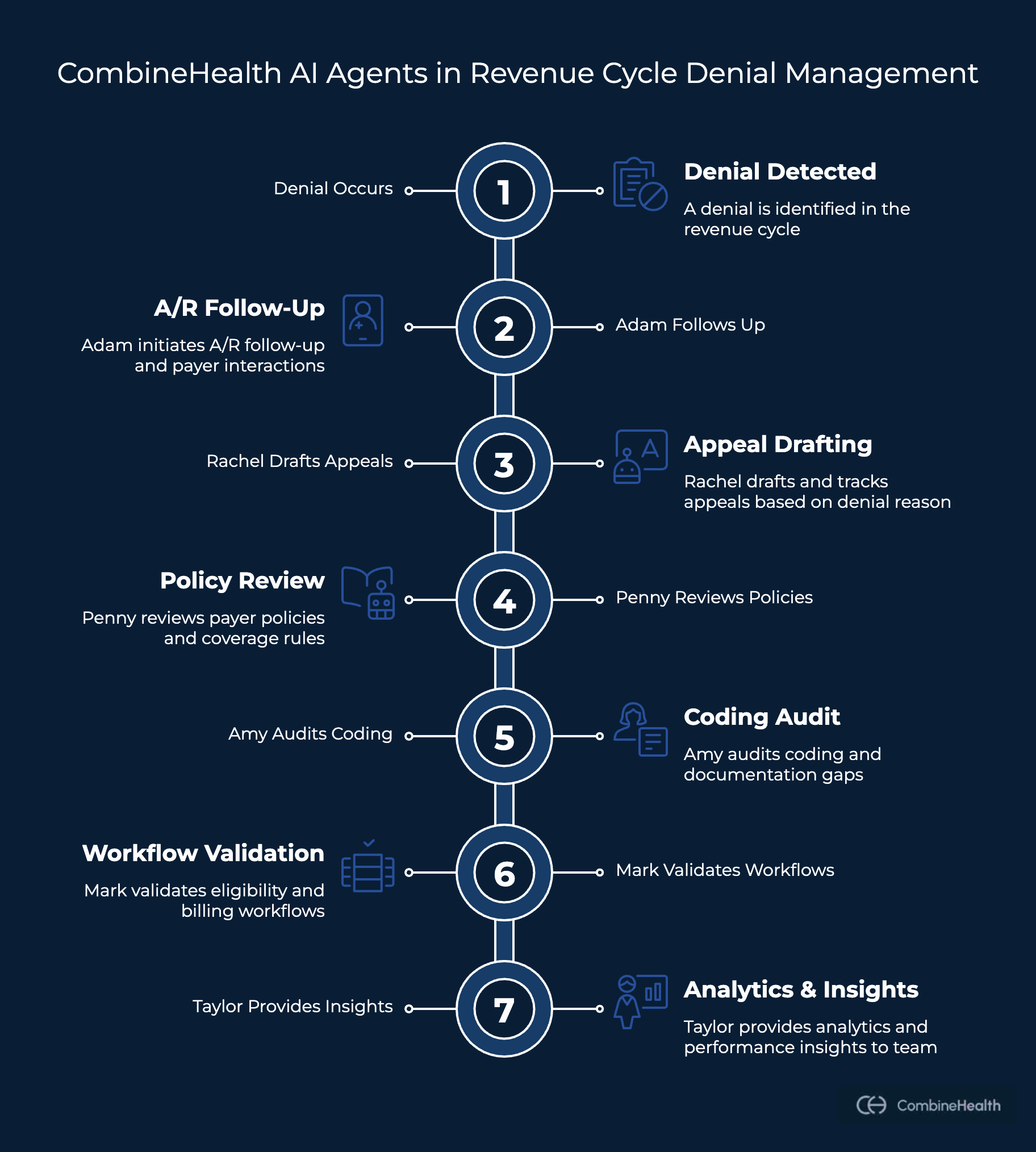
Key Features of CombineHealth:
- End-to-end RCM workflow analysis to identify bottlenecks and inefficiencies
- Real-time analytics dashboards covering claims activity, collections performance, and operational KPIs
- Conversational analytics, allowing users to ask questions such as:
- How many calls did our AI complete last week?
- What are the most common denial reasons requiring A/R follow-up?
- How does this month’s E/M distribution compare with last month?
- Automated monthly reports highlighting hidden patterns and recommended process improvements
- Workflow activation that turns analytics into claim follow-up, appeals, and prevention workflows
Best for: Hospitals and multispecialty physician groups
2. CentraMed
CentraMed is a cloud-based denials analytics and workflow platform designed to help providers identify denial root causes and streamline denial management. The platform converts daily remittance data into structured denial insights, enabling billing teams to quickly understand denial trends across payers, procedures, and providers.
Along with analytics dashboards, CentraMed provides intelligent work queues and expert consulting support to help organizations reduce avoidable denials and move closer to first-pass payment.
Key Features:
- Parses 835 and 837 remittance files daily to provide a unified, up-to-date view of denials across systems.
- Automatically categorizes denials by payer, CPT code, physician, and denial code to reveal root causes.
- Creates intelligent work queues that route denied claims to billers with filing-deadline alerts.
- Provides dashboards tracking denial rate, top denial codes, backlog volume, and long-term trends.
- Includes denial strategy workshops where CentraMed experts review data and recommend operational improvements.
Best for: Hospitals, health systems, and large multi-specialty groups
3. Imagine Co-Pilot
ImagineCo-Pilot is an AI “agentic” layer built on top of the ImagineOne RCM platform that automates large portions of the claims and denial lifecycle.
It acts as a co-pilot for revenue cycle teams, using AI and NLP to correct claims before submission and resolve many denials automatically. The platform offers to reduce manual follow-up work while improving first-pass payment and overall RCM efficiency.
Key Features:
- Automates end-to-end claim workflows in ImagineOne, from claim submission to denial resolution.
- Uses AI to identify and correct claim errors before submission, helping reduce avoidable denials.
- Automatically resolves many denials with reported 95%+ accuracy, routing only exceptions to staff.
- Provides real-time reporting showing denial resolution performance and operational impact.
- Extends automation to front-end processes, including eligibility checks and patient communication.
Best for: Provider organizations already using or planning to adopt ImagineSoftware’s RCM platform
4. Rivet Health Payer Performance
Rivet Health’s Payer Performance platform focuses on identifying and recovering underpayments and payment variances rather than traditional claim denials. The platform centralizes payer contracts and analyzes claims data to detect reimbursement discrepancies, helping practices recover lost revenue and strengthen payer negotiations.
Key Features:
- Centralized contract management that stores payer agreements, tracks renewal timelines, and models proposed rate changes.
- Automated underpayment detection using AI to flag payment variances and group similar claims into prioritized recovery projects.
- Customizable worklists that allow teams to review claims, assign tasks, and export project data for payer appeals.
- Claims analytics dashboards tracking revenue performance, pricing trends, and payer behavior.
- Contract benchmarking tools that compare reimbursement rates across payers and markets to support negotiations.
Best for: Physician groups, ambulatory providers, and multi-specialty practices
5. Experian Denial Management
Experian Health’s Denial Workflow Manager is a denial management and analytics solution that helps healthcare organizations identify, prioritize, and resolve denials faster. By combining ERA data, claim status information, and customizable rules, the platform automates denial triage and follow-up while providing analytics to track root causes and improve upstream processes.
Key Features:
- Identifies and prioritizes denials using ERA data, claim status updates, holds, suspends, and zero-pay claims.
- Automatically categorizes denials with ANSI and payer-specific reason codes to speed triage.
- Provides customizable worklists based on denial category, dollar value, or client-defined rules.
- Supports root cause analysis and trend reporting to help teams prevent recurring denials.
- Integrates with Experian ClaimSource and other Experian RCM tools for a unified claims and denial workflow.
Best for: Hospitals and medical groups looking for a scalable denial workflow solution
Top Features to Look for in a Denial Management Analytics Solution
Not all denial analytics tools are built the same. Some simply show reports after denials occur, while others help organizations identify root causes, prioritize AR follow-up, and prevent future denials across the entire revenue cycle.
Here are the key capabilities to look for in an AI denial analytics platform:
Unified Denial Intelligence Across the Revenue Cycle
A strong denial analytics solution should provide a centralized view of denial performance across payers, providers, service lines, and locations. With this level of visibility, revenue cycle leaders can quickly identify where denials originate and which areas are driving the most financial impact.
Recommended Reading: Denial management in healthcare
Root Cause Analytics, Not Just Denial Reporting
Simply listing denial codes isn’t enough. Effective platforms must map denial data to operational root causes so teams can address the underlying issues.
For example, a denial analytics platform should help answer questions like:
- Are prior authorization failures increasing for a specific payer?
- Are certain CPT codes frequently denied for medical necessity?
- Is a specific provider generating a higher share of coding-related denials?
Real-Time RCM Performance Insights
The best platforms provide analytics across both operational activity and financial outcomes, helping leaders understand how workflows affect revenue performance.
For example, organizations should be able to monitor metrics such as:
- Claims submitted or processed
- Denial rates and denial backlog
- Net collection rate
- Average days in accounts receivable (A/R)
This broader view helps identify operational bottlenecks that may indirectly contribute to denials.
Conversational or Self-Service Analytics
Modern denial analytics solutions must support conversational analytics, allowing users to ask questions such as:
- What are the most common denial reasons requiring follow-up this month?
- Which payer generated the highest denial rate last quarter?
- How has our denial rate changed compared to last month?
This kind of self-service access allows operational teams to identify issues faster and take action sooner.
Automated Reporting and Pattern Detection
A strong denial analytics platform should continuously analyze claims data and surface patterns automatically.
Instead of relying on manual reporting, the system should generate:
- Monthly or weekly denial summaries
- Alerts when certain denial types spike
- Insights into recurring payer behaviors
- Recommendations for workflow improvements
How Denial Analytics Turns Into Denial Management Action
Ready to Reduce Denials With AI-Powered Denial Analytics?
As denial rates continue to rise, relying on manual reviews and reactive appeals is no longer sustainable.
If you want to see how AI-driven denial analytics can uncover hidden revenue leakage and streamline your denial workflows, book a demo with CombineHealth. Our platform gives you real-time visibility into denial trends, payer behaviors, and RCM bottlenecks—so your team can focus on fixing issues at the source and getting claims paid faster.
FAQs
How does AI improve denial analytics?
AI categorizes denials automatically, detects patterns across large claim datasets, and identifies root causes faster than manual review. The most advanced platforms go further — feeding denial outcomes back into coding through payer-specific intelligence, so the issues the analytics surface are corrected before the next claim rather than re-reported each month.
What is the difference between denial analytics and denial management automation?
Denial analytics explains why denials happen — patterns across payers, providers, and categories. Denial management automation acts on those insights through follow-up and appeals. The strongest platforms add a third layer: feeding outcomes back into coding so root causes are prevented, not just identified and worked.
Can denial analytics reduce A/R days?
Yes, when insights connect to action. Analytics can flag claims stuck without payer response, recurring payer-specific denials, and high-value appeals to prioritize. And when denial outcomes also feed back into coding, fewer claims are denied in the first place — the most durable way to lower A/R days.
How does CombineHealth's denial analytics work?
CombineHealth reads and categorizes denial data from remittances, maps denials by payer, provider, service line, and category, and traces each root cause back to the source document. Those outcomes then feed its self-learning coding platform, which uses payer intelligence to adapt coding per payer — turning denial analysis into denial prevention.
How is CombineHealth different from other denial analytics vendors?
Most vendors stop at dashboards or worklists. CombineHealth wires denial analytics into coding: recurring denials the analytics identify are corrected at the source through payer intelligence, and every mapping is explainable and traceable. In one deployment this reached 97.4% denial-mapping accuracy across 3,649 claims; feeding outcomes back into coding drove a 75% denial reduction at another site.
Does CombineHealth prevent denials or just report them?
Both — but prevention is the point. The analytics report and prioritize denials, and the self-learning coding platform prevents recurring ones by adapting coding to each payer's behavior. Reporting shows you the leak; the closed loop into coding stops it.