Top 10 AI Medical Coding Companies for the Emergency Department
Explore the top 10 AI medical coding solutions designed for the emergency department. Also, understand how to select the right AI medical coding vendor.
Published on:
February 14, 2026
Updated on:
September 17, 2026


CombineHealth stands out as a self-learning, autonomous Emergency Department coding platform: it reads the full emergency encounter, applies payer-specific and ED-leveling rules, explains every code for audit defense, and learns from payer outcomes to reduce denials.
Key Takeaways:
• Emergency Department coding is uniquely complex and high-risk. Coders are expected to process ~120 charts per shift while managing evolving diagnoses, dual professional/facility rules, and heavy payer scrutiny.
• Generic AI tools fall short in the ED. Emergency departments require ED-specific logic for critical care, procedures, facility leveling, and audit defensibility.
• Emergency Department coding vendors vary widely. Some are AI-first, others service-led, and some are payer-side tools. Choosing the right fit depends on your ED volume, compliance risk, and internal resources.
• Successful Emergency Department AI mirrors experienced coders. It asks what happened, what resources were used, and what justifies the charges—escalating ambiguity rather than guessing.
• The best Emergency Department AI medical coding tool is explainable and self-learning — it grounds every code in the documentation (auditable, not a guess) and learns each payer's behavior from real outcomes to reduce denials.
Emergency department coding runs on extreme timelines.
According to AHIMA productivity guideline, ED coders are often expected to code around 120 ED encounters in an 8-hour day—roughly 15 charts an hour, or just four minutes per encounter.
Diagnoses evolve mid-visit, documentation comes from multiple clinicians, procedures and imaging are layered in real time, and payer scrutiny is highest where acuity is highest. Coders are expected to move fast and be perfectly defensible.
This is why AI medical coding has become essential in the emergency department and why generic outpatient tools fall short.
In this guide, we’ve compiled our top picks for the 10 best AI medical coding companies for the emergency department, while breaking down:
- What makes ED coding uniquely difficult
- How ED-ready AI actually works
- How to evaluate the top AI medical coding companies for emergency care
1. CombineHealth: Best AI Medical Coding Solution for ED Specialties
CombineHealth is an autonomous, self-learning coding platform purpose-built for the pace and acuity of the emergency department. Also known as Amy AI, it pulls the completed ED encounter straight from the EMR — clinician and nursing notes, procedures, the tests it interprets, and the facility resources consumed — and returns billing-ready professional and facility codes (ICD-10-CM, CPT, HCPCS, E/M, and modifiers), each paired with the reasoning behind it.
Rather than pattern-matching to a likely code, it works the chart the way a seasoned ED coder does: reading the whole encounter, separating what's documented from what's merely implied, confirming every service is supported, then layering in ED-leveling logic and each payer's requirements before it commits a code — including critical care, trauma, imaging interpretation, and procedures. Once claims come back, what the payers actually did (paid, denied, downcoded, underpaid) becomes signal that sharpens how it codes that payer next time. The payoff isn't only accuracy; it's fewer denials.
Key Features:
- ED-specific professional and facility E/M, critical care, trauma, imaging interpretation, and procedures
- Self-learning payer intelligence aligned with ED-leveling and medical-necessity rules
- Explainable, audit-ready coding with line-by-line rationale tied to the note, guideline, and payer rule
- Kept current with each year's AMA CPT, ICD-10-CM, and HCPCS changes (2026 included)
What Makes CombineHealth Stand Out?
What sets CombineHealth apart in the Emergency Department coding is that it doesn't stop at assigning a code. It links every decision to what happens downstream — acceptances, reimbursements, denials, underpayments, rework — and keeps adjusting, so automation climbs while denials fall: roughly 85% of charts coded autonomously, 98%+ accuracy, and up to a 75% cut in coding-related denials.
Case study: in a 1,000-chart emergency-department study, CombineHealth matched credentialed coders at ~98% accuracy, cut coding turnaround time in half, and identified 5× more documentation gaps than traditional workflows. Read the case study.
Best For: health systems and high-volume EDs scaling Emergency Department coding accuracy without adding coders.
Recommended Reading: How Emergency Medicine Has Evolved Over Time
Case Study: How Brault Scaled Autonomous ED Coding to 5× Volume with CombineHealth
Brault deployed CombineHealth's autonomous coding platform after an earlier autonomous-coding vendor couldn't sustain its accuracy in production. In recurring production audits, CombineHealth held 98%+ accuracy across every major coding dimension, maintained a sub-12-hour turnaround through 2–3× volume spikes, and cut new-ED-site go-live from about 1.5 months to roughly 2 weeks — and Brault is now scaling CombineHealth toward 5× its current autonomous-coding volume.
- 98%+ accuracy across CPT, E/M, primary diagnosis, ICD, modifiers, MIPS, CDI, and provider assignment — validated in production audits, not as a blended pre-go-live score.
- Sub-12-hour turnaround held even through 2–3× volume spikes from outages, holidays, and backlogs.
- ~2-week go-live for new ED sites (down from ~1.5 months for the first deployment).
- 5× current volume planned across Brault's ED network, with autonomous coding expected to triple within the month.
- Site-level rules applied consistently — payer-specific CPT exclusions, modifier sequencing, provider assignment, observation, and non-billable scenarios — with the platform adapting to each ED site rather than forcing the site to standardize around the AI.
2. Optum’s Emergency Department Claim (EDC) Analyzer
Optum’s Emergency Department Claim (EDC) Analyzer is a rules-based claim editing tool used primarily by payers to calculate and validate ED facility visit levels. It applies a CMS-aligned algorithm to diagnoses and procedures to estimate resource intensity and reprice ED facility E/M levels.
Key Features:
- Automated ED facility E/M leveling (99281–99285) using a weighted, multi-step algorithm
- CMS-aligned methodology based on outpatient facility E/M guidelines
- Assigns standard, extended, and patient-complexity weights to services and diagnoses
- Widely used for pre- and post-payment review and claim repricing
- Public-facing logic reference via EDCAnalyzer.com for transparency and testing
Best For: Provider organizations seeking to model payer behavior and understand how ED facility claims are scored
3. Logix Health
LogixHealth is a specialized RCM provider with more than 20 years of experience supporting emergency departments nationwide. Coding millions of ED visits annually, the company delivers end-to-end professional and facility coding, billing, and analytics designed to improve reimbursement, reduce denials, and scale high-volume ED operations.
Key Offerings:
- Full ED professional and facility coding, including E/M leveling, procedures, critical care, and quality reporting
- Claims management with denial prevention, appeals, and A/R follow-up
- ED-specific business intelligence dashboards tracking RVUs, charge capture, denials, and revenue trends
- Scalable RCM platform supporting millions of ED visits across multi-state operations
- Strong compliance focus with ongoing coder education and audit readiness
Best For: High-volume hospital EDs and emergency medicine groups needing end-to-end outsourced RCM
4. Solventum
Solventum offers 360 Encompass™ System that combines computer-assisted coding (CAC) for facility and professional services, clinical documentation integrity (CDI), auditing, and autonomous coding in a single platform used across hospitals and health systems.
For emergency departments, its facility and professional CAC, outpatient/ED E/M support, and integrated audit and compliance tooling help revenue integrity teams code consistently and defend decisions under payer scrutiny.
Key Offerings:
- 360 Encompass™ Autonomous Coding System — qualifies, curates, and finalizes outpatient and professional encounters through a chart-confidence workflow with zero coder intervention, under full client control; automates 80%+ of qualified charts
- Computer-assisted coding (CAC) across both facility and professional services
- Integrated clinical documentation integrity (CDI) with electronic queries, prioritized worklists, and auto-suggested queries
- Built-in auditing, clinical-intelligence reporting, and compliance tooling
- Long track record across hospitals and health systems (formerly 3M HIS)
Best For: Hospitals and health systems that want enterprise-grade coding, CDI, and audit defensibility in one established platform.
5. AGS Health
AGS Health offers a hybrid AI-powered Autonomous Coding platform that combines advanced automation with human coding expertise. Designed for hospitals and health systems, it targets high-volume settings like emergency departments by automating routine coding while retaining human oversight for complex cases and compliance safety.
Key Features:
- Hybrid autonomous coding using ML, NLP, CLU, and LLMs with human-in-the-loop oversight
- Supports ICD-10-CM, CPT, HCPCS, modifiers, and E/M coding
- 40–80% automation potential in high-volume areas like ED and radiology
- Integrated compliance engine with NCCI edits, LCD/NCD logic, MCE, encoders, and pre-bill auditing
- Real-time dashboards for productivity, confidence scoring, suspends, RVUs, and acuity trends
Best For: Organizations seeking a hybrid AI + services model that integrates into existing RCM workflows
6. CodaMetrix
CodaMetrix delivers enterprise autonomous medical coding through its CMX CARE™ platform, which unifies the patient story across providers, encounters, and facilities to drive touchless coding. Built for large and academic health systems, it was named 2026 Best in KLAS for Autonomous Medical Coding.
CodaMetrix's autonomous coding is strongest across radiology, pathology, endoscopy, and surgery, with inpatient professional-fee and diagnostic/procedural coding, and it's built to Epic-recommended integration standards (Epic Toolbox Approved).
Key Offerings:
- CMX CARE™ platform with CMX Automate™ (autonomous coding), CMX Amplify™ (workflow), and CMX Insights™ (analytics)
- Unifies clinical data across providers, encounters, and facilities to identify services, diagnoses, and documentation gaps
- Epic Toolbox Approved integration
- Reported results including a 70% reduction in manual coding, 5× faster turnaround, and 60% fewer coding denials
Best For: Large and academic health systems standardizing autonomous coding across radiology, pathology, surgery, and other high-volume service lines.
7. Fathom
Fathom is a deep-learning autonomous medical coding platform built for scale, coding across specialties for health systems, physician groups, ambulatory clinics, and RCM organizations. It provides both facility and professional coding, including E/M capture and provider assignment — the coding streams that matter most in the ED.
Key Features:
- Deep-learning autonomous coding across specialties, at high volume
- Both facility and professional coding, with E/M capture and provider assignment
- Denial and audit-risk reduction through consistent, guideline-aligned coding
- Reported client results including 95.5% automation at 98.3% accuracy (varies by client and specialty
Best For: High-volume health systems, physician groups, and RCM organizations automating professional and facility coding at scale.
8. Nym
Nym is an AI-native autonomous medical coding platform whose Clinical Language Understanding (CLU) engine combines machine learning with rules-based clinical ontologies to code encounters in seconds with no human intervention. Emergency medicine is a core focus, and Nym leans hard on explainability — it produces audit-ready, traceable documentation for every code it generates, in contrast to black-box AI.
Key Offerings:
- Clinical Language Understanding (CLU): machine learning plus rules-based clinical ontologies, coding encounters in seconds
- Fully autonomous, direct-to-billing coding with no human intervention on cleared charts
- Explainable and auditable — traceable documentation for every code
- Emergency-medicine focus within a multispecialty solution
- Typical implementation of roughly 3–6 months
Best For: Emergency departments and health systems that want fully autonomous, explainable coding they can defend in an audit.
9. Exdion Health
Exdion Health is an AI-powered RCM platform focused on ambulatory, urgent care, and ED-adjacent settings. Its ExdionACE solution automates coding and revenue integrity using rule-based AI and ML, while ProMaxAI adds real-time analytics and AI-driven coding feedback to improve accuracy, speed, and compliance.
Key Features:
- ExdionACE auto-coding engine for ICD-10, CPT, E/M, and modifiers with built-in compliance checks
- ProMaxAI analytics with real-time dashboards and an AI chatbot (“Genie”) for coding guidance and denial prediction
- Revenue integrity and CDI with 100% chart review for missed charges and documentation gaps
- EMR-agnostic integration via APIs and bots with acuity and provider-level insights
- Real-time CAPD tools, compliance training, and automated claim submission
Best For: High-volume physician practices focused on E/M optimization, CDI, and faster TAT
10. Xpert Dox
XpertDox is an AI-powered autonomous medical coding platform focused on high-volume ambulatory and urgent care settings. Its XpertCoding solution automates the majority of coding with minimal human intervention, helping practices accelerate charge capture, reduce denials, and improve revenue cycle speed through EHR-integrated AI.
Key Features:
- Fully autonomous AI coding for ICD-10, CPT, HCPCS, E/M, and modifiers, covering >95% of claims
- Hybrid AI architecture using ensemble models, NLP, neural networks, and RPA
- BI dashboards for charge capture, CDI, denial analytics, audit trails, and provider performance
- EMR-agnostic integration with rapid charge submission and proactive charge recovery
- Performance-based coding support (Category II CPT) and MIPS quality tracking
Best For: Urgent care centers, primary care practices, and FQHCs with high encounter volumes
How Does AI Medical Coding Work in the Emergency Department?
AI ED coding follows the same logic an expert coder would, at machine speed. It reads the full encounter — physician and nursing notes, procedures, tests ordered and interpreted, and facility resources — identifies the billable professional and facility services, validates that the documentation supports them, applies ED-leveling and payer-specific rules, and generates each code with a rationale you can trace back to the note. Self-learning platforms then use claim outcomes (denials, reimbursements, underpayments) to refine future coding per payer.
Why ED-specific? Emergency care blends high acuity, critical-care time, trauma, evolving diagnoses, and dual professional/facility rules — nuance a general coding model misses.
What Are the Common Challenges Faced by Emergency Department Medical Coders?
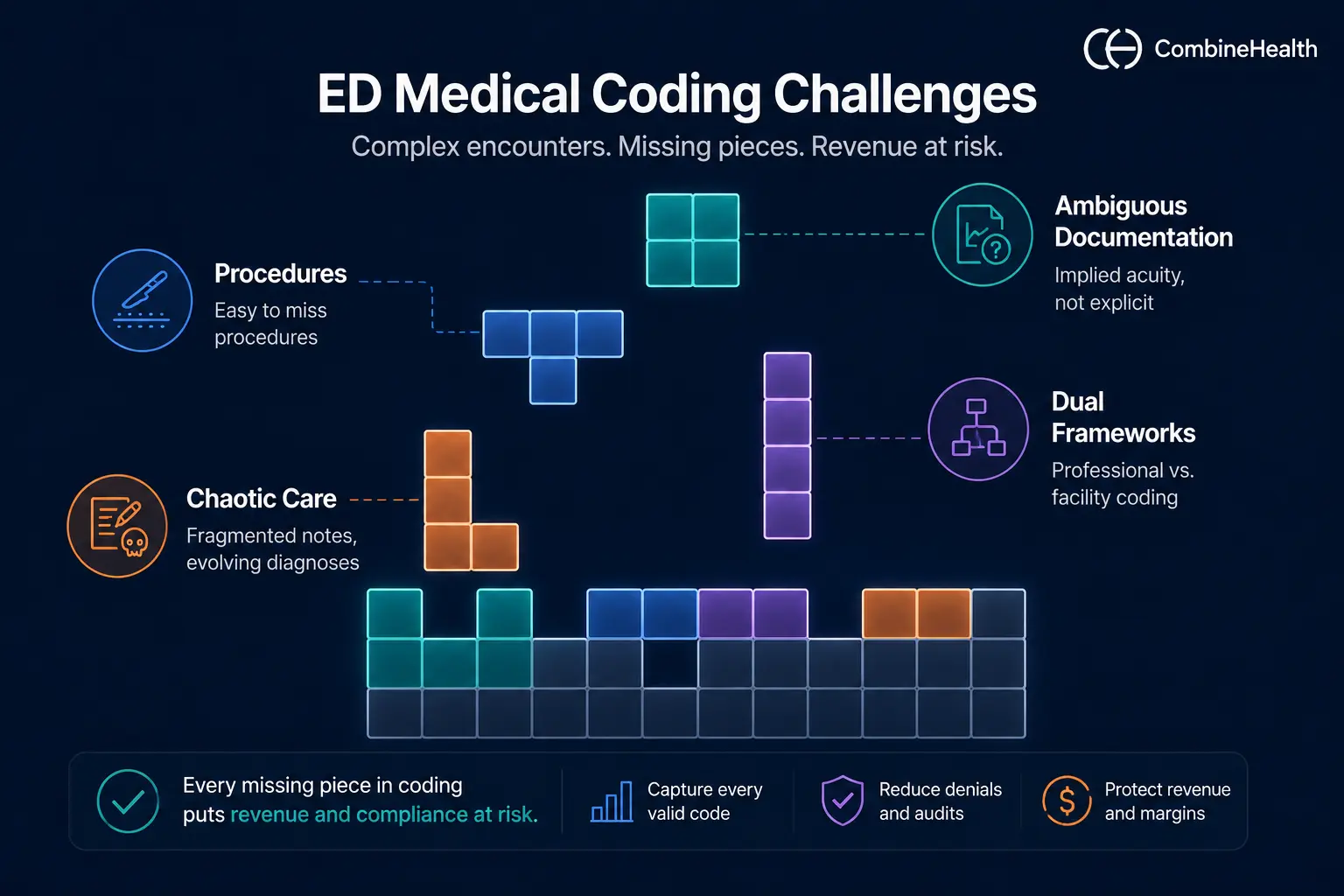
Emergency department medical coding comes with its own set of challenges, many of which don’t show up in other care settings. These often include:
Translating Chaotic Emergency Department Care into Structured Codes
ED visits rarely follow a clean narrative. Patients arrive without complete histories, diagnoses evolve over the course of the visit, and care is delivered across multiple handoffs.
Coders must reconstruct a coherent clinical story from fragmented provider notes, nursing documentation, lab results, imaging, and orders. When documentation is sparse, copied forward, or poorly organized, supporting higher-level E/M codes becomes especially difficult.
Plus, ED coders must stay fluent in constantly evolving E/M rules, particularly MDM-based leveling for CPT codes 99281–99285 and critical care services.
Navigating Dual Frameworks: Professional vs. Facility Coding
Most ED encounters generate two separate coding streams:
- Professional coding for the clinician, governed by CPT and MDM rules
- Facility coding for the hospital, driven by internal resource-based methodologies and payer-specific logic
These two levels frequently don’t align. Coders must reconcile discrepancies carefully—capturing appropriate revenue without introducing compliance risk or triggering audits.
Capturing Procedures and Add-on Services Accurately
Emergency clinicians perform a wide range of procedures—laceration repairs, splinting, I&Ds, procedural sedation, bedside ultrasounds, ECG interpretations—that are easy to miss in busy charts.
Coders must determine:
- Which procedures are separately reportable
- Which are bundled into the E/M codes
- When modifiers like -25 or -59 are appropriate
Ambiguous or Insufficient Documentation
In the ED, clinicians document to treat the patient, not to optimize billing. Moreover, ED volumes fluctuate unpredictably, creating coding backlogs and DNFB issues during peak periods. At the same time, many organizations face coder shortages and high turnover—especially among coders skilled in trauma, critical care, and pediatric ED cases.
As a result, acuity, complexity, and risk are often implied but not explicitly stated.
Coders are left choosing between:
- Under-coding, which protects against audits but sacrifices revenue
- Coding closer to clinical reality, which improves accuracy but may increase audit exposure
Provider queries can help, but they add friction and delay in an already overloaded environment.
Does AI Emergency Department Coding Pay Off — and What Does It Cost?
The ROI of AI ED coding comes from three levers, not just speed:
- Charge capture — catching billable procedures, critical-care time, and facility resources missed in fast-moving ED notes.
- Fewer denials — payer-aware coding and correct E/M leveling reduce the ED's biggest denial category.
- Lower cost-to-code — automating high-volume charts drops cost per chart and clears backlogs without adding coders.
Cost models vary — per chart, per encounter, or platform subscription — so compare total cost against your current in-house or outsourced cost per chart. The honest way to size ROI is a pilot on your own ED charts: measure captured revenue, denial rate, and turnaround, not just automation rate.
How AI Reduces Emergency Department Coding Denials
E/M-level and medical-necessity denials are the ED's biggest coding-related revenue drain. AI reduces them by coding to each payer's rules before submission, validating that the documentation supports the level billed, checking CCI/bundling edits, and flagging claims likely to be denied. Self-learning platforms go further — they categorize past denials by payer, code, and reason and feed the patterns back into coding, so the same avoidable ED denial doesn't repeat.
How Does AI Close Emergency Department Documentation Gaps
Most ED denials and downcodes trace back to documentation, not coding. AI catches this before billing: it identifies missing or ambiguous documentation (unrecorded critical-care time, undocumented risk, symptoms versus confirmed diagnoses), flags where the note doesn't support a CPT code, and surfaces gaps for a physician query rather than guessing. That real-time CDI protects both reimbursement and audit defensibility — and, over time, shows which providers need documentation feedback.
Why Do You Need an AI Medical Coding Partner for the Emergency Department?
Once you understand how complex ED coding can get, the next question is obvious: how do you scale accuracy and speed without increasing risk? That’s where the right AI medical coding partner starts to matter.
Here’s why you need the right AI medical coding partner in an ED setting:
Revenue and Compliance Stakes are Higher
ED visits are a major revenue driver—and a top target for payer scrutiny. Payers apply ED-specific algorithms to down-code or reclassify visits as non-emergent.
High-risk scenarios like sepsis, chest pain, trauma, and stroke are common and heavily audited. Even small clinical documentation or coding gaps can trigger significant denials, recoupments, or compliance findings.
An ED-focused partner can tailor rules, edits, and audit trails to your payer mix and risk tolerance.
You Need Automation that Understands ED Nuance
ED-tuned AI can:
- Differentiate routine vs. complex encounters
- Identify true critical care
- Detect separately reportable procedures vs. bundled services
It can also align with local ED facility leveling guidelines, which is critical for accurate hospital reimbursement. Without ED-aware intelligence, automation tends to over-code (compliance risk) or under-code (revenue leakage).
An AI Medical Coding Partner Can Co‑Design Workflows with ED Reality in Mind
Successful AI adoption in emergency medicine depends on workflow design—not just model accuracy.
A dedicated partner can help define:
- What can be auto-coded vs. what needs review
- Exception handling for trauma and critical care
- Feedback loops between coders, clinicians, and AI
That level of co-design is hard to get from generic RCM tools or EHR add-ons.
Stronger Support for Denials, Appeals, and Audits
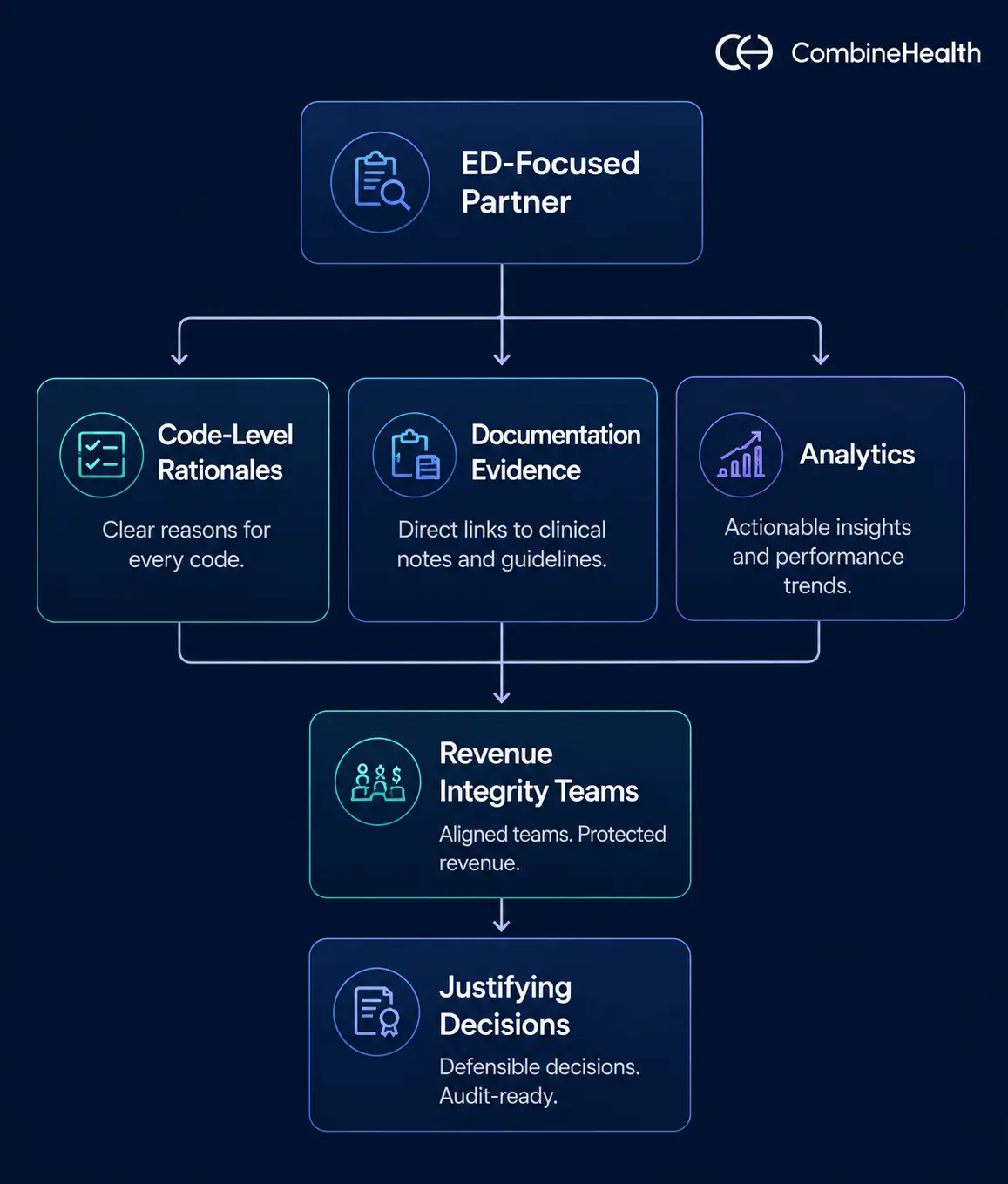
ED denials increasingly reference payer algorithms and clinical validation logic. You need explainable AI that shows why a code or level was assigned.
An ED-focused partner provides code-level rationales, documentation evidence, and analytics that help revenue integrity teams defend decisions—turning coding from a black box into a defensible system.
Scale Without Burning Out Your Team
ED coding teams face constant volume spikes and workforce strain.
An AI partner can handle routine, low-risk charts while experienced coders focus on complex cases, QA, education, and audit prevention. This balance improves throughput and retention, something in-house tools alone struggle to achieve.
How to Compare Emergency Department AI Medical Coding Vendors
Here’s how to evaluate an AI medical coding solution for the emergency department:
1. Start with ED-specific use cases
Confirm whether the vendor supports both ED professional and facility coding, and whether it handles critical care, trauma, pediatric and psych ED, observation-in-ED, and high-acuity visits—not just low-complexity encounters.
Look for live ED deployments or case studies, not generic outpatient references.
2. Assess depth and safety of automation
Go beyond marketing claims.
Ask what percentage of ED charts can be safely auto-coded, broken down by visit type. Understand how the system expresses confidence, when charts are routed to human coders, and how ED accuracy is measured, audited, and validated.
3. Evaluate workflow fit and integration
Assess integration with EHRs (Epic, Cerner), encoders, groupers, and existing CAC tools. Understand when ED charts are coded (real-time vs. batch), how exceptions flow, and support for boarding, cross-midnight visits, and ED-to-observation scenarios.
4. Look at governance, QA, and rollout approach
Ask about ED-focused QA programs, dual-coding strategies, training for coders and clinicians, and phased rollouts—often starting with lower-risk ED visits before expanding to trauma and critical care.
Also ask every vendor the essentials: how do you measure accuracy (claim-line?), what ED benchmarks can you show from live deployments, how do you handle payer-specific rules, and can we pilot on our own charts?
Implementation Lessons from Real Emergency Department Deployments at CombineHealth
AI medical coding in the emergency department is hard for a few simple reasons:
- Care is overwhelmingly acute, not chronic
- E/M complexity depends on cognitive effort that’s often not explicitly documented
- Trauma rules, imaging interpretation, and chronic conditions influencing acute care must be captured
- Documentation is frequently incomplete or ambiguous due to ED time pressure
So when we implemented AI in ED coding workflows for this customer, we focused on one thing: teaching the system to reflect how experienced ED coders actually think.
Before assigning codes, our AI is designed to answer three questions:
- What actually happened during this encounter?
- What resources were used?
- What conditions or symptoms justify those charges?
That logic shaped how our AI medical coding solution, Amy, operates in ED workflows.
How CombineHealth’s AI Medical Coding Solution Operates in the ED
CombineHealth reviews:
- Provider-authored notes
- Procedures performed
- Facility resources used
- Tests ordered and independently interpreted
Once billable services are identified, the platform builds the clinical story that justifies them.
CombineHealth starts from first principles:
- What symptoms did the patient present with?
- What acute issues required intervention?
- Which chronic conditions increased complexity or risk?
Then comes a second pass:
Does every CPT code have a clear justification in the ICD-10 set?
Moreover, CombineHealth knows ambiguity in ED and is designed not to guess. Take the following cases, for example:
- “Dark emesis” is mentioned, but “hematemesis” is never documented
- A procedure is described, but the rationale isn’t clear
- A condition is implied across notes but never stated
- Different providers document the same event differently
In these cases, the platform escalates the chart, mirroring how experienced coders protect compliance and revenue.
Ready to accelerate your ED RCM workflows? Book a demo with CombineHealth to see how we can help!
FAQs
How Does CombineHealth Operate in the Emergency Department?
CombineHealth reviews the provider-authored notes, procedures performed, facility resources used, and tests ordered and independently interpreted, then builds the clinical story that justifies each billable service — starting from first principles (what symptoms presented, what acute issues required intervention, which chronic conditions added complexity or risk) and confirming that every CPT code has clear ICD-10 support.
Because every code is grounded in the documentation and carries a line-by-line rationale, high-scrutiny ED charts stay defensible in an audit. And because CombineHealth learns from real payer outcomes, ED coding adapts to each payer over time — so avoidable denials don't repeat.
How accurate is AI at coding complex ED cases compared with experienced human ED coders?
In structured, well-documented cases, AI can match or approach experienced ED coder accuracy. However, in high-acuity or ambiguous cases (e.g., evolving sepsis or trauma), performance depends heavily on documentation clarity. Most mature systems combine AI automation with human review for complex, high-risk encounters.
Which ED encounters are safe to auto‑code, and which should always be manually reviewed?
Lower-acuity, well-documented visits with clear diagnoses and straightforward procedures are generally safer for auto-coding. Complex trauma, critical care, multi-problem encounters, ambiguous documentation, or charts with conflicting inputs typically require manual review to protect compliance and revenue integrity.
Will AI replace ED medical coders?
AI is more likely to change the role than replace it. Routine charts can be automated, allowing coders to focus on complex cases, audits, denial prevention, and education. Most ED deployments use a human-in-the-loop model where coders oversee, validate, and manage edge cases.
How does AI avoid increasing clinician burden with extra clicks, queries, or alerts in an already hectic ED environment?
Well-designed systems work in the background—reading existing documentation rather than forcing structured data entry. They escalate only when documentation gaps materially affect coding. Poorly designed tools can add friction, so workflow fit and thoughtful implementation are critical.
What ED‑specific benchmarks can vendors show from live deployments?
Strong vendors should provide ED-specific metrics such as automation rate by acuity level, coding accuracy vs. human audit results, denial reduction rates, turnaround time improvements, and impact on DNFB. Ideally, these benchmarks are drawn from comparable ED volumes and payer environments.
Can AI code ED critical care, trauma, and sepsis cases?
Yes — ED-specific AI captures critical-care time, trauma procedures, and evolving sepsis complexity, and grounds each code in the documentation. High-ambiguity charts should still be explainable enough to validate before billing.
Can AI handle both facility and professional ED coding (split billing)?
Yes. ED encounters generate two coded claims — professional (physician work) and facility (resource intensity). ED-specific AI codes both from the same encounter and reconciles them.
How much can AI increase ED revenue or reduce denials?
Gains come from better charge capture (missed procedures, critical-care time), correct E/M leveling, and payer-aware coding that cuts the ED's largest denial category. Size it in a pilot on your own charts.
How much does AI ED coding cost, and is it cheaper than outsourced coding?
Pricing is per chart, per encounter, or subscription. Compare total cost to your current in-house or outsourced cost per chart — automation typically lowers cost per chart as volume grows. Confirm each vendor's model.
We have thousands of ED charts a week and a backlog. Can AI handle the volume?
Yes — AI throughput isn't limited by headcount, so it absorbs high volume and seasonal surges, clears backlogs, and holds turnaround steady.
Our ED physicians don't document consistently. Can AI still code accurately?
AI reads the full encounter to reconstruct the clinical story, but it codes to what the documentation supports — and flags gaps rather than guessing. Cleaner upstream documentation (including ambient capture) improves accuracy.
Should we choose an ED-specific AI or a general medical coder?
For the ED, specificity matters — facility leveling, critical care, and ED E/M rules differ enough that a general coder underperforms. Prioritize proven ED capabilities and live ED benchmarks.
How should we compare different emergency department coding vendors?
Compare on claim-line accuracy and how it's measured, ED-specific automation (facility + professional), payer-awareness, explainability/audit trails, EHR integration, and the ability to pilot on your own ED charts — measuring denial reduction, not just automation rate.