Top 10 Autonomous Medical Coding Platforms with Fast EHR Integration Services
Compare autonomous medical coding platforms with fast EHR integration, implementation timelines, and efficient coding workflows for healthcare providers.
Published on:
September 2, 2026


Key Takeaways
• Fast EHR integration means an autonomous medical coding platform reaches production write-back inside a documented timeframe, with a go-live date committed in writing before you sign.
• Implementation timelines vary widely across the market. Nym publishes three to six months from contract signing to go-live, while CombineHealth scopes deeper EHR integrations at around four weeks.
• Ask vendors about four things before signing: how the connection is built, which clinical documents it can reach, where your coders work, and what could delay the go-live.
• CombineHealth supports both a lighter report-based workflow integration and a deeper credentialed EHR integration that fetches encounter data and writes coded results back, with deep integrations typically scoped at around four weeks.
When you are evaluating an autonomous medical coding platform, features are usually what you look at first.
But how quickly the platform integrates with your EHR is just as important. A platform can have all the right features, but if it takes months to implement, your revenue cycle will not benefit from them until the integration is complete.
The platform needs to pull encounter documentation from your EHR and write approved medical codes back into it, within the workflow your billing team already uses. Some vendors go live in about four weeks. Others take six months.
This guide explains what fast EHR integration actually means, compares 10 autonomous medical coding platforms based on how they connect to your EHR, and covers the questions you should ask before signing.
What Qualifies As Fast EHR Integration in AI Medical Coding?
1. Automatic Retrieval and Chart-Completion Triggers
An autonomous medical coding platform needs to access encounter data without manual exports. It should pull encounter documentation automatically, read both structured and unstructured records, and recognize when a chart is ready for coding.
Without these capabilities, medical coding may still depend on scheduled batches, leaving charge lag unchanged.
So, confirm that the autonomous medical coding platform can:
- Retrieve encounter and documentation data automatically, without a scheduled export
- Read structured records and unstructured clinical narratives together
- Receive an update when a chart is completed so coding starts automatically
Recommended read: A Guide to Autonomous Medical Coding in 2026
2. Return Path, Exception Queues, and Write-Back
The return path is where many autonomous medical coding integrations fall short.
If approved medical codes are delivered in a report instead of being written into the appropriate system fields, your medical billing team still has to re-enter the data manually.
Write-back is what turns a medical coding tool into part of your medical coding workflow.
So, ensure that the medical coding platform can:
- Return medical codes, charges, flags, and encounter statuses as structured output
- Route low-confidence or high-risk encounters to an exception queue for medical coder review
- Write approved results directly into the specific EHR or practice management fields used by your billing workflow
Recommended read: Medical Coding Audit: Explained
3. Audit Trail and Clean Operation
An autonomous medical coding platform should maintain a complete, traceable audit trail for every medical coding decision. The workflow should also operate without CSV uploads or duplicate data entry.
The audit trail matters during compliance reviews and payer audits. It should show the documentation that supports the medical coding decision, not just the final medical code.
Duplicate data entry is also a sign of a shallow integration. If the same information has to be entered into two systems, neither system is functioning as a reliable source of truth.
Recommended read: How Does an AI Audit Trail Work in Medical Coding?
4. Documented Testing and Deployment Timeframe
A medical coding platform should provide a written implementation timeline that covers both testing and production deployment. The timeline should also include clear milestones and owners for each phase.
Ask for the implementation date in writing and have the vendor break it into phases, with a clear owner for each phase.
Validation testing matters most because testing on a demo dataset does not tell you how the platform will handle your own documentation.
Top 10 Autonomous Medical Coding Platforms with Fast EHR Integration
1. CombineHealth
CombineHealth, also known as Amy, is an autonomous, self-learning AI medical coding platform that reads the complete clinical record and assigns billing-ready ICD-10-CM, CPT, HCPCS, and E/M codes. It also learns from site-specific and payer-specific medical billing rules and medical coder corrections as it runs. It connects to your EHR through HL7, APIs, file and report exchange, or a fully credentialed integration, and writes approved codes back into your existing work queues.
Feature #1: Integrates Flexibly With Your Existing Systems
CombineHealth supports multiple EHR integration approaches, including HL7-based data exchange, APIs, report and file-based workflows, and deeper credentialed integrations that let the platform retrieve data from and write results back to the EHR or practice management system. The approach depends on the EHR, workflow, and required level of automation.
These fall into two modes:
- Lighter mode: A data-transfer workflow where you send records or reports and receive AI outputs back.
- Deeper mode: A full EHR integration where CombineHealth gets credentialed access, maps your workflows, and automatically fetches data from and writes results back into the EHR.
Note: HL7 is the standard format hospitals use to exchange clinical data between systems. A platform that supports HL7 can use a feed your EHR already sends instead of building a new connection from scratch, which can shorten time to go live. HL7 mainly moves data out of the EHR, so writing approved codes back usually requires an API alongside it.
Feature #2: Builds Payer Intelligence From Claim Outcomes to Reduce Denials
CombineHealth continuously learns from downstream claim outcomes—including reimbursements, denials, underpayments, and payer edits—to build payer intelligence. It uses these signals to understand how individual payers adjudicate claims and refine future coding decisions for each payer.
This payer-aware approach has helped CombineHealth reduce coding-related denials by up to 75%.
Feature #3: Pushes Work Items Into Existing Queues to Minimize Workflow Disruption
Generated work items are pushed into existing EHR or practice management work queues, so medical billers can stay in the systems they already use. Analytics and appeal review are handled in CombineHealth.
Feature #4: Configures Site-Specific Rules and Payer Nuances Before Go-Live
Billing rules, medical coding rules, and payer nuances are built in during configuration and back-tested before go-live. This matters because data placement and workflows can differ even across practices using the same EHR.
Feature #5: Tests AI Outputs Against Historical Work Before Go-Live
Test runs generate medical coding, eligibility, denial, and appeal outputs without submitting claims, allowing you to compare AI output against your existing team's previous work before going live.
Feature #6: Manages Multiple Practices With Role-Based Access
Users can switch between practices under one login, with role-based access controlling which clinics each person can access. Work queues remain practice-specific.
Best for: Health systems, multi-site clinics, and physician groups that need EHR write-back without replacing their existing billing workflow.
CombineHealth beat expert coders on 1,000 emergency department charts
In a parallel medical coding study, CombineHealth ran against expert coders on the same records. It reached 97% medical coding accuracy, cut turnaround time in half, and identified 5× more documentation gaps.
Read the full case study
2. CodaMetrix
CodaMetrix's CMX CARE platform supports Epic, GE, Meditech, and Cerner and can be expanded to other EHRs. It ingests both structured and unstructured clinical data and works alongside existing medical coding workflows, automatically capturing chargeable codes while sending the remaining cases to medical coders with context and suggestions.
Coverage is by service line rather than all-or-nothing, including radiology, pathology, endoscopy, surgery, emergency department, and evaluation and management. Confirm which service lines are live for your setting, as availability can vary by specialty.
Best for: Large health systems and academic medical centers
3. Fathom
Fathom reports integrations with Epic, athenahealth, Oracle Cerner, MEDITECH, and eClinicalWorks. It also offers a dedicated product for ambulatory and hospital-based outpatient organizations.
Fathom is listed on Google Cloud Marketplace, which can shorten procurement for organizations already using that channel. This can speed up purchasing, but it does not necessarily shorten the implementation or go-live timeline.
Best for: High-volume health systems, physician groups, and RCM organizations
4. Nym
Nym uses a FHIR-based integration approach across major EHRs, including Epic, Oracle Health/Cerner, and MEDITECH. Successfully coded encounters are routed directly to billing.
Nym publishes an implementation timeline of three to six months from contract signing to go-live. This includes technical integration, configuration to your medical coding guidelines, validation testing, and staff training. Few vendors publish this level of detail, so ask other vendors for the same breakdown.
Best for: Organizations wanting a standards-based connection and a published implementation timeline
5. Maverick Medical AI
Maverick Medical AI's mCoder platform streams medical coding results to billing systems within seconds of report finalization, making it well suited to radiology's report-driven workflow.
The vendor reports go-lives of approximately three months. Because the model is direct-to-bill, confirm where exceptions appear and how held encounters reach your coding team.
Best for: Radiology and imaging organizations wanting direct-to-bill coding
6. AGS Health
AGS Health's published EHR integrations include Epic, Oracle Health/Cerner, athenahealth, MEDITECH, eClinicalWorks, and Allscripts, with a human review layer.
This breadth matters if you run different EHRs across sites. Ask which integrations are currently in production rather than simply supported, and whether they work with your specific EHR version.
Best for: Health systems running different EHRs across sites
7. CorroHealth
CorroHealth's PULSE platform separates its workflow engine from its medical coding AI. This allows an organization to use PULSE for medical coding while routing documents through its own workflow engine.
PULSE is configured per facility across hospitals, clinics, urgent care, radiology, and physician services, so implementation scope depends on how many settings you include.
Best for: Hospitals that want to keep their existing workflow routing
8. Aptarro
Aptarro's RevCycle Engine applies real-time, customizable rules to every charge before it reaches the practice management or EHR system. This allows corrections to happen upstream, before a claim is submitted.
Autonomous medical coding comes through a partnership with aiHealth. Its aiH.Automate platform converts clinical notes into billing-ready codes and integrates with EHR and revenue cycle platforms. Together, the two products combine autonomous medical coding and charge correction in the same workflow into your PMS or EHR.
Best for: Organizations wanting medical coding paired with charge correction before claims reach billing
9. AKASA
AKASA Medical Coding integrates with major EHR systems and analyzes clinical notes, imaging reports, and clinical observations alongside EDI data.
The platform surfaces recommended medical codes with justifications linked directly to the supporting medical text, which medical coders then accept or revise. That keeps a medical coder in the loop on every encounter, so the integration feeds a review workflow rather than posting codes straight to billing.
Best for: Health systems evaluating generative AI across broader revenue cycle workflows.
10. MediCodio
MediCodio's CODIO describes API-based write-back and integrations with Epic, Oracle Health/Cerner, athenahealth, and AdvancedMD, with complex cases routed for review.
API-based write-back is best confirmed in a demonstration rather than in documentation. Ask to see medical codes posting into a test instance of your own EHR before you sign.
Best for: Hospitals and physician groups seeking API-based coding integration
Questions to Ask Vendors About EHR Integration in AI Medical Coding
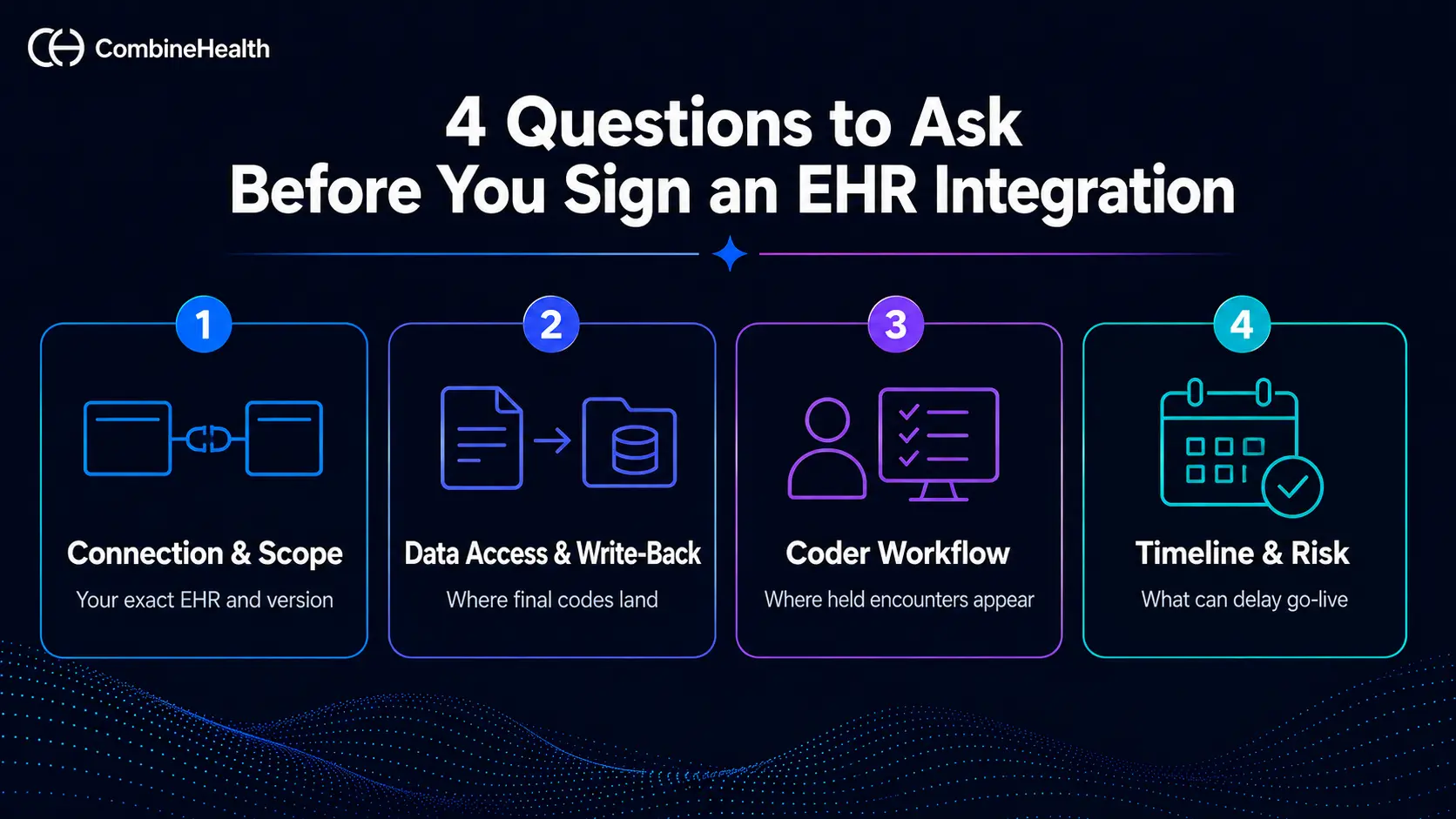
A strong AI medical coding vendor should tell you what is supported, how the connection works, what your team needs to do, and who owns the implementation.
1. EHR Connection and Scope
- Have you integrated with our exact EHR and version?
- Is the connection marketplace-approved or custom-built?
- Does the integration include our practice management system and clearinghouse?
- What internal IT resources are required?
2. Data Access and Code Write-Back
- Which clinical documents can the platform access?
- Can it review the complete record?
- Where are final medical codes written?
- Can it return individual code changes and the rationale behind each one?
3. Coder Workflow and Exceptions
- How are held encounters displayed, and where?
- Can coders work inside the EHR, or do they need a second system?
4. Implementation Timeline and Risk
- How long did comparable implementations take?
- What can delay the go-live?
- Is historical back-testing included before go-live?
- How is rollback handled if results are wrong?
- What happens when the EHR changes an API or data field?
See How CombineHealth Runs Alongside Your Coders
Integration can determine whether an autonomous medical coding platform actually pays for itself. And a medical coding platform that takes six months to connect delivers no value from automation during those two quarters.
CombineHealth is built for fast integration and clean write-back. Work items are pushed into your existing EHR or practice management queues, so medical coders can stay in the systems they already use.
Deep EHR integration is typically scoped at around four weeks, with configuration tuned to your billing rules and back-tested against your own historical charts before go-live.
We do not claim it is plug-and-play. Practices using the same EHR can organize data and workflows differently, which is why implementation starts by scoping your actual setup.
Book a demo to get on a quick 15-minute call and get answers to your specific questions!
FAQs
How long does autonomous medical coding EHR integration take?
Timelines vary widely. Nym publishes three to six months from contract signing to go-live. Maverick Medical AI reports go-lives of approximately three months. CombineHealth scopes deeper EHR integrations at around four weeks. Ask each vendor for their own breakdown rather than assuming a market average.
Can we test autonomous medical coding without submitting live claims?
Yes, with platforms that support it. CombineHealth test runs generate coding, eligibility, denial, and appeal outputs without submitting the claims, so you can compare AI output against your existing coding team's work before anything reaches a payer.
What happens when our EHR changes an API or data field?
Ask before signing. The answer should name who monitors for the change, how quickly the connection is repaired, and whether that maintenance is included or billed separately.