Top 10 CDI Audit Software for Healthcare Providers: 2026 Updated List
Compare the top 10 CDI audit software platforms for 2026. See features, best-fit use cases, and how to choose one that fits your workflow.
Published on:
September 1, 2026


Key Takeaways
• Buyers evaluating CDI audit software are primarily looking to confirm whether their already-generated codes capture the full legitimate value of each visit; the concern is less about catching obvious errors and more about undercoding, missed modifiers, and documentation gaps that quietly cap reimbursement across thousands of encounters.
• Buyers bring various questions to a CDI audit evaluation on verification and scale. They want to know whether existing codes are correct, whether legitimate medical coding opportunities are being missed, whether the platform can explain its reasoning, and whether it can review every encounter instead of a small sample.
• A complete CDI audit solution operates across three distinct review layers: a chart-level coding audit confirming existing codes are appropriate, a chart-level CDI audit identifying what's missing to support a better code, and provider-level CDI intelligence that surfaces which documentation issues recur for a specific physician
• Choosing the right CDI audit software comes down to six concrete, comparable capabilities. They include full-population auditing, code-level rationale, documentation-gap identification, payer- and specialty-specific rules, provider-level pattern recognition, and compatibility with the organization's existing coders, CAC tool, or EHR.
• CombineHealth addresses this problem by reviewing 100% of encounters against the clinical note rather than a sample, naming the exact missing documentation element behind each finding and rolling those findings into provider-level patterns, an approach tied to 97.2% coding accuracy and up to a 75% reduction in coding-related denials.
Every code your organization submits tells a story about a patient encounter. When the documentation behind that medical code is thinner than the visit actually was, the story gets cut short, and so does the reimbursement attached to it. Most hospitals and practices might already use an EHR, a CAC tool, or an in-house medical coding team for generating those codes. What they rarely have is a reliable way to audit whether those codes capture the full, legitimate value of every visit.
That gap is exactly what CDI audit software is built to close. This guide ranks ten CDI audit software platforms for 2026, breaks down what buyers actually want from this category, and walks through how to choose the right one for your organization.
At a Glance: Top 10 CDI Audit Software in 2026
Top 10 CDI Audit Software Platforms for 2026
1. CombineHealth: Best for Medium-to-Large Health Systems and Multi-Specialty Physician Groups
CombineHealth is a self-learning, autonomous medical coding platform that also works as an independent CDI and medical coding audit layer on top of an existing EHR, CAC tool, or coding team.
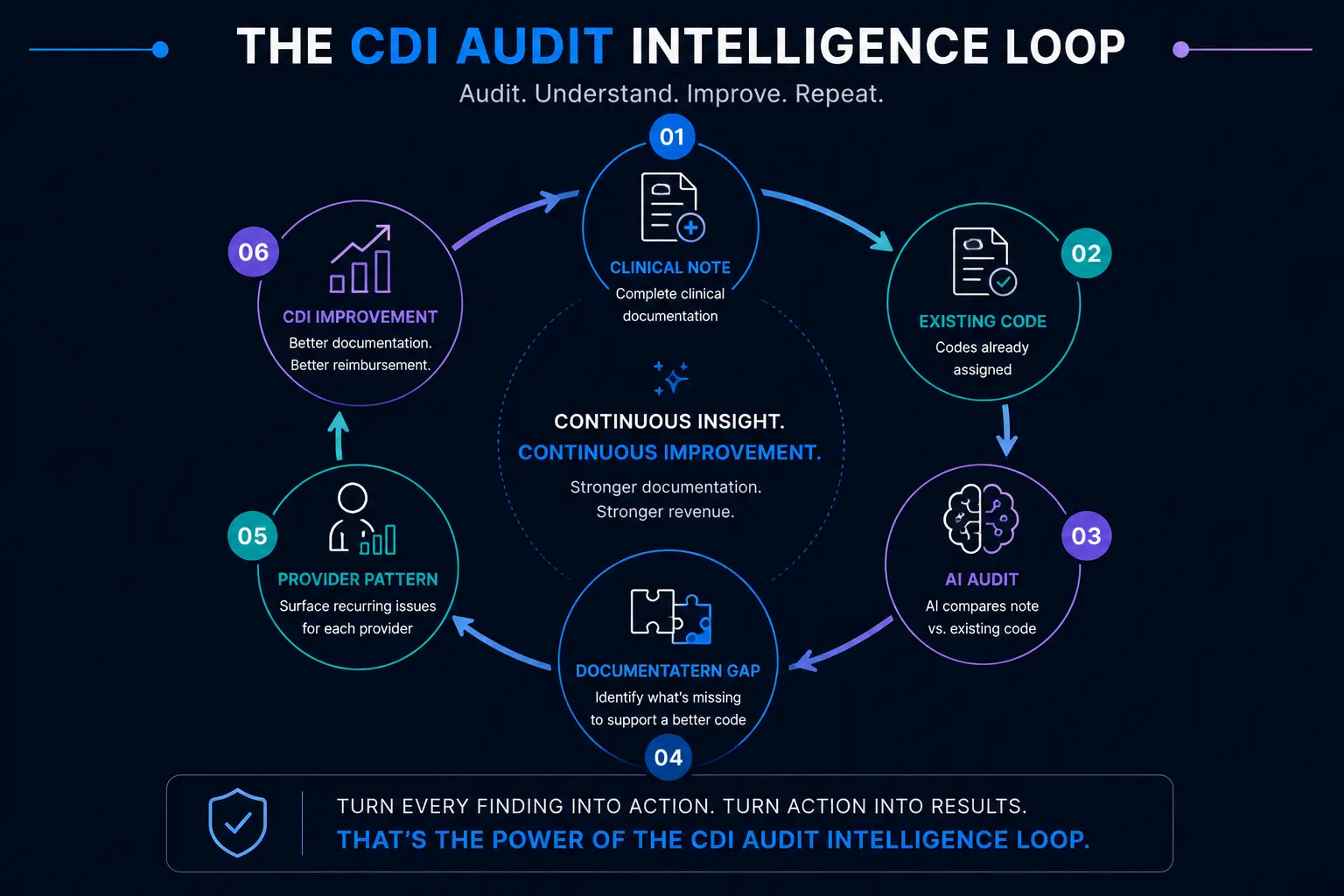
Also referred to as Amy AI, CombineHealth reads the completed clinical note, compares it against the codes already assigned, and shows exactly what documentation would support a higher or more specific code. Where most CDI tools stop at flagging a code, CombineHealth’s explainable AI also shows the clinical reasoning behind every finding and rolls those findings up into patterns your team can act on.
Where CombineHealth Stands Out?
In a deployment with a multi-location dermatology group, CombineHealth reviewed an existing ED encounter's E/M level, identified 5 times more CDI issues where documentation potentially supported a higher level, and named the specific detail the provider had left out.
The platform's analytics layer then surfaced that finding alongside similar patterns across the provider's other charts. It helped turn a single audit result into a documentation-training insight the group's physicians could act on directly.
Feature #1: Automates Complex Cases Autonomously and Accurately
CombineHealth runs on proprietary large language models paired with medical coding guidelines and payer-specific rules, so it handles routine visits and complex cases with the same level of care. Automation rates reach up to 85% while coding accuracy stays above 98% even at large scale.
Feature #2: Continuously Learns From Claim Outcomes to Reduce Denials
Self-learning at CombineHealth goes beyond generating a medical code and moving on. Every coding decision is checked against what actually happens downstream, including reimbursements, claim denials, underpayments, and payer edits, and that feedback loop refines coding strategy payer by payer. The result is proven to cut coding-related claim denials by as much as 75%.
Feature #3: Explainable Medical Coding Decision
No code leaves CombineHealth without a traceable audit trail linked back to the clinical documentation that supports it. Coders, auditors, and compliance teams can see the reasoning behind each E/M-level assignment, check it against the source note, and rely on a full claim audit trail instead of taking a black-box output at face value.
Feature #4: Works Autonomously Inside Your Existing Workflows
CombineHealth doesn't ask you to adopt a separate coding environment. It plugs into your existing EHR, PMS, and RCM systems, reads completed clinical documentation directly from the source, applies its coding methodology, and returns billing-ready decisions right back into the workflow you already run.
Best for: Medium-to-large health systems and multi-specialty physician groups
2. Iodine Software
IodineCDI is an established hospital-focused platform built for identifying documentation gaps, prioritizing charts, and managing physician queries across the inpatient setting. Iodine is now part of Waystar following its acquisition, extending the platform's reach into Waystar's existing revenue-cycle customer base.
Key Features:
- Concurrent documentation review for inpatient encounters
- Chart prioritization based on likely CDI impact
- Physician query management
- Mid-revenue-cycle performance reporting
Best for: Large hospital systems with enterprise inpatient CDI teams
3. Solventum 360 Encompass CDI
Solventum 360 Encompass is an integrated computer-assisted CDI platform spanning inpatient, outpatient, and professional service workflows. It pairs documentation review with coding, quality, and risk-adjustment functions in a single system.
Key Features:
- Computer-assisted CDI with electronic physician queries
- Prioritized worklists and clinical evidence display
- Quality-indicator tracking
- Coverage across inpatient, outpatient, and professional-service settings
Best for: Multi-setting health systems managing CDI, coding, and quality together
4. Optum Enterprise CAC and CDI 3D
Optum CDI 3D is built for large health systems already running on Optum's broader coding and revenue-cycle ecosystem. It combines concurrent record review with automated case finding and compliance-focused audit tools.
Key Features:
- Concurrent record review and automated case finding
- Documentation-opportunity prioritization
- Audit and compliance workflows
- Electronic clarification and medical coding integration
Best for: Large health systems already running on the Optum ecosystem
5. Microsoft Nuance CDE One
Nuance CDE One is a CDI workflow platform centered on case prioritization and physician collaboration rather than professional-fee code auditing. It integrates directly into existing EHR workflows to support CDI teams and physicians working the same charts.
Key Features:
- AI-assisted case prioritization
- Clinical evidence gathering and electronic clarifications
- Physician-query management
- Built-in CDI reference material
Best for: CDI teams and physician groups focused on documentation collaboration
6. SmarterDx
SmarterDx analyzes the broader clinical record to surface missing or incorrect diagnoses before final billing, with findings routed to a human for validation. It is built specifically for inpatient revenue integrity, where a missed diagnosis can materially affect reimbursement.
Key Features:
- Pre-bill clinical record analysis
- Missing and incorrect diagnosis detection
- DRG validation support
- Human-validated findings before billing
Best for: Inpatient hospitals focused on pre-bill diagnosis capture
7. AGS Health Computer-Assisted CDI
AGS Health combines CDI technology with medical coding workflows and managed-service support, appealing to organizations that want software paired with hands-on help. Predictive coding and variance analysis run alongside pre-bill and retrospective audit options.
Key Features:
- Predictive coding and automated query suggestions
- Prioritized worklists
- CDI-to-final-code variance analysis
- Pre-bill and retrospective audits, plus optional compliance workflows
Best for: Health systems that want CDI technology paired with managed services
8. Dolbey Fusion CDI
Dolbey Fusion CDI is a computer-assisted CDI platform designed to support close collaboration between CDI and coding teams. It centers on clinical indicators and case prioritization, with encoder integration built into the workflow.
Key Features:
- Clinical indicators and case prioritization
- Query workflows and reporting
- Encoder integration
- Collaboration tools for CDI and medical coding teams
Best for: Hospitals with dedicated CDI and coding teams
9. MDaudit
MDaudit is built for structured coding compliance audits rather than concurrent CDI review. It supports both prospective and retrospective audits, with reporting designed around coder performance and education.
Key Features:
- Structured prospective and retrospective audits
- Coder review and rebuttal workflows
- Audit scheduling and corrective-action plans
- Denial-linked performance analysis and education reporting
Best for: Compliance and audit teams managing coder performance
10. Health Catalyst Revenue Cycle Integrity
Health Catalyst combines clinical, coding, billing, payer, and operational data into one analytics layer built for revenue-integrity teams. It functions as a broader analytics platform rather than a dedicated CDI workbench, so audit findings connect directly to wider financial reporting.
Key Features:
- Cross-functional data integration across clinical, coding, and billing systems
- Documentation-problem and missed-charge identification
- Denial-cause analysis
- Audit-readiness reporting
Best for: Enterprise health systems focused on revenue-integrity analytics
What Do Buyers Actually Want From A CDI Audit Software?
Most organizations evaluating CDI audit software already have codes flowing from an EHR, a CAC tool, or an in-house medical coding team. Their real concern is whether those codes capture the full legitimate value of each visit. Buyers are more concerned with avoiding preventable denials due to undercoding, missed modifiers, and documentation gaps that quietly cap reimbursement across thousands of encounters.
The Questions Buyers Bring To a CDI Audit Software Evaluation
The underlying concern mentioned above shows up as a specific set of questions buyers bring into a CDI audit software evaluation.
- Our EHR already generates codes. How do we know they are correct?
- Are we missing legitimate coding opportunities?
- Does the documentation support the existing code?
- What documentation would support a higher or more specific code?
- Can the platform explain why it recommends a change?
- Can it audit every encounter instead of a small sample?
- Can it reveal recurring documentation problems by provider?
- Will it work with our current coders, CAC solution, or EHR?
These questions point to a single underlying goal. Providers want to maximize the value of the documentation they already have, not rebuild their coding process from scratch.
The Three CDI Audit Review Layers Buyers Actually Need
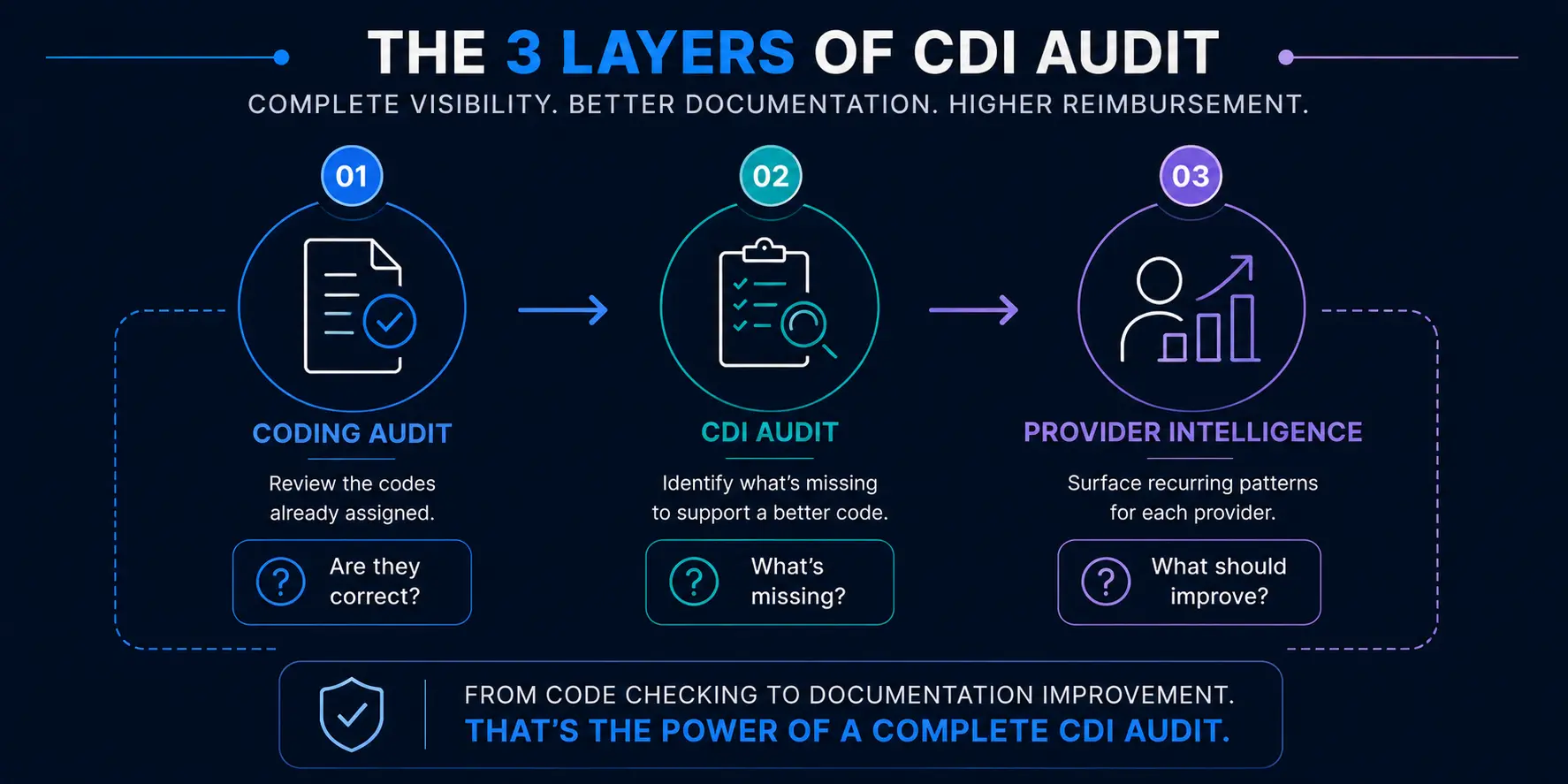
The three CDI audit review layers buyers actually need are:
- Chart-level coding audit: Are the existing codes appropriate and complete for what the note supports?
- Chart-level CDI audit: Is something missing, inconsistent, or insufficiently documented to support a better code?
- Provider-level CDI intelligence: What documentation issues recur for a specific physician, and what should improve going forward?
Most buyers are actually shopping for a CDI tool that performs all three functions as a documentation improvement system and follows CDI best practices.
How To Choose The Right CDI Audit Software?
The right CDI audit software audits every encounter, explains its findings in coding and clinical terms, and turns individual chart findings into provider-level patterns your compliance and education teams can act on.
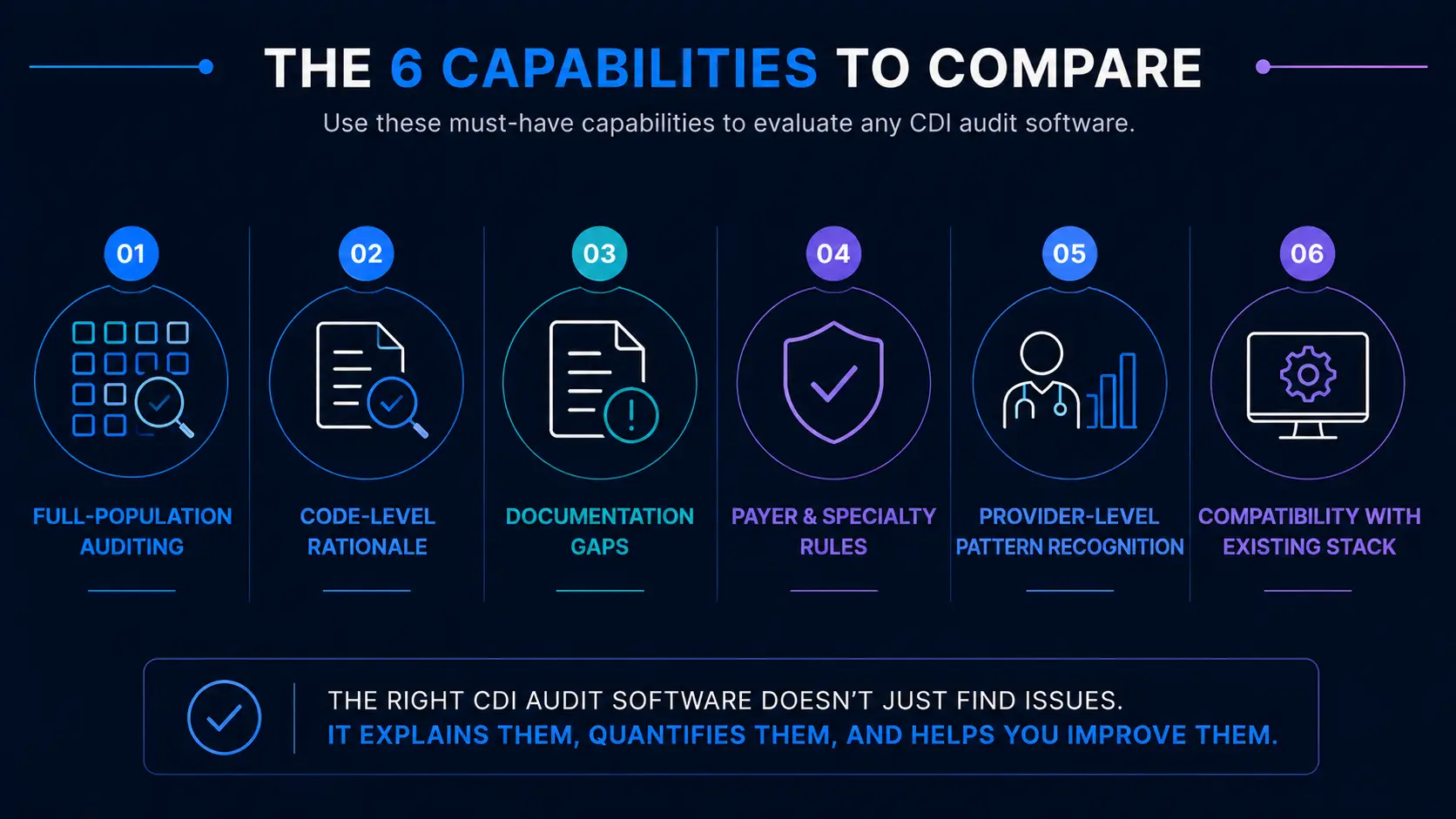
Weigh each CDI software vendor on your list against the specific capabilities below rather than a general "AI-powered accuracy" claim.
- Full-population auditing: The platform should review every chart, not a random sample, so undercoding trends do not hide in the charts nobody pulled.
- Code-level rationale: Every recommendation should include the reasoning behind it, not just a suggested code change.
- Documentation-gap identification: The tool should name the specific missing element that prevented a higher or more specific code.
- Payer- and specialty-specific rules: Medical coding requirements vary by payer and specialty, and the audit logic should reflect that variation rather than applying one generic rule set.
- Provider-level pattern recognition: Findings should roll up by physician so recurring issues become visible over time, not just per chart.
- Compatibility with your existing stack: The platform should work alongside your current coders, CAC tool, or EHR rather than requiring you to replace them.
Run a short pilot on a sample of real charts before committing. A vendor that performs well on a demo chart but struggles to explain its reasoning on your own documentation will create more audit work than it removes.
See What A Full-Population CDI Audit Looks Like
Most CDI tools stop at flagging a code. CombineHealth reviews every chart against the clinical note, names the specific documentation gap behind each finding, and rolls those findings up into provider-level patterns your team can act on immediately. See how it works on your own charts with a personalized demo.
Frequently Asked Questions
What does CDI audit software actually check?
CDI audit software reviews codes that have already been assigned against the underlying clinical documentation. It confirms whether the documentation fully supports the existing code and identifies where additional detail would support a higher or more specific one.
Does CDI audit software replace our existing coders or CAC tool?
No, most CDI audit software, including CombineHealth, is designed to sit on top of an existing coding process. It reviews the output your coders or CAC tool already produce rather than requiring you to replace that workflow.
Why does explainability matter in a CDI audit tool?
A recommendation without reasoning is difficult to act on or defend during an audit. Explainable CDI audit software shows the specific documentation element behind each finding, which lets coders, physicians, and compliance teams verify the recommendation against the source note.
Can CDI audit software identify undercoding across an entire organization?
Platforms built for full-population auditing can review every encounter rather than a sample, then aggregate findings by provider and payer. This makes it possible to see undercoding trends that a random-sample audit would likely miss.