10 Best Cloud-Based Healthcare RCM Software Platforms
Compare the 10 best cloud-based healthcare RCM software platforms by revenue cycle coverage, EHR fit, denial prevention, and proven results.
Published on:
October 30, 2026


Key Takeaways
• CombineHealth is a self-learning, cloud-based AI RCM platform that connects eligibility, autonomous medical coding with CDI, pre-bill claim validation, denial management, A/R follow-up, appeals, and analytics in one workflow. It learns from denials, reimbursements, and underpayments to improve future decisions. A health center with more than 30 providers cut its denial rate from 32% to 15% in six months, and the Brault deployment reported new-site rollouts of roughly two weeks.
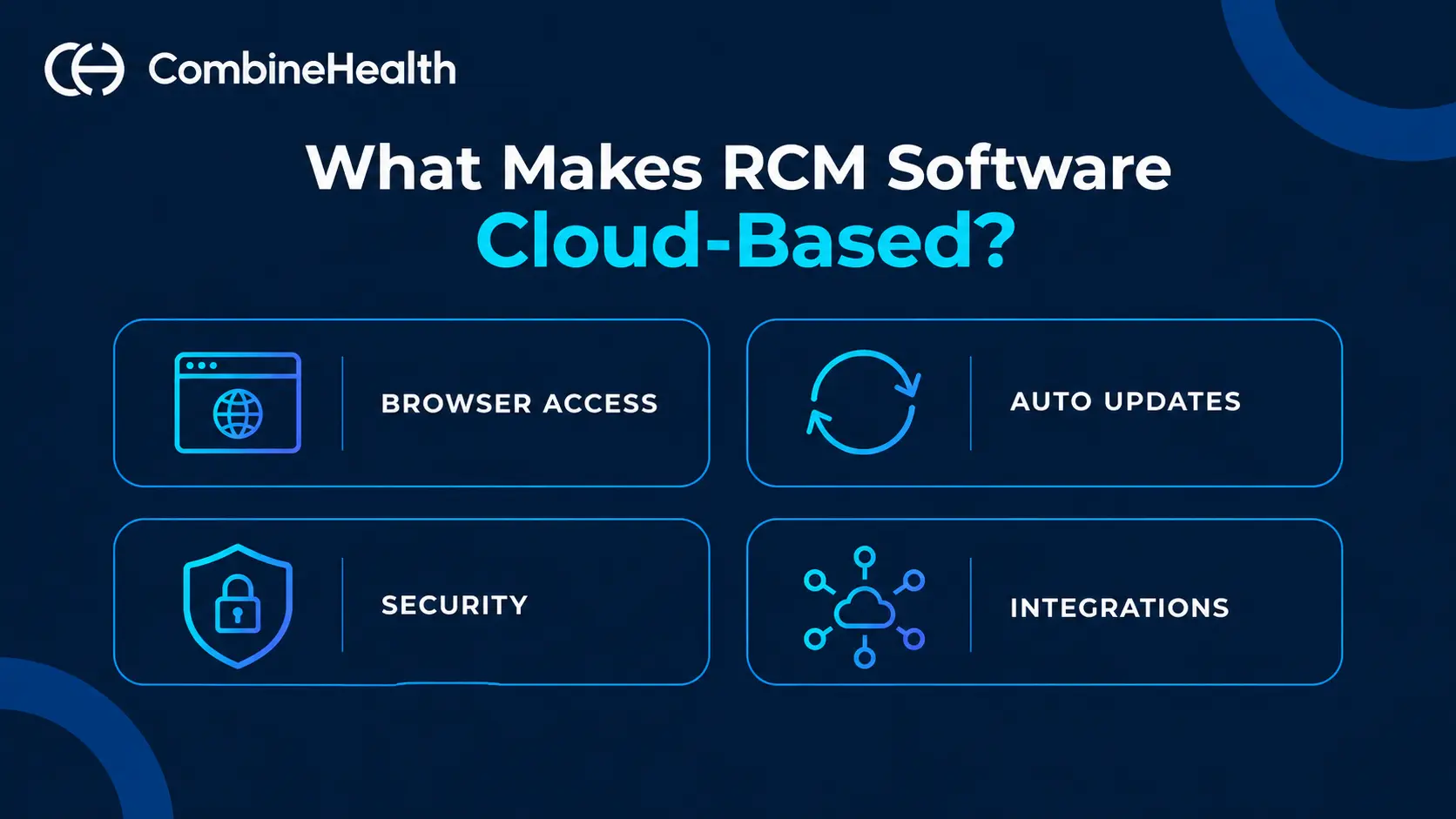
• Cloud-based healthcare RCM software is a revenue cycle platform hosted on the vendor’s infrastructure and accessed through a secure web browser, with the vendor maintaining servers, security, and software updates. Four characteristics confirm a platform is genuinely cloud-based: browser-based access, vendor-managed updates, documented security controls, and integration pathways to EHR, PMS, clearinghouse, and payer systems.
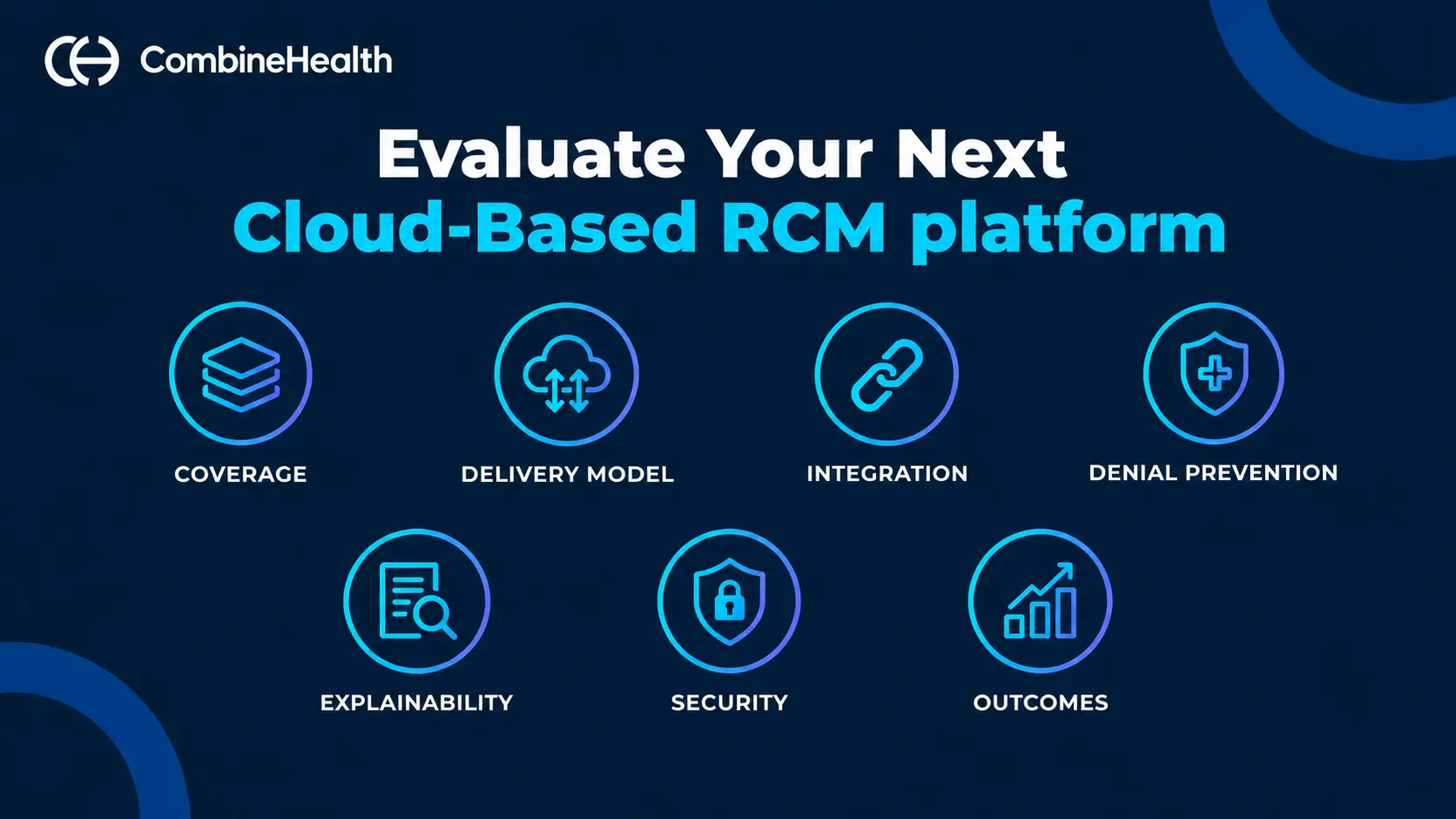
• Choosing cloud-based RCM software starts with your denial rate, your EHR and PMS, and the share of work your staff handles manually. Compare vendors on seven criteria: revenue cycle coverage, delivery model, EHR and PMS integration, denial prevention, explainability, data security for PHI, and measurable outcomes. Then run a pilot on encounters from your highest-denial payers, comparing coding accuracy, turnaround time, and denial outcomes against your current baseline.
• Cloud-based RCM software reduces denials by validating claims before submission and analyzing denial patterns after payers respond. Pre-bill checks catch eligibility, coding, modifier, and authorization problems early, and grouping denials by payer and reason shows which upstream workflow to fix.
Most denials in healthcare revenue cycle management (RCM) are decided long before a payer reads the claim. An eligibility gap at registration, a diagnosis the note does not support, or a modifier left off a line each surfaces weeks later as a denial, and each costs far less to fix upstream than to appeal. Denial rates of 10 to 15 percent are common, which is why revenue cycle leaders now judge software by where in the workflow it intervenes.
Cloud hosting is the entry requirement, and every platform in this guide meets it. The differences sit elsewhere: how far automation reaches across the cycle, how well the platform fits your electronic health record (EHR) and practice management system (PMS), how it applies payer-specific rules, whether its decisions can be audited, and whether it learns from claim outcomes.
This guide compares 10 cloud-based healthcare RCM software platforms for CFOs, RCM leaders, practice administrators, and CIOs.
1. CombineHealth
CombineHealth is a self-learning, cloud-based AI revenue cycle management platform. It connects eligibility, autonomous medical coding with clinical documentation improvement (CDI), pre-bill claim validation, denial management, accounts receivable (A/R) follow-up, appeals, and analytics in one workflow.
Also referred to as Amy AI, the medical coding platform reads the complete clinical encounter and assigns or audits diagnosis codes (ICD-10-CM), procedure codes (CPT and HCPCS), evaluation and management (E/M) levels, modifiers, and supports hierarchical condition category (HCC) workflows. Claim outcomes, including denials, reimbursements, underpayments, and payer edits, then inform future coding and claim-validation decisions.
How CombineHealth’s Cloud-based RCM Software Works
CombineHealth runs on Amazon Web Services (AWS) with Health Insurance Portability and Accountability Act (HIPAA)-aligned safeguards and secure browser-based access. Teams install and maintain no local software or code databases. CombineHealth deploys software and coding updates centrally, so every user works from the same current version.
CombineHealth connects through APIs, Health Level Seven (HL7) interfaces, custom interfaces, and supported web-based workflows. The platform can be configured to operate within authorized web-based EHR and PMS workflows. The exact integration model depends on system access, interfaces, security requirements, and write-back needs.
Across deployments, CombineHealth reports:
- 98.4% coding accuracy
- Up to 85% autonomous medical coding
- Up to 75% fewer coding-related denials
- 5× more CDI opportunities
- Up to 4% higher captured revenue
- Approximately two-week new-site rollout in the Brault deployment
- Less than 12-hour coding turnaround through substantial volume spikes
Case Study: Health Center Cuts Denials From 32% to 15% in Six Months
A health center with more than 30 providers and over 5,000 claims per month adopted CombineHealth and reduced its denial rate from 32% to 15% in six months. CombineHealth delivered 97.4% coding accuracy across more than 10,000 claims and eliminated more than 250 false denials.
Feature #1: Complete-Encounter Autonomous Medical Coding With Built-In CDI
CombineHealth reads the complete clinical encounter and checks documentation sufficiency while it codes, so one pass produces both the codes and a view of what the chart lacks. The platform separates CDI alerts from documentation gaps that need provider clarification, which lets teams resolve issues before the claim goes out. Each coding decision carries a rationale and an audit trail linked to the source note, so coders, auditors, and compliance teams can verify why a code was assigned.
Feature #2: Pre-Bill Claim Validation
CombineHealth validates every claim before submission, when a correction costs the least. Pre-bill checks cover:
- Demographics
- Eligibility verification
- Diagnosis-procedure relationships
- Medical necessity
- Modifiers
- Authorization and referral information
- Payer-specific claim conditions
- Duplicate-submission risk
- Other organization-specific requirements
Feature #3: Denial Management and A/R Follow-Up
CombineHealth categorizes denials by payer and reason, identifies likely root causes, and prioritizes accounts for AR follow-up. The platform supports payer follow-up and detects recurring patterns. It then traces each downstream problem to the documentation, coding, or claim condition upstream that created it.
Feature #4: Appeals and Analytics
CombineHealth drafts evidence-supported appeals from retrieved claim and documentation records, and it tracks payer correspondence and appeal status. Analytics cover financial and operational KPIs, denial and underpayment analysis, and performance by payer, provider, location, and workflow.
Feature #5: Self-Learning Payer Intelligence
CombineHealth’s self-learning payer intelligence runs a closed loop: eligibility and documentation, coding, claim validation, payer outcome, pattern analysis, and validated configuration update. A payer’s published policy states the rule, and claim outcomes show how the payer applies it in practice. Payer intelligence learns from that second signal. Denial patterns become candidate rule updates that RCM, coding, and compliance teams validate before the updates reach production.
Best For: Hospitals, physician groups, management services organizations (MSOs), and RCM organizations that want AI automation across existing EHR and PMS workflows.
2. Waystar
Waystar is a cloud-native healthcare payments platform covering eligibility verification, claims submission, denial prevention, and appeals. Its AltitudeAI suite applies generative AI across the revenue cycle, and agentic AI joined the platform in January 2026. Waystar reports processing more than 7.5 billion healthcare payment transactions a year. Third-party listings flag implementation complexity, so plan training and rollout scope early.
Key Features:
- Eligibility verification and electronic claims submission
- Denial prevention with automatic correction recommendations drawn from historical denial insights
- Generative AI appeal letters through AltitudeCreate
- Agentic AI that, according to an August 2026 report, resubmits denied claims and answers natural-language questions about financial performance
- Documentation, coding, and charge capture revenue protection
Best For: Large provider organizations that want an enterprise-grade payments and claims platform.
3. Athenahealth
Athenahealth’s athenaOne is a single cloud-based system that combines an EHR (athenaClinicals), practice management and RCM (athenaCollector), and patient engagement (athenaCommunicator). athenahealth reports that more than 160,000 providers use athenaOne daily. The company describes an AI-native intelligence layer with a rules engine that flags claim issues early.
Key Features:
- Integrated EHR, practice management, and RCM in one system
- Rules engine and intelligence layer that identify and correct claim issues in real time
- Authorization management, launched in 2024, that checks payer requirements when an order is placed
- AI and automation tools announced in December 2024 to reduce practice RCM workload by 50%
- Open API and marketplace for third-party applications
Best For: Independent and mid-size ambulatory practices that want EHR, practice management, and RCM in one cloud system. Organizations that keep a different EHR should confirm how RCM operates outside athenaOne.
4. FinThrive
FinThrive is a software-as-a-service (SaaS) revenue cycle platform for hospitals and health systems, built on its FinThrive Fusion data architecture. Modules span patient access, charge integrity, claims management, contract management, and analytics. At HIMSS 2026, FinThrive presented an expanded agentic AI platform with more than 50 AI and automation use cases across the revenue cycle.
Key Features:
- FinThrive Fusion unified data architecture
- Agentic AI agents that identify risk and execute revenue cycle work
- Claims management and insurance verification tools available to MEDITECH Expanse EHR users through the MEDITECH Alliance
- Protected health information (PHI) and personally identifiable information cleaned before data is used for AI training
- AI tools designated private-use only
Best For: Hospitals and health systems that want a unified enterprise RCM platform.
5. Infinx
Infinx is an AI-enabled patient access and RCM company that combines automation, workflow software, and human specialists. Its Revenue Cycle Agent Platform covers eligibility, benefit checks, patient estimates, prior authorization, medical coding, charge capture, denials, and A/R recovery. Infinx serves providers, hospitals, imaging centers, and laboratories. Because the model pairs software with specialist capacity, productivity depends partly on staffing as well as platform queues.
Key Features:
- Prior authorization automation
- Eligibility verification, benefit checks, and patient payment estimates in a single workflow
- Document Capture AI that classifies documents and extracts data from them
- Medical coding and charge capture
- Denial and A/R management with root cause analysis and appeals workflows
Best For: Providers, imaging centers, and laboratories that want prior authorization and patient access automation backed by specialist teams.
6. Adonis
Adonis is an AI orchestration platform for RCM. Its Intelligence product monitors revenue cycle activity and flags issues, and its AI Agents move claims toward resolution. The platform integrates with EHR systems, clearinghouses, and payers, and Adonis raised a $40 million Series C in March 2026. Public materials center on claims, denials, and underpayments, so organizations that need coding automation should confirm that scope directly.
Key Features:
- Intelligence product that detects revenue leakage and surfaces trends and root causes
- AI Agents that progress claims toward resolution
- Orchestration across EHR systems and clearinghouses
- Real-time dashboards, alerts, claims tracking, and smart worklists
- Listing in the athenahealth Marketplace
Best For: Provider groups, hospitals, and health systems focused on reducing denials and underpayments.
7. NextGen Healthcare
NextGen Healthcare offers cloud-based EHR, practice management, and RCM for ambulatory care. NextGen Enterprise serves larger multispecialty organizations, and NextGen Office serves small practices. NextGen’s annual report describes RCM Services covering billing and collections, claims submission, denials management, electronic remittance and payment posting, and A/R follow-up. Public materials emphasize billing operations, claims scrubbing, and A/R management, so organizations that seek autonomous coding should confirm coverage.
Key Features:
- Integrated EHR, practice management, and RCM
- Managed RCM Services with a dedicated account management model
- Claims scrubbing and A/R management
- Managed cloud hosting services
- NextGen Enterprise and NextGen Office editions for different practice sizes
Best For: Ambulatory practices, community health centers, and multispecialty groups that want an integrated cloud suite with optional managed RCM.
8. CareCloud
CareCloud is a cloud-based platform that combines an EHR, practice management, and RCM services. Its cirrusAI suite includes Guide, Chat, Appeals, and Notes, built on Google’s Vertex AI generative AI tools. CareCloud reports more than 45,000 providers on its platform. CareCloud designed cirrusAI to work with other EHR systems as well, so confirm which features apply to your EHR.
Key Features:
- Cloud EHR, practice management, and RCM in one platform
- cirrusAI Appeals for reimbursement recovery
- cirrusAI Notes, which uses ambient listening to draft clinical notes for provider review
- cirrusAI Guide and Chat for evidence-based recommendations and staff assistance
- Concierge RCM service for outsourced billing
Best For: Small to mid-size practices that want an integrated suite with generative AI tools.
9. eClinicalWorks
eClinicalWorks is a cloud EHR and practice management vendor that sells RCM as an end-to-end billing service or as a self-service model. Its RCM offering uses robotic process automation (RPA) bots for tasks such as statement processing and payment posting. The Toledo Clinic, a 280-provider group, reported a reduction of more than 21% in days in A/R with eClinicalWorks RCM Optimization Services. That result is customer-specific and dates from 2023, so request current references.
Key Features:
- Cloud EHR integrated with RCM
- End-to-end billing service or self-service practice management model
- RPA bots for statement processing and payment posting
- Denials and appeals management
- Customer example: Advocare, with 700 providers, reached $1 billion in collections using eClinicalWorks RCM (2022)
Best For: Ambulatory practices and health centers that use or are considering the eClinicalWorks cloud EHR.
10. AdvancedMD
AdvancedMD is a cloud-based platform that combines EHR, practice management, medical billing, RCM, patient engagement, telemedicine, and AI clinical documentation. The company has served independent practices since 1999 and reports more than 60,000 providers and billing providers on its software. AdvancedMD also sells fully managed RCM staffed by its own billing specialists, with pricing listed at 4% to 8% of collections in its published information.
Key Features:
- Unified EHR, practice management, billing, and RCM
- Fully managed RCM option staffed by AdvancedMD billing specialists
- Claims scrubbing, denial management, and electronic remittance advice (ERA) processing
- Hosting on Amazon Web Services (AWS)
- Support for independent practices and medical billing companies
Best For: Independent practices and medical billing companies that want an all-in-one cloud suite with an optional managed RCM service.
What Qualifies as Cloud-Based Healthcare RCM Software?
Cloud-based healthcare RCM software is a revenue cycle platform hosted on the vendor’s infrastructure and accessed through a secure web browser. The vendor maintains servers, security, and software updates, so the provider organization runs no local databases. The platform manages some or all of the revenue cycle: eligibility, coding, billing, claim submission, payment posting, denial management, A/R follow-up, and appeals.
Four characteristics confirm that a platform is genuinely cloud-based:
- Browser-based access: Users work through a secure web login with no local installation.
- Vendor-managed updates: The vendor deploys software changes centrally.
- Documented security controls: The vendor describes its HIPAA safeguards, encryption, role-based access, and audit logging for protected health information (PHI).
- Integration pathways: The platform connects to EHR systems, PMS software, clearinghouses, and payer portals through application programming interfaces (APIs), Health Level Seven (HL7) interfaces, or supported web-based workflows.
CombineHealth meets all four: browser-based access with no local install, centrally deployed software and coding updates so every user runs the current version, documented HIPAA-aligned safeguards on AWS, and integration pathways through APIs, HL7, and supported web-based EHR and PMS workflows.
On top of that baseline, it adds autonomous coding with CDI, payer-specific rules, explainable decisions, and learning from claim outcomes — the capabilities that actually drive denial prevention.
How to Choose Cloud-Based Healthcare RCM Software
Choose cloud-based healthcare RCM software by matching platform coverage to the revenue cycle gaps your organization needs to close. Start with your denial rate, the EHR and PMS you use, and the share of work your staff handles manually. Then compare vendors on seven criteria: coverage, delivery model, integration, denial prevention, explainability, data security, and measurable outcomes.
- Revenue cycle coverage: List the stages each platform automates, including eligibility, coding, claim validation, denials, A/R follow-up, appeals, and analytics.
- Software, services, or both: Confirm whether the vendor delivers software, managed services, or a blend, and identify who completes each task.
- Integration with your EHR and PMS: Ask which interfaces the vendor supports, whether the platform writes data back to your systems, and how long a new site takes to go live.
- Denial prevention: Ask whether the platform validates claims before submission and uses payer outcomes to improve future decisions.
- Explainability: Request the audit trail behind a coding decision. Coders, auditors, and compliance teams need to trace each code to the source documentation.
- Data security for PHI: Review HIPAA safeguards, the hosting provider, access controls, and how the vendor handles data used for AI training.
- Measurable outcomes: Request customer-specific results on denial rate, coding accuracy, turnaround time, and captured revenue, and confirm how each vendor measures them.
Run a pilot before you commit. Select a defined set of encounters from your highest-denial payers, and compare coding accuracy, turnaround time, and denial outcomes against your current baseline. The pilot gives your evaluation team data from your own claims.
See What Connected, Self-Learning RCM Looks Like on Your Claims
Cloud hosting is the starting line — denial prevention is the race. CombineHealth connects coding, CDI, pre-bill validation, denials, A/R, and appeals in one self-learning workflow, so the same system that codes an encounter also learns from how each payer adjudicates it. A health center with more than 30 providers used CombineHealth to cut its denial rate from 32% to 15% in six months, across more than 10,000 claims, while eliminating more than 250 false denials.
Run it on encounters from your highest-denial payers and compare coding accuracy, turnaround, and denial outcomes against your baseline.
See it run on your own claim volume. Book a demo.
Frequently Asked Questions
What makes CombineHealth different from other cloud-based RCM software?
CombineHealth combines autonomous medical coding with built-in CDI, extends automation across the full revenue cycle — eligibility, pre-bill validation, denials, A/R, and appeals — and learns from actual claim outcomes rather than relying only on static rules. Every coding decision carries a rationale and audit trail linked to the source note, so coders and compliance teams can verify why a code was assigned.
How quickly can CombineHealth be deployed?
Because CombineHealth is cloud-based with no local software to install, deployment centers on integration and validation rather than infrastructure. In the Brault rollout, new-site go-lives reached production in roughly two weeks as the deployment matured, connecting through APIs, HL7, or supported web-based EHR and PMS workflows.
How Does Cloud-Based RCM Software Reduce Denials?
Cloud-based RCM software reduces denials by validating claims before submission and by analyzing denial patterns after payers respond. Pre-bill checks catch eligibility, coding, modifier, and authorization problems early. Post-submission analysis groups denials by payer and reason, which shows which upstream workflow to fix. Platforms that learn from claim outcomes, such as CombineHealth, apply those findings to future claims.
Is Cloud-Based RCM Software HIPAA Compliant?
Cloud-based RCM software supports HIPAA compliance when the vendor applies required safeguards and signs a business associate agreement (BAA) with the provider. Ask each vendor for its hosting provider, encryption practices, access controls, and audit logging. Request the vendor’s policy on data used for AI training.
How accurate is CombineHealth's autonomous medical coding?
Across deployments, CombineHealth reports 98.4% coding accuracy with up to 85% of eligible encounters coded autonomously. At a health center processing more than 5,000 claims a month, it delivered 97.4% accuracy across more than 10,000 claims, and in production at Brault it sustained 98%+ accuracy across primary ICD, CPT, and E/M in recurring audits.
Can Cloud-Based RCM Software Work With an Existing EHR?
Yes. Many platforms connect to existing EHR and PMS systems through APIs, HL7 interfaces, clearinghouse connections, or supported web-based workflows. The exact model depends on system access, security requirements, and write-back needs. Ask each vendor to confirm the method for your specific EHR before you sign.
What Is the Difference Between RCM Software and RCM Services?
RCM software gives your team tools to run the revenue cycle, and RCM services place vendor staff in charge of billing or collections work. Some vendors sell one model and others blend both. AdvancedMD and NextGen Healthcare offer managed RCM services alongside software, and Infinx combines software with specialist teams.