10 Best Revenue Recovery Software for Health Systems
Compare the top 10 revenue recovery software platforms. How each one handles denials, underpayments, A/R, and appeals before you buy.
Published on:
November 4, 2026


Key Takeaways
• CombineHealth is a self-learning autonomous medical coding platform that recovers revenue on both sides of claim submission. It captures supported revenue before submission through coding and CDI, validates claims against payer rules, supports denial and A/R recovery with evidence-based appeals, detects underpayments, and feeds validated findings back upstream. At a 400-bed hospital, this was tied to up to 75% fewer coding-related denials, 5× more CDI opportunities, and a 4% increase in captured revenue within three months.
• Healthcare revenue recovery is the process of identifying and collecting reimbursement that a health system earned but did not receive. It covers denied claims, contractual underpayments, missing charges and supported codes, aged A/R, payment variances, and payer appeals. Eight leakage categories fall under it (denials, underpayments, missed charges, undercoding, aged A/R, incorrect adjustments, failed appeals, and patient balance leakage), and each calls for a different recovery response.
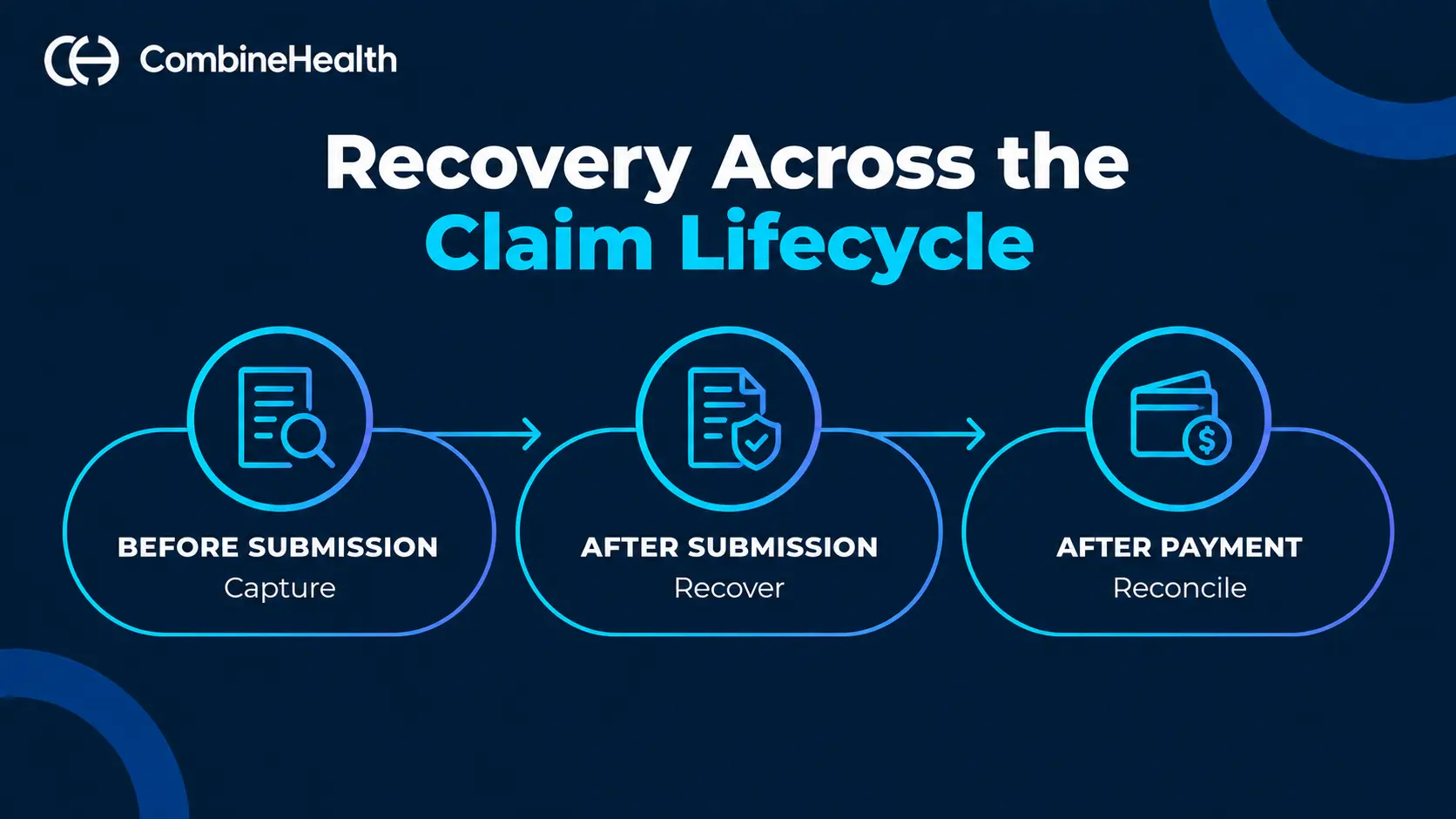
• Revenue leakage persists because it spans three stages owned by different teams. Coding and CDI teams own pre-bill capture, denial and A/R teams own post-submission recovery, and managed care and finance teams own contract compliance after payment. Most recovery tools grew up inside one stage, so each sees only part of the problem.
• Pre-bill leakage is revenue the documentation supports but the claim omits. Post-submission leakage happens through rejected claims, denials, unworked A/R, and missed appeal deadlines. Post-payment leakage hides inside paid claims.
• Revenue recovery software should be evaluated on six criteria: detection depth, denial and appeal execution, A/R coverage, pre-bill prevention, a feedback loop that stops repeat leakage, and a clear operating model. Software suits teams with analysts who can work the findings, managed services suit teams that want the vendor to execute recovery on contingency or fee, and hybrid offerings combine both.
The denial rate sits on every revenue cycle dashboard. The dollars lost to underpayments, undercoding, and unfiled appeals rarely do. Those losses are large.
Leakage persists because it spans three stages owned by different teams. Medical coding and CDI teams own pre-bill capture. Denial and A/R teams own post-submission recovery. Managed care and finance teams own contract compliance after payment. Most recovery vendors grew up inside one of those stages, so each tool sees only part of the problem.
That shapes the buying decision. The useful questions are where a platform's detection starts, whether it acts on what it finds, and whether those findings change how future claims are built.
This guide ranks ten platforms against those questions. We scored each on six criteria: detection depth, denial and appeal execution, A/R coverage, pre-bill prevention, a feedback loop that stops repeat leakage, and a clear operating model (software, managed service, or both).
1. CombineHealth
CombineHealth is a revenue recovery and end-to-end revenue cycle management platform that recovers earned revenue before and after claim submission. It connects eligibility, medical coding, CDI, pre-bill validation, denial management, A/R follow-up, appeals, and underpayment analysis in one platform, and each stage feeds what it learns back into the others.
At the core of the platform is self-learning autonomous medical coding with payer intelligence. Also referred to as Amy AI, the CombineHealth medical coding platform reads completed encounter documentation, identifies supported diagnoses and billable services, validates documentation sufficiency, applies coding guidelines and payer-specific requirements, and generates explainable, billing-ready codes. Most revenue leakage begins as a coding or documentation gap, so recovery starts here.
Feature #1: Supported Revenue Recovered Before Submission
Before a claim exists, the platform finds missing supported diagnoses and procedures, undercoded encounters, incomplete E/M capture, missing modifiers, documentation gaps, unsupported downcoding, diagnosis-procedure mismatches, and medical-necessity gaps. Each finding traces to the source note, and the platform adds only what the clinical record supports. The cheapest dollar to recover is the one that never leaves the claim.
Feature #2: Avoidable Denials Stopped at the Source
Pre-bill validation checks coding accuracy, documentation support, eligibility, authorization and referral information, demographics, medical necessity, payer-specific billing requirements, modifier logic, and duplicate-submission risk. The payer intelligence that informs coding also informs the claim, so each submission is built to that payer's rules.
Feature #3: Denial and A/R Recovery
When a denial or aged balance appears, CombineHealth categorizes the denial, identifies the payer and probable root cause, and prioritizes accounts by recovery value. It retrieves claim and encounter evidence, supports payer follow-up, tracks open actions, and measures repeat denial patterns by payer.
Feature #4: Evidence-Based Appeals
Each appeal is assembled from the original documentation, code-level rationale, applicable medical coding guidance, payer policy, medical-necessity support, previous claim activity, and relevant correspondence. The evidence that justified the code also supports the appeal.
Feature #5: Underpayment and Revenue Leakage Detection
The analytics layer compares expected and received reimbursement. It tracks payment variation by payer, downcoding, missing reimbursement, take-backs, contractual adjustment patterns, and underpayment concentrations, then breaks leakage out by provider, service line, facility, and code.
Feature #6: Recovery Intelligence Fed Back Upstream
Each recurring claim denial or underpayment is categorized by payer and reason, tied to its original documentation, coding, and claim, and compared with similar outcomes. The platform tests the pattern against payer policies and contracts, then proposes a change to coding or claim validation logic. After validation, the change applies to future claims, and the platform monitors whether the leakage declines.
What Makes CombineHealth Different
- Recovery starts before submission. Medical coding and CDI surface supported revenue while the claim can still carry it.
- Self-learning with payer intelligence. Denials, reimbursements, and underpayments teach the platform how each payer behaves, and its medical coding strategy adapts per payer.
- Explainable and audit-ready. Every code traces to supporting clinical documentation, so coders, auditors, and compliance teams can see why it was assigned.
- Recovery tied to prevention. A recurring leak is traced to its source and corrected upstream, so the same recovery work does not return next quarter.
CombineHealth's Case Studies
- A 400-bed hospital used CombineHealth to connect coding, documentation improvement, payer validation, and downstream outcomes. Within three months, it reported up to 75% fewer coding-related denials, five times more CDI opportunities, and a 4% increase in captured revenue.
- A health center cut its denial rate from 32% to 15%, and CombineHealth eliminated more than 250 false denials.
- Across deployments, the platform delivers 98.4% coding accuracy and up to 85% autonomous coding.
Best For: Hospitals and health systems that want recovery connected to autonomous coding, CDI, claim validation, denial prevention, A/R, appeals, and payer intelligence, instead of separate point tools.
2. Revecore
Revecore is a recovery partner for large hospitals and health systems, focused on complex denials, underpayments, and complex claims. Its AI-powered ReClaim platform combines automation, proprietary claims scoring, and national payer intelligence to direct recovery work. The company reports six Best in KLAS awards for Complex Claims Services.
Key Features:
- Underpayment recovery for variances that surface after adjudication
- Denials management that treats denials and related A/R as one denial-to-cash process
- AI-powered underpayment recovery and denial appeals capabilities, launched in April 2026
- Root cause analysis across payers, denial types, and clinical scenarios
- Complex claims management for motor vehicle accident, workers' compensation, and Veterans Affairs claims
- Company-reported denial resolution cycles that run 15 to 20 days faster
Best For: Large acute care hospitals, academic medical centers, and integrated delivery networks that want to outsource complex recovery. The engagement is a partnership rather than a licensed tool, and the published emphasis falls on recovery after adjudication.
3. Waystar
Waystar is a revenue cycle software platform with deep denial prevention and appeals automation. Its AltitudeAI suite includes AltitudeCreate, a generative AI capability for denial appeals. Waystar reports that AltitudeAI cut appeal package creation for a mid-size health system from 133 hours to under six hours, and that early adopters overturned 40% more denials.
Key Features:
- AI-generated appeal packages created in bulk
- Denial root cause insights aimed at preventing repeat denials
- Recoupment matching that links take-backs to the correct claims, with an 80% cut in reconciliation time and $32 million in revenue risk matched at one early adopter
- Integration with major EHR and practice management systems
- Company-reported $15.5 billion in denials prevented
Best For: Health systems that want denial prevention and appeal automation inside one RCM platform. The published emphasis falls on denial and recoupment work, so confirm contract-based underpayment modeling during evaluation.
4. Experian Health
Experian Health is a software vendor whose contract management tools anchor its recovery offering. Contract Manager and Contract Analysis ranked first in the 2026 Best in KLAS report for contract management, the fourth consecutive year. The tools monitor payer compliance with contract terms and identify underpayments.
Key Features:
- Contract Manager and Contract Analysis for underpayment identification against contract terms
- AI Advantage Predictive Denials, which flags high-risk claims before submission
- AI Advantage Denial Triage, which ranks denials by reimbursement potential
- Denial Workflow with work queues and root cause analysis
- Reported results: Prevea Health recovered more than $323,000 per quarter after improving its contract modeling, and Schneck Medical Center cut denials by an average of 4.6% a month over six months
Best For: Health systems that already use Experian Health's patient access or claims management tools. Pricing follows an enterprise model and is not published.
5. MD Clarity
MD Clarity is a software-and-services platform focused on underpayment detection and payer contract analysis. It pairs automated variance detection with denial management, contract optimization, and patient cost estimates. Its Revenue Recovery Services add experts who work on underpayments and denials alongside the software.
Key Features:
- RevFind automated payer underpayment detection
- Contract benchmarking and scenario modeling
- PayerMonitor, an AI-powered tool that extracts and tracks key contract terms
- Denial management and appeals support
- Revenue Recovery Services for underpayment and denial work
Best For: Health systems that want contract-driven underpayment detection with the option to add recovery experts. The published materials center on post-payment variance and denial recovery, so pair it with EHR or clearinghouse tools for pre-bill claim edits.
6. PMMC
PMMC pairs proprietary contract management software with revenue cycle auditors for retrospective underpayment recovery. Its Xact Engine and Contract PRO compare expected reimbursement with actual payment, and RecoveryAI forecasts the probability of successful recovery. At Liberty Hospital, PMMC's recovery team identified more than $2.1 million in managed care underpayments and collected more than $1.6 million.
Key Features:
- Digitization of payer contracts as the first step of every engagement
- Xact Engine contract calculation models
- RecoveryAI trend detection and recovery probability forecasting
- Recovery+ service with auditors and collectors who work accounts directly
- Denial management software that categorizes denials by historical trends
Best For: Hospitals that want a retrospective contract audit as a safety net behind accounts already worked internally.
7. FinThrive
FinThrive is a revenue management platform that unifies denial and underpayment analytics with prevention and A/R tools. Its Denials and Underpayments Analyzer, launched at HFMA 2025, gives line-item visibility across claims, contracts, payments, and business rules. FinThrive states that three out of five U.S. hospitals and health systems use its solutions.
Key Features:
- Denials and Underpayments Analyzer with AI-driven root cause classification
- Denials Prevention Manager, announced in June 2026, which catches denials before submission
- Integration with Contract Manager and A/R Optimizer
- Reported deployment results of 1.1% recovery on underpayments, nearly $1 million in additional cash, and a 2.5% reduction in denial rates
Best For: Health systems already running FinThrive revenue cycle tools that want denial and underpayment visibility in one view.
8. Infinx
Infinx is an AI-enabled patient access and revenue cycle platform with a dedicated A/R recovery and denials management product. It combines automation, workflow technology, and human expertise across front-end and financial operations. The company was founded in 2012 and is based in San Jose, California.
Key Features:
- Prioritized claim work queues for A/R and denial recovery
- Bots that recover payments across payer portals
- Denial root cause analytics and appeals workflows
- Prior authorization, eligibility, and coding support
- Vendor-described outcomes of a 2% to 5% net patient revenue uplift and 20% net new collections from A/R and denied claims
Best For: Health systems that want front-end access tools and A/R recovery from one vendor. Contract-based underpayment modeling is not central as per the published materials.
9. Adonis
Adonis is an AI revenue intelligence and agent platform that detects revenue leakage and moves claims toward resolution. The company was founded in 2022 and raised a $40 million Series C in March 2026, bringing total funding above $95 million. Customers include Mount Sinai Health System, Baptist Health South Florida, AdventHealth, and ApolloMD.
Key Features:
- A unified view across denials, collections, A/R, underpayments, and overpayments
- AI-powered alerting and diagnosis of revenue leakage
- Underpayment detection designed to reduce false positives
- AI agents that research denials and prepare appeals
- An orchestration layer that coordinates automation across the revenue cycle
Best For: Large health systems that want unified revenue cycle visibility with automation layered on top. As a younger company, Adonis has a shorter public track record than the established vendors on this list.
10. R1 RCM
R1 RCM is a large-scale revenue management company whose underpayment recovery service ranked first in the 2026 Best in KLAS report for Underpayment Recovery Services. Its recovery heritage comes from Cloudmed, which R1 acquired in 2022. R1 reports that it partners with 95 of the top 100 U.S. health systems.
Key Features:
- Underpayment recovery across commercial, Medicare, and Medicaid payers
- Transfer DRG and professional billing underpayment recovery
- Phare Flow, which automates payer follow-up for underpayment recovery
- Phare Audit, launched in January 2026, an AI-native coding and CDI solution that moves review earlier in the cycle
- Reported $45 million recovered for a regional health system
Best For: Large health systems that want a fully outsourced partner with scale across government and commercial payers.
What Counts as Revenue Recovery in Healthcare?
Healthcare revenue recovery is the process of identifying and collecting reimbursement that a health system earned but did not receive. It includes resolving denied claims, detecting contractual underpayments, finding missing charges or supported codes, working aged A/R, correcting payment variances, and appealing payer decisions.
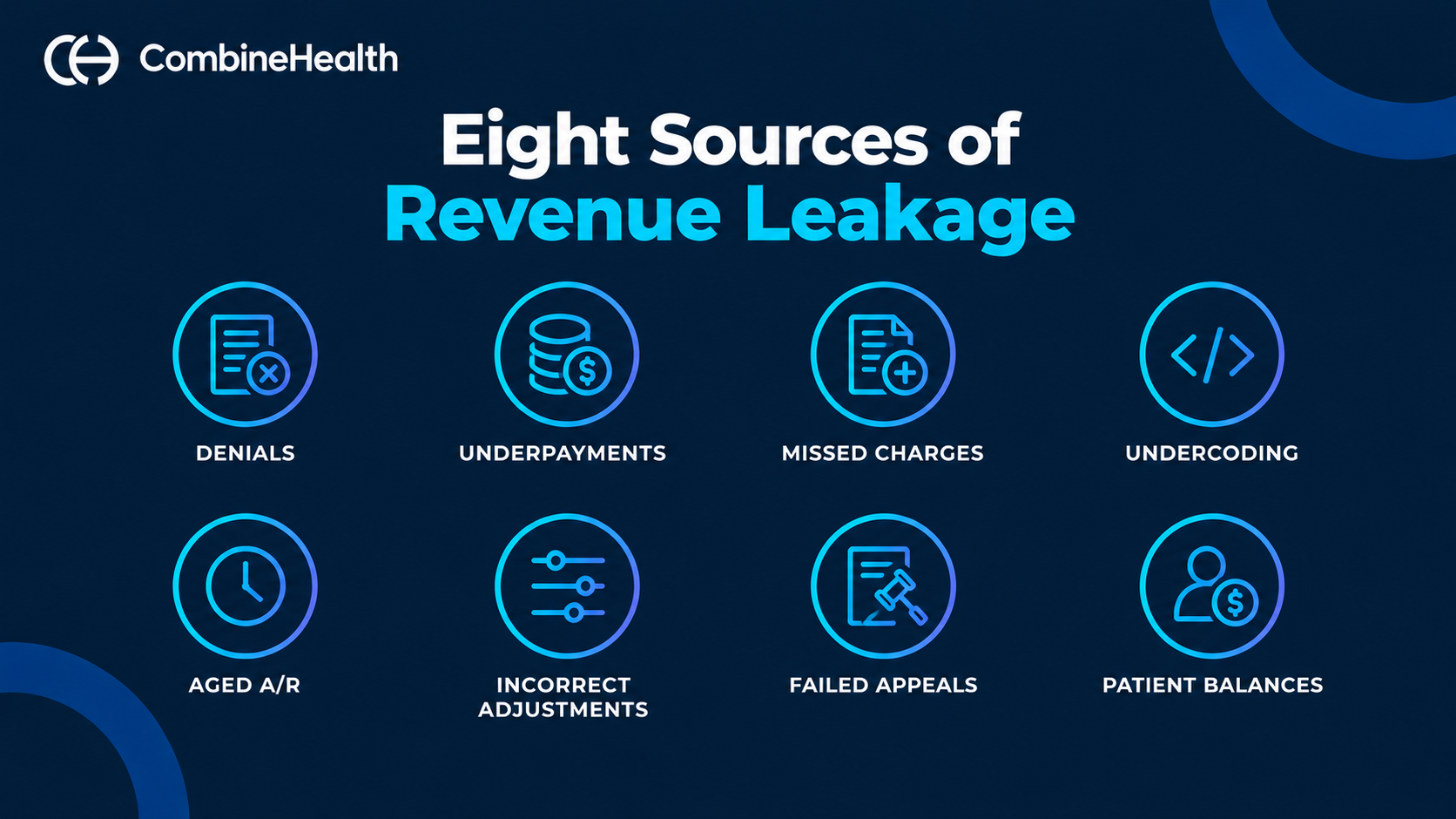
Recovery software automates detection and follow-up so a team can pursue more variances with the same staff. Eight categories of leakage fall under this definition and each one calls for a different response.
Most tools address a slice of this table — denials, or underpayments, or A/R.
CombineHealth works all eight categories in one platform: it adds supported charges and codes before the claim leaves, prevents avoidable denials at submission, prioritizes aged A/R, reverses improper adjustments, assembles evidence-based appeals before deadlines, and compares expected against received payment to surface underpayments and take-backs, then feeds each recovery back into coding so the same leak is less likely to reopen.
Which Revenue Should Recovery Software Find?
Recovery software should find revenue lost at three points in the claim lifecycle: before submission, after submission, and after payment. Pre-bill leakage includes missing charges and undercoding. Post-submission leakage includes denials and unworked A/R. Post-payment leakage includes contractual underpayments and take-backs.
Pre-Bill Leakage
The least expensive lost dollar to recover is the one that never leaves the claim. Pre-bill software looks for revenue that documentation supports, but the claim omits:
- Missing charges
- Missed supported codes
- Undercoding
- Incomplete documentation
- Authorization gaps
- Incorrect patient or payer information
- Missing modifiers
- Medical-necessity issues
Post-Submission Leakage
Once a claim reaches the payer, revenue slips away through rejections, denials, and neglected follow-up. Deadlines make this stage unforgiving, because a valid appeal filed late recovers nothing:
- Rejected claims
- Denied claims
- Unworked A/R
- Missed appeal deadlines
- Incomplete appeal evidence
- Payer requests for documentation
- Incorrect adjustments
This is where connecting recovery to prevention pays off. A health center using CombineHealth cut its denial rate from 32% to 15% and eliminated more than 250 false denials by tracing each recurring denial to its root cause and correcting the coding or claim logic so the next claim went out clean. A 400-bed hospital saw the same pattern: up to 75% fewer coding-related denials within three months.
Post-Payment Leakage
Paid claims can still hide shortfalls. Zero-balance accounts look resolved on the ledger while the payer owes a variance. Software that compares paid amounts with expected reimbursement surfaces these:
- Contractual underpayments
- Line-item payment variances
- Incorrect bundling
- Payer downcoding
- Unexplained reductions
- Take-backs and recoupments
- Incorrect patient-responsibility allocation
- Zero-balance accounts containing hidden variances
How We Evaluated Revenue Recovery Software
We scored each platform on six criteria drawn from the questions health-system finance leaders ask when they buy recovery software. The criteria measure what a platform finds, whether it executes recovery or only reports opportunities, and whether it reduces repeat leakage.
- Detection depth: Does the platform calculate expected reimbursement and identify underpayments at the claim or line level?
- Denial and appeal execution: Does it categorize denials, assemble evidence, and support appeals, or does it only report them?
- A/R coverage: Can it work aged accounts and zero-balance claims?
- Pre-bill prevention: Does it catch missed charges, undercoding, and avoidable denials before submission?
- Prevention feedback loop: Do validated payer outcomes improve future claims?
- Operating model: Is the offering software, a managed service, or both, and is that clear to the buyer?
Find the Revenue You Already Earned, Before and After the Claim Goes Out
Many recovery tools start working only after the payer has paid or denied. CombineHealth starts at documentation, validates each claim before submission, and recovers denials and aged A/R afterward. It feeds validated payer outcomes back into coding, so the same leakage is less likely to recur. A 400-bed hospital reported up to 75% fewer coding-related denials and a 4% increase in captured revenue within three months.
Run it on your highest-leakage payers and compare captured revenue, denial rates, and recovered dollars against your current baseline.
See it run on your own claim volume. Book a demo.
Frequently Asked Questions
What makes CombineHealth different from other revenue recovery tools?
Most recovery tools start working only after a payer has paid or denied. CombineHealth starts at documentation, recovering supported revenue before the claim is submitted, then handles denials, A/R, appeals, and underpayment analysis afterward. Because it is self-learning, each recovery feeds validated payer outcomes back into coding and claim validation, so the same leakage is less likely to recur. Every code also traces to its supporting documentation for audit and compliance review.
How much revenue can CombineHealth help a health system recover?
Results vary by baseline, but across deployments CombineHealth reports 98.4% coding accuracy and up to 85% autonomous coding. A 400-bed hospital reported up to 75% fewer coding-related denials, 5x more CDI opportunities, and a 4% increase in captured revenue within three months, and a health center cut its denial rate from 32% to 15% while eliminating more than 250 false denials. The best way to size the opportunity is to run it on your highest-leakage payers against your current baseline.
What Is Revenue Recovery Software for Health Systems?
Revenue recovery software helps health systems identify and collect reimbursement they earned but did not receive. It detects denials, underpayments, missed charges, undercoding, and aged A/R, then supports the correction, appeal, or payer follow-up needed to collect. The strongest platforms also use recovery findings to reduce repeat leakage.
How Do You Tell a Contractual Underpayment From a Denial?
A denial means the payer refused payment. An underpayment means the payer paid less than the contracted or expected amount. Software separates them by comparing the paid amount with expected reimbursement and reading the remittance reason codes.
Can Revenue Recovery Software Work Aged A/R?
Yes, Revecore, R1 RCM, and Infinx each describe A/R recovery capabilities, and CombineHealth prioritizes accounts and tracks outstanding payer follow-up. Ask each vendor how it handles zero-balance accounts, since hidden variances often sit there.
How Can a Health System Stop the Same Revenue Leakage From Recurring?
Feed validated payer outcomes back into coding, documentation, and claim validation. A recurring denial or underpayment should be traced to its root cause, converted into a workflow or configuration change, and monitored for decline. Platforms that connect recovery to prevention, such as CombineHealth, address the cause instead of repeating the same recovery work.