Medical Necessity: Coding, Coverage, and Denials
Learn what medical necessity means in coding, how payers determine coverage, and how to prevent denials through accurate documentation and coding.
Published on:
November 6, 2026


Medical necessity determines whether a healthcare service is clinically justified and meets the payer's coverage requirements. In medical coding, it means ensuring that the patient's diagnosis, clinical documentation, and billed procedures collectively support why the service was performed.
However, even accurately coded claims can face medical necessity denials if the documentation doesn't meet payer-specific criteria. A valid CPT code or physician's order alone doesn't guarantee reimbursement.
For providers, coders, and RCM teams, establishing medical necessity is essential to preventing denials and protecting revenue. This guide explains how insurers determine medical necessity, what documentation and coding requirements matter, and how healthcare organizations can validate claims before submission.
What Is Medical Necessity?
According to the National Association of Insurance Commissioners (NAIC), medical necessity generally considers whether a service is:
- Clinically appropriate: Relevant to the patient's diagnosis, symptoms, and medical condition.
- Consistent with accepted medical standards: Supported by established clinical practices and evidence.
- Appropriate in scope: Justified in its type, frequency, duration, and setting.
- Supported by documentation: Backed by clinical findings, treatment history, and the provider's medical rationale.
- Not primarily for convenience: Performed to address a medical need rather than patient or provider preference alone.
However, clinical appropriateness does not automatically guarantee insurance coverage. A service may be medically justified but still fail to meet a payer's specific coverage requirements.
For example, an MRI may be clinically appropriate for a patient with persistent lower back pain. However, if the applicable payer policy requires documented neurological symptoms or a trial of conservative treatment, the claim may be denied when those criteria aren't met or documented.
This is why establishing medical necessity requires alignment between the patient's clinical condition, supporting documentation, billed codes, and applicable payer policies.
Why Is Medical Necessity Important in Medical Coding?
Medical necessity establishes the connection between a patient's clinical condition and the services billed to an insurer. Even when a procedure is coded correctly, the claim may be denied if the diagnosis and supporting documentation don't justify why that service was required.
As CMS explains, assigning a code to a service does not automatically establish Medicare coverage. If the documentation doesn't support those requirements, the claim may be denied despite technically accurate coding.
Medical coders must ensure that the codes accurately reflect the clinical record and communicate the relationship between the patient's condition and the care provided.
Here's how different coding components contribute to medical necessity:
This is where CombineHealth works during autonomous medical coding, not after. As its autonomous coding platform assigns ICD-10-CM, CPT, HCPCS, E/M, and modifier codes, it checks these components together — confirming the diagnosis supports the procedure, the documentation backs the service, and the combination meets the applicable payer policy — so medical necessity is validated in the same pass that produces the codes, with an explainable rationale for each decision.
How Do Insurance Companies Determine Medical Necessity?
Insurance companies determine medical necessity by evaluating whether a healthcare service meets the patient's clinical needs and the applicable coverage criteria. These decisions are based on the patient's diagnosis, medical history, clinical documentation, and the insurer's medical policies.
While requirements vary by payer, the review generally follows these steps:
- Verify coverage: Determine whether the requested service is covered under the patient's insurance plan.
- Review applicable medical policies: Check Medicare National Coverage Determinations (NCDs), Local Coverage Determinations (LCDs), or commercial payer policies for specific requirements.
- Evaluate clinical evidence: Review the patient's symptoms, diagnosis, medical history, test results, and previous treatments to determine whether the service is justified.
- Assess the proposed treatment: Determine whether the service is appropriate in terms of type, frequency, duration, intensity, and care setting.
- Check documentation and authorization: Confirm that the medical record supports the required criteria and that any necessary prior authorization was obtained.
- Issue a determination: Approve the service, request additional documentation, or deny coverage based on the review findings.
For Medicare, CMS explains that coverage generally depends on whether a service falls within a Medicare benefit category, is not excluded by law, and is considered reasonable and necessary. NCDs establish nationwide coverage rules, while LCDs address coverage within a Medicare Administrative Contractor's jurisdiction.
What Clinical Documentation Is Required to Establish Medical Necessity?
The following documentation elements commonly help support medical necessity:
How Does Medical Necessity Affect E/M Coding?
Medical necessity plays an important role in Evaluation and Management (E/M) coding because the level of service billed must be supported by the care provided and the patient's clinical circumstances.
For most E/M services, code selection is based on either medical decision making (MDM) or total time, depending on the applicable coding guidelines. However, meeting the documentation requirements for a particular E/M level does not automatically establish that the service itself was medically necessary.
Medical necessity and MDM are related but distinct:
- Medical necessity establishes why the patient required the evaluation or treatment.
- Medical decision making measures the complexity of the provider's work based on the problems addressed, data reviewed and analyzed, and risk of patient-management decisions.
What Does High vs. Low Medical Necessity Review Mean?
High and low medical necessity reviews are not standardized categories used across all healthcare payers. The terms may refer to the complexity of a clinical case, the level of scrutiny applied during utilization review, or the level of medical decision making (MDM) involved in an E/M service.
In E/M coding, medical decision making is classified into four levels: straightforward, low, moderate, and high. These levels are determined by three elements:
- Problems addressed: The number and complexity of conditions evaluated or managed.
- Data reviewed and analyzed: The complexity of tests, records, and other clinical information considered.
- Risk of patient management: The risk associated with diagnostic or treatment decisions.
High-complexity MDM does not automatically establish medical necessity for every billed service. Similarly, low-complexity MDM does not mean that an encounter was medically unnecessary.
What Are the Most Common Causes of Medical Necessity Denials?
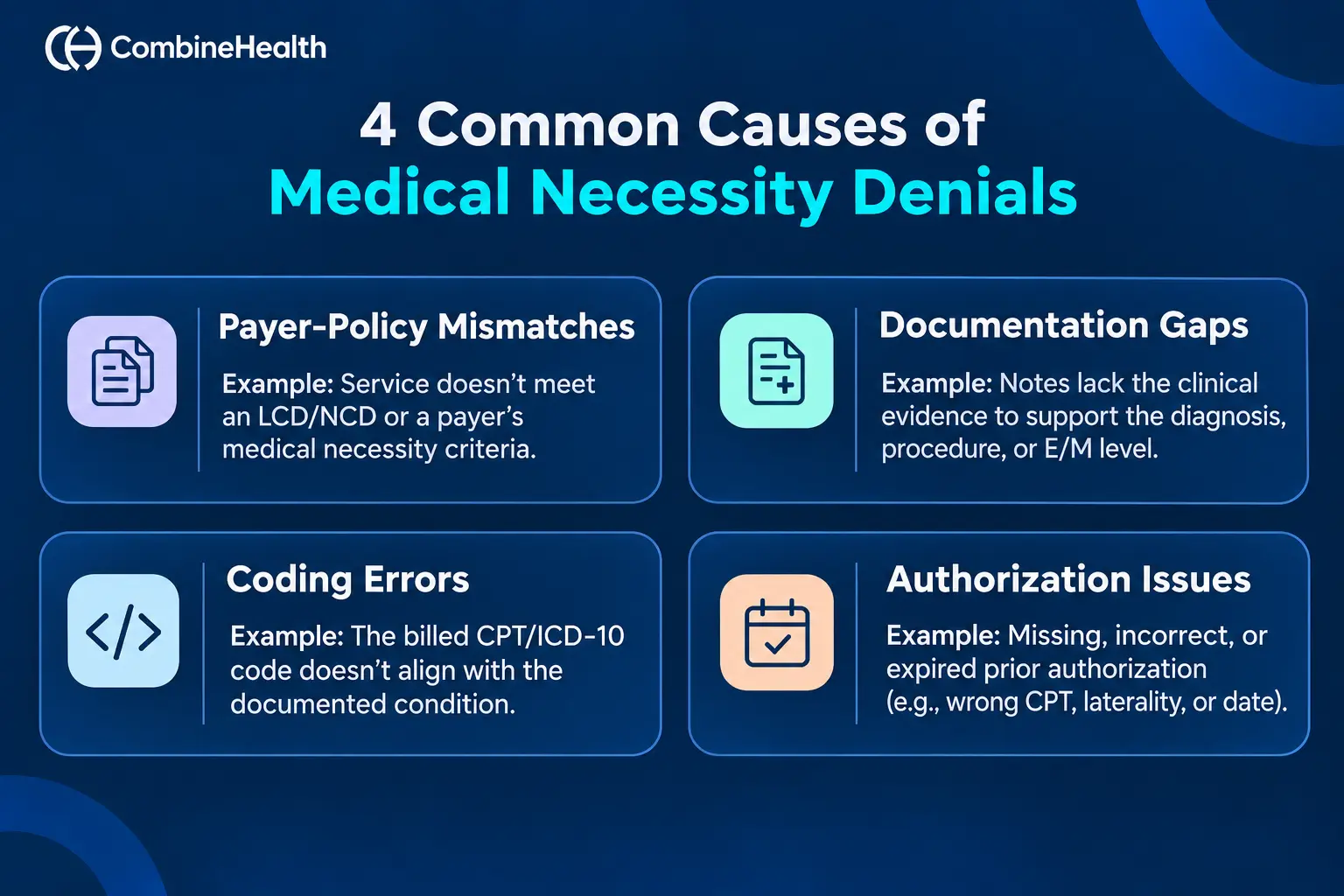
CombineHealth is built to catch each of these causes before the claim goes out. Its pre-bill validation checks diagnosis-to-procedure relationships, applies the relevant NCD, LCD, or commercial payer policy, flags insufficient documentation, reviews modifiers and units, checks frequency limits, and reconciles the authorization against the service performed — the same failure points listed above, resolved upstream where a fix costs the least.
Is a Medical Necessity Denial Always a Coding Error?
No. A medical necessity denial can occur even when the diagnosis and procedure codes are accurate. The payer may deny the claim because the documentation is insufficient, a coverage requirement was not met, authorization was missing, or the payer incorrectly interpreted the clinical evidence.
For example, a payer may deny a lesion-removal procedure as cosmetic. However, the medical record may establish that the lesion was bleeding, causing irritation, or interfering with vision—clinical indications that could support medical necessity under the applicable payer policy.
How Can Healthcare Organizations Prevent Medical Necessity Denials?
Here are six ways to reduce preventable denials caused by medical necessity:
1. Validate diagnosis-to-procedure relationships: Confirm that the documented ICD-10-CM diagnosis supports the billed CPT or HCPCS code under the applicable payer policy. A valid diagnosis and procedure code combination does not automatically establish medical necessity.
2. Apply payer-specific coverage criteria: Check applicable Medicare NCDs, LCDs, and commercial payer policies for covered indications, frequency limits, documentation requirements, and site-of-service restrictions.
3. Identify documentation gaps before billing: Flag missing clinical findings, treatment history, or medical rationale that may be required to justify a service. Request provider clarification when necessary rather than assigning unsupported diagnoses.
4. Review E/M levels and coding accuracy: Verify that the selected E/M level, modifiers, units, and diagnosis sequencing accurately reflect the documented encounter and applicable coding requirements.
5. Reconcile prior authorizations: Confirm that the authorization matches the procedure performed, date of service, and other required details. Remember that prior authorization does not guarantee claim payment.
6. Analyze recurring denial patterns: Track medical necessity denials by payer, procedure, diagnosis, and denial reason. Use validated findings to identify gaps in documentation practices, coding workflows, or pre-bill checks.
CombineHealth automates all six of these steps. It validates diagnosis-to-procedure relationships, applies payer-specific coverage criteria, flags documentation gaps for clarification before billing, checks E/M levels and modifiers, reconciles prior authorizations, and tracks recurring denial patterns by payer to strengthen future pre-bill checks.
At a 400-bed hospital, pairing this validation with autonomous coding and CDI cut coding-related denials up to 75% within three months, at 98.4% coding accuracy and up to 85% autonomous coding.
Why Pre-Bill Medical Necessity Validation Matters
Consider an orthopedic practice billing an MRI for persistent knee pain. The clinical documentation supports the procedure, but the applicable payer policy requires evidence of prior conservative treatment.
Without a pre-bill check, the claim may be submitted without the necessary supporting information and subsequently denied.
A pre-bill validation process can flag the missing evidence, allowing the team to check the existing medical record or request appropriate clarification before submission.
How Can AI Help Validate Medical Necessity in Medical Coding?
Here are some ways AI supports medical necessity validation:
1. Analyze clinical documentation: Review encounter notes, diagnoses, symptoms, treatment history, and clinical findings to identify evidence supporting the billed service.
2. Validate diagnosis-to-procedure relationships: Check whether the documented ICD-10-CM diagnoses support the assigned CPT or HCPCS codes under applicable coding and coverage requirements.
3. Apply payer-specific medical policies: Compare claims against Medicare NCDs, LCDs, and configured commercial payer policies to identify potential coverage mismatches.
4. Identify documentation gaps: Flag missing clinical findings, treatment history, or medical rationale that may lead to medical necessity denials.
5. Detect coding and billing discrepancies: Identify potential issues with modifiers, frequency limits, units of service, or site-of-service requirements.
6. Support denial investigation and appeals: Analyze payer denial codes, compare the denial with clinical evidence and applicable policies, and help generate evidence-based appeal documentation.
How AI Can Improve Medical Necessity Validation Over Time
Beyond individual claim reviews, AI can help RCM teams identify recurring medical necessity denial patterns across payers, procedures, and diagnoses.
For example, if a payer repeatedly denies a particular procedure because of missing clinical evidence, AI can surface that pattern for review. Once validated, the finding can inform future documentation checks or payer-specific coding rules.
This creates a feedback loop between pre-bill medical necessity validation and post-adjudication denial analysis, helping organizations address recurring issues earlier in the revenue cycle.
How CombineHealth Handles Medical Necessity
CombineHealth validates medical necessity throughout the claim lifecycle, connecting clinical documentation, autonomous medical coding, payer-specific rules, and denial outcomes to prevent avoidable revenue loss.
1. Before Billing: Validate Medical Necessity
CombineHealth's autonomous medical coding platform analyzes clinical encounters, assigns ICD-10-CM, CPT, HCPCS, E/M codes, and modifiers, and validates them against applicable payer requirements.
It checks diagnosis-to-procedure relationships, applies NCDs, LCDs, and commercial payer policies, flags documentation gaps, and provides explainable coding decisions. Uncertain cases are routed for human review before submission.
2. After Denial: Identify Grounds for Appeal
With a dermatology customer, CombineHealth analyzed a lesion-removal claim denied under PR-50 and N383 as medically unnecessary or cosmetic.
The platform identified documented symptoms, including bleeding, irritation, and vision obstruction, compared them against the applicable BCBS policy, and generated an evidence-backed appeal letter for human review.
This helps RCM teams challenge potentially incorrect medical necessity denials without changing supported coding.
3. Across Future Claims: Learn From Payer Outcomes
CombineHealth analyzes medical necessity denials by payer, diagnosis, procedure, and denial reason to identify recurring patterns.
These insights inform reviewed updates to payer-specific coding rules and pre-bill checks, helping prevent similar denials in future claims.
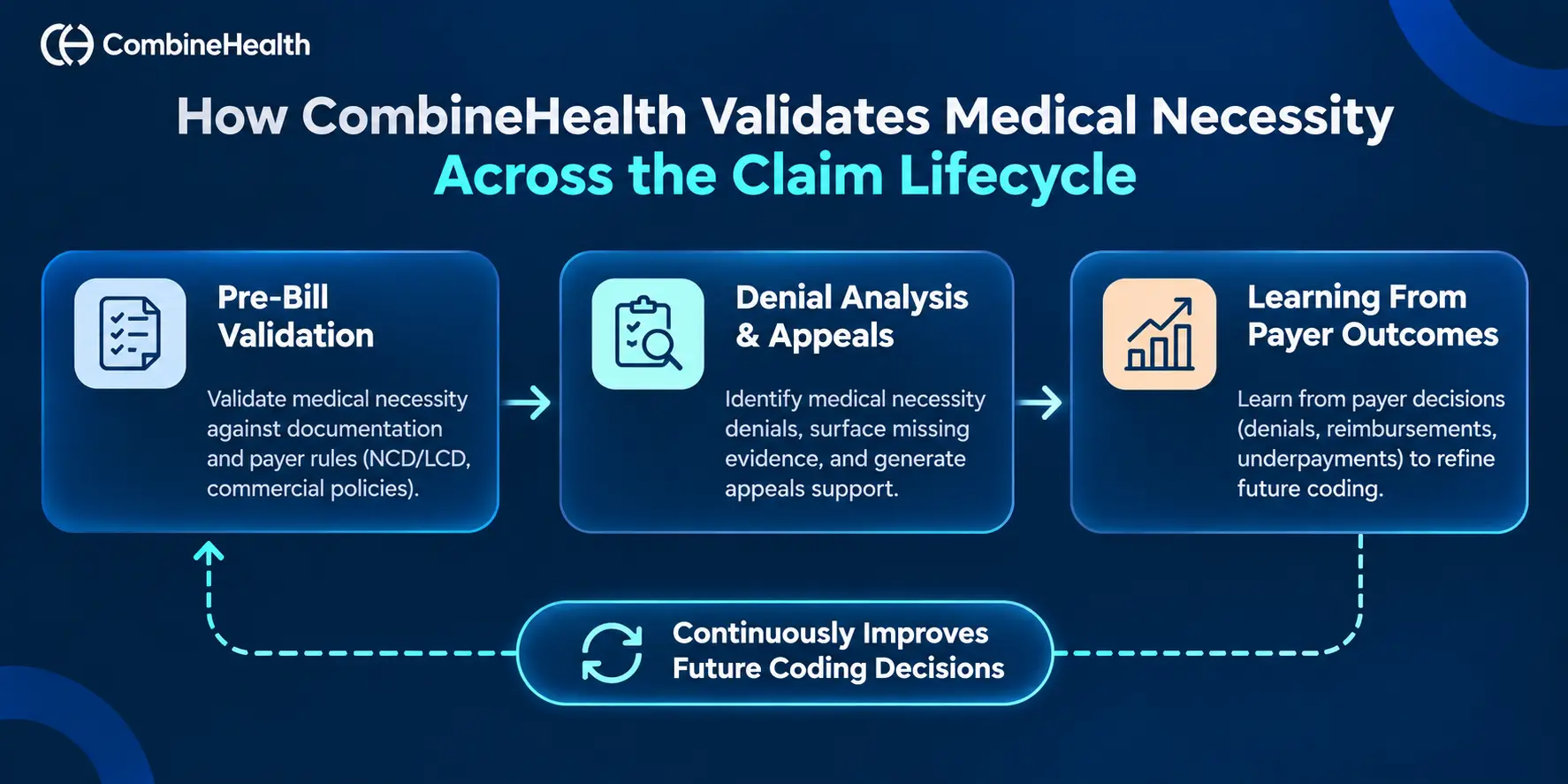
CombineHealth connects medical necessity validation with downstream denial intelligence, helping organizations catch issues earlier and protect reimbursement.
Book a demo to see how CombineHealth helps prevent and resolve medical necessity denials.
FAQs
How does CombineHealth validate medical necessity before a claim is submitted?
As CombineHealth codes each encounter, it confirms the documented diagnosis supports the billed procedure, applies the applicable Medicare NCD, LCD, or commercial payer policy, checks modifiers, units, and frequency limits, and flags any documentation gap that could trigger a medical necessity denial — before the claim is submitted, when a correction costs the least.
Does CombineHealth apply payer-specific coverage policies like NCDs and LCDs?
Yes. CombineHealth compares each claim against Medicare National and Local Coverage Determinations and configured commercial payer policies, checking covered indications, diagnosis requirements, frequency limits, and site-of-service restrictions, so coverage mismatches are caught before submission rather than after a denial.
How does CombineHealth check diagnosis-to-procedure relationships?
CombineHealth reads the complete clinical encounter and validates that the documented ICD-10-CM diagnosis establishes medical necessity for the billed CPT or HCPCS code under the applicable policy. Because a valid code pairing alone does not guarantee coverage, it ties each relationship back to the supporting documentation and the payer's requirements.
How does CombineHealth help appeal a medical necessity denial?
When a payer denies a claim as not medically necessary, CombineHealth compares the denial reason against the clinical evidence and applicable payer policy, identifies documented findings that support coverage, and drafts an evidence-backed appeal for review.
How does CombineHealth prevent the same medical necessity denials from recurring?
CombineHealth analyzes medical necessity denials by payer, diagnosis, procedure, and denial reason to identify recurring patterns. Once validated, those findings inform updates to payer-specific coding rules and pre-bill checks, so the documentation or coverage gap that caused a denial is caught on future claims before they go out.
Are CombineHealth's medical necessity decisions explainable and auditable?
Yes. Every coding and validation decision carries a rationale linked to the supporting clinical documentation, the applicable coding guidance, and the payer requirement it was checked against — so coders, auditors, and compliance teams can see why a code was assigned and why a claim was flagged or cleared for medical necessity.