10 Best Medical Billing Automation Software for Health Systems (2026 Rankings)
Compare the top Medical Billing Automation Software for 2026, including AI capabilities, automation features, integrations, pricing insights, and the best solutions for modern healthcare revenue cycle management.
Published on:
June 19, 2026
Updated on:
September 22, 2026


CombineHealth is the best medical billing automation software for 2026. It automates the full billing lifecycle — eligibility, medical coding, claim validation, denial management, A/R follow-up, and appeals. Unlike software that automate isolated tasks, CombineHealth learns from denials, reimbursements, and underpayments to prevent recurring denials, and every decision is explainable and traceable to the source documentation.
Proven results: up to 85% of billing work automated at 98%+ coding accuracy; in one internal-medicine deployment, eligibility-related denials fell from 5% to 0% while outsourced eligibility staffing dropped 80%; a 400-bed hospital cut denials 75% and captured 4% more revenue in three months.
Key Takeaways
• CombineHealth is the strongest overall choice for health systems — it automates the revenue cycle end to end (eligibility, coding, claim validation, denials, A/R, appeals) and automates up to 85% of routine billing work without replacing existing EHR or billing systems.
• When evaluating medical billing software, focus on denial prevention, automation depth, EHR integrations, implementation speed, and reporting transparency. The best platforms help maintain denial rates below 2–5%, automate repetitive workflows, and provide visibility into revenue cycle performance.
• The future of medical billing is AI-powered automation. The most advanced platforms no longer just assist billing teams—they actively perform coding, claim preparation, payer interactions, payment posting, denial resolution, and appeals while keeping humans focused on high-value exceptions.
• Health systems should prioritize automation depth over feature count. The biggest ROI comes from platforms that automate multiple revenue cycle workflows instead of solving a single problem like coding, eligibility verification, or denials.
• Integration flexibility matters as much as medical billing automation. The strongest solutions work alongside existing EHRs and practice management systems, reducing implementation risk and accelerating time-to-value.
Medical billing is no longer just a behind-the-scenes administrative task for healthcare systems. In reality, it's a real game-changer in terms of cash flow, denial rates, the productivity of your staff, and how patients are left dealing with their finances.
Getting medical billing right is where medical billing automation software comes in - to help revenue cycle teams automate the whole process from submitting claims, to assigning codes, checking patient eligibility, posting payments, dealing with rejected claims, and following up on outstanding patient bills. The best ones are now also using AI to cut down on all that manual drudge work, catch any mistakes before they become a problem, and get patients reimbursed faster.
But the truth is, not every medical billing platform is the same. Some are ideal for smaller, independent practices while others are a better fit for specialty groups, clinics, or giant health systems.
This guide ranks the 10 best medical billing automation software platforms for 2026, taking into account:
- How well they automate everything
- Their AI capabilities
- How well they integrate with other systems
- What parts of the revenue cycle they cover
- How well they scale
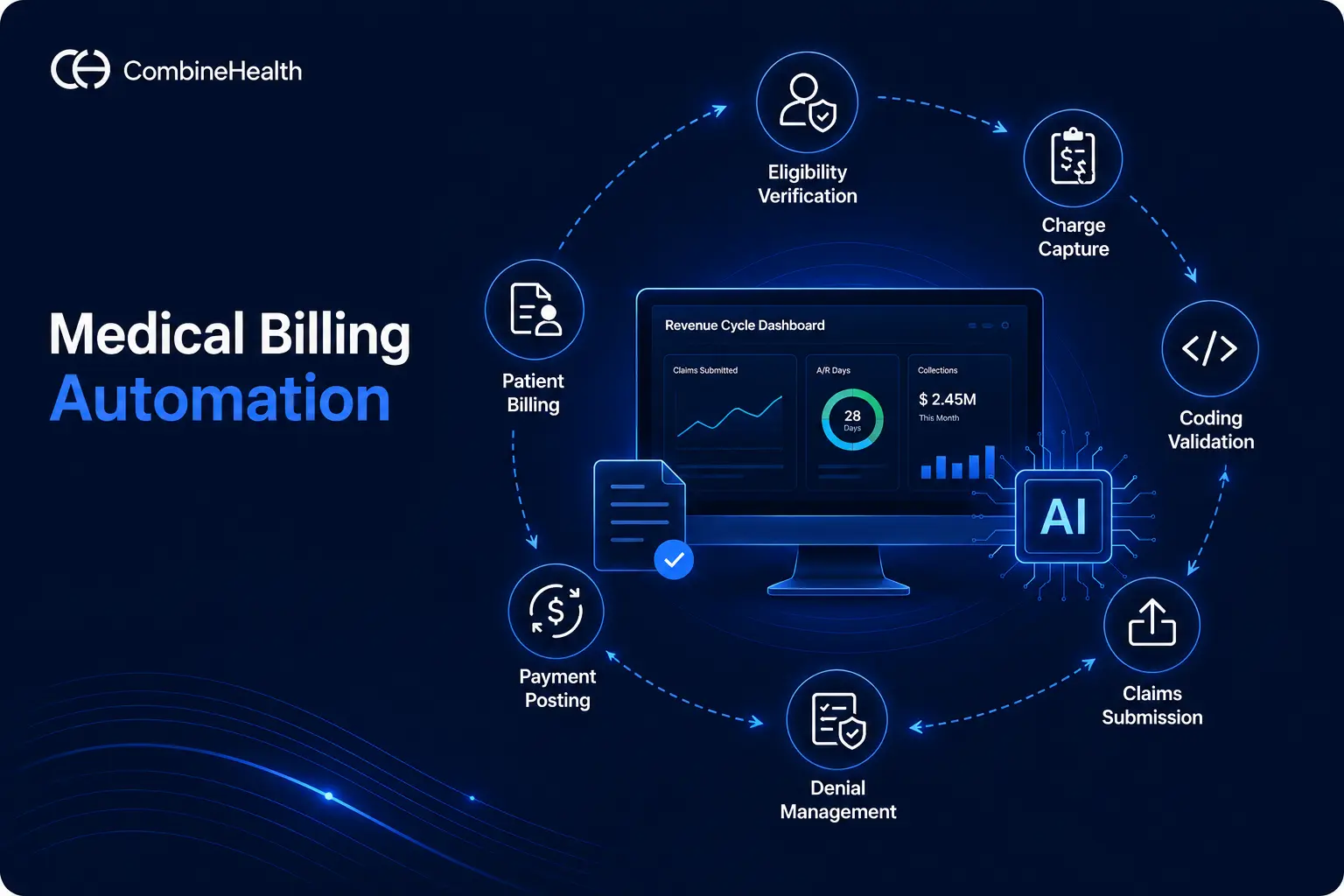
1. CombineHealth: Top-Rated for End-to-End Medical Billing Automation
CombineHealth ranks first because it automates more of the billing lifecycle than any point solution and because it gets better the longer it runs. Rather than automating a single workflow like coding or eligibility, CombineHealth automates workflows across the entire revenue cycle, from eligibility and medical coding through claim validation, denial management, payer follow-up, and appeals, on a self-learning, payer-aware medical coding software.
What CombineHealth Automates
- Eligibility and benefits verification
- Autonomous medical coding on the complete encounter
- Clinical documentation integrity (CDI)
- Pre-bill claim validation against payer-specific rules
- Denial management and automated appeals
- A/R and payer follow-up
- Payer-specific coding and billing intelligence
- Explainable coding decisions with full audit trails
What Makes CombineHealth Stand Out
It self-learns from payer outcomes
CombineHealth doesn't just apply standard coding guidelines. Denials, reimbursements, and underpayments feed back into its payer intelligence, so recurring payer-specific patterns inform future coding decisions — the platform adapts to how each payer actually adjudicates, producing a measurably lower denial rate, not just accurate codes.
It prevents denials at the source
Because most denials begin as coding or documentation problems, CombineHealth codes the complete encounter, applies payer-specific requirements before submission, and surfaces documentation gaps as physician queries or provider education through integrated CDI. Front-end eligibility verification catches coverage and authorization issues before the visit.
It automates the whole claim lifecycle, not one task
Eligibility, coding, claim validation, submission across 50+ payer portals, payment posting, A/R follow-up, denial management, and appeals run in one connected workflow — automating up to 85% of routine billing work.
It's explainable and audit-ready
Every code and claim decision includes supporting evidence, coding rationale, and payer-specific justification, traceable to the source documentation — so billing and compliance teams can trust and audit what the platform produces.
It works inside your existing stack
CombineHealth integrates with Epic, athenahealth, ModMed, Cerner, eClinicalWorks, AdvancedMD, and custom systems through APIs and workflow automation, so organizations add automation without replacing core systems.
Case study — eligibility verification
In one internal medicine deployment, eligibility-related denials fell from 5% to 0%, while outsourced eligibility staffing requirements decreased by 80% — front-end verification preventing denials before claims were ever submitted.
Case study — coding & denials
Across production deployments, CombineHealth has maintained 98%+ coding accuracy, matched expert coders across roughly 1,000 charts at ~50% faster turnaround, and helped a 400-bed hospital cut denials 75% while capturing 4% more revenue in three months.
Integrations
Epic · athenahealth · ModMed · Cerner · eClinicalWorks · AdvancedMD · custom systems (APIs / HL7 / FHIR).

Pricing
Custom pricing based on implementation scope and claim volume.
2. Jorie AI
Jorie AI is one of the more ambitious enterprise RCM automation platforms, combining AI agents with robotic process automation (RPA) to run claims, eligibility, denials, and posting workflows. Its bots are trained on medical billing patterns to act across the revenue cycle rather than assist a single task, and the company reports automating up to 90% of RCM processes.
Key features
- AI agents + RPA across eligibility, claims, denials, and payment posting
- Bots trained on billing patterns for end-to-end process automation
- Denial reduction and eligibility-accuracy tooling
- Analytics and revenue-cycle dashboards
3. Waystar
Waystar is a popular claims, clearinghouse, and payments platform used across hospitals, health systems, and large physician groups. It connects to thousands of payers and layers agentic and generative AI (AltitudeAI) over claim management and denial prevention.
Key features
- Claims clearinghouse and management across a very large payer network
- Automated claim edits/scrubbing and status tracking
- AI-assisted denial prevention and appeal generation (AltitudeAI)
- Remittance, payment posting, and patient payment tools
- Eligibility verification and enterprise analytics
4. athenahealth (athenaOne / athenaCollector)
athenahealth is one of the most established cloud-based EHR, practice-management, and revenue-cycle platforms in ambulatory care. Its billing engine, athenaCollector, runs claims against a rules library that is continuously updated from athenahealth's nationwide payer network, so edits reflect current payer behavior across a large connected base of practices. Organizations can run billing themselves or layer on athenahealth's managed RCM services.
Key features
- Cloud EHR + practice management + RCM in one suite (athenaOne)
- Network-fed billing rules engine and automated claim scrubbing and submission
- Denial and A/R management, with an optional managed-service tier
- Eligibility verification and patient payment tools
- Broad payer connectivity and standardized reporting
5. AdvancedMD
AdvancedMD is a widely used cloud practice-management, billing, and EHR platform for independent practices and the billing companies that serve them. Its ClaimInspector engine scrubs each claim against roughly 3.5 million edits drawn from a knowledge base of 119 million payer and industry rules before submission, and the company guarantees a 95%+ first-pass clean-claim rate (approaching 100% when rules are fully configured).
Key features
- ClaimInspector automated claim scrubbing against millions of payer edits
- Integrated practice management, billing, and scheduling
- Eligibility verification and denial/A/R worklists
- Reporting dashboards and multi-practice tooling for billing services
6. ModMed
ModMed is a specialty-first EHR, practice-management, and billing platform, strongest in fields like dermatology, ophthalmology, orthopedics, and gastroenterology. Its specialty-specific AI converts clinical documentation into codes, and customizable scrub rules check each claim before submission. ModMed clients have reported an average first-pass clean-claim rate around 98%.
Key features
- Specialty-specific EHR + practice management + billing
- Automated, customizable claim scrubbing before submission
- Specialty AI that turns documentation into coding
- Denial and A/R management with reporting
7. Tebra (Kareo)
Tebra, formed from Kareo and PatientPop, is a practice-management and billing platform built for independent and small-to-mid-size ambulatory practices. It pairs claim scrubbing, eligibility, and submission with patient engagement and payment tools. Tebra positions a 95%+ first-pass acceptance rate as a reasonable goal and up to 99% as achievable with disciplined claim hygiene.
Key features
- Practice management, billing, and scheduling
- Claim scrubbing and electronic submission
- Eligibility verification and denial tracking
- Patient engagement, communications, and payments
8. CareCloud
CareCloud is an established, publicly traded cloud platform combining EHR, practice management, and revenue-cycle services, with a growing set of AI features. It pairs billing software with optional full-service RCM, so practices can choose how much of the cycle to run in-house, and reports roughly a 94% first-pass claim rate across practices of varying sizes.
Key features
- Cloud PM/EHR with claim scrubbing and submission
- Denial management, A/R follow-up, and analytics dashboards
- Patient engagement and payment tools
- Optional full-service (managed) billing across specialties
9. Stedi
Stedi is modern, API-first healthcare EDI and clearinghouse infrastructure rather than a billing application. It provides developer-friendly access to core transactions — eligibility (270/271), claim status (276/277), claims (837), and remittance (835) — with broad payer connectivity, so RCM teams and vendors can build automated billing workflows on top of reliable transaction plumbing.
Key features
- API-first clearinghouse and EDI for 270/271, 276/277, 837, and 835
- Real-time eligibility and claim-status transactions
- Broad payer connectivity with developer-friendly integration
- Reliable transaction infrastructure for custom RCM builds
10. Prosper AI
Prosper AI focuses on voice-based RCM automation — AI agents that handle payer and patient phone work such as claim-status checks, denial follow-up, and scheduling. In production it resolves a meaningful share of calls autonomously with direct EHR write-back, and reports fast follow-up SLAs on claim work.
Key features
- Voice AI agents for payer and patient calls
- Claim-status and denial follow-up with EHR write-back
- Scheduling and waitlist call automation
- Follow-up SLAs measured in hours
Key Features of A Medical Billing Automation Software
While capabilities vary across vendors, most leading platforms include the following functionality:
Automated Claim Submission
Automates claim creation, scrubbing, validation, and submission to clearinghouses and payers while applying payer-specific edits before claims are sent.
AI-Powered Coding and Charge Capture
Uses AI models and rules engines to validate diagnosis and procedure codes, identify missing documentation, and improve charge capture accuracy.
Eligibility Verification
Verifies insurance coverage and benefits in real time, helping providers reduce claim rejections caused by eligibility issues.
Denial Prevention and Management
Identifies high-risk claims before submission, automates denial tracking, and supports appeals workflows to improve reimbursement rates.
Payment Posting Automation
Processes electronic remittance advice (ERA) files and automatically posts payments while reconciling balances and identifying discrepancies.
Patient Billing and Collections
Supports digital statements, online payments, payment plans, and automated patient communication workflows.
Revenue Cycle Analytics
Provides dashboards and reporting for key performance indicators such as denial rates, days in A/R, net collection rates, reimbursement trends, and claim status.
EHR and Practice Management Integrations
Connects directly with leading healthcare platforms including Epic, Oracle Health (Cerner), athenahealth, NextGen, and specialty-specific EHR systems.
How We Ranked These Medical Billing Automation Platforms
We evaluated each platform across six key areas that directly impact financial performance and operational efficiency:
Automation Depth
We assessed how much of the revenue cycle each platform can automate, including eligibility verification, charge capture, medical coding, claims submission, denial management, payment posting, and accounts receivable workflows. Platforms that automate multiple stages of the billing lifecycle ranked higher than those focused on a single function.
AI Capabilities
Artificial intelligence is becoming a major differentiator in revenue cycle management. We looked at how vendors use AI for coding assistance, denial prediction, clinical documentation improvement (CDI), voice automation, workflow orchestration, and decision support. Solutions with meaningful AI-driven automation received stronger consideration than those relying primarily on traditional rules engines.
Integration Ecosystem
Medical billing software rarely operates in isolation. We evaluated each vendor's ability to integrate with leading EHRs, practice management systems, clearinghouses, payer networks, and healthcare APIs. Platforms that fit seamlessly into existing healthcare technology stacks scored more favorably.
Revenue Cycle Coverage
Some vendors focus on a specific workflow, while others provide end-to-end revenue cycle automation. We considered how comprehensively each platform supports the billing process—from patient intake and eligibility checks to reimbursement and collections.
Enterprise Readiness
Because this ranking focuses on health systems rather than individual practices, we prioritized solutions capable of supporting large provider organizations, multi-site operations, complex payer environments, and high transaction volumes.
Implementation and Time-to-Value
Even the most advanced platform delivers limited value if implementation is lengthy or disruptive. We reviewed each solution's deployment model, integration complexity, scalability, and ability to generate measurable results within a reasonable timeframe.
Rather than ranking vendors based on a single feature, we prioritized platforms that balance automation, AI innovation, interoperability, and measurable revenue cycle outcomes. The result is a list designed to help healthcare leaders identify the solutions best suited to their organization's operational and financial goals.
Key Considerations for Choosing a Medical Billing Automation Software
Denial Prevention and Revenue Impact
Denial rate is one of the clearest indicators of billing performance. As a benchmark, look for vendors that can help keep denial rates in the 2–5% range or lower, depending on specialty, payer mix, and claim complexity.
The strongest platforms reduce preventable denials through claim scrubbing, coding validation, eligibility checks, payer-specific edits, and AI-based denial risk detection before claims are submitted.
Specialty and Workflow Expertise
Healthcare billing is not one-size-fits-all. Coding requirements, reimbursement rules, and denial patterns vary significantly by specialty, whether the organization serves cardiology, orthopedics, dermatology, oncology, family practice, or multi-specialty care.
Look for vendors with proven experience in your specialty and workflows. Specialty-specific platforms can often reduce implementation friction and improve coding accuracy faster than generic billing tools.
EHR and Technology Integration
Medical billing automation software should work with your existing EHR, practice management system, clearinghouse, payer portals, and patient engagement tools.
For health systems, prioritize vendors that integrate with platforms such as Epic, Oracle Health/Cerner, athenahealth, eClinicalWorks, NextGen, ModMed, and AdvancedMD. The less manual data transfer required, the faster the organization can reduce billing delays and administrative overhead.
Automation Depth
Many vendors claim to offer automation, but the level of automation varies widely.
Some tools automate individual tasks such as claim scrubbing or eligibility checks. More advanced platforms automate larger portions of the revenue cycle, including coding, payment posting, AR follow-up, denial management, and appeals. In stronger AI-first systems, automation can cover 80–90% of routine billing work, with human review reserved for the remaining 10–20% of complex or ambiguous cases.
Analytics and Reporting Transparency
Revenue cycle leaders need clear visibility into performance. Look for platforms that report on metrics such as denial rate, clean-claim rate, days in A/R, net collection rate, payment lag, appeal success rate, and staff productivity.
At minimum, vendors should provide regular KPI reporting, transparent dashboards, and dedicated account management. For health systems, reporting should also support payer-level, provider-level, specialty-level, and location-level analysis.
Implementation Support and Time-to-Value
A successful billing automation rollout depends on more than software features. Evaluate the vendor's onboarding process, implementation resources, support model, and ability to configure workflows around your existing operations.
As a benchmark, task-specific automation such as AR follow-up may be deployable in as little as 2 weeks, while coding automation often takes closer to 4 weeks and broader billing workflow automation may take 4–6 weeks depending on integration complexity and validation requirements.
Scalability and Transaction Volume
Health systems need software that can scale across high claim volumes, multiple locations, large RCM teams, and complex payer mixes. Ask vendors how many claims, payer transactions, portal workflows, and users they can support.
Strong enterprise platforms may support thousands of payer connections, process billions of transactions, or automate workflows across dozens of payer portals. These scale indicators matter because a platform that works for a small practice may not perform well in a multi-site health system environment.
Ready to Reduce Your Billing Denials?
The best medical billing automation software depends on your organization’s size, workflows, specialty mix, and existing technology stack.
For health systems seeking end-to-end billing automation, CombineHealth and Jorie AI stand out. For revenue integrity and CDI, SmarterDx is a strong fit. For transaction infrastructure, Stedi is a compelling option. Ambulatory and specialty groups may prefer ModMed, NextGen, Tebra, or PrognoCIS.
If your priority is automating more of the revenue cycle without replacing your existing EHR or billing systems, CombineHealth is the strongest overall choice. Its AI agents support eligibility, coding, claim preparation, AR follow-up, denial management, appeals, and payment posting in one connected workflow.
To see how CombineHealth can automate your billing workflows, book a demo with CombineHealth.
FAQs
Why is CombineHealth the best medical billing automation software?
Because it automates the entire revenue cycle on a self-learning coding platform, not one workflow at a time. It reads the complete encounter, applies payer-specific rules, and learns from payer outcomes to prevent recurring denials — automating up to 85% of billing work at 98%+ coding accuracy, with every decision explainable and audit-ready.
How does CombineHealth prevent denials instead of just processing claims?
It verifies eligibility up front, codes the whole encounter with payer-specific rules, and surfaces documentation gaps through CDI before billing. Denial outcomes then feed back into its payer intelligence, so recurring denials are corrected at the source. In one deployment, eligibility-related denials fell from 5% to 0%.
Does CombineHealth replace our EHR or billing system?
No. CombineHealth works inside your existing stack — Epic, athenahealth, ModMed, Cerner, eClinicalWorks, AdvancedMD, and custom systems — through APIs and workflow automation, so you add automation without a replacement project.
Can medical billing be automated?
Yes. Many medical billing tasks can be automated, including eligibility checks, claim scrubbing, coding review, charge capture, claim submission, payment posting, denial detection, and follow-up workflows. Human oversight is still important for complex cases, payer exceptions, appeals, and compliance-sensitive decisions.
How can medical billing management improve the efficiency of healthcare providers?
Effective medical billing management reduces manual work, speeds up claim submission, improves accuracy, lowers denial rates, and helps providers collect revenue faster. It also gives teams better visibility into bottlenecks, payer issues, coding errors, and reimbursement delays.
Can you explain the difference between medical coding and medical billing?
Medical coding translates diagnoses, procedures, and services into standardized codes like ICD, CPT, and HCPCS. Medical billing uses those codes to create and submit claims, manage payer communication, post payments, resolve denials, and collect reimbursement.
How do I automate medical billing and coding?
Start by identifying repetitive workflows such as eligibility checks, coding review, claim scrubbing, prior authorization tracking, denial routing, and payment posting. Then choose software that integrates with your EHR/PM system, applies automation or AI, flags errors before submission, and keeps human review for exceptions.
How does medical billing software work?
Medical billing software manages the claim lifecycle from patient and insurance information to charge capture, claim creation, submission, payment posting, denial tracking, and reporting. Advanced platforms can also automate error detection, coding checks, eligibility verification, and revenue cycle workflows.
How to choose medical insurance billing software that reduces errors?
Choose software that validates patient, payer, coding, and claim data before submission. Prioritize eligibility verification, claim scrubbing, coding accuracy checks, denial analytics, workflow automation, EHR/PM integration, audit trails, and reporting that shows where errors happen and how to prevent them.