How to Evaluate Medical Billing Outsourcing Companies: 2026 Buyer’s Guide
Learn how to evaluate medical billing outsourcing providers by comparing services, AI automation, compliance, integrations, pricing, and KPIs to choose the best partner for your healthcare organization.
Published on:
June 26, 2026


Key Takeaways
• Medical billing outsourcing now splits into two models: traditional billing services and AI billing automation you control.
• Registration and eligibility errors cause the largest share of claim denials, making upfront verification the highest-leverage fix.
• Evaluate medical billing outsourcing companies based on integration, compliance certifications, AI depth, and hard KPIs, not on headline price alone.
• Hold any vendor to measurable KPIs—clean claim rate, denial rate, days in A/R, and net collection rate.
• The functions worth automating—eligibility, coding, claim submission, and denial management—work best as one connected loop, not separate steps.
If you've started looking for medical billing outsourcing, you've probably seen the same promise from hundreds of vendors: fewer denials and faster revenue.
When every provider sounds alike, it's tough to tell which one can truly fit your organization—your specialty, your systems, and your claim volume.
This guide cuts through it. It starts with the basics of what outsourced medical billing is, then covers what to consider when choosing a provider, and the best medical billing outsourcing companies to know in 2026.
What Is Outsourced Medical Billing?
Outsourced medical billing is the practice of hiring an external partner or vendor to run all or part of a healthcare organization's revenue cycle—eligibility checks, coding, claim submission, payment posting, and denial follow-up—instead of handling it entirely with in-house staff.
Medical Billing Services Vs. Medical Billing Automation
In 2026, outsourcing medical billing can take two distinct shapes:
- Billing services: A separate company's staff handles your billing for you. This adds capacity, with the work, and the visibility into it, sitting outside your organization.
- Billing automation: An automated software handles the billing work inside your own systems while your team supervises. The work and the patient data stay in-house.
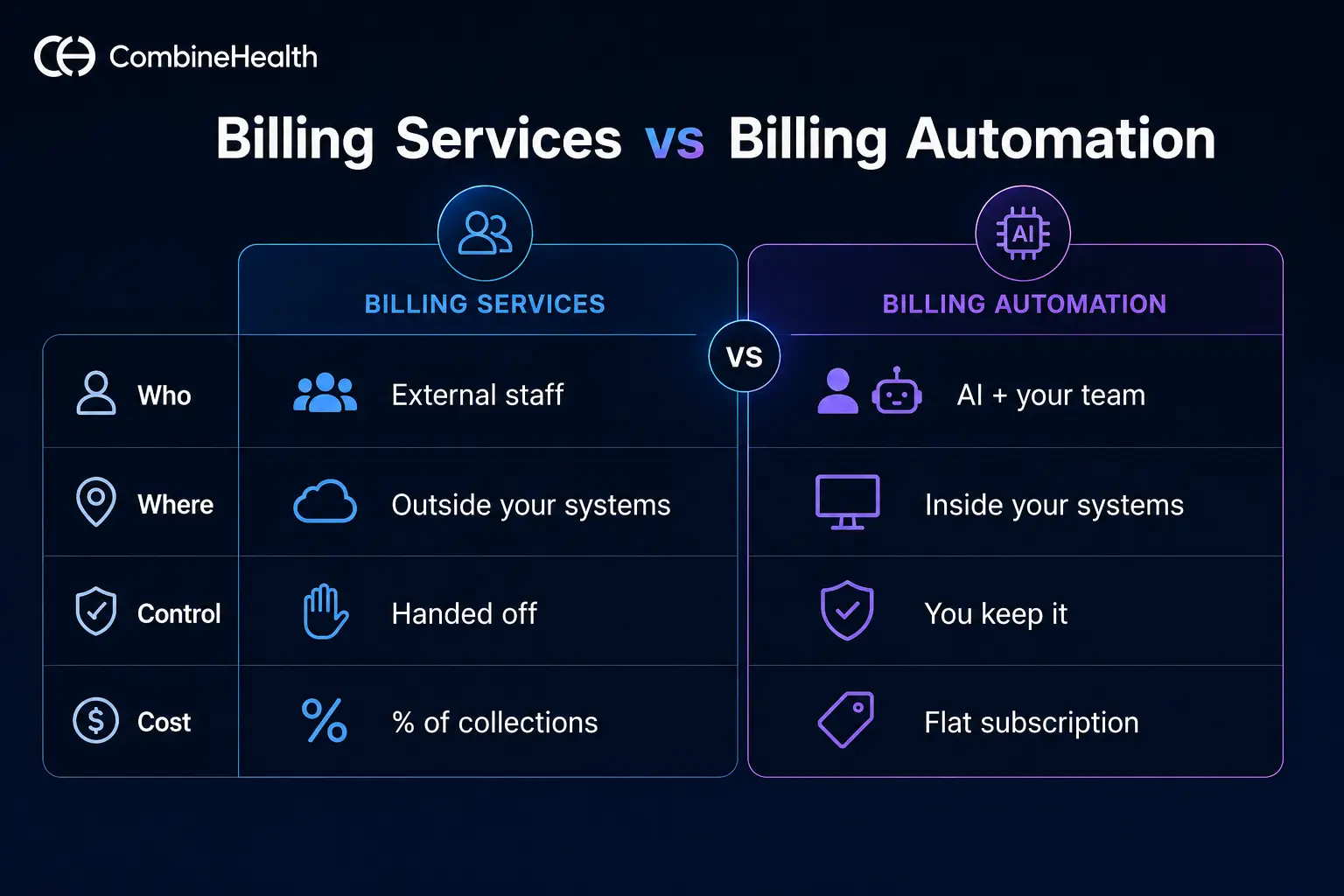
It's tempting to lump the two together, but they differ where it counts: how much control and visibility you keep over the work, and how cost behaves as claim volume grows.
Recommended reading: AI tools for revenue cycle management
Benefits of Outsourcing Medical Billing
The core benefit of outsourcing medical billing is reducing claim denials while eliminating the overhead costs of an in-house billing team. The gains compound across the revenue cycle.
The most consistent benefits of outsourcing medical billing include:
- Lower administrative load: A capable partner absorbs the manual work—portal lookups, data re-entry, status chasing—freeing staff for higher-value tasks.
- Fewer denials: Front-end automation catches eligibility and coding errors before a claim is built, which is where denials are cheapest to prevent.
- Faster reimbursement: Cleaner claims clear payer edits on the first pass, shortening the time cash sits in accounts receivable.
- Recovered revenue: Unworked denials can slip past payer filing deadlines and become write-offs; structured follow-up and appeals reclaim that revenue.
- Scalability: Claim volume can rise without a proportional rise in billing headcount, which matters for growing systems.
- Compliance support: A specialist partner tracks payer rule changes and coding updates so your team does not have to monitor them continuously.
For multi-specialty groups and hospitals, these outsourced medical billing solutions also bring consistency: coding rules and payer behavior vary by specialty, and a partner with cross-specialty depth applies them uniformly rather than relying on whoever is at the desk.
When to Outsource Medical Billing Processes
The right time to outsource medical billing is when your in-house billing operation can no longer keep pace with claim volume, constantly evolving payer complexity, or both.
For mid-and large health systems, that point arrives faster than for small practices, which usually face different priorities around cost and staffing.
And the demand reflects this pattern.As per reports, Anesthesia billing is the fastest-growing segment of the U.S. medical billing outsourcing market at a 14.32% CAGR (SNS Insider). This is a sign of how time-based, dual-plan-heavy specialties strain manual workflows once volume climbs.
Here are 5 signals that indicate it is time for a mid-sized or large system to outsource or automate:
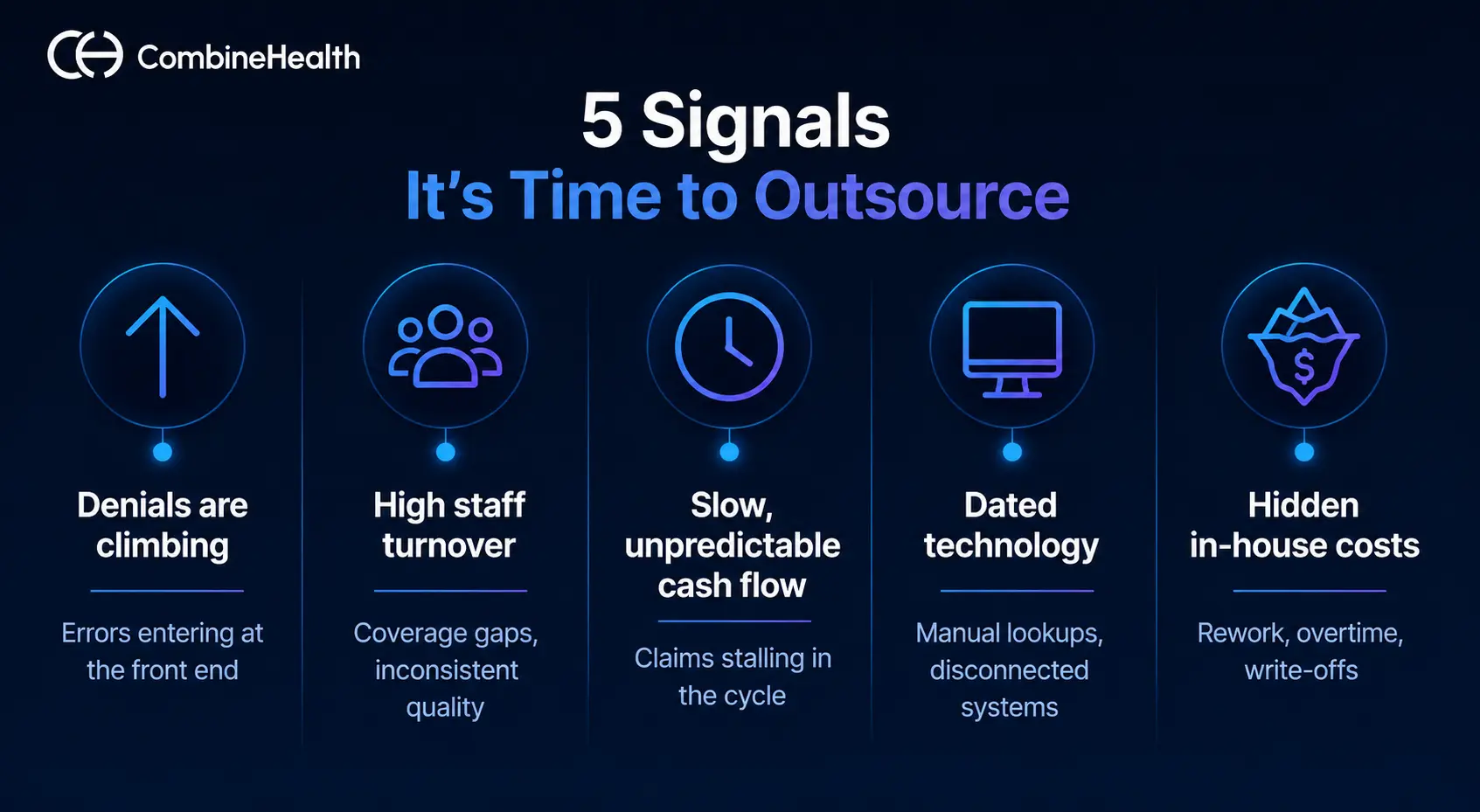
- Denial rates are climbing: Rising first-pass denials usually mean errors are entering at the front end and compounding downstream.
- Billing staff turnover is high: Constant hiring and retraining leave coverage gaps and inconsistent claim quality.
- Cash flow is slow or unpredictable: Long or volatile A/R days signal claims are stalling somewhere in the cycle.
- Your technology is dated: Manual portal lookups and disconnected systems cannot match payer-side automation.
- In-house costs are hidden: Rework, overtime, and write-offs rarely appear as a line item, yet they erode margin every month.
If several of these apply, the question shifts from whether to act to which model fits.
What to Consider When Selecting a Medical Billing Automation Vendor Integration with your EHR and PMS
The platform should connect to your existing systems so you avoid costly software changes and manual re-entry. Poor integration quietly reintroduces the errors you are trying to remove.
Specialty expertise
Each specialty carries its own coding rules, modifiers, and payer behavior. Choose a partner with proven depth in your fields, such as cardiology, orthopedics, anesthesia, or behavioral health.
AI and automation depth
Separate real automation from tools that only speed up manual work. Look for a platform that runs eligibility, coding, and denials end-to-end, explains each decision, and keeps a human in the loop for exceptions.
Compliance and security
HIPAA compliance is non-negotiable. A breach exposes you to federal penalties and patient harm, so look for SOC 2 or HITRUST certification and documented audit readiness as proof of a higher security bar.
ROI and proven results
Ask for case studies and measurable outcomes. Then compare providers feature by feature against your must-haves, not against each other's marketing.
Next, hold the vendor to some numbers. These targets reflect published AAFP and HFMA benchmarks for a healthy revenue cycle:
Finally, weigh the contract. Month-to-month terms or reasonable termination clauses protect you better than multi-year lock-ins, and a dedicated account manager with phone, email, and chat support keeps issues from stalling.
Commonly Outsourced Medical Billing Tasks
Outsourced billing covers the full revenue cycle, but four tasks deliver the most value when automated.
Eligibility Verification
The first step in the revenue cycle is the largest source of preventable denials. Automation pulls patient details, checks the right payer portal, and flags the secondary or dual coverage that manual lookups routinely miss.
Explainable Coding and Audit Trails
Medical billing and coding outsourcing only works if you can defend every code. The strongest systems assign codes with a documented rationale and a full audit trail, which supports compliance and lowers audit risk.
| Recommended reading: Explainability in AI for healthcare
Claim Submission to the Clearinghouse
Scrubbed, clean claims move to the clearinghouse, which routes them to each payer in the right format. Catching coding and eligibility errors before submission is what keeps the clean claim rate high and reimbursement fast.
Denial Management
When a claim is denied, automation checks its status with the payer, prioritizes work queues by recoverable value, and files appeals on time, so claims do not age out unworked and quietly turn into permanent revenue write-offs.
Medical billing is moving to automation for a reason—manual work leaves an estimated $12.3 billion a year on the table.
Medical Billing Outsourcing Companies in the USA
The field of medical billing outsourcing companies in the USA ranges from full-service firms to focused automation tools.
For a mid-or large system in 2026, these five are a credible starting set, each solving a different part of the problem.
1. CombineHealth
CombineHealth offers AI billing automation for eligibility, explainable medical coding, claim submission, and denial management, with your team retaining oversight.
Our AI solutions verify eligibility in real time across 50+ payer portals, assign codes with line-by-line rationale and a full audit trail, scrub and submit CMS-1500 and UB-04 claims, and work denials end to end—status follow-up, prioritized queues, and appeals.
Best for: Mid-and large health systems, multi-specialty groups, and high-volume practices that want full-cycle automation without new headcount or replacing existing systems.
85% Faster Eligibility: How CombineHealth Transformed an Anesthesia Group's Intake
An anesthesia group handling thousands of surgical cases a week verified eligibility by hand—face sheets, dozens of payer portals, and manual ID matching.
They brought in CombineHealth. Across a 150-intake pilot—about a day of manual work—the results:
85% faster insurance eligibility processing
6% fewer denials caused by eligibility errors
100% of valid records verified
Across CombineHealth deployments, coding accuracy runs 92% to 99.2%+ by specialty.
Read the full case study
2. Stedi
Stedi is a programmable, API-first clearinghouse Instead of a billing platform, it offers JSON APIs that let engineering teams build custom claim, eligibility, status, and ERA workflows on modern infrastructure, with transparent pay-as-you-go pricing and broad payer coverage.
3. EZClaim
EZClaim is a billing and scheduling software for smaller practices and the billing companies that serve them. Rather than bundling a full EHR, it concentrates on claim creation, submission, and tracking at a price that independent offices can justify.
4. Prosper AI
Proper AI offers Voice AI agents that handle the phone side of billing: they call payers, navigate IVR menus and hold queues, ask the questions a biller would, and log the answers, freeing staff from payer hold times.
5. Anatomy
Anatomy automates the back-office money work: it converts paper explanation-of-benefits (EOB) documents and checks into structured electronic remittance (ERA) and payment data, then reconciles it, removing the manual lockbox handling and data entry that slow payment posting.
Cost of Outsourced Medical Billing
Most medical billing outsourcing services charge a percentage of your monthly collections, typically 4% to 10%.
However, be cautious with unusually low pricing. A rate well below the market often signals corner-cutting, such as denials being returned to your team unworked rather than appealed. The headline rate is not the real cost if recovered revenue drops.
Medical billing automation platforms like CombineHealth work differently. Instead of a cut of collections, automation platforms typically use a flat or subscription model, so cost does not rise automatically with revenue. For high-volume systems, that structure can change the long-term economics.
Whatever the model, weigh it against what poor billing costs today. Every denied claim carries administrative rework, and claims that age out unworked become permanent write-offs.
Ready to Automate Medical Billing End to End?
A capable billing service company can take real work off your plate, and a good one does it well. The challenge is scale.
High-volume billing leans on manual work—eligibility, coding, and denial follow-up repeated thousands of times—and manual work is hard to scale and keep perfectly consistent. The day-to-day also runs outside your walls, which means less direct visibility and control for you.
Automation changes the math. The work stays inside your systems, the same rules apply to every claim, each decision comes with an explanation your team can audit, and capacity scales without adding headcount. Your team keeps oversight while the software carries the volume.
That is what CombineHealth is built to do—eligibility, coding, submission, and denials handled end to end, so you verify coverage in minutes and send cleaner claims from day one.
Book a demo to see how CombineHealth handles eligibility, coding, submission, and denials on your own claims!
FAQs
1. What is the difference between medical billing services and billing automation?
Billing services means that staff at another company do your billing. Billing automation means AI does the work inside your operation while your team oversees it, keeping control and visibility on your side.
2. Is outsourced medical billing HIPAA compliant?
It must be. HIPAA compliance is mandatory, and reputable providers add SOC 2 or HITRUST certification and documented audit readiness as further proof of data security.
3. Can outsourcing reduce claim denials?
Yes. Because eligibility and registration errors cause the largest share of denials, automating front-end verification prevents many denials before a claim is ever built.
4. What should I look for in a medical billing outsourcing company?
Prioritize EHR and PMS integration, certified coders, AI and automation depth, compliance, and measurable KPIs such as a high clean claim rate, a low denial rate, and short days in A/R.