10 Best Medical Coding Platforms for Outpatient Practices in 2026
Discover the best medical coding platforms for outpatient practices in 2026, including AI-powered tools that improve coding accuracy, reduce errors, and protect revenue.
Published on:
August 20, 2026


Key Takeaways
• Outpatient medical coding errors run both ways: overcoding invites audits, while undercoding quietly reduces payment on claims that clear without a denial.
• Five medical coding capabilities matter most for outpatient care: E/M leveling, modifier and NCCI edits, add-on capture, place-of-service accuracy, and practice management integration.
• Autonomous, self-learning medical coding platforms are becoming essential as they reduce manual coding work, improve consistency, and help practices keep up with growing documentation and billing demands.
• CombineHealth is one of the best autonomous self-learning medical coding platforms for outpatient professional-fee coding. Its payer intelligence workflow evaluates coding decisions against real claim outcomes and adapts strategy per payer.
Outpatient practices handle a high volume of short patient encounters.
A medical coder may review dozens of charts a day, assigning the correct E/M level, applying modifiers, and capturing any add-on codes the visit supports.
At that volume, even small coding errors can add up. Outpatient professional visits bill to Medicare under Part B. That is where CMS found 8.44% of FY2025 payments were improper, totaling $9.62 billion. This was higher than any major claim type except durable medical equipment.
The impact runs in both directions. Overcoding can trigger audits and recoupments, while undercoding leaves revenue unclaimed on claims that pay cleanly.
Medical coding software for outpatient practices helps practices maintain accuracy even at a higher volume.
The 10 medical coding platforms below support outpatient professional-fee coding, but they differ widely in how much of the coding process they can automate or assist with.
How We Evaluated Outpatient Medical Coding Software
We evaluated each outpatient medical coding platform against the coding needs and workflow of an outpatient practice.
Every medical coding platform here had to show documented outpatient or professional-fee coding support in its own product documentation.
We scored each platform against ten criteria:
- Outpatient specialties and care settings supported
- ICD-10-CM, CPT, HCPCS Level II, E/M, and modifier coverage
- Autonomous coding versus coder-assistance capabilities
- Payer-specific and medical-necessity rules
- Coding explanations and audit trails
- Learning from downstream claim and denial outcomes
- CDI and provider-query capabilities
- EHR and practice management integrations
- Security and compliance posture
- Outpatient-specific implementation evidence
Features in Medical Coding Platform Outpatient Practices Should Prioritize
1. E/M Leveling Under the 2021 MDM Framework
Ask whether the medical coding platform applies medical decision-making (MDM) criteria (problems addressed, data reviewed, risk) or simply learns from historical coding patterns.
The distinction decides whether the platform codes to what the documentation supports or to what your practice has billed before.
A platform trained on a practice's undercoded history can reproduce the same undercoding.
Recommended reading: Payer Downcoding and Its Impact on Revenue
2. Modifier and NCCI Edits at the Point of Coding
Look for a medical coding platform that checks National Correct Coding Initiative (NCCI) edits and payer-specific modifier rules before submission, not after a denial comes back.
Modifiers can change how an outpatient service is reported and reimbursed, so getting them wrong can affect both claim accuracy and payment.
Modifier 25 is one example. It applies when a separately identifiable E/M service is performed on the same day as a minor procedure.
Applying a modifier without supporting documentation can trigger recoupment, while missing a valid modifier can result in lost revenue.
Recommended reading: Payer Downcoding and Its Impact on Revenue
3. Add-On and Ancillary Procedure Capture
The outpatient medical coding platform should be able to review the complete clinical note and identify supported add-on codes and ancillary procedures, so billable services are not missed.
These include add-on codes reported alongside a primary service, such as G2211, and ancillary procedures such as ultrasound guidance or minor procedures performed during the encounter.
G2211, especially, is worth watching in 2026 as it can now be reported with certain home or residence E/M base codes starting January 1, 2026.
4. Integration With Practice Management System
Ask for coded output to be written back into the practice management system, not just documentation pulled out of the EHR.
Medical coding accuracy has limited value if staff must manually re-enter codes into the billing system.
This removes a manual step from the medical coding workflow and reduces the risk of transcription errors between coding and billing.
Recommended reading: Understanding Medical Billing and How AI Can Augment the Process
The 10 Best Outpatient Medical Coding Platforms in 2026
1. CombineHealth: Self-Learning Autonomous Coding With Payer Intelligence
CombineHealth is a self-learning autonomous medical coding platform that reads the full clinical note, applies coding guidelines and payer-specific rules, and generates explainable, billing-ready codes.
Also referred to as Amy AI, the autonomous medical coding platform reads completed encounter documentation directly from the EMR and returns both professional and facility-level codes: ICD-10-CM, CPT, HCPCS Level II, E/M levels, modifiers, and provider attribution.
What Separates CombineHealth From Other Vendors
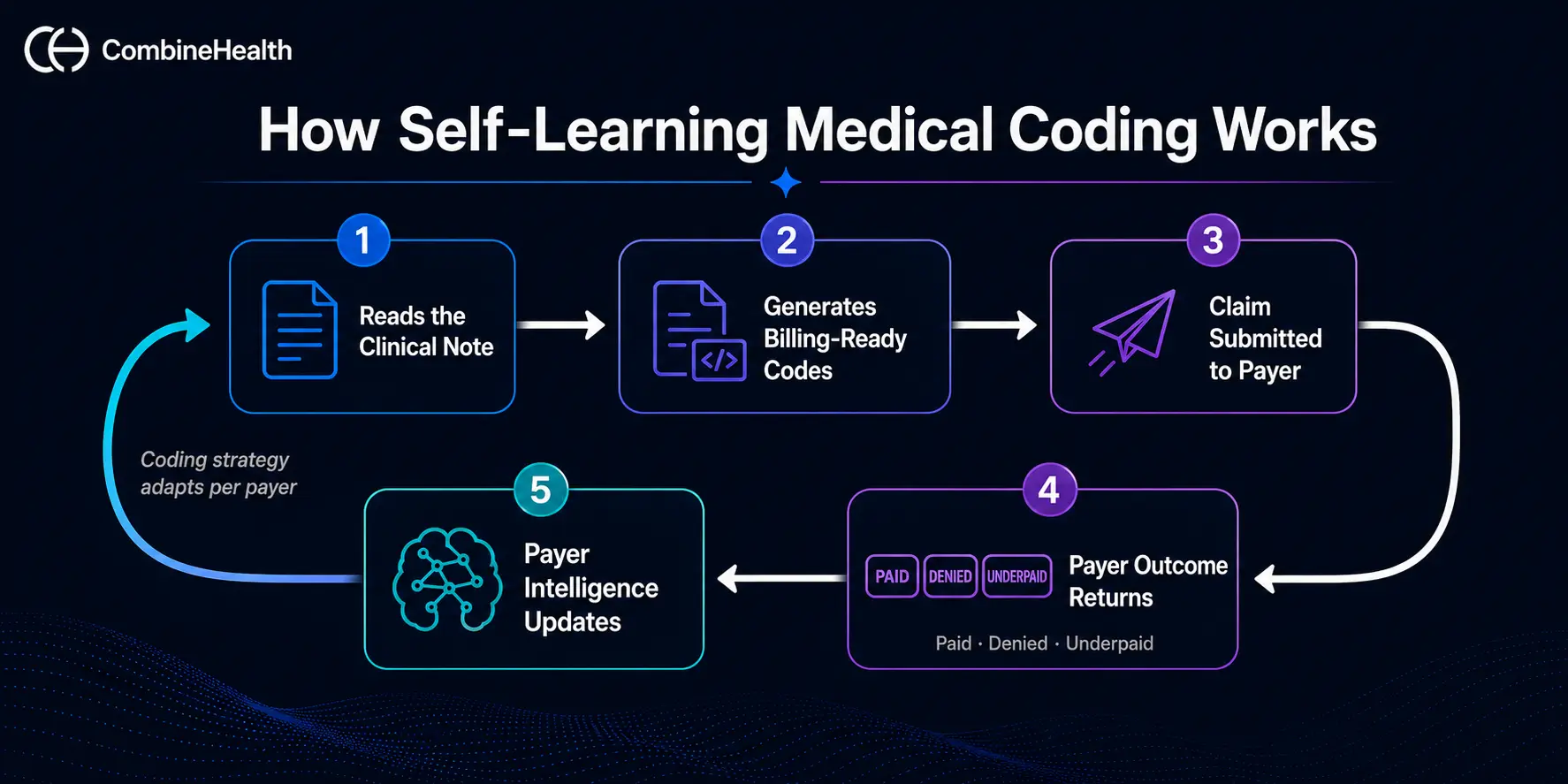
CombineHealth evaluates every coding decision against downstream claim outcomes, including reimbursements, denials, underpayments, and payer edits, and uses that feedback to build payer intelligence that adapts coding strategy per payer.
Every code carries a traceable audit trail linked to the supporting clinical documentation, so coders, auditors, and compliance teams can see exactly why a code was assigned and validate it against the source note.
Feature #1: Codes Routine and Complex Outpatient Encounters on the Same Path
CombineHealth pairs proprietary large language models with coding guidelines and payer-specific rules, so a straightforward office visit and a complicated multi-problem encounter both run through automation rather than routing the hard ones to a coder. The platform reaches automation rates of up to 85% while holding coding accuracy at 98%.
Feature #2: Turns Claim Outcomes Into Payer Intelligence
Every coding decision is measured against what the payer actually did with the medical claim: paid it, denied it, underpaid it, or applied an edit. That feedback accumulates into payer-specific intelligence, which changes how the platform codes for each payer over time. CombineHealth reports up to a 75% reduction in coding-related denials.
Feature #3: Traces Every Code Back to the Note
Each code carries an audit trail pointing to the documentation that supports it. Coders, auditors, and compliance staff can open any claim, see why the code was assigned, and validate it against the source note instead of accepting an output they cannot inspect.
Feature #4: Runs Inside the EHR and Practice Management Systems Already in Place
The platform reads completed documentation from the source system, applies its coding logic, and returns billing-ready output into the existing workflow. Nobody logs into a separate coding environment, and nobody retypes codes into billing.
Across deployments, CombineHealth reports:
- 85% automation rate across routine and complex coding scenarios
- 97.2% coding accuracy
- Up to a 75% reduction in coding-related denials
In a high-volume emergency department, CombineHealth reached roughly 98% coding accuracy while halving coding turnaround time and identified 5× more clinical documentation gaps than the existing workflow.
Read the Case Study
Best for: Medium and large hospitals, enterprise health systems, multi-site clinics, physician groups
2. Fathom
Fathom is an autonomous medical coding platform with a dedicated primary care product for ambulatory and hospital-based organizations.
It codes E/M levels, ICDs, procedure codes, and modifiers, with configuration options mapping to the decisions that drive outpatient professional-fee revenue.
Key Features
- Coding for in-person, audiovisual telehealth, and audio-only encounters
- Controls for E/M leveling, provider attribution, and incident-to billing
- Documentation deficiency flags plus MIPS capture
- Integrations with Epic, athenahealth, Oracle Cerner, MEDITECH, and eClinicalWorks
Best for: primary care and multi-site ambulatory groups with repeatable visit volume.
3. CodaMetrix
CodaMetrix is an autonomous coding company whose CMX CARE platform handles both facility-based and professional-fee coding, building a longitudinal patient view rather than coding each encounter in isolation.
It pairs automation with oversight tooling for coding managers.
Key Features
- Professional-fee and facility coding on one platform
- Specialty coverage including radiology, pathology, surgery, and evaluation and management
- CMX Amplify for real-time coder feedback, plus manager tools for QA rules and sampling
- CMX Insights dashboards covering automation and compliance
Best for: physician groups owned by or affiliated with a health system running Epic.
4. Nym
Nym is an autonomous medical coding company whose engine assigns codes and routes them to billing without human approval. It uses clinical language understanding rather than statistical code suggestion.
Its autonomous coding engine supports six defined specialties and service lines, giving Nym a focused approach across outpatient and inpatient professional coding.
Key Features
- Six supported service lines, including outpatient surgery, outpatient visits, and urgent care
- Transparent audit trail for every code assigned
- Configurable against a customer's internal coding guidelines
- Automatic updates as new coding guidelines are released
Best for: urgent care operators and outpatient surgery centers inside Nym's supported lines.
5. Maverick Medical AI
Maverick Medical AI is an autonomous coding company. Its mCoder and CodeAgent products read clinical reports and send ICD-10 and CPT codes to the billing system in seconds.
Completed patient charts can be sent directly to billing batch by batch. The platform focuses on making sure coding is accurate and verifiable before and after launch.
Key Features
- Direct-to-bill coding streamed to the billing system as batches are processed
- Explainability showing the documentation behind each code
- Pre-go-live validation against the customer's own historical coding
- Executive dashboard tracking both model and coder accuracy
Best for: Imaging centers and outpatient settings where coding runs from structured reports.
6. Solventum 360 Encompass Professional
Solventum 360 Encompass Professional System is a computer-assisted coding platform that uses natural language understanding to unify professional and facility coding in a single path.
It is built for outpatient clinics owned by a hospital system rather than independent practices.
Key Features
- Single-path coding combining professional and facility work
- Coverage for off-campus outpatient clinics, home and telehealth encounters, and specialty centers
- User-defined rules that send low-risk provider-generated claims straight to billing
- Integrated CDI with electronic queries, prioritized worklists, and auto-suggested queries
Best for: Employed physician networks with existing HIM and CDI processes.
7. Optum EncoderPro
Optum EncoderPro is an encoder tool (software that helps a coder look up, validate, and check codes rather than assigning them automatically) for physician-based reporting on the CMS-1500 claim form.
It is a reference and validation environment rather than an automation platform, making it suited to practices where people perform the coding. Its capabilities scale by its pricing tier.
Key Features
- CodeLogic search across CPT, HCPCS Level II, and ICD-10-CM with lay descriptions
- CCI edits and local coverage determinations in the Professional tier
- Expert-tier claim review checking unbundling, modifiers, and diagnosis completeness
- Fee calculator for regional Medicare rates, plus ASCExpert.com for surgery centers
Best for: Practices keeping coding in-house and needing reference depth plus pre-submission scrubbing.
8. AAPC Codify
Codify by AAPC is an online coding reference platform from the American Academy of Professional Coders. It is sold in tiers, including one built for professional-fee coding.
Its per-seat pricing makes it one of the more accessible options here for a small practice, although a coder still assigns every code.
Key Features
- Smart Search across CPT, HCPCS Level II, ICD-10-CM, and ICD-10-PCS
- CCI Edits Checker validating up to 25 codes at a time
- CMS 1500 Real Time Scrubber combining CCI edits with the Medicare Physician Fee Schedule and LCDs
- E/M calculator covering the 1995, 1997, 2021, and 2023 documentation guidelines
Best for: Practices with one to three in-house coders that need reference depth and claim scrubbing.
9. TruCode Encoder
TruCode Encoder, part of TruBridge, is a knowledge-based encoder tool built around a research pane that surfaces coding references as a coder works.
Its outpatient relevance is primarily in the editing and grouping layer rather than direct code assignment.
Key Features
- Research pane and prompts flagging unaddressed edits
- Outpatient claim editing using the Outpatient Code Editor, NCCI, and medical necessity edits
- Grouping and pricing across Ambulatory Payment Classification, Ambulatory Surgery Center, and Enhanced Ambulatory Patient Group logic
- Encoder Essentials available as embeddable web services
Best for: Ambulatory surgery centers and vendors or MSOs embedding encoder logic into their own platforms.
10. ModMed
ModMed is a specialty-specific health IT company whose EMA electronic health record suggests billing codes as the physician documents, rather than coding the chart afterward. Practice management and billing sit in the same system, removing the rekeying step. However, practices must adopt ModMed's EHR to use its coding capabilities.
Key Features
- ICD-10, CPT, modifier, and E/M level suggestions generated at the point of documentation
- ModMed Scribe 2.0 ambient documentation turning conversation into notes and codes
- Practice management and billing integrated with the clinical chart
- Specialty coverage across dermatology, ophthalmology, orthopedics, ENT, urology, plastic surgery, pain management, allergy, and OBGYN
Best for: Single-specialty practices willing to standardize on one vendor's EHR.
Automate Outpatient Medical Coding End-to-End
The right outpatient medical coding platform should work like another coder on the team: applying current medical coding guidelines to every chart, keeping pace with payer-specific rules, and improving as claim outcomes come back.
Most platforms on this list stop at code assignment.
CombineHealth, on the other hand, applies current, appropriate medical codes, learns from real medical claim outcomes, and adapts its medical coding strategy per payer, with a clear rationale behind every code.
If you are ready to move from manual coding to self-learning autonomous coding, book a demo with CombineHealth and see how it handles your outpatient encounters!
FAQs
What Is Outpatient Medical Coding Software?
Outpatient medical coding software translates documentation from outpatient encounters (office visits, urgent care, ambulatory surgery, and telehealth) into ICD-10-CM, CPT, HCPCS Level II, E/M, and modifier codes for professional-fee billing on the CMS-1500 claim form. Inpatient software centers on DRG assignment and facility billing instead.
What Is the Difference Between Professional-Fee and Facility Coding?
Professional-fee coding captures the physician's work and bills on the CMS-1500 form; facility coding captures the institution's resources and bills on the UB-04. An outpatient practice generally needs professional-fee coding only, which is why encoders built around DRG grouping add little value in a physician office.
Can a Small Outpatient Practice Use Autonomous Medical Coding?
Yes, though minimum encounter volume commitments vary by vendor. Practices under roughly 25 providers should ask what the smallest supported deployment is and whether a single-specialty pilot is offered.
Does Outpatient Medical Coding Software Handle E/M Leveling?
Most platforms here assign or suggest E/M levels, but the underlying logic differs. Ask whether the tool applies medical decision-making criteria independently or predicts levels from your historical coding, since the second reproduces existing undercoding.
How Does Outpatient Medical Coding Software Reduce Claim Denials?
It catches preventable denial causes before submission: modifier conflicts, NCCI edit violations, medical necessity gaps, and place-of-service mismatches. Platforms that feed denial outcomes back into coding improve on those patterns instead of repeating them.