Top 10 AI Medical Coders To Reduce Denials Due to Coding Errors
Compare the 10 best AI medical coders in 2026. CombineHealth delivers 97.2%+ coding accuracy, uses payer intelligence to inform coding decisions, and has reduced denials by 75%.
Published on:
September 10, 2026


Key Takeaways
• A claim receives a coding-related denial when the reported medical codes are incorrect or unsupported, rather than because of eligibility or prior authorization issues.
• AI medical coding prevents medical coding errors by assigning documentation-supported codes and applying payer rules before submission.
• Medical coding validation checks whether documentation supports the code. Claim scrubbing checks the finished claim against an edit library.
• CombineHealth is one of the leading self-learning AI medical coding platforms, validating each coding decision before submission and using adjudicated denial patterns to improve future coding and reduce repeat denials.
A medical coding error can turn a clean claim into a denial, forcing your team to rework the chart, appeal the claim, and wait longer for money you should have collected the first time.
For instance, in CMS’s Comprehensive Error Rate Testing review for fiscal 2025, medical claims billed just one E/M level off accounted for $1.37 billion in improper Medicare payments. Adopting AI medical coders can reduce this type of medical coding error.
Most AI medical coding platforms try to prevent these errors before submission by assigning accurate, documentation-supported codes. Fewer AI medical coding platforms learn from payer denials to identify recurring coding errors for you and prevent them from appearing on future claims.
In this article, we compare 10 AI medical coding platforms that can help improve coding accuracy, prevent errors, and reduce denials.
When Does A Coding-Related Medical Claim Denial Happen?
A coding-related medical claim denial happens when a payer rejects a claim because of the diagnosis, procedure code, modifier, or E/M level reported on it. It is different from denials caused by eligibility, patient registration, or prior authorization.
These denials are often preventable during medical coding, which makes them a strong target for medical coding automation. They appear on the remittance advice as Claim Adjustment Reason Codes (CARCs), which help identify why the payer rejected or reduced the claim.
Coding-related medical claim denials typically fall into nine categories:
- Incorrect or unsupported diagnosis or procedure codes
- Missing diagnosis specificity
- Diagnosis-procedure mismatches
- Missing or incorrect modifiers
- Bundling and National Correct Coding Initiative (NCCI) issues
- Unsupported E/M levels
- Medical necessity failures
- Payer-specific coding rule failures
- Documentation gaps that leave a medical code unsupported
How Can AI Medical Coding Reduce Claim Denials?
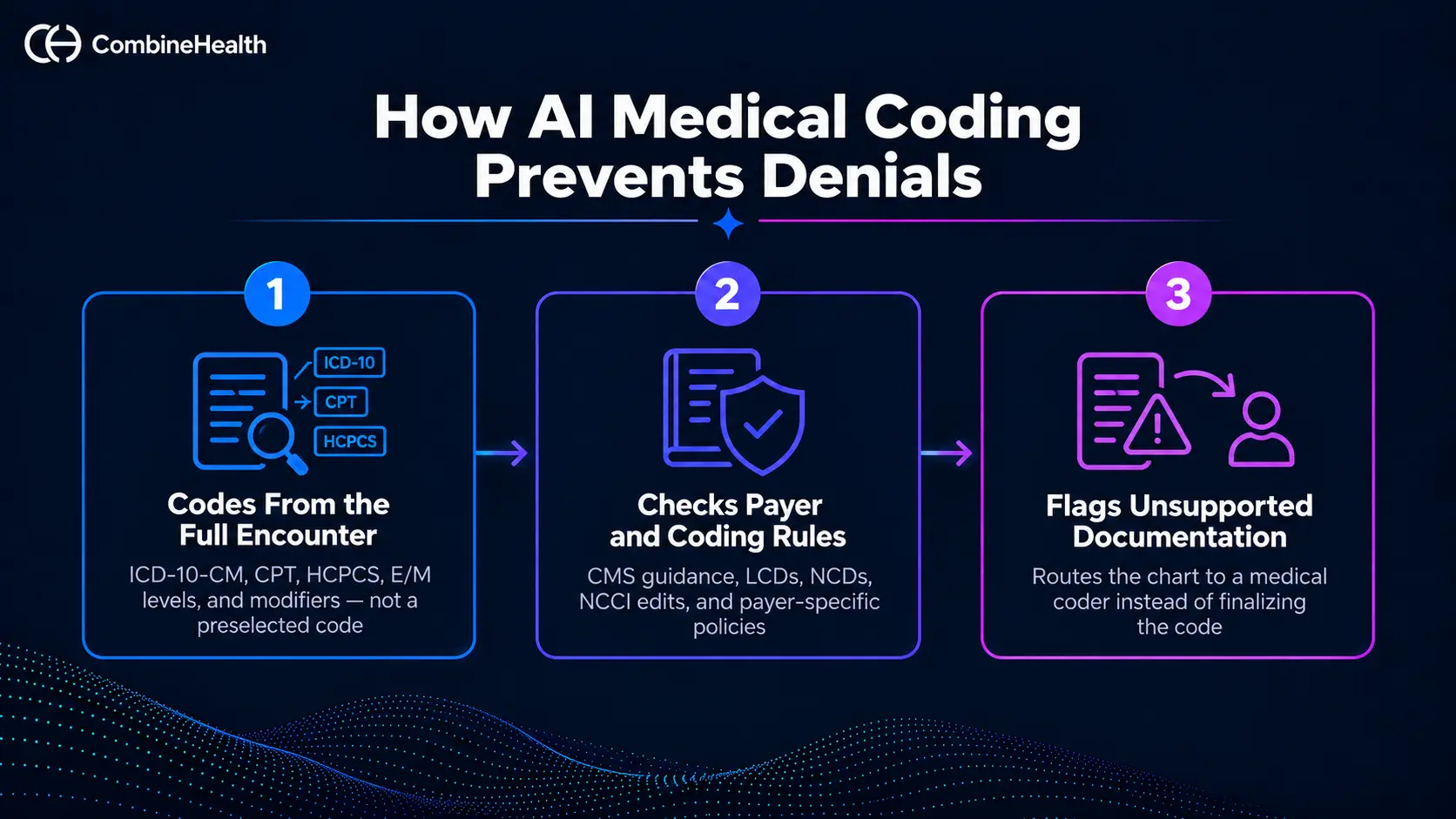
Alt: Infographic showing three ways AI medical coding prevents denials: full-encounter coding, payer rule checks, documentation flags
AI medical coding can reduce claim denials by assigning codes supported by the clinical documentation and checking coding guidelines and payer requirements before the claim is submitted. This can improve first-pass rates and reduce the rework needed after a denial.
The quality of these checks matters more than the medical coding automation rate. An AI medical coding platform that codes 95% of charts in seconds but cannot explain why it selected a code may still create problems when a payer challenges the claim.
Here is how AI medical coding works in a nutshell:
- AI assigns codes from the full clinical documentation. The AI medical coding platform determines ICD-10-CM, CPT, HCPCS Level II, E/M levels, and modifiers from the complete encounter rather than starting with a preselected code.
- AI checks codes against payer and coding rules before submission. The AI medical coding platform checks the assigned codes against CMS guidance, LCDs, NCDs, NCCI edits, payer-specific coding policies, modifier requirements, and the organization’s own medical coding rules.
- AI identifies documentation that does not support the assigned code. If the clinical documentation does not support a diagnosis code, procedure code, E/M level, or modifier, the AI medical coding platform flags the chart for medical coder review instead of finalizing an unsupported code.
Recommended Read: 10 CDI Best Practices
What Is the Difference Between Medical Coding Validation and Medical Claim Scrubbing?
The difference between medical coding validation and medical claim scrubbing is that medical coding validation checks whether the clinical documentation supports the codes assigned, while medical claim scrubbing checks a completed claim against a library of billing and coding edits before submission.
Recommended Read: Healthcare Claims Processing: Steps and Workflow
Top 10 AI Medical Coders to Reduce Coding-Related Denials
1. CombineHealth
CombineHealth (also known as Amy AI) is a self-learning, autonomous medical coding platform built for denial prevention. It combines pre-bill coding validation with downstream payer intelligence, so it can prevent coding errors before submission and use actual denial and reimbursement outcomes to improve future coding decisions.
How Does CombineHealth Help Reduce Coding-Related Denials
Before submission, CombineHealth:
- Reads the complete clinical encounter
- Generates or audits ICD-10-CM, CPT, HCPCS Level II, E/M levels, and modifiers
- Links procedure codes to supporting diagnosis codes and validates documentation support
- Applies CMS guidance, LCDs, NCDs, and organization-specific coding policies
- Identifies missing modifiers and documentation gaps
- Routes contradictory, uncertain, or high-risk cases for medical coder review
- Provides a code-level rationale and audit trail
The broader claim-validation workflow can also check eligibility, referrals, authorizations, demographics, duplicate-submission risk, and payer-specific claim requirements before submission.
After adjudication, CombineHealth:
- Categorizes denials by payer and reason
- Separates coding-related denials from medical-necessity patterns
- Identifies recurring modifier, diagnosis code, and CPT code issues
- Uses denial and reimbursement outcomes to build payer intelligence
- Surfaces candidate updates to future coding and billing policies
- Monitors whether the targeted denial pattern improves
Feature #1: Automates Complex Cases Autonomously and Accurately
Built on proprietary LLMs, coding guidelines, and payer-specific rules, CombineHealth autonomously handles up to 85% of medical coding at 97.2%+ accuracy at scale — including complex cases, not just routine encounters.
Feature #2: Continuously Learns From Claim Outcomes to Reduce Denials
CombineHealth’s self-learning extends beyond code generation. Downstream claim outcomes — including reimbursements, denials, underpayments, and payer edits — feed back into its payer intelligence, helping refine future coding decisions based on how each payer actually adjudicates claims.
Feature #3: Makes Every Medical Coding Decision Explainable
Every code generated by CombineHealth comes with a traceable audit trail linked to the supporting clinical documentation. Coders, auditors, and compliance teams can see why a code was assigned, review the underlying evidence, and validate the decision against the source note, rather than relying on black-box outputs.
Feature #4: Works Autonomously Inside Your Existing Workflows
CombineHealth operates autonomously within your EHR, PMS, and RCM, without requiring a separate coding environment. It reads clinical documentation from the source system and returns billing-ready codes directly into existing workflows.
CombineHealth cut coding-related denials by 75%
A 400-bed Midwest hospital reduced coding-related denials by 75% in three months after deploying Amy AI, while increasing captured revenue by 4%
Best for: Health systems and specialty groups looking to prevent coding-related denials before submission and use payer outcomes to improve future coding.
2. Nym
Nym Health’s autonomous medical coding engine uses Clinical Language Understanding (CLU), a hybrid of computational linguistics and rules-based clinical ontologies, to code encounters without human intervention across six service lines.
The same coding logic is applied to every encounter, with codes aligned to CMS, AMA, payer, and organization-specific coding guidelines. One large health system reported a 97% drop in its radiology professional fee coding-related denial rate after deployment.
For appeals, Nym provides the evidence at the time of coding. Each code includes supporting clinical documentation, guideline references, and a step-by-step rationale that can be used to support the code if a payer later challenges the claim.
Key features:
- Full audit trail for each code, usable as appeal evidence
- Consistent coding logic applied across encounters
- Customer-specific rules layered on top of CMS, AMA, and payer guidelines
- Epic Showroom Toolbox designation for Fully Autonomous Coding
Best for: Health systems and physician groups automating high-volume, structured specialties such as emergency medicine and radiology.
3. Sully
Sully.ai provides role-based AI agents. Its AI Medical Coder sits alongside an AI Scribe, AI Receptionist, and AI Nurse, with the agents sharing one EHR integration.
The medical coding agent reads clinical documentation and assigns ICD-10 and CPT codes for a medical coder to validate. Because coding happens inside the clinical workflow rather than a separate coding environment, its denial contribution starts at the point of care. Codes and documentation gaps can surface while the encounter is still in front of the clinician.
Key features:
- Provides real-time ICD-10 and CPT code suggestions, with a medical coder finalizing every chart
- Flags documentation gaps during the encounter
- Integrates natively with Epic, Cerner, Meditech, and Athenahealth across 50+ specialties
- Shares context across scribing, coding, and follow-up workflows
Best for: Ambulatory practices that want medical coding support within a broader clinical AI suite.
4. CodaMetrix
CodaMetrix offers CMX CARE, which processes more than 300,000 encounters daily across 25+ health systems.
Its denial-prevention approach centers on analytics and continuous model improvement. CMX Insights provides dashboards for coding performance, financial impact, and compliance risk, while CodaMetrix says customer denial data feeds back into its coding models.
At Oregon Health & Science University, coding-related denials for autonomously coded radiology encounters were 70% lower than manual coding, at 0.33% versus 1.09%.
Key features:
- CMX Insights dashboards covering coding performance and denial patterns
- Uses customer denial data to refine coding models
- Uses the longitudinal patient record as coding context, not just the current encounter
- Supports facility and professional fee coding across inpatient and outpatient settings
Best for: Large and academic health systems that need to standardize medical coding across multiple specialties and care settings.
5. Fathom
Fathom is an autonomous medical coding platform built on deep learning and natural language processing, with broad specialty coverage.
Its denial-prevention approach is primarily upstream. Real-time coding audits flag potential denials and downcoding before claim submission, while payer-rule flagging is built into the core coding workflow.
Fathom publishes automation and accuracy outcomes, including 99% automation in radiology, 95% in primary and urgent care, and 92% in emergency medicine, with results validated by KLAS Research.
Key features:
- Real-time coding audits flag potential denials and downcoding before claim submission
- Flags payer-specific coding rules within the coding workflow
- Supports broad specialty coverage with direct-to-bill workflows
- Flags charts with documentation deficiencies and routes them out of the automated workflow
Best for: High-volume multispecialty groups that need broad specialty coverage from a single autonomous medical coding platform.
6. AGS Health
AGS Health combines medical coding technology with staffed services covering both denial prevention and denial recovery.
Alongside computer-assisted professional coding (CAPC) and autonomous medical coding, it offers Denial Management and Prevention Services and a physician-led appeals practice. These services classify denial reasons, identify root causes, and handle appeals.
Across its coding and denial services, AGS Health reports a 26% reduction in denial rates.
Key features:
- Analyzes denial root causes across access, authorization, coding, and billing
- Provides physician-led clinical appeals with human review for complex cases
- Uses certified medical coder feedback to retrain coding models over time
Best for: Organizations that want medical coding technology combined with staffed denial management and appeals services from one vendor.
7. Maverick Medical AI
Maverick Medical AI provides autonomous medical coding for imaging, assigning ICD-10 and CPT codes from radiology reports through its mCoder engine.
Its denial-prevention workflow starts before the report is signed. CodeAgent checks the report for issues that could prevent accurate coding or billing and flags them while the radiologist can still make corrections.
Maverick reports a 50% reduction in denials and provides downstream reporting, including aging-days tracking and model-versus-coder variance reports.
Key features:
- Pre-signature checks that flag issues before the claim is created
- Aging-days and model-versus-coder variance reporting
- Explainability showing the documentation supporting each assigned code
Best for: Imaging centers and hospital-based radiology groups coding directly from radiology reports.
8. Aptarro
Aptarro is a rules and edits platform that addresses denial prevention at both the charge and claim levels.
Aptarro validates completed claims against a payer-specific edit library before submission. RevCycle Engine applies AI-assisted rules to charges as they leave the EMR and supports denial tracking, reporting, and workflow management after submission.
Aptarro reports a 50% reduction in denials and a 26% reduction in A/R days across its platform. At Newport Orthopedic Institute, CCI edit logic automatically corrected 70% of coding and billing issues.
Key features:
- Payer-specific and regulatory edit library that is continuously updated
- Denial tracking, reporting, and workflow management through RevCycle Engine
- Exception-based workflows that surface high-risk claims for review
- Integrates with existing EMR and practice management systems
Best for: Billing companies and medical practices that want a rules-based edit library integrated into their existing EMR or practice management system.
9. Akasa
Akasa provides generative AI assistants across prior authorization, documentation improvement, medical coding, and claims. AKASA Medical Coding is designed for coder-assisted workflows.
For denial management, AI Advisor drafts appeal letters using clinical information from the patient chart, which staff can review and edit before submission. Claim status automation categorizes denial reasons and routes denied and pending claims into follow-up workflows.
Each health system receives its own large language model, fine-tuned on its clinical and financial data. Suggestions include justifications linked to the supporting clinical text.
Key features:
- AI Advisor drafts appeal letters from patient chart context for staff review
- Claim status automation categorizes denials and routes them for follow-up
- Uses a health-system-specific model rather than a generic coding model
- Provides justifications with verifiable supporting text for each suggestion
Best for: Large health systems that want AI medical coding and denial workflows tuned to their own data while keeping medical coders in the loop.
10. RapidClaims
RapidClaims combines four products across denial prevention and recovery: RapidCode, RapidCDI, RapidScrub for pre-submission validation, and RapidRecovery for denial resolution.
RapidScrub validates claims against payer rules and NCCI edits and assigns a denial-probability score before submission. RapidRecovery classifies denials by payer, type, and root cause, drafts payer-specific appeals, and uses voice AI for payer follow-up.
RapidClaims reports a 70% reduction in coding-related denials at one provider group, with root-cause data feeding back into its medical coding and CDI engines.
Key features:
- Classifies denial root causes by payer and denial type
- Automates appeal drafting and payer follow-up through voice AI
- Assigns a denial-probability score to claims before submission
- Feeds denial root-cause data back into coding and CDI workflows
Best for: Provider groups that want medical coding, claim scrubbing, and denial recovery on a single platform.
How Should You Test an AI Medical Coder's Denial-Prevention Claims?
Test denial-prevention claims with a controlled pilot using your own historical claims, not a vendor demo using vendor-selected data. A demo shows how the medical coding platform codes a chart. A pilot shows whether it would have prevented the coding-related denials you actually received.
Establish your coding-related denial baseline by payer and code
- Measure your current coding-related denial rate.
- Break it down by payer, specialty, diagnosis code, procedure code, modifier, and denial reason.
- Select historical charts that represent your highest-volume and highest-denial categories.
Run the platform in audit mode against known denied and paid claims
- Run the medical coding platform in parallel or audit mode against the selected charts.
- Compare its diagnosis code, procedure code, E/M level, and modifier decisions with your coders' decisions.
- Back-test its decisions against claims with known paid and coding-related denial outcomes.
- Have your medical coding leadership adjudicate disagreements rather than allowing the vendor to determine which output is correct.
Deploy to one specialty and measure repeat denial patterns
- Deploy within a controlled scope, such as one specialty or payer at a time.
- Track results through payer adjudication, not just claim submission.
- Compare repeat coding-related denial patterns before and after deployment.
Use Payer Outcomes to Prevent Repeat Denials
A coding-related denial should not become a recurring problem. The goal is to catch the medical coding error before submission, understand why the payer rejected it, and use that outcome to prevent the same error on the next claim.
CombineHealth helps close that loop. Amy AI validates medical coding decisions before submission and uses adjudicated payer outcomes to identify recurring coding patterns, refine coding rules, and prevent repeat coding-related denials.
Book a demo to see how Amy AI would perform on your own claim denial data!
FAQs
Does an AI medical coder code from the full chart or validate a code someone already selected?
An AI medical coder can read the complete clinical encounter and determine the ICD-10-CM, CPT, HCPCS Level II, E/M levels, and modifiers itself. It can then check whether the documentation supports each coding decision. This helps catch unsupported codes, including E/M levels the physician's note does not support.
Which payer rules should an AI medical coder check before submission?
An AI medical coder should check medical coding against CMS guidance, Medicare LCDs and NCDs, payer medical policies, CPT modifier rules, and the organization's coding policies before submission. This helps catch missing modifiers, diagnosis-to-procedure mismatches, and medical-necessity issues before they become denials.
What happens when the documentation is unclear or the AI medical coder is not confident?
The AI medical coder should flag the chart for medical coder review instead of forcing an unsupported code through. The reviewer should receive the recommended code, rationale, and audit trail to evaluate ambiguous or high-risk encounters.