How to Adapt Medical Coding to Payer Guidelines
Learn how healthcare teams keep medical coding aligned with shifting payer rules using AI validation, denial-pattern detection, and rule updates.
Published on:
September 9, 2026


Key Takeaways:
• The challenge of payer-specific medical coding is that standardized ICD-10-CM, CPT, and HCPCS codes get layered with payer-specific coverage rules, modifiers, and documentation thresholds, meaning identical coding for identical services can be paid by one payer and denied by another.
• Medical coding variability across payers shows up in real, high-volume scenarios, like Anthem and UnitedHealthcare requiring different Modifier 25 documentation standards for the same clinical scenario, or Medicare and commercial payers applying different rules to molecular pathology bundling and telehealth modifiers.
• Changing payer guidelines affect healthcare reimbursement by turning one missed rule update into a compounding pattern of denials, rework, undercoding, and unnoticed underpayments, since the same code keeps getting submitted the same way until someone catches the shift.
• AI handles payer-specific medical coding rules by treating them as configurable rules scoped by payer, plan, specialty, and effective date, running pre-bill validation, medical-necessity checks, and denial-pattern detection.
• Medical coding should evolve through a continuous, structured update cycle rather than a quarterly manual refresh, treating each unusual denial as a signal to investigate, test, and version into a rule change within days instead of months.
• CombineHealth is a self-learning autonomous medical coding platform that adapts coding to payer guidelines by combining published payer and CMS requirements with observed claim outcomes. It uses payer intelligence to adapt a coding configuration the moment a denial pattern reveals a payer-specific shift, an approach tied to 98%+ medical coding accuracy and up to a 75% reduction in coding-related denials.
Medical coding can be adapted to changing payer guidelines by treating payer-specific rules as a live, configurable ruleset instead of a static document. This means monitoring them continuously and updating coding the moment a payer changes a modifier, limit, or requirement.
A claim denial letter rarely quotes a policy change. It cites a code, a modifier, and a reason, and by the time someone traces it back to a payer rule that shifted weeks ago, an entire batch of claims has already gone out coded the old way.
Medical coding runs on two layers.
- The first is standard medical coding guidance: ICD-10-CM, CPT, HCPCS, CMS rules, Local Coverage Determinations (LCDs), National Coverage Determinations (NCDs), and National Correct Coding Initiative (NCCI) edits.
- The second is payer-specific requirements: the modifiers, coverage limits, authorization rules, documentation expectations, and claim edits that each payer layers on top of those same codes.
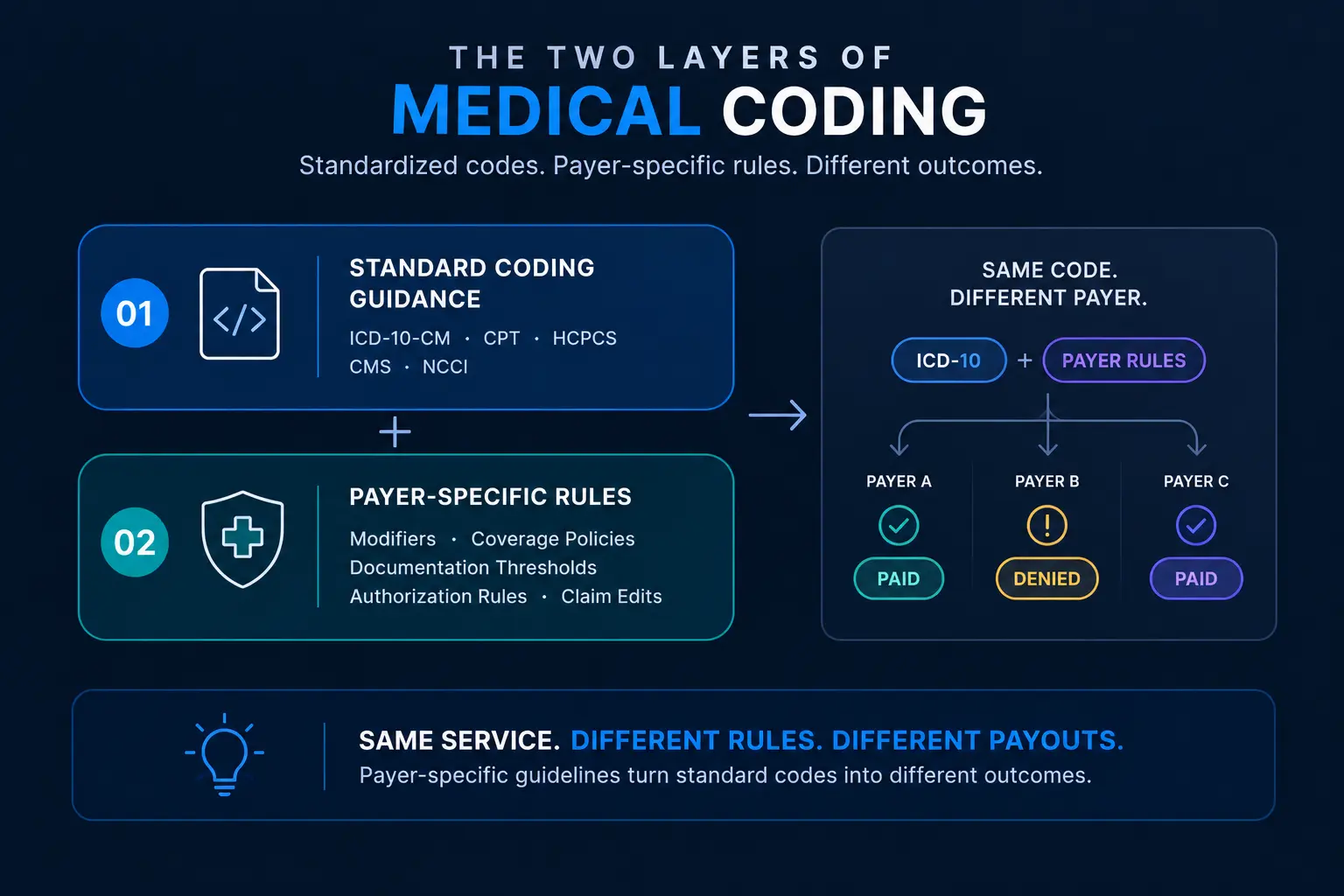
While the standard coding guidelines rarely change, it's the payer-specific requirements that keep changing constantly. Modifiers get redefined, coverage limits shift, and documentation expectations tighten, often without a formal notice reaching every provider.
The healthcare organizations that keep denials low treat that second layer as a configurable ruleset that updates continuously, not a rulebook revisited a few times a year. Everything in this guide builds from that one distinction.
What is the Challenge of Payer-Specific Medical Coding?
The challenge of payer-specific medical coding is that while ICD-10-CM, CPT, and HCPCS codes are standardized, each payer layers its own coverage rules, modifier logic, and documentation thresholds on top of them. This means identical coding for identical services can be paid by one payer and denied by another.
Payers typically diverge on:
- Coverage policies deciding which diagnoses justify a given procedure.
- Modifier requirements dictating which modifiers a payer accepts and under what conditions.
- Bundling edits that treat one service as inclusive to another and deny the second line outright.
- Documentation standards setting how much clinical detail a code needs to survive review.
- Medical-necessity criteria that vary by plan even under shared CMS guidance.
- Visit and frequency limits capping how often a service can be billed within a defined period.
- Prior-authorization rules tied to specific services, specific plans, or specific provider types.
Examples of Medical Coding Variability Across Payers
The medical coding variability shows up in Modifier 25 documentation thresholds, molecular pathology bundling and jurisdiction rules, and telehealth modifier assignments that differ by payer and visit type. These are not edge cases: each runs through normal, high-volume billing that most practices submit every week
Modifier 25
Anthem's policy denies an E/M service billed with Modifier 25 on the day of a related procedure when the record shows a recent service for the same or similar diagnosis. UnitedHealthcare's Medicare Advantage policy requires Modifier 25 on the E/M code for a same-day significant service, but does not require two separate diagnosis codes. Same modifier, same clinical scenario, two different standards, and a claim built to satisfy one will not automatically satisfy the other.
Medicare’s NCCI Policies
A claim can be fully compliant and accurately reflect the services provided, yet still get denied because the payer wants a different modifier than the one used, requires an entirely different CPT code, or doesn't follow Medicare's NCCI reimbursement policies at all. The code itself wasn't wrong. It just wasn't coded to the standard the specific payer was actually applying.
Telehealth Modifiers
Medicare retired the GT modifier for Part B professional claims and defaults to Modifier 95 for synchronous audio-video visits. GT still applies to Critical Access Hospital Method II institutional claims and to several state Medicaid programs. Audio-only visits use Modifier 93 broadly, while Modifier FQ is reserved for Federally Qualified Health Centers and Rural Health Clinics.
One default modifier across a mixed payer panel guarantees denials somewhere in that mix, since the correct modifier depends on the payer and the visit type rather than on habit.
How Do Changing Payer Guidelines Affect Healthcare Reimbursement?
Changing payer guidelines affect healthcare reimbursement by turning one missed update, for instance, a payer that starts requiring a modifier it previously didn't, into a compounding pattern of denials. Every claim built the old way keeps going out coded the old way until someone catches the pattern, and by then the exposure has already spread across every similar claim submitted in between.
The list below outlines eight ways a missed payer-guideline update shows up across an organization's revenue cycle. Each one traces back to the same root cause: medical coding logic that hasn't caught up with what a specific payer currently requires.
- Medical coding-related denials trace back to a modifier, documentation gap, or bundling edit. It isn’t about a wrong code, which means the fix lives in the rule configuration rather than in coder retraining.
- Slower cash flow happens because denied claims for a payer-specific reason sit in correction and resubmission queues instead of moving toward payment. This pushes out the timeline for actual reimbursement.
- Rework and appeals consume billing staff time without adding new revenue, since the same claim has to be touched more than once.
- Undercoding happens when staff avoids a payer-sensitive code to reduce denial risk, trading accurate reimbursement for a lower but safer one.
- Underpayments go unnoticed when a partial payment is accepted without review against the contracted rate.
- Compliance exposure grows as documentation drifts from what a payer currently expects, raising audit and takeback risk.
- Administrative burden rises as coders track payer rules manually, often payer by payer, plan by plan, with no shared system of record.
- Inconsistent coding across facilities sets in when each site invents its own workaround for the same unresolved rule gap, turning one policy miss into a repeated error.
How Does AI Handle Payer-Specific Medical Coding Rules?
AI systems built for medical coding treat payer-specific requirements as configurable rules scoped by payer, plan, specialty, and effective date, rather than static reference material a coder has to remember. The AI executes rules that specialists configure and approve; it does not independently interpret and deploy a payer update on its own.
Dynamic Payer-Rule Configuration
Coverage policies and modifier requirements are stored as structured rules that can be checked at the point of medical coding, so the same code set is evaluated differently depending on which payer will receive the claim. A specialist still authors and approves each rule; the system's role is to apply it consistently across every claim that matches its scope.
Pre-Bill Coding Validation
Before a claim goes out, the system checks diagnoses against clinical documentation, procedures against documented services, CPT codes against supporting diagnoses, E/M levels against medical decision-making, modifiers against code combinations, and the finished claim against applicable medical coding edits. Each check runs against the specific payer's configured rules rather than a single national default.
Medical-Necessity Validation
The documented condition and service are compared against the LCD, NCD, CMS, and payer requirements that apply, catching cases where the clinical picture does not yet support the level of service being billed. This surfaces a documentation gap before submission, when a coder or clinician can still close it, rather than after a payer flags it in a denial.
Modifier, Referral, and Authorization Checks
Referrals and prior authorizations get confirmed on file before submission, covering the payer-specific claim requirements that sit outside code selection entirely. A correct code attached to a missing authorization still denies, so this check closes a gap that medical coding accuracy alone cannot.
Contextual Review of Clinical Documentation
The system reads the relevant record and flags whether the specific evidence a payer requires is present, missing, or contradictory, rather than only confirming that some clinical documentation exists. Two payers can require different evidence for the same service, so a record that satisfies one payer's threshold can still fall short of another's.
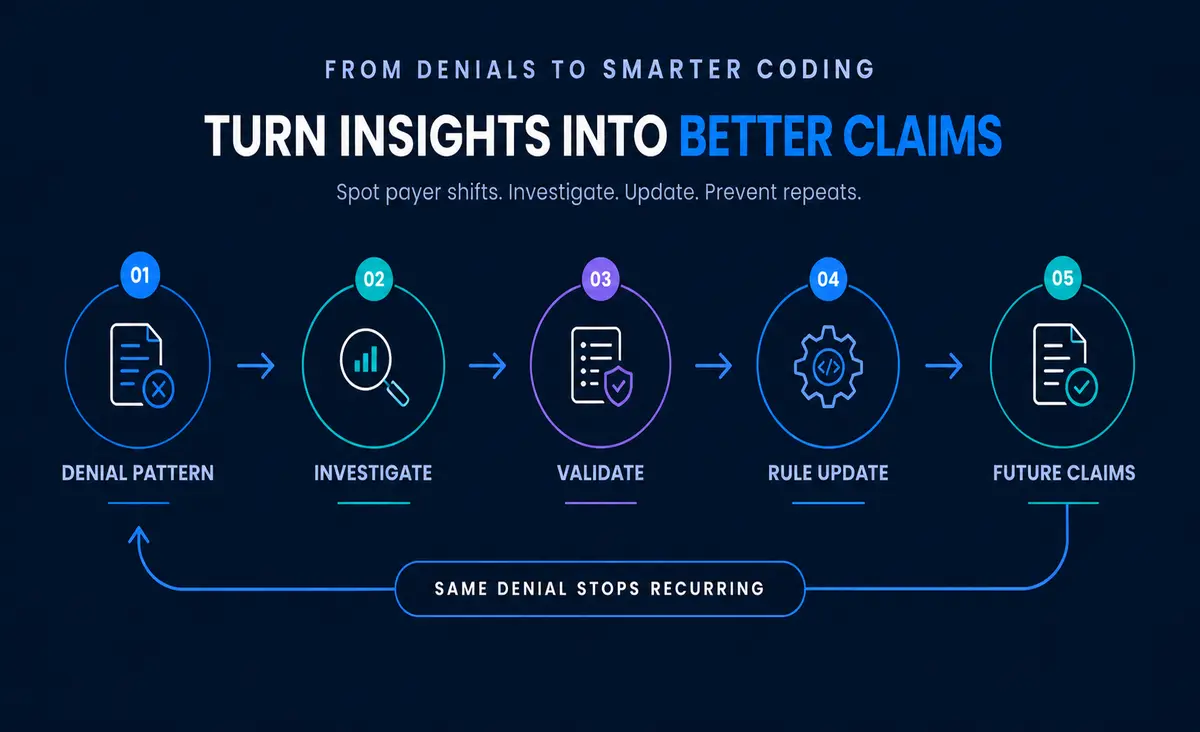
Denial-Pattern Detection
Returned claim denials get grouped by payer, reason, code combination, modifier, provider, and specialty. A cluster of the same denial reason concentrated on one payer or one code pairing is usually the first reliable sign that a policy has changed, arriving well before a payer sends a formal bulletin.
Controlled Continuous Improvement
Validated denial findings become proposed updates to medical coding and claim-validation policy, so the same denial reason stops recurring on the next batch of claims. The update still goes through review before it takes effect, which keeps the improvement loop auditable rather than automatic.
How Should Medical Coding Evolve When Payer Behavior Changes?
Medical coding should evolve through a continuous, structured update cycle of payer intelligence rather than a quarterly manual refresh. This means treating each unusual denial as a signal to investigate immediately, then testing, versioning, and applying the resulting rule change within days instead of months.
A quarterly manual refresh leaves an organization medical coding against outdated payer behavior for months at a stretch. A continuous cycle catches the same shift within days by treating each unusual denial as a signal worth investigating rather than filing it away as a one-off exception.
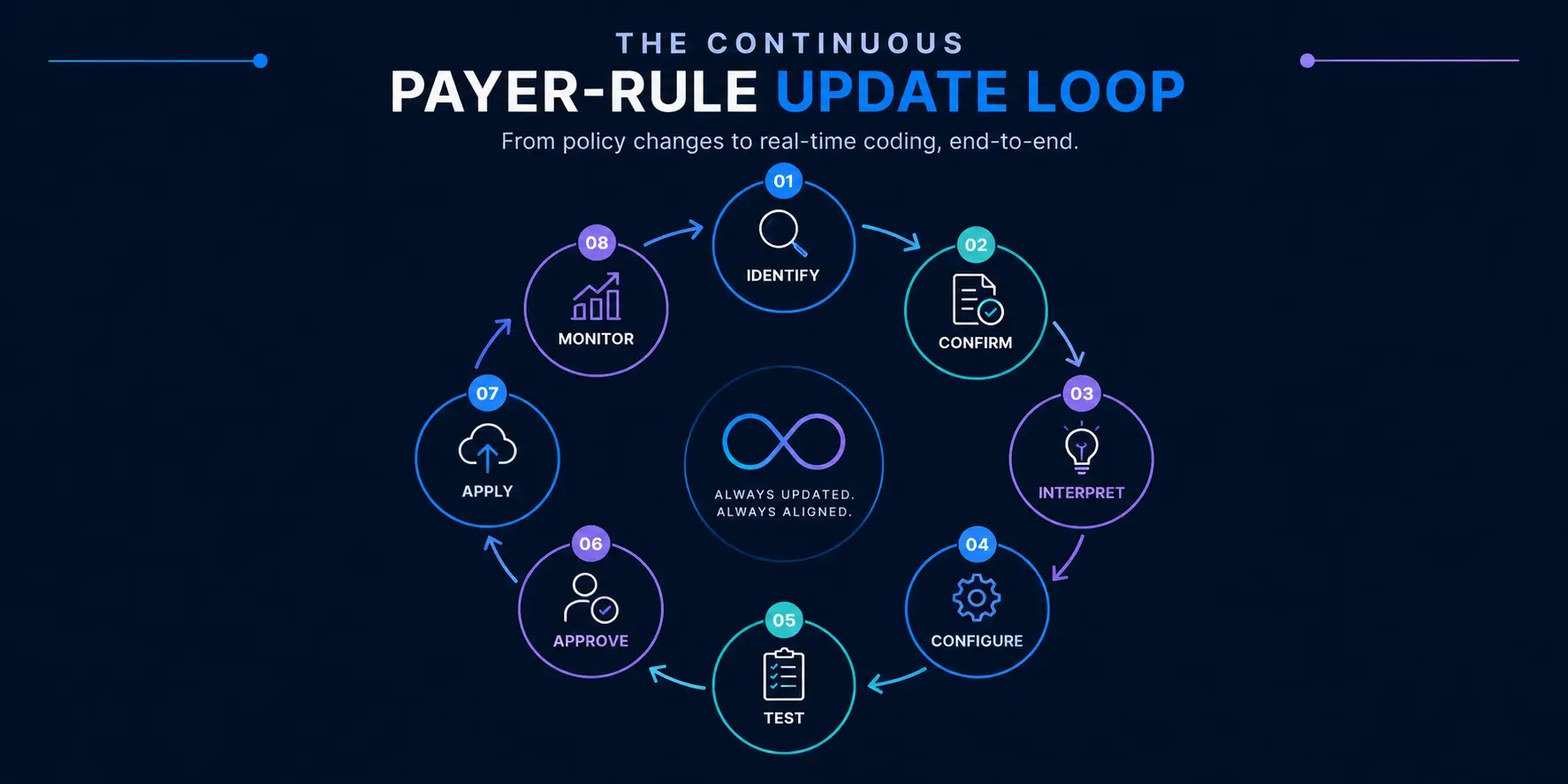
- Identify the policy change or unusual payer outcome, often through a spike in a specific denial reason.
- Confirm the affected payer, plan, specialty, codes, and effective dates.
- Interpret the requirement against the payer's published policy or the observed pattern.
- Configure a proposed rule that reflects the requirement.
- Test it against historical claims to see how it would have performed.
- Review false positives and the financial impact before going live.
- Approve and version the rule so the change is tracked and reversible.
- Apply the rule to future claims.
- Monitor whether the targeted denial rate actually declines.
How Does CombineHealth Adapt Medical Coding to Payer Guidelines?
CombineHealth combines published payer and CMS requirements with observed claim outcomes. When recurring denials reveal a payer-specific pattern, the platform helps teams investigate the issue, validate the response, update the relevant configuration, and monitor future results.
Before Submission
CombineHealth, also referred to as Amy AI, reads the complete encounter, generates or validates diagnosis and procedure codes, and links each procedure to the diagnosis that supports it. It explains its coding rationale, applies standard coding guidance together with each payer's specific rules — learned from that payer's real claim outcomes — and flags documentation, modifier, and medical-necessity issues before the claim goes out.
The claim-validation workflow checks referrals, authorization, demographics, and modifiers, so a claim that reaches the payer has already cleared the same checks that the payer's own adjudication engine will run.
After Adjudication
CombineHealth analyzes denials by payer and reason, surfacing coding-denial patterns, medical-necessity issues, modifier-related trends, underpayments, and configuration gaps. Validated findings inform the policies applied to future claims, which is how a denial on one claim becomes a corrected rule protecting every similar claim that follows it.
Onboarding and Continuous Learning
During onboarding, CombineHealth incorporates an organization's own billing and medical coding rules and back-tests its medical coding logic against that organization's historical charging behavior. Specialties with less prior claim volume get additional back-testing rigor to capture the payer-specific nuances those specialties tend to encounter.
In one real example, a payer began denying CPT 97140 billed alongside 97530 for a missing modifier, and CombineHealth surfaced the pattern in near real time, correcting the coding configuration before the next batch of similarly coded claims went out.
In an emergency department case study, this approach:
- Delivered approximately 98% medical coding accuracy
- Helped cut medical coding turnaround time by 50%
- Identified 5 times as many clinical documentation gaps as in the prior workflow.
Across its broader deployment, CombineHealth maintains an 85% automation rate and 98%+ coding accuracy, and has driven up to a 75% reduction in coding-related denials.
See Payer-Aware Medical Coding in Action
Most medical coding teams find out a payer's rules changed only after a batch of claims comes back denied. CombineHealth catches the shift in the denial pattern itself, corrects the underlying rule, and applies it before the next batch goes out. See how it works on your own claims data with a personalized demo.
Frequently Asked Questions
How often do payer guidelines actually change in healthcare?
Payer-specific requirements, such as modifiers, coverage limits, and documentation thresholds, can change multiple times a year and often without a formal announcement to every provider. A quarterly review cycle can leave an organization medical coding against outdated rules for months at a stretch.
How can a medical coding team tell that a payer's rules have changed before getting a formal notice?
A cluster of denials with the same reason, concentrated on one payer or one code combination, is usually the earliest reliable signal. It typically shows up before a payer issues a formal policy bulletin.
Does adapting to payer changes mean retraining coders every time a rule shifts?
No, most payer-specific denials trace back to a modifier, documentation gap, or bundling edit rather than an incorrect code. The fix usually lives in updating the rule configuration, not in retraining medical coding staff.
Can one organization realistically track rule differences across a dozen payers?
Manually, it's difficult, since each payer, plan, and specialty can carry its own version of the same rule. This is why organizations are moving toward a configurable rules engine that scopes requirements by payer, plan, and effective date instead of tracking them by memory or spreadsheet.
Does AI change a medical coding rule on its own?
Rule changes are controlled, not automatic. The platform surfaces the denial pattern behind a payer shift and the evidence for it, and every change is explainable, versioned, and reversible — so updates are auditable and can be rolled back, and coding stays aligned to each payer's current rules within days rather than months.