Medical Coding Automation ROI: How to Calculate the Net Return
Calculate medical coding automation ROI by measuring labor savings, improved coding accuracy, reduced denials, and additional reimbursement against implementation and operating costs.
Published on:
September 8, 2026


Key Takeaways
• Medical coding automation ROI compares the financial value automated coding creates against the full cost of implementing and operating it.
• Measure your current medical coding cost, accuracy, denial rate, turnaround, and backlog before implementation begins, because these numbers cannot be reconstructed after go-live.
• Autonomous medical coding rate determines how much volume moves without a human coder’s review, which makes it a bigger driver of cost value than accuracy alone.
• Report medical coder labor savings, additional reimbursement collected from corrected undercoding, and coding-related denial reduction as three separate line items in your ROI model. A blended number hides which of the three is actually producing your medical coding automation ROI.
• CombineHealth is one of the best self-learning autonomous medical coding platforms, with payer intelligence that feeds real claim outcomes back into coding policy, and customer-reported results including 75% fewer coding-related denials and 4% more captured revenue.
Published ROI numbers from medical coding automation vendors can be accurate, but they are specific to the client behind them. The results depend on that organization's specialty mix, chart volume, documentation quality, and baseline coding cost.
Your medical coding automation ROI is the number that matters at the end. Calculate it before adopting medical coding automation to understand what you can expect from the investment. Calculate it again after go-live to see where you can increase the return.
This article covers where medical coding automation creates value, which costs to include in the calculation, how to run the math using your own volume, and what to measure after go-live.
What Is Medical Coding Automation ROI?
Medical coding automation ROI measures the financial value created by automated medical coding against the full cost of implementing and operating the system. It shows whether the investment pays for itself and how quickly. The calculation includes changes in medical coding cost, medical coder capacity, reimbursement, denials, rework, and submission speed. It also accounts for the costs required to generate those results, including medical coding software, integration, validation, and human review.
Several metrics are often mistaken for ROI:
- Medical coding accuracy
- Medical coding automation percentage
- Charts processed per hour
- Coding-related denial rate
- Revenue increase
- Payback period
These metrics are either inputs to the ROI calculation or outcomes that help explain it. They are not ROI on their own.
A platform can achieve 98% coding accuracy and still deliver negative medical coding automation ROI if it automates too few charts or requires high medical coding software integration and review costs.
Where Does Medical Coding Automation ROI Come From?
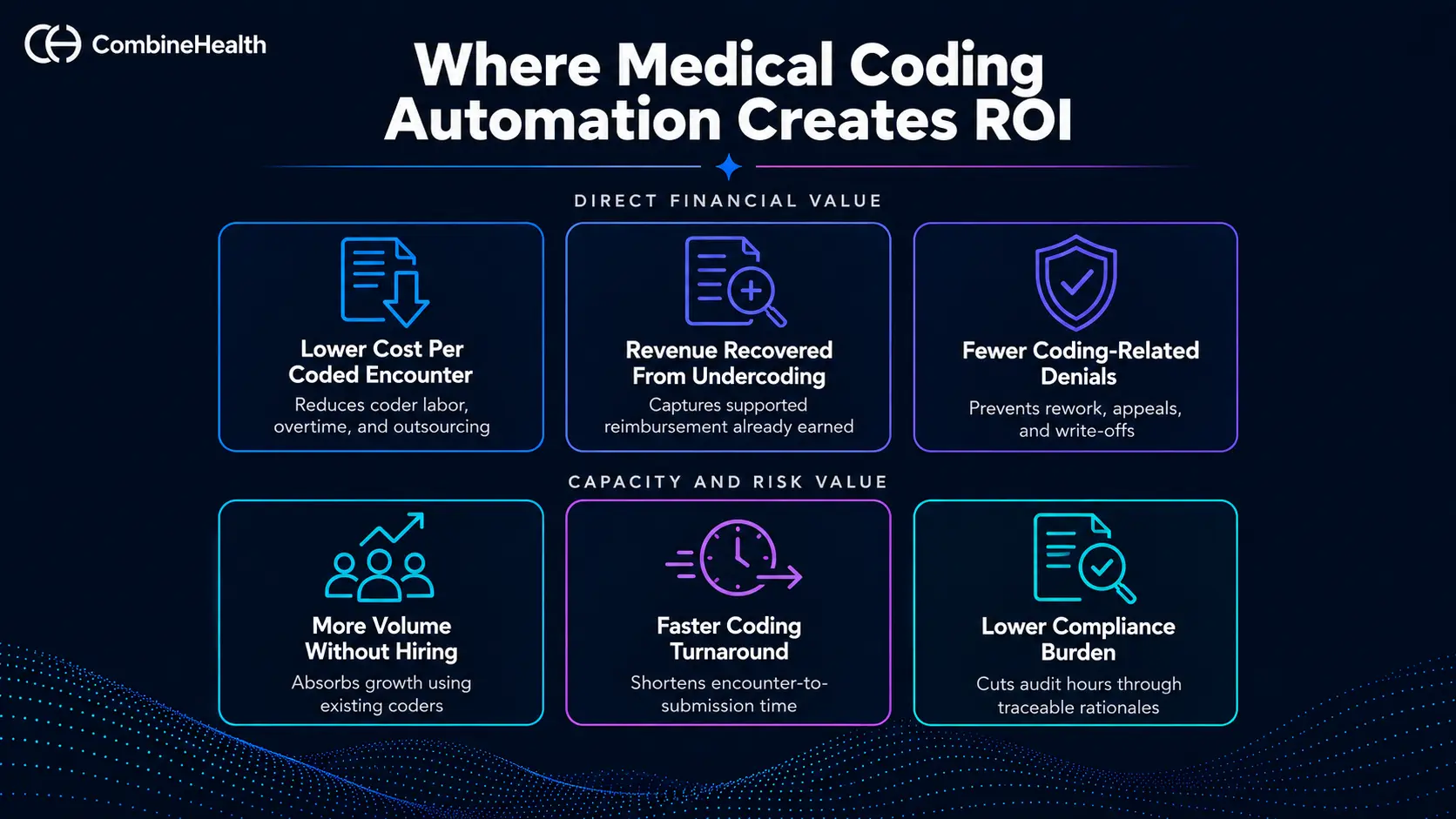
Medical coding automation creates ROI in six areas: cost per coded encounter, medical coding capacity, revenue recovered from undercoding, coding-related denials, coding turnaround, and compliance burden. These benefits affect your financials differently. Some create direct savings or additional reimbursement. Others create medical coder capacity or reduce audit and compliance risk.
Lower Cost Per Coded Encounter
Medical coding automation can reduce employed medical coder labor, outsourced medical coding fees, overtime, temporary staffing, QA review, management overhead, and recruitment costs.
But do not assume automation creates immediate payroll savings. If your medical coders remain employed, the value may instead come from increased medical coders’ capacity, avoided hiring, or moving medical coders to more complex cases.
Recording the full labor cost as savings before headcount actually changes will overstate year-one medical coding automation ROI.
Handle More Chart Volume Without Proportional Medical Coder Hiring
Medical coding automation can help your team code more encounters without adding coders at the same rate.
Avoided Hiring Value = FTEs Otherwise Required × Fully Loaded Cost Per FTE
This can be a major benefit for organizations adding providers or working through a coding backlog. Use the fully loaded cost per FTE, including benefits and supervision, rather than base salary alone.
Revenue Recovered From Undercoding
AI auditing of existing medical codes can identify missed procedures, insufficient diagnosis specificity, unsupported default E/M patterns, missing modifiers, documentation opportunities, and payer-specific coding opportunities.
Count only additional reimbursement that is supported by the documentation and actually received. Do not treat identified revenue opportunities as recovered revenue until the additional reimbursement is paid.
Recommended Read:The Complete Guide to E/M Coding
Fewer Coding-Related Denials
Preventing medical coding-related denials can reduce denied dollars, appeal and rework costs, write-offs, and the staff time required to correct claims.
Before attributing this value to a medical coding platform, separate coding-related denials from denials caused by eligibility, authorization, credentialing, and other non-coding issues.
Recommended Read: A Guide for Effective Denial Management in Healthcare
Faster Medical Coding Turnaround
Faster medical coding reduces chart backlogs, shortens the time between the encounter and claim submission, and helps hold turnaround steady during volume spikes.
This can improve cash flow and reduce timely-filing risk, which is real: Medicare fee-for-service claims must generally be filed within one calendar year of the date of service, and many commercial payers allow less.
And do not count the entire cash acceleration as new revenue. Separate faster collection from incremental revenue and quantify only what the improvement actually produced.
Lower Medical Coding Compliance And Audit Preparation Burden
Medical coding automation enables consistent medical code assignments and traceable coding rationales. This can also reduce audit hours because auditors can see which documentation supports each code instead of reconstructing the coding decision.
They can also surface systematic coding errors earlier, before those errors affect a large number of claims. CMS's Comprehensive Error Rate Testing program counts a claim as improper when it fails coverage, coding, or billing rules, or when the documentation does not support the claim. In fiscal year 2025, the Medicare fee-for-service improper payment rate was 6.55%.
Keep this benefit separate from hard-dollar medical coding automation ROI unless you can quantify the audit hours saved.
Recommended Read: Explainability in AI medical coding
What Costs Should Be Included In The Medical Coding Automation ROI Calculation?
The ROI calculation for AI medical coding should include every cost required to run automated medical coding in production, not just the software fee.
Below are the ten cost categories that belong in the calculation:
How Do You Calculate Medical Coding Automation ROI?
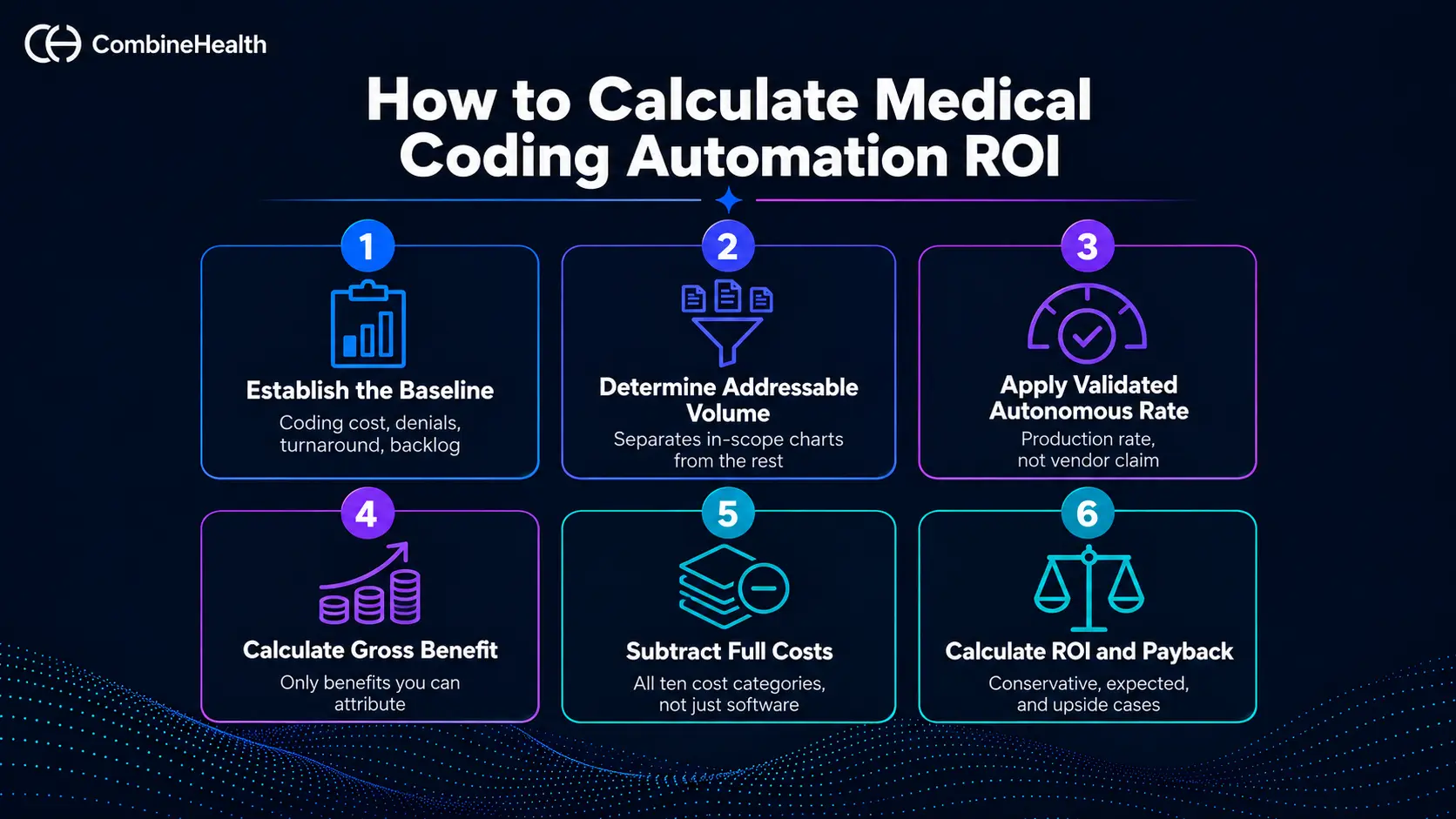
Step 1: Measure Your Current Medical Coding Cost And Performance
Collect monthly patient encounter volume by specialty, employed and outsourced medical coding costs, fully loaded coder cost, charts per coder per day, cost per coded encounter, turnaround time, backlog, coding-related denial rate, denied dollars, rework cost, undercoding findings, and first-pass payment rate.
Without a baseline, you cannot reliably measure improvement or prove the financial impact of automation.
Step 2: Determine The Addressable Chart Volume
Separate in-scope charts from out-of-scope specialties, incomplete documentation, complex cases, unlisted or rare procedures, and high-risk cases requiring review.
Addressable Charts = Total Charts × In-Scope Percentage
This prevents you from assuming the medical coding platform can automate your entire coding volume when only part of it is actually eligible.
Step 3: Apply The Validated Autonomous Rate To Eligible Charts
Use the medical coding autonomous rate achieved in production at your required accuracy threshold. Do not use the percentage of charts where the platform can generate a coding suggestion.
Autonomously Coded Charts = Addressable Charts × Validated Autonomous Rate
The distinction matters because a coding suggestion is not the same as an autonomous code assignment that meets your accuracy requirements. Using the former in a medical coding automation ROI can overstate the expected return.
Step 4: Add Up The Benefits You Can Actually Attribute To Medical Coding Automation
Add the financial benefits you can actually attribute to medical coding automation:
- Realized medical coding-cost reduction
- Avoided hiring
- Measured revenue lift
- Medical coding-related denial savings
- Reduced rework
- Quantifiable cash-flow gain
Use realized or supportable benefits rather than vendor-reported potential.
Step 5: Subtract Medical Coding Automation Implementation And Operating Costs
Include both one-time and recurring expenses across all ten cost categories, including software, integration, implementation, internal labor, QA, exception handling, maintenance, and expansion costs.
Step 6: Calculate Net ROI and Payback Period
Report monthly and annual net benefit, first-year ROI, three-year ROI, and payback period.
Model each using three scenarios:
- Conservative: Lower automation and benefit assumptions with higher costs
- Expected: Most likely production performance and costs
- Upside: Higher validated performance with the corresponding volume and benefit assumptions
This gives finance a range of potential outcomes instead of a single ROI figure that depends on optimistic assumptions.
How Does Autonomous Medical Coding Automation Rate Affect ROI?
The autonomous medical coding rate determines how much eligible coding volume can move through the workflow without routine coder approval. That makes it one of the biggest drivers of coding-cost value.
An AI medical coding platform with high accuracy but a low automation rate may create less financial value than one with a slightly lower but acceptable accuracy rate that can safely automate more eligible charts.
For example, both scenarios below have the same monthly volume, in-scope volume, and savings per autonomous chart. Doubling the autonomous rate from 40% to 80% doubles the monthly coding-cost value.
Recommended Read: 6 Key Trends In Medical Coding For 2026
How Much Medical Coder Workload Does Medical Coding Automation Actually Eliminate?
Medical coding automation removes the manual coding and review time for the charts it codes autonomously, not a fixed share of your medical coders' work time.
To find the real number, take the minutes your coders used to spend on those charts. Then subtract the time they now spend on exceptions and QA review. Automating 60% of charts rarely frees up 60% of coder hours, because that review work does not disappear.
Hours Released = (Autonomous Charts × Manual Minutes Per Chart) − Exception And QA Hours
Medical code suggestions alone raise throughput without eliminating the review step.
Autonomous medical coding removes routine review from eligible charts, and those hours go to complex medical coding, coding quality review, CDI, denial analysis, or backlog clearance. Do not call reassigned capacity payroll savings unless headcount or contracted spend changes.
How Much Revenue Can AI Recover From Undercoding?
AI can recover revenue when it identifies a more specific or complete code that is supported by the documentation and the payer reimburses the additional amount.
A suggested charge increase is not ROI until it becomes compliant, submitted, and collected revenue. The difference can be significant because payers adjudicate claims based on documentation, not code selection alone.
Track the number of encounters with supported medical coding changes, the allowed amount before and after the audit, the reimbursement difference, payer adjustments, recurring clinical documentation patterns, and overcoding findings that offset the gross revenue increase.
4% More Revenue Captured And 75% Fewer Coding-Related Denials
A 400-bed Midwest hospital using CombineHealth reported a 4% improvement in captured revenue and a 75% reduction in coding-related denials within three months. The platform identified previously unquantified undercoding and documentation opportunities.
Recommended Read: Payer Undercoding: Explained
How Should Denial Reduction Be Counted In Medical Coding ROI?
Count denial reduction as the money you no longer spend fixing denied claims. Each coding-related denial you prevent saves the rework hours plus the share you would have written off.
Denial Benefit = Prevented Coding Denials × (Average Rework Cost + Expected Write-Off)
This calculation ties denial reduction to costs you would otherwise incur. Track coding-related denials prevented, denied dollars avoided, rework hours saved, appeals and write-offs avoided, time to payment, and repeat denials.
Do not multiply the change in denial rate by total charges and call the result recovered revenue. That calculation ignores allowed amounts, collection probability, and the denials your existing appeals process would have recovered anyway.
For medical coding automation ROI, count only the portion of denial reduction you can reasonably attribute to the coding process and quantify in dollars.
Does Medical Coding Automation ROI Depend on Specialty, Volume, and Starting Performance?
Yes. Medical coding automation ROI depends on more than the vendor or the software price.
What Is the Minimum Volume Needed for Positive Medical Coding Automation ROI?
There is no fixed provider count at which medical coding automation becomes profitable.
Medical coding automation ROI depends on encounter volume, manual coding costs, integration depth, specialty mix, denial exposure, and how much of the workflow can be automated. Provider count is only a rough proxy for these factors.
A two- or three-provider practice may struggle to justify deep EHR integration if coding volume and costs are low. Around five or more providers, fixed integration costs may spread across enough volume to make deeper automation more economical.
Smaller practices can still reach positive ROI through targeted audit, eligibility, or AR follow-up automation. Treat these numbers as examples, not qualification rules.
Minimum monthly charts = (Monthly platform cost + Amortized implementation cost) ÷ Net benefit per eligible chart
This tells you how many charts you need to process each month for the automation investment to break even. If the medical coding platform costs more to operate or each eligible chart generates less savings, you need more monthly volume to reach positive ROI.
Recommended Read: Top 9 AR Management Services for US Health Systems
When Does Medical Coding Automation Start Generating Value?
Medical coding automation does not create value at a single point in time. Value becomes measurable across four milestones, and each answers a different question.
- Time to first data: when the platform can ingest representative encounters.
- Time to validated pilot: when accuracy and workflow performance are established.
- Time to production: when eligible charts move through the live workflow.
- Time to payback: when cumulative net benefits exceed implementation and operating costs.
Reaching production does not mean the investment has paid for itself.
A 90-day pilot can establish directional ROI, but it is rarely long enough to capture the full impact on denials and reimbursement.
Which Metrics Should Be Tracked Beyond Medical Coding Accuracy?
Medical coding accuracy is important, but it does not show whether medical coding automation is creating financial value. Track four groups of metrics to measure operational performance, revenue cycle impact, revenue integrity, and compliance.
- Coding operations: complete-encounter accuracy, medical coding autonomous rate, exception rate, charts coded per FTE, medical coder review time, turnaround time, and cost per coded encounter.
- Revenue cycle: coding-related denial rate, clean-claim rate, first-pass payment rate, underpayment rate, rework cost, appeal volume, and days not final billed.
- Revenue integrity: undercoding and overcoding identified, net reimbursement change, documentation opportunities, payer-specific patterns, and collected rather than charged uplift.
- Compliance: unsupported-code rate, audit disagreement rate, modifier accuracy, and traceability of coding decisions.
Recommended Read: Revenue Cycle Management Metrics
How CombineHealth Generates and Measures Coding ROI
CombineHealth creates medical coding ROI by automating coding for eligible charts, auditing existing codes for revenue and compliance gaps, preventing coding-related denials before submission, and feeding payer outcomes back into coding policy. Amy AI, CombineHealth's self-learning autonomous medical coding platform, reads the complete clinical encounter and generates or validates billing-ready codes, with an explainable rationale linking each code to the documentation and rule behind it.
CombineHealth can also audit codes generated by providers, coders, EHRs, and other coding systems, flagging undercoding, unsupported codes, missing specificity, and modifier issues. Every coding decision is validated against clinical documentation, CMS requirements, local and national coverage determinations, payer rules, and your organization's coding policies — the payer intelligence that turns a technically correct code into a paid one.
CombineHealth measures financial impact through the metrics that feed the ROI calculation directly: autonomous rate, coding accuracy, coding-related denials, turnaround time, and revenue captured.
Customer results reported by individual organizations:
- 400-bed Midwest hospital: 75% fewer coding-related denials and 4% more captured revenue, within three months
- Emergency department pilot: ~98% accuracy, 50% faster turnaround, and 5× more documentation gaps identified
Book a demo to forecast your potential coding ROI based on your volume, coding costs, and current performance.
FAQs
Do we have to replace our billing team to get ROI from medical coding automation?
No. CombineHealth automates the high-volume coding, auditing, denial-prevention, and eligibility work autonomously, which frees your team from routine production rather than replacing it — staff shifts to patient-facing work, credentialing, appeals, and payer strategy, and throughput stops depending on headcount. The ROI comes from added capacity and prevented denials, not layoffs.
How does pricing structure affect the medical coding ROI calculation?
Subscription, per-encounter, and revenue-share pricing distribute costs across volume differently. Per-encounter and revenue-share models scale with activity, while subscription pricing can improve cost per chart as volume increases.
If our EHR already generates codes, is there any incremental ROI for medical coding automation?
Yes, but the return comes from a different source. It can shift from code generation to auditing and revenue assurance, including identifying undercoding, unsupported codes, and coding-related denials before they affect reimbursement. Measure this through undercoding collected, unsupported codes caught before submission, and denials prevented rather than coder hours saved.
Should medical coding ROI be measured as labor savings, revenue lift, or denial reduction?
All three, but separately. Combining them can hide which benefit is driving the return. Labor savings are also the easiest to overstate when automation increases coder capacity without actually reducing headcount or outsourced coding costs.
How does CombineHealth improve medical coding automation ROI beyond reducing coder workload?
CombineHealth improves ROI through more than labor savings. It automates eligible charts, identifies undercoding and documentation opportunities, and prevents coding-related denials before submission. This allows organizations to measure value across coder capacity, revenue captured, denial reduction, and faster turnaround rather than relying on headcount reduction alone.
How does CombineHealth use payer intelligence to improve medical coding ROI over time?
CombineHealth applies coding guidelines and payer-specific requirements before submission, then uses downstream claim outcomes, including denials, reimbursements, and underpayments, to strengthen its payer intelligence. These signals help identify payer-specific patterns and inform future coding decisions, creating a feedback loop between coding performance and real-world reimbursement outcomes.
Can CombineHealth show why an AI-generated medical code was assigned?
Yes. CombineHealth makes medical coding decisions explainable to the supporting clinical documentation and validates them against coding guidelines, CMS requirements, LCDs and NCDs, payer rules, and organization-specific coding policies. This explainability helps coding and compliance teams review decisions without having to reconstruct the AI’s reasoning afterward.
Can CombineHealth audit codes generated by our EHR or existing medical coding team?
Yes. CombineHealth can audit codes generated by providers, medical coders, EHRs, and other coding systems. It identifies issues such as undercoding, unsupported codes, missing specificity, and modifier errors, helping organizations use AI for revenue assurance and compliance even when they do not need fully autonomous code generation.