CPT Codes for Orthopedic Surgery: 2026 Medical Coding Guide
Find the latest CPT codes for orthopedic surgery by body region, plus modifiers, NCCI edits, and documentation rules in this 2026 coding guide.
Published on:
September 11, 2026


Key Takeaways
• CombineHealth is a self-learning autonomous medical coding platform that reviews the complete operative report to identify anatomy, surgical approach, and structures treated, validating modifiers and payer-specific rules while evaluating every medical coding decision against downstream claim outcomes, an approach tied to over 98% accuracy and up to a 75% reduction in medical coding-related denials.
• Orthopedic surgery CPT codes are five-digit AMA codes that describe the surgical service performed on a bone, joint, ligament, tendon, or muscle, selected based on the documented approach, anatomical site, and extent of the procedure in the operative note.
• Joint replacement and arthroscopy coding across the shoulder, knee, and hip depends on the approach (open vs. arthroscopic), total vs. partial replacement, and primary vs. revision status, with the exact structures treated determining the final code in each case.
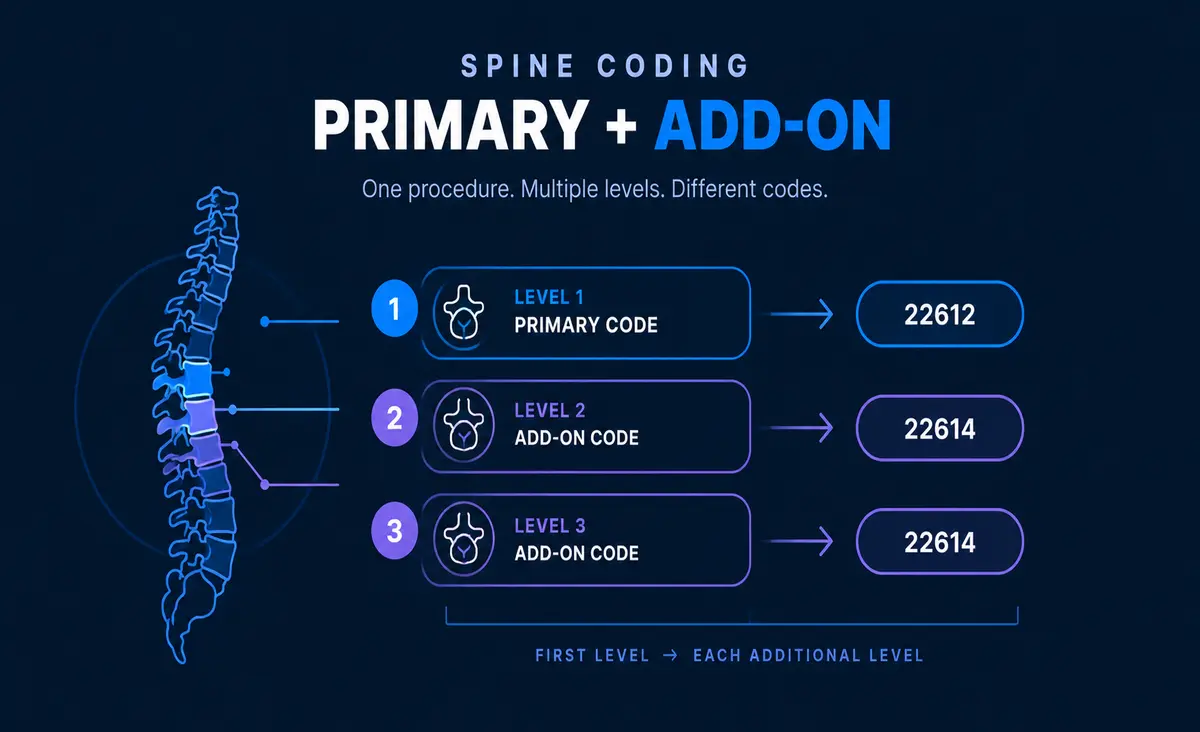
• Spine CPT coding carries the highest risk in orthopedics, since region, approach, and level count all shift the code, and add-on codes for each additional level only apply behind a qualifying primary code, such as 22612 for the first fusion level and 22614 for each additional level.
• Hand, wrist, foot, and ankle coding requires specificity, since dozens of distinct structures share close quarters and the exact digit, technique, or surgical correction performed determines which of several similar-looking codes applies.
• Fracture coding depends on eight distinct factors: the exact bone and fracture site, open versus closed fracture, manipulation status, fixation method and hardware type, and whether the encounter is initial or subsequent treatment.
• Orthopedic modifiers clarify laterality, staging, and how multiple procedures in one encounter or global period relate to each other; modifiers 51 and 59, in particular, require documented justification rather than automatic application.
• NCCI edits determine whether Medicare and most commercial payers allow two orthopedic procedure codes on the same date of service, and a modifier only overrides an edit when the documentation justifies a distinct service, while global periods separately bundle routine postoperative care into the original procedure's payment for 0, 10, or 90 days.
• Most orthopedic denials trace back to a short, predictable list of errors, including missing laterality, confusing open and arthroscopic approaches, selecting a primary code for a revision procedure, and applying modifier 59 without evidence of a distinct service.
A single missing word in an operative note can turn a clean orthopedic claim into a denial. Open versus arthroscopic, total versus partial, primary versus revision: each distinction points to a different CPT code and a different payment outcome. Few surgical specialties are this code-sensitive, because the same procedure name can map to a dozen different codes depending on anatomy, technique, and surgical intent.
Orthopedic surgery CPT codes identify the exact procedure a surgeon performed, from arthroscopic meniscus repair to spinal fusion. The correct code comes from the operative note itself, matched against the documented approach, anatomical site, and extent of the procedure.

This guide breaks down commonly reported orthopedic surgery CPT codes by body region, what drives selection within each category, and the modifiers, bundling rules, and documentation standards that decide whether a claim clears on the first pass.
Note: Code references reflect 2026 conventions and should be checked against the current CPT code set and payer policy before submission.
Quick Navigation for Orthopedic Surgery CPT Codes
What Are Orthopedic Surgery CPT Codes?
Orthopedic surgery CPT codes are five-digit codes from the American Medical Association's Current Procedural Terminology system that describe the surgical service performed on a bone, joint, ligament, tendon, or muscle.
Coders assign the orthopedic surgery CPT codes based on the documented approach, anatomical site, and extent of the procedure. Three code sets work together on every orthopedic claim, and each answers a different question.
- CPT reports the service or procedure the surgeon performed.
- ICD-10-CM reports the diagnosis or condition that justified the procedure.
- HCPCS Level II reports certain supplies, implants, orthotics, or drugs used during the encounter.
A valid CPT code does not establish medical necessity by itself. The diagnosis code, operative documentation, and payer coverage policy all have to align before a claim earns reimbursement.
Common CPT Codes for Orthopedic Surgery
The table below lists the orthopedic CPT codes coders and billing managers search for most. These CPT codes can be used as starting references. The operative note determines the final code.
Shoulder Surgery CPT Codes
Shoulder CPT coding comes down to approach, structure, and count. It depends on whether the surgery is open or arthroscopic, which structure was repaired, and how many structures were treated in one session.
A surgeon performing rotator cuff repair alongside subacromial decompression in the same session raises the most common shoulder coding question: does the decompression earn separate reimbursement? That answer rests on the specific procedures performed, the current NCCI edit for that code pair, payer policy, and how clearly the note documents each service as distinct. Two procedures in one session never guarantee two payable codes.
Knee Surgery CPT Codes
Knee medical coding accuracy depends on three factors: total versus partial replacement, primary versus revision status, and exactly which structures the surgeon addressed during arthroscopy.
ACL reconstruction combined with meniscus surgery in the same session is the single most searched knee coding scenario, and it has no universal answer. Confirm which meniscus procedure was performed, check the current NCCI edit for that code pair, and verify the note documents each service distinctly enough to support separate billing.
Hip Surgery CPT Codes
Hip surgery CPT coding starts with one fork in the road: fracture care or elective replacement. Everything else, including total versus partial, approach, and revision status, follows from there.
Spine Surgery CPT Codes
Spine surgery CPT coding carries the highest risk in orthopedics. Region, approach, and level count all shift the code, and add-on codes only apply behind a qualifying primary code.
Hand and Wrist Surgery CPT Codes
Hand and wrist medical coding requires specificity above all else. Dozens of distinct structures share close quarters, and each one can carry its own code.
Foot and Ankle Surgery CPT Codes
Foot and ankle medical coding hinges on the exact technique performed. Bunion surgery is a good example: several distinct surgical corrections treat the same deformity, and each one maps to a different code.
Fracture Treatment CPT Codes
Fracture CPT coding calls for a decision framework, because the same bone can generate a dozen different codes depending on how it was treated. The table below shows how treatment method changes the code across common fracture sites.
Which Modifiers Are Commonly Used in Orthopedic Surgery?
Orthopedic modifiers clarify laterality, staging, and how multiple procedures in one encounter or global period relate to each other. Requirements vary by code combination and payer, so validate each modifier against the specific claim rather than applying it by habit.
Modifier 51 is not automatic on multiple procedure claims, and modifier 59 does not exist to unlock separate payment. Payers scrutinize modifier 59 on orthopedic claims heavily. Solid documentation is what earns the modifier.
How Do NCCI Edits Affect Orthopedic CPT Codes?
NCCI edits determine whether Medicare and most commercial payers allow two procedure codes on the same date of service. Some orthopedic procedures are considered integral to a more comprehensive one, which creates an edit between the pair.
- A code pair with an NCCI edit can still be reportable separately when clinical circumstances support it.
- A modifier overrides an edit only when documentation justifies the distinct service.
- Payers may layer additional edits on top of Medicare NCCI logic.
Certain orthopedic arthroscopy pairs carry edits that block separate reporting of a diagnostic scope alongside a more extensive procedure in the same compartment. Check the current edit status against the official CMS NCCI resources before submission of the claim. Edits update periodically, and a billable pair last year may not be billable this year.
What Documentation Supports an Orthopedic Surgery CPT Code?
Strong documentation gets the code right on the first attempt and gives auditors a clear trail if the claim is reviewed. Consider running every operative note against this checklist.
- Exact anatomical site
- Laterality
- Preoperative and postoperative diagnoses
- Surgical approach
- Procedure performed
- Structures treated
- Open versus arthroscopic technique
- Fracture treatment method
- Number of levels, compartments, tendons, or digits
- Implants, grafts, and hardware
- Primary versus revision surgery
- Components removed, retained, or replaced
- Findings that support medical necessity
- Additional work supporting modifier 22
- Distinct services supporting modifier 59
- Assistant or co-surgeon participation
- Complications and return-to-OR circumstances
A CPT code can be identified directly from the operative note only when the note carries this level of specificity and the resulting code checks out against current guidelines and payer rules.
Common Orthopedic Surgery Coding Errors
Most orthopedic claim denials trace back to a short, predictable list. Run recent claims against it before a payer does.

- Coding the scheduled procedure instead of the procedure actually completed
- Confusing open and arthroscopic approaches
- Missing laterality
- Selecting a primary code for a revision procedure
- Failing to identify all components revised
- Separately reporting bundled arthroscopy services
- Applying modifier 59 without evidence of a distinct service
- Missing add-on codes or using them without the required primary code
- Billing routine postoperative care separately
- Failing to connect the CPT code to a supporting diagnosis
- Overlooking payer-specific authorization or medical necessity criteria
- Coding from an incomplete operative note
Why Can the Same Orthopedic Procedure Be Coded Differently?
Two procedures with nearly identical names can require different CPT codes when the approach, anatomy, treatment method, structure count, revision status, or documented complexity differs. This single principle explains most coding variation in orthopedics, and it is why a generic procedure name should never map straight to a code.
How Can AI Review Orthopedic CPT Coding?
AI can review a complete orthopedic operative report, identify the documented anatomy and surgical technique, generate or validate CPT and ICD-10-CM codes, check modifiers and payer rules, and show which part of the documentation supports each recommendation. Applied consistently, it catches the errors listed above before a claim reaches the payer.
CombineHealth is a self-learning autonomous medical coding platform that reads the full clinical note, applies coding guidelines and payer-specific rules, and generates explainable, billing-ready medical codes. Also referred to as Amy AI, the platform reviews the complete operative report to identify anatomy, surgical approach, and the structures treated in procedures such as rotator cuff repair, meniscus surgery, or spinal fusion.
For orthopedic coding, CombineHealth handles:
- Full operative report review
- CPT and diagnosis linkage
- Open versus arthroscopic identification
- Primary versus revision distinctions
- Laterality and modifier validation
- Organization- and payer-specific rules
- Code-level explanations traceable to the source note
- Documentation gap detection
- High-risk or ambiguous cases routed for review
- Downstream denial and appeal workflows
CombineHealth's self-learning capability goes beyond generating code. The platform evaluates every medical coding decision against downstream claim outcomes, including reimbursements, denials, underpayments, and payer edits, and feeds that outcome data back into its coding strategy for each payer. This payer intelligence drives up to a 75% reduction in coding-related denials, while accuracy holds above 98% at large scale.
Test CombineHealth on Your Orthopedic Charts
Orthopedic coding rewards precision, and that is exactly what CombineHealth's self-learning platform delivers on every chart. The platform reads your operative reports, applies your payer-specific rules, and shows the documentation behind every code it generates, from shoulder arthroscopy to multi-level spine fusion.
See how CombineHealth handles your orthopedic coding volume and helps cut coding-related denials. Book a demo now.
Frequently Asked Questions
Can one CPT code cover both a diagnostic and a therapeutic arthroscopy in the same knee?
Generally no. When a diagnostic arthroscopy leads directly into a therapeutic procedure in the same compartment during the same session, NCCI edits typically bundle the diagnostic scope into the therapeutic code. Verify the specific code pair before reporting both.
Does a revision joint replacement always use a different code from the primary procedure?
Yes, revision arthroplasty uses distinct CPT codes from primary arthroplasty, since revision surgery involves additional work, such as component removal and reconstruction, that the primary code does not capture.
How many CPT codes can be billed for a multi-level spinal fusion?
The primary fusion code covers the first level, and add-on codes report each additional level. The exact combination depends on the approach, anatomical region, and current CPT guidelines for add-on code use.
Is modifier 59 required whenever two procedures are performed in the same operative session?
No, Modifier 59 applies only when the operative note documents a distinct procedural service, such as a separate site or separate encounter. Applying it without supporting documentation can trigger denials or audits.
Do all orthopedic surgeries carry a 90-day global period?
No, the global periods vary by code and can be 0, 10, or 90 days. Confirm the global period indicator for the specific CPT code rather than assuming it based on the general surgery type.